Step into a kitchen, place four coins on a digital scale, and the readout registers precisely 10 grams. In everyday cooking, that is barely enough seasoning to marinate a single serving of meat.
In the early morning hours of October 20, 2026, a rocket blasted off from Japan’s Tanegashima Space Center. The robotic probe inside is embarking on a nearly five-year round trip to Mars and back. Its singular goal: bringing home roughly that exact weight in extraterrestrial soil.
Hundreds of Millions of Kilometers for the Weight of Four Coins
At 03:41 Beijing Time this morning, Japan’s H3 rocket lifted off carrying the Martian Moons eXploration (MMX) spacecraft. Led by the Japan Aerospace Exploration Agency (JAXA), the four-ton probe has now formally begun its deep-space trek.
The spacecraft will cruise through interplanetary space for nearly a year, slated to arrive at Mars in August 2027. Once there, it will spend three years closely surveying Mars’s largest moon, Phobos, before touching down to gather samples. By 2031, the spacecraft is scheduled to deliver its precious cargo back to Earth.
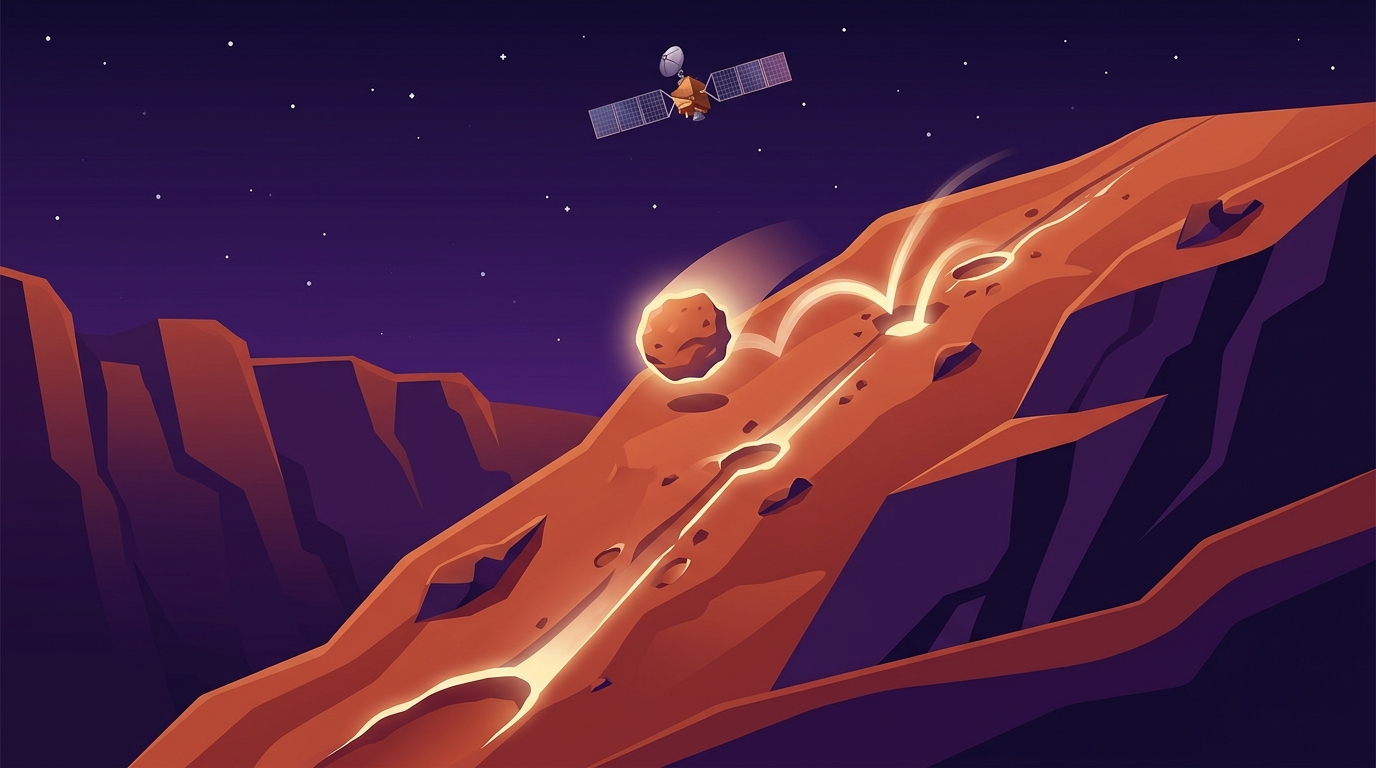
In the inner Solar System, Earth is unique in having a large moon, while Mars is the only other planet accompanied by natural satellites—two modest bodies. Phobos, the larger of the two, is an irregular, potato-shaped rock spanning just 20 kilometers across, roughly the distance of a quick drive across town. Yet a spacecraft is voyaging hundreds of millions of kilometers through deep space just to visit this unassuming moon.
Ten grams sounds miniscule—about the weight of four US pennies or a couple of raisins. But in deep-space rocketry, escaping a celestial gravitational well means every extra gram requires exponential propellant. For cutting-edge laboratory instruments on Earth, a few grams of pristine dust provide plenty of material for decades of worldwide analysis.
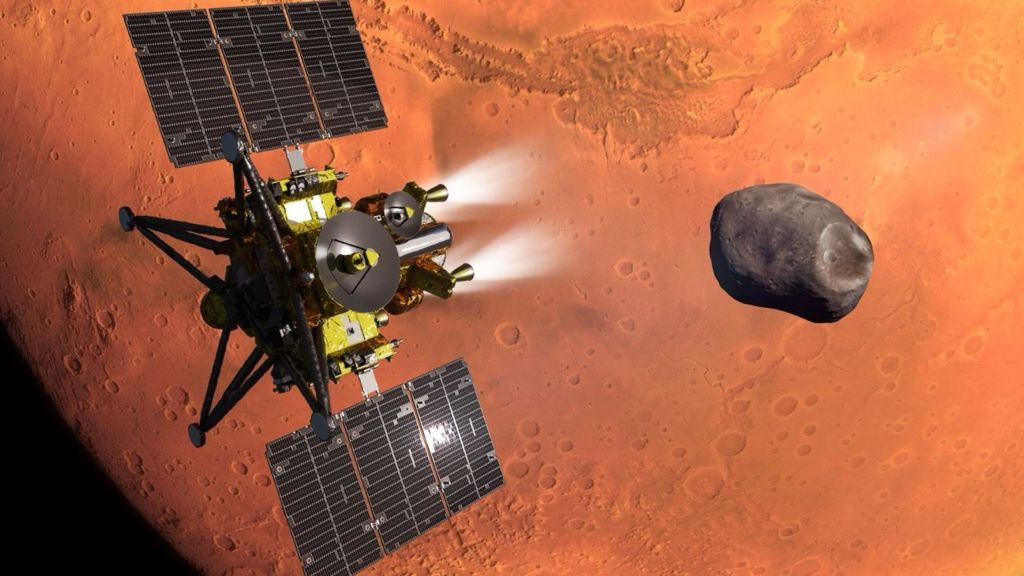 Figure: MMX spacecraft cruising above Mars and Phobos. Credit: JAXA/BBC.
A Micro-Rover Scouts Ahead, Two Sampling Systems Dig In
Gathering soil from the surface of a nearly weightless celestial body is far more treacherous than past lunar landings. The surface gravity on Phobos is a mere one-thousandth of Earth’s gravity. A sudden nudge or rough touchdown could easily rebound a spacecraft back into space.
To manage landing risks, engineers devised a tiered reconnaissance strategy. Before the mothership descends, it will deploy a shoebox-sized micro-rover named Idefix. Jointly built by France and Germany, the rover weighs roughly 25 kilograms—about the size of a microwave oven. It will crawl and roll across the surface in the ultra-low gravity, probing the soil’s firmness and mechanical resistance.
Data transmitted by Idefix will help mission controllers pinpoint a flat, hazard-free touchdown site. Following this assessment, the MMX mothership will make two brief landings on the moon’s surface. Each touchdown will last mere tens of minutes, employing two complementary collection systems.
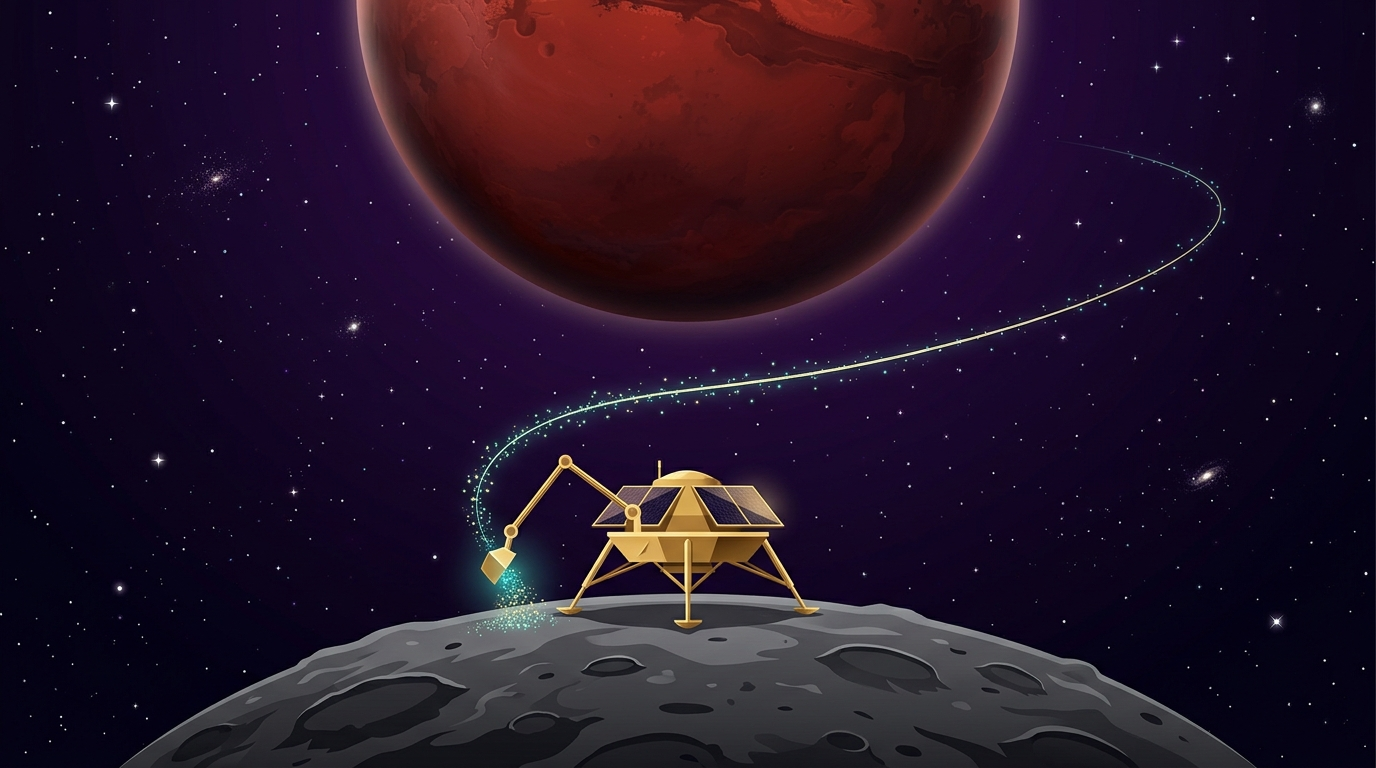
The first system is a mechanical core drill designed to penetrate roughly 2 centimeters into the subsurface to extract consolidated rock fragments. The second is a pneumatic gas sampler that uses bursts of compressed gas to loft loose surface dust directly into a sample canister. This dual-track redundancy guarantees the spacecraft can secure at least 10 grams of material.
The sealed sample return capsule will hurtle back into Earth’s atmosphere in 2031, parachuting into the remote expanse of the Woomera Prohibited Area in South Australia. NASA’s Johnson Space Center will receive roughly 15% of the collected material for scientific analysis.
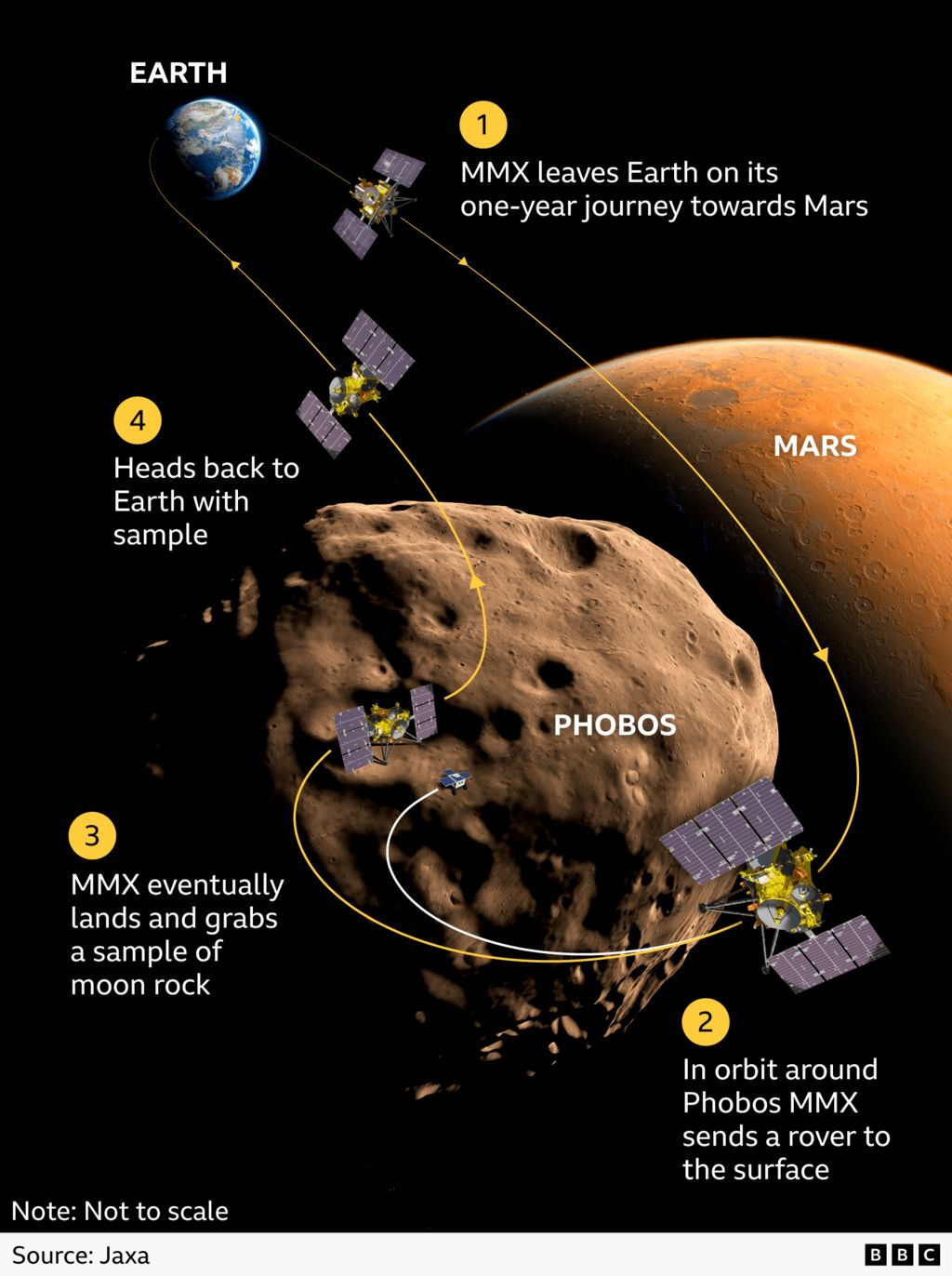 Figure: The full lifecycle of the MMX mission from launch and survey to sampling and return. Credit: JAXA/BBC.
Ten Grams of Minerals Can Unlock an Origin Story
Scientists are ravenous for this handful of dust because Phobos’s origins remain an enduring astronomical enigma. For half a century, planetary scientists have argued over how the moon came to be, dividing broadly into two competing camps.
The first hypothesis is the giant-impact debris model. In the Solar System’s early history, a massive collision blasted molten rock off Mars. That ejecta cooled and coalesced in orbit, accreting into two small satellites.
The second hypothesis posits that Phobos is a captured rogue asteroid. Under this scenario, the moon was once a nomadic body from the outer asteroid belt that wandered too close to Mars and was snagged by the planet’s gravitational pull.
The mineralogical fingerprints of these two formation paths could not be more distinct. As sample analysis expert Sara Russell noted: “Once you have the samples, you can almost immediately tell whether it’s an impact product or a captured asteroid.” If the dust contains igneous signatures of rocks melted during a giant impact, the debris model wins; if it is rich in primitive carbon compounds and water-bearing clay minerals, capture theory takes the day.
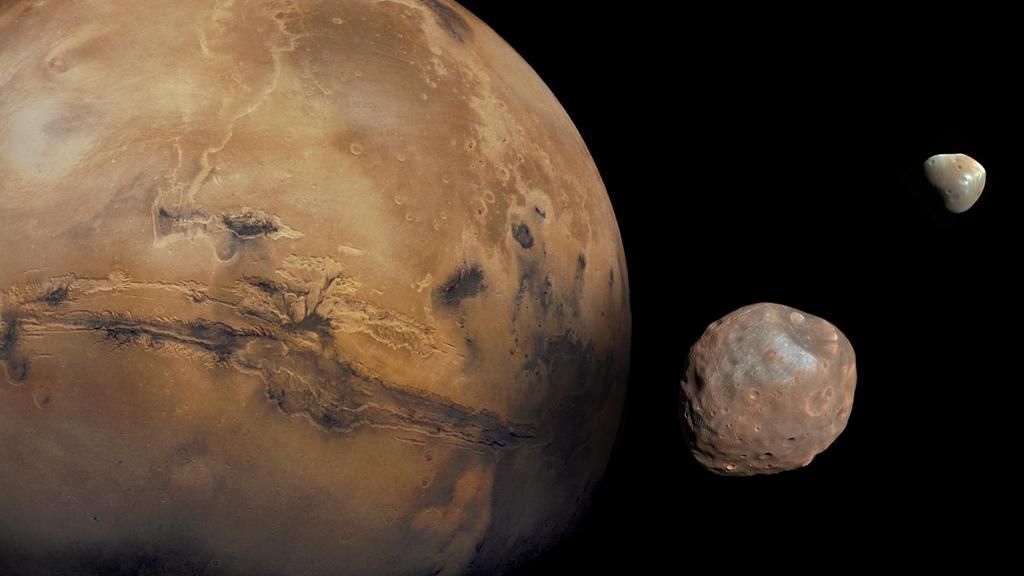 Figure: Mars alongside its two potato-shaped moons, Phobos and Deimos. Credit: NASA/BBC.
A Celestial Catch-Basin for Ancient Martian Ejecta
The sampling expedition also holds the tantalizing prospect of an unexpected bonus. Phobos orbits closer to its parent planet than any other moon in the Solar System, skimming just 6,000 kilometers above the Martian surface. That is shorter than many transcontinental flight routes. Looking up from Phobos, the red planet looms large, occupying nearly half the sky.
Because of this extreme proximity, Phobos has spent billions of years acting as a cosmic dustbin for Martian debris. Whenever meteorites crashed into Mars, plumes of crustal fragments were blasted into space. Orbiting through these dust clouds, Phobos steadily swept up Martian ejecta, tucking the fragments into its regolith.
Physical simulations indicate that several percent of Phobos’s surface soil may actually consist of Martian material. On Mars itself, billions of years of atmospheric weathering, water, and windstorms have eroded ancient rock strata. The pristine grains preserved within Phobos’s airless, vacuum freezer could hold an untarnished record of early Mars.
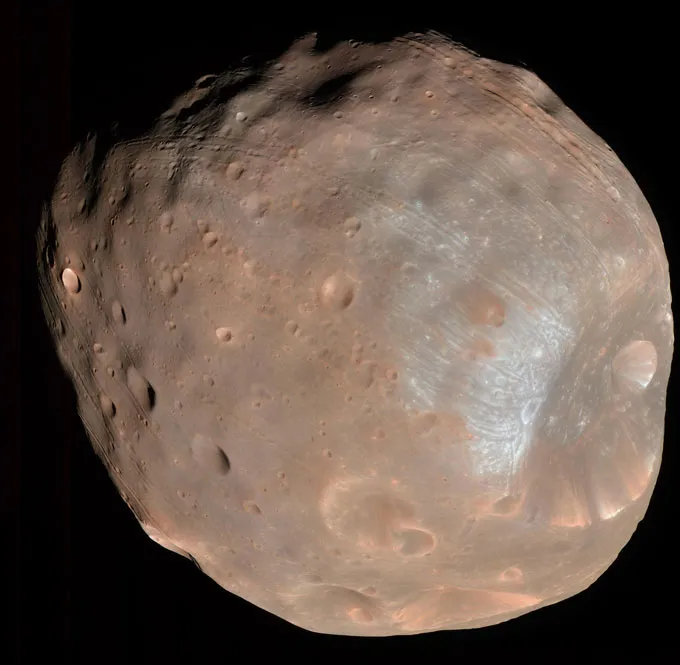 Figure: The heavily cratered surface of Phobos photographed by the Mars Reconnaissance Orbiter. Credit: University of Arizona, JPL-Caltech/NASA/Science News.
Returning Untarnished Samples to Avoid Earth Contamination
General observers might wonder why scientists do not simply study Martian meteorites that have already fallen to Earth. Martian meteorites found on our planet are exceedingly rare. Worse, the moment a meteorite lands on Earth, it is contaminated by atmospheric moisture, airborne chemicals, and ubiquitous microbes. Only an unadulterated sample retrieved directly from space in a hermetically sealed capsule can preserve pristine geological records.
Scientists express boundless excitement even for microscopic yields. As NASA’s Michael Zolensky put it: “A few grams of sample is a true treasure for scientists.” Planetary scientist Chrysa Avdellidou similarly stressed: “You don’t need kilograms to do science; every gram counts.” With modern laboratory technology, a speck of powder is all researchers need to date minerals and unravel planetary history.
Exploring Phobos has historically proven one of spaceflight’s most unforgiving endeavors. Over the past several decades, three prior missions targeting the Martian moons were lost to propulsion or avionics failures. NASA’s flagship Mars Sample Return program has suffered delays and budget overhauls, while China plans a Mars surface sampling mission for 2028. Following this morning’s launch, MMX could very well be the first mission in human history to bring pristine samples from the Martian system back to Earth.
On a kitchen balance, 10 grams of dust feels utterly weightless. Yet when those mineral grains touch down in the Australian outback in 2031, their crystal lattices may finally resolve decades of planetary debate. A few pinches of soil could soon tell humanity once and for all how Mars got its mysterious moons.
Reference Links:
- BBC News
- Science News