Look up at a full moon at night, and chances are you have tried capturing it with a smartphone camera. More often than not, the screen shows little more than an overexposed white blob, resembling a harsh streetlight. The delicate crater shadows, rich textures, and subtle shades visible to the naked eye are completely washed out in the snapshot. Roughly 380,000 kilometers away in lunar orbit, that same gap between human vision and mechanical sensors proves just as stark.
On October 7, 2026, NASA released the preliminary scientific findings from the Artemis II mission. Four astronauts completed a 10-day circumlunar journey aboard the Orion spacecraft—marking humanity’s first return to lunar vicinity in more than half a century. To the surprise and delight of planetary geologists, some of the mission’s most impactful discoveries came not from automated instruments, but from human eyes and hand-drawn tablet sketches made right beside Orion’s windows, accompanied by real-time verbal descriptions.
Humanity’s return to the Moon signals a fundamental shift in deep-space exploration. For five decades, lunar science relied almost entirely on remote sensing—collecting data via uncrewed orbiters and digital sensors. Now that astronauts are back on the front lines, their direct eyesight, field sketches, and oral narratives are filling critical gaps that cameras missed: mineral color nuances, subtle rock textures, and fleeting meteoroid impact flashes.
Smartphone Shots Yield Overexposed Blobs; Human Eyes Discern Tri-Color Strata in Orbit
Anyone snapping night photos with a smartphone knows how easily cameras struggle with extreme contrast. On the lunar surface, without an atmosphere to scatter sunlight, sunlit slopes blaze with blinding brilliance while shaded craters plunge into pitch darkness. To avoid blowing out bright highlights, orbital cameras must restrict their exposure—a compromise that inevitably crushes shadowed terrain into flat, featureless black.
Human vision, however, possesses an extraordinary dynamic range capable of resolving bright highlights and deep shadows simultaneously. Human retinas also exhibit superior sensitivity to subtle chromatic variations compared to off-the-shelf camera sensors. Stationed by Orion’s windows, the four astronauts could clearly distinguish rich tonal subtleties across the lunar landscape.
Far from a uniform, dull concrete gray, the lunar surface revealed three distinct mineral palettes to the crew’s naked eyes. Deep bluish regions indicated titanium-rich volcanic deposits; brownish terrains reflected variations in iron content; and a distinct greenish sheen marked deposits of impact glass—silicate debris melted under extreme heat when meteorites slam into the lunar crust and rapidly quench into glass beads. By distinguishing these subtle mineral hues, human eyesight provided immediate, natural prospecting clues for choosing future lunar landing and base sites.
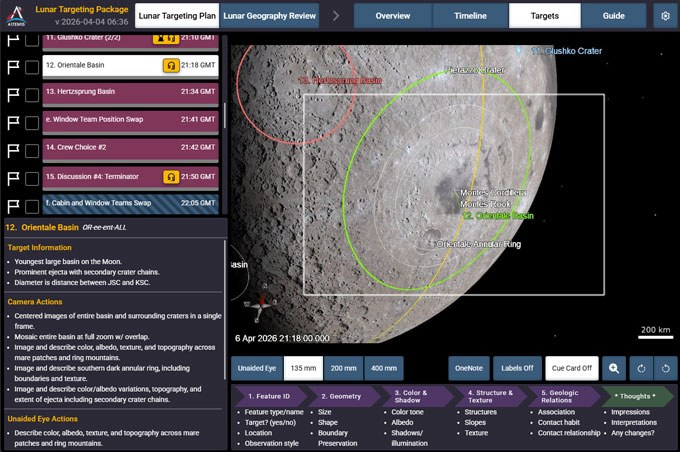 Figure: Custom tablet interface displaying lunar charts and scientific observation logs. Source: NASA (Science News)
Returning to the Moon After Half a Century: The Stylus Becomes the Ultimate Science Tool
On April 1, 2026, the Artemis II spacecraft roared into the sky. The four-person crew spent ten days in space before splashing down safely in the Pacific Ocean on April 10. Six months after splashdown, on October 7, NASA published the preliminary science findings on schedule—a date that coincidentally marked the 67th anniversary of the Soviet Union’s Luna 3 capturing humanity’s very first photograph of the lunar farside.
Prior to launch, terrestrial geologists put the four astronauts through rigorous field geology training. During their limited lunar flyby windows, NASA astronaut Christina Koch picked up a specialized stylus and quickly mapped observations across digital lunar charts on her tablet. She documented the intricate stratigraphic layering of the Orientale Basin—a massive, ancient multi-ring impact basin located on the western limb of the Moon.
Koch mapped stratigraphy and structural textures directly on her screen. Stratigraphy refers to the sequential layering of rock deposits, much like the tiers of a mille-feuille cake. While camera images provide flat 2D slices heavily skewed by lighting angles, trained astronauts could perceive three-dimensional relief, tracing structural trends on the fly.
Earth and planetary scientist Sara Schmidt praised the field records, noting that these firsthand observations could drive new scientific investigations for the next 60 years. NASA science lead Kelsey Young also emphasized that human field observations have equipped the planetary science community with an entirely new toolset. These hand-drawn field sketches transformed cold, ambiguous orbital pixels into coherent, highly structured geological records.
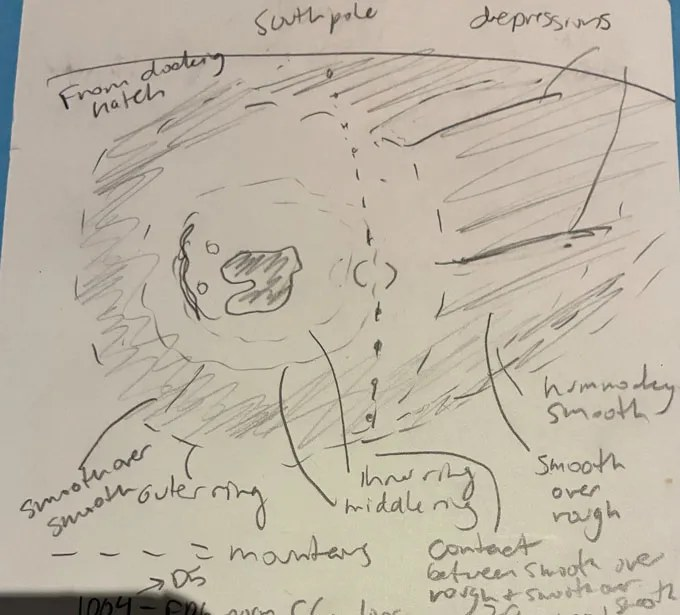 Figure: Hand-drawn sketch of Orientale Basin by Christina Koch in lunar orbit, annotating textures and stratigraphy. Source: NASA (Science News)
Five Flashes in 54 Minutes: Golf-Ball Meteoroids Provide a Baseline for Base Safety
During the circumlunar phase, Orion experienced a 54-minute solar eclipse window. From the spacecraft’s vantage point, the Moon blocked out the Sun entirely, appearing as a dark silhouette encircled by the glowing solar corona. Within this total darkness, the astronauts spotted rare, faint optical events with their unaided eyes.
In total, the crew witnessed five distinct impact flashes. An impact flash occurs when high-velocity space debris slams into the airless lunar surface, producing an instantaneous burst of light upon kinetic vaporization. Each flash lasted less than a second, resembling a distant camera flashbulb. Moving swiftly, the astronauts picked up their styluses and plotted approximate coordinates on a dark-side digital chart using three distinct colors.
Ground science teams calculated that the micrometeoroids responsible for these flashes had an average mass of roughly 8.5 grams and measured about 4.5 centimeters across—roughly the size of a standard golf ball. This marks the smallest meteorite impacts on the lunar surface ever confirmed and recorded optically by human observers.
These empirical observations provide reassuring confidence for long-term lunar surface missions. Modeling based on the 54-minute dataset indicates that during the planned Artemis IV lunar landing in 2028, the probability of an astronaut encountering a dangerous direct meteorite strike is less than one in ten million—far lower than the annual odds of an average person being struck twice by lightning. Direct visual impact flash observations have provided empirical safety parameters for engineering future long-term lunar surface habitats.
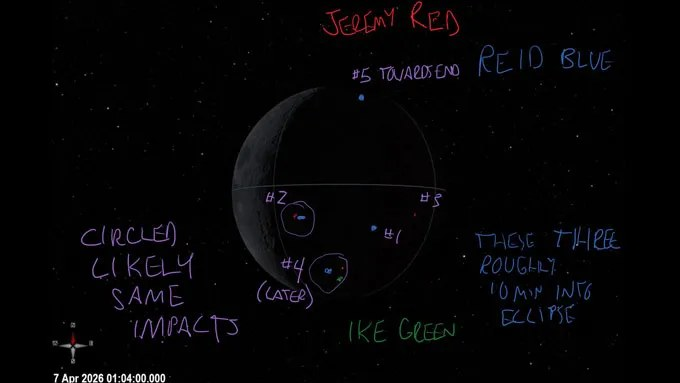 Figure: Locations of visual impact flashes marked in three colors by astronauts on a dark-Moon visualizer. Source: NASA / CSA (Science News)
Window Ablation Impairs Camera Calibration; Human Sight Bridges the Uncrewed Blind Spot
One might reasonably ask: Orion was equipped with scientific cameras, so why rely on astronaut sketches and visual sightings? The answer lies in an unexpected operational hurdle during the mission. Due to tight pre-launch schedules, onboard scientific cameras could not undergo comprehensive ground optical calibration prior to liftoff.
Upon returning to Earth, Orion entered the dense upper atmosphere at nearly 40,000 kilometers per hour. High-temperature plasma washing over the hull physically ablated the outer surfaces of the thick spacecraft windows. This altered the optical transmittance of the window panes, preventing ground recovery teams from reproducing the exact lighting conditions experienced in flight and leaving the onboard camera imagery difficult to calibrate accurately.
Where mechanical instrumentation faced bottlenecks, astronauts’ visual observations and oral reports bridged critical gaps. The crew paid special attention to the lunar terminator—the moving dividing line between daylight and darkness, marking lunar sunrise and sunset. Along the terminator, low-angle sunlight casts elongated shadows that dramatically exaggerate subtle topographic relief.
The lighting dynamics along the terminator closely mirror the illumination environment at the rim of permanently shadowed craters across the lunar South Pole. Astronauts’ real-time visual impressions of shadowed blind spots under grazing illumination resolved knowledge gaps that orbital satellites had struggled to illuminate. These firsthand human visual insights are being incorporated directly into descent and landing trajectory planning for the planned 2028 crewed South Pole landing.
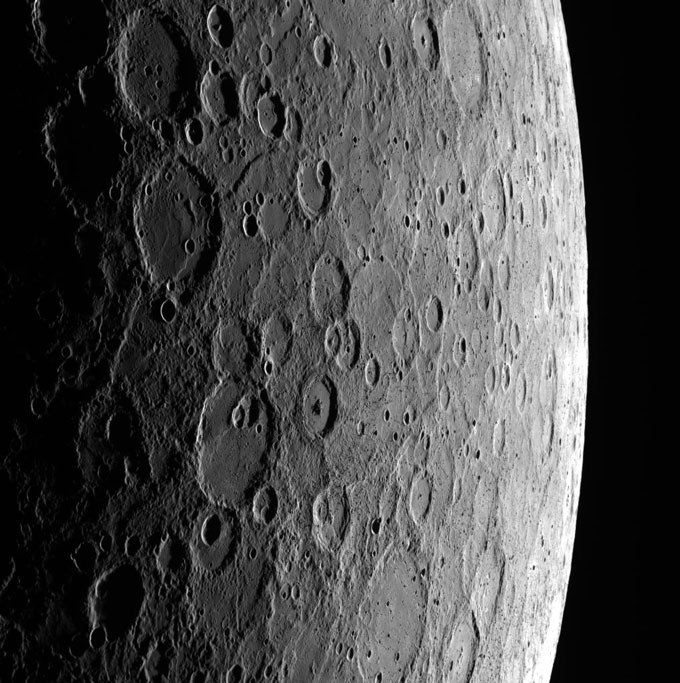 Figure: The lunar terminator region, where low-angle sunlight casts elongated shadows that accentuate subtle surface topography. Source: JHU APL (Science News)
Field Observation Reshapes Deep Space: Astronauts Rewrite the Rules of Lunar Science
For over half a century, human knowledge of the Moon was shaped almost exclusively by robotic probes. Satellites captured oceans of numerical readings, while automated algorithms stitched digital mosaics across terrestrial servers. Yet while remote sensing excels at broad geographic mapping, machines lack the holistic cognitive synthesis and situational judgment of the human mind when confronted with unfamiliar terrain.
The early scientific harvest from Artemis II underscores the irreplaceable value of human field observation. The human brain adapts to extreme contrasts within tens of milliseconds; astronauts can recognize mineral layers in seconds and synthesize structural logic with a stylus in minutes.
Lunar exploration is shifting its center of gravity from purely robotic remote sensing back toward nuanced human field observation. With their eyes, sketches, and spoken logs, astronauts caught critical details that sensors missed: the Moon’s authentic colors, structural rock strata, and miniature impact bursts. The true dividend of returning humans to deep space is the situational acuity that no automated algorithm can replace.
References:
- Science News coverage
- NASA Scientific Reports & Data Archives