
After polishing off a handful of Doritos, an orange-yellow seasoning powder invariably clings to your fingertips. On September 6, 2024, a team from Stanford University’s Department of Materials Science and Engineering published a paper in Science (Science 385, eadm6869). Lead author Zihao Ou and colleagues applied this exact yellow food dye to the bellies of live mice; within minutes, the normally turbid abdominal skin became as transparent as a glass windowpane. Intuition suggests that dyeing an object yellow blocks incoming light; yet high concentrations of absorbing molecules opened up a clear optical window directly through living tissue.
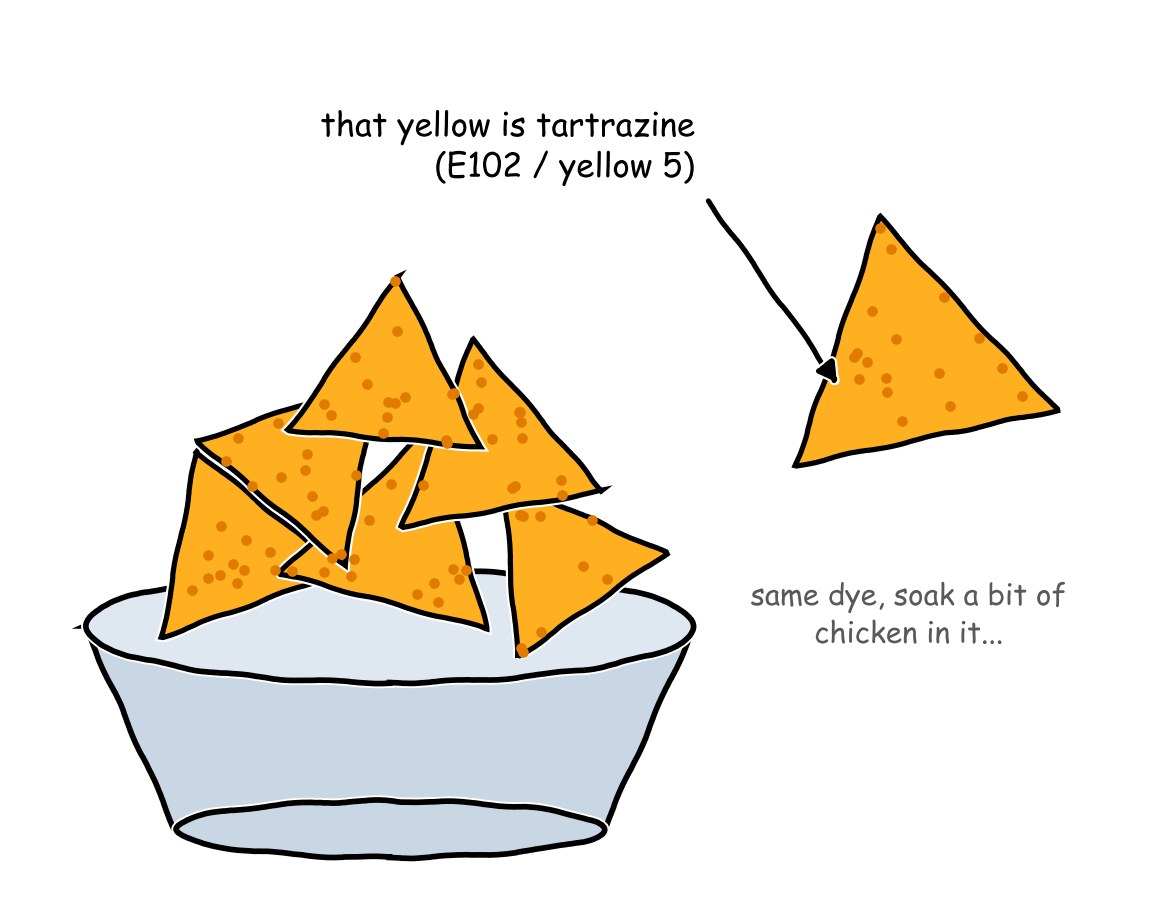 Figure: A hand-drawn diagram by the author mapping out common snack foods that contain tartrazine. Source: CasualPhysicsEnjoyer (Substack)
Intrigued by the striking images in the journal, an independent physics hobbyist blogging under the moniker CasualPhysicsEnjoyer set out to replicate the phenomenon in his own kitchen. He ordered a pouch of food-grade tartrazine online, sliced fresh raw chicken breast into thin strips from the supermarket, mixed dye solutions across several concentrations, and submerged the meat for a 6-hour soak. In an essay titled Making Chicken Transparent Using Dorito Dust, he documented every detail. Making biological tissue transparent relies on absorbing molecules to match internal refractive indices; bridging the gap from in vivo lab imaging to translucent kitchen meat hinges entirely on thermal kinetics and molecular diffusion.
Absorbing Dyes in Water: Pulling Up Refractive Indices Past the 425 nm Resonance
Why can’t an ordinary flashlight shine through raw chicken breast? The same physical mechanism explains why milk and clouds appear stark white and opaque. Biological tissues are dense composites of water, proteins, and lipids. Water has a refractive index of roughly 1.33, whereas proteins and lipids sit well above 1.40 (often near 1.45). When light enters tissue, it encounters a water-lipid interface every few microns. Tens of thousands of scattering events scramble directed photons into a diffuse haze, leaving the naked eye with an opaque, pinkish-white surface.
Traditional biomedical imaging clears deep tissue by dehydrating specimens with organic solvents or stripping away lipids altogether. Such methods are highly cytotoxic, limiting tissue clearing strictly to fixed, post-mortem specimens. The Stanford team inverted that logic: if dense lipids cannot be removed from living animals, why not raise the refractive index of water instead? Bring water and lipids to the same baseline, and interface scattering largely vanishes. They harnessed the Kramers-Kronig relations—fundamental physical identities linking a material’s optical absorption spectrum directly to its refractive index across wavelengths. Injecting strong absorbing molecules into water at a specific resonance naturally boosts the solution’s real refractive index at longer wavelengths.
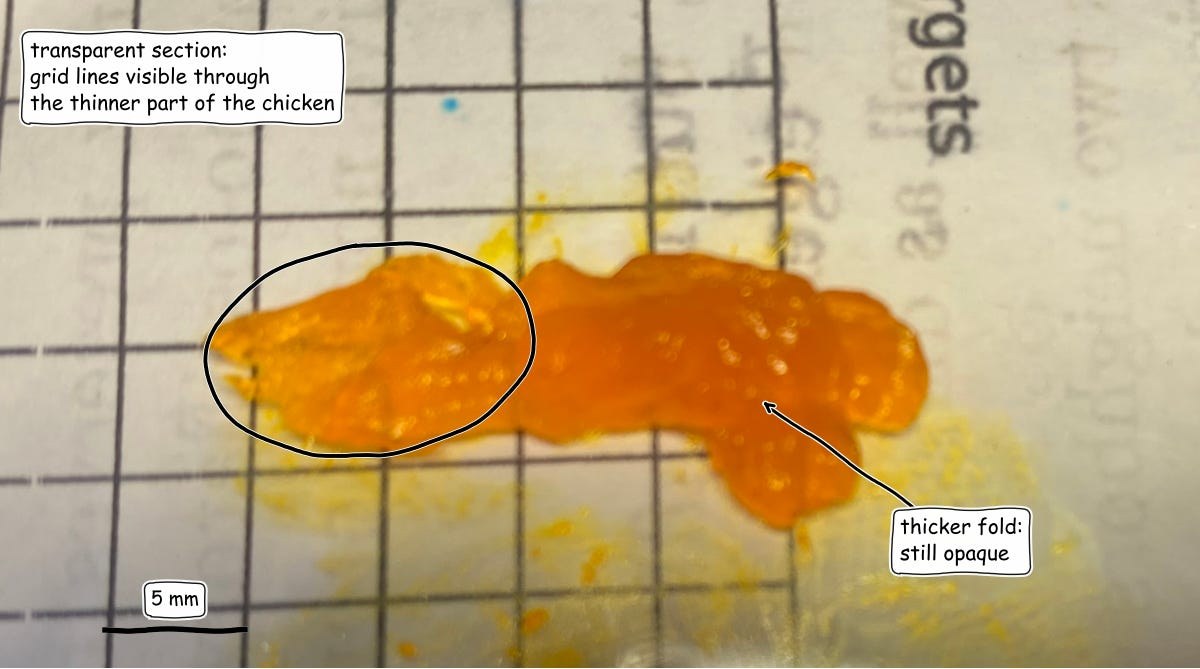 Figure: A 2 mm raw chicken breast slice after soaking in ~0.19M tartrazine solution at room temperature for 6 hours. Under a desk lamp, underlying grid lines show through; it retains the texture of raw meat but looks like gummy candy. Source: CasualPhysicsEnjoyer (Substack)
The molecule chosen for the task was tartrazine (EU food additive E102, C.I. 19140), commonly known as FD&C Yellow No. 5. This water-soluble azo dye carries the chemical formula C16H9N4Na3O9S2 with a molecular weight of 534.37 g/mol. Its primary electronic absorption peaks sharply in water at 425 nm in the blue-violet spectrum. When dissolved at high molarity in interstitial fluid, tartrazine strongly quenches blue photons. Immediately redward of this resonance—across red and near-infrared wavelengths—the real refractive index of the aqueous solution jumps dramatically, matching the surrounding lipids and structural proteins. By sacrificing transmission in the blue-violet spectrum, strong absorbing dyes achieve precise refractive index matching in red and orange bands, suppressing tissue scattering by orders of magnitude.
A 0.6M Solution Clears the Abdomen: In Vivo Enteric Neurons Revealed in Real Time
With the theoretical framework validated, the Stanford researchers demonstrated practical efficacy in Science (Achieving optical transparency in live animals with absorbing molecules). The team prepared an aqueous tartrazine solution of approximately 0.6M and applied it topically to the shaved abdomen and scalp of anesthetized mice. As the yellow dye diffused through intercellular gaps, underlying viscera that previously required surgical laparotomy emerged clearly under the microscope through intact skin.
In recordings published alongside the paper, the abdomen of a treated mouse appears transformed into an amber viewing window. Without making an incision, researchers tracked gut peristalsis and performed high-resolution fluorescence imaging of the deep myenteric plexus—the intricate neural meshwork embedded between intestinal muscle layers that orchestrates gut motility. Once imaging was complete, excess dye washed away easily with warm water; absorbed tartrazine was safely cleared and excreted through metabolic pathways, restoring the skin to its natural opacity within minutes.
Reversibly converting turbid living tissue into an optical window transforms the penetration depth of light-based medical tools. In ordinary tissue, laser beams scatter and dissipate within millimeters, constraining deep-tissue diagnostic imaging and photodynamic therapy (using targeted wavelengths to activate photosensitizers and destroy deep lesion cells). By establishing a micron-scale optical window directly in live animals with a 0.6M dye solution, non-invasive deep laser imaging has broken free from the confines of fixed specimens.
Slicing to 2 mm for a 6-Hour Soak: At 30% Concentration, a Hard Crust Precipitates
Since the core compound is a common snack ingredient, could raw chicken breast be turned into clear glass on an everyday kitchen counter? CasualPhysicsEnjoyer purchased food-grade E102 tartrazine powder (>80% dye purity) to test the optical clearing effect at home. He began by carving fresh chicken breast into 5 mm cutlets, subsequently trimming them down to 2 mm slices to minimize the optical path length.
To map out the relationship between concentration and transparency, the test included three experimental groups: a pure water control; an intermediate group mixed at 10% weight-to-weight ratio (~0.19M); and a high-concentration group at 30% weight (~0.56M), approaching the 0.6M threshold in the Science paper. All three 2 mm chicken cutlets were submerged in jars and left stationary at room temperature for 6 hours.
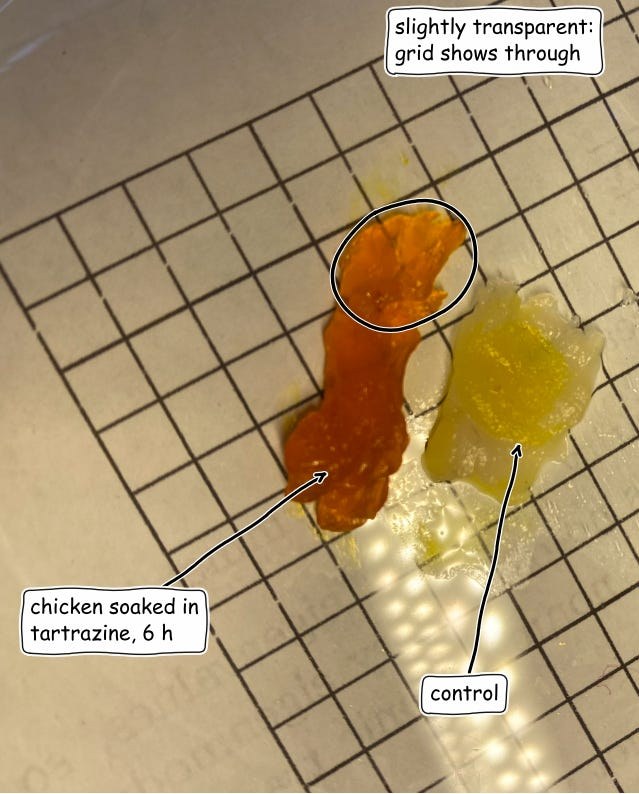 Figure: Another angle of the same test batch: on the left is the dye-soaked chicken slice; on the right is the pure water control. Source: CasualPhysicsEnjoyer (Substack)
After 6 hours, the kitchen results revealed a nuanced picture. The pure water control remained milky, opaque, and impervious to backlight. The 10% (~0.19M) slice developed a translucent, gummy gelatinous texture along its edges, letting underlying text faintly show through, though far from crystal clear. The 30% (~0.56M) high-concentration bath produced an unexpected hurdle: tartrazine precipitated heavily on the surface, encasing the chicken in a rigid yellow crystalline crust. A follow-up attempt extending soak time to 12 hours failed to deepen penetration. At room temperature, aggressively raising dye concentration triggers supersaturated surface crystallization; a semi-translucent gummy cutlet at 0.19M marked the physical ceiling of passive kitchen soaking.
40°C and Mechanical Shaking: Molecular Diffusion Bottlenecks in the Kitchen
Why did Stanford achieve pristine window-like clarity in live mice, while 2 mm chicken breast soaked for 6 to 12 hours in a kitchen stalled between gummy translucency and crystalline crusts? Dissecting the methods section of the original paper highlights three vital control variables absent on the kitchen counter: a precise 0.62M concentration, a thermostatted 40°C environment, and continuous mechanical agitation. The kitchen attempt approximated ~0.56M, but overlooked the two physical parameters governing molecular transport kinetics.
Tartrazine is a relatively bulky molecule with a molecular weight of 534.37 g/mol. Driving these large azo molecules into tightly packed myofibrillar lattices requires substantial thermal energy and kinetic diffusion. Stanford maintained incubation at 40°C, which simultaneously lifted tartrazine’s aqueous solubility limit and provided thermal motion to accelerate penetration. Continuous mechanical shaking disrupted the stagnant boundary layer at the tissue surface, sustaining a steep concentration gradient for steady 0.62M uptake. At an ambient kitchen temperature of ~20°C, a 30% w/w solution sits right on the edge of saturation. In stagnant fluid, osmotic pressure pulled water out of the tissue into the hypertonic bath; the local dye layer crossed into supersaturation, crystallizing into a crust that sealed off interior pores.
Chemical purity also played a role. While food-grade E102 contains over 80% active dye, the remaining percentage consists largely of inorganic salts like sodium chloride or sodium sulfate, lowering solubility via salting-out effects. Under 0.19M moderate concentration, the chicken remained gummy and partially translucent; at 0.56M, surface crusting dominated. The scientific literature encapsulates the optical phenomenon in elegant Kramers-Kronig equations; translating those equations into visible clarity requires 0.62M concentration, 40°C heating, and steady agitation in unison. The semi-translucent 0.19M chicken slice strips away the hype of popular science headlines: buying cheap food dye is trivial, but mastering temperature and fluid dynamics marks the true boundary of experimental engineering.
References:
- CasualPhysicsEnjoyer: Making Chicken Transparent Using Dorito Dust
- Science: Achieving optical transparency in live animals with absorbing molecules
- Hacker News Discussion