On July 29, 2026, Quanta Magazine published an article with a headline carrying a distinct flavor of black humor unique to physics: “Physicists Solve a Muon Mystery. Now, Old Results Don’t Add Up.”
My initial reaction upon reading it was: Wait, does this mean the mystery is solved, but the problem just got bigger?
Yes, exactly.
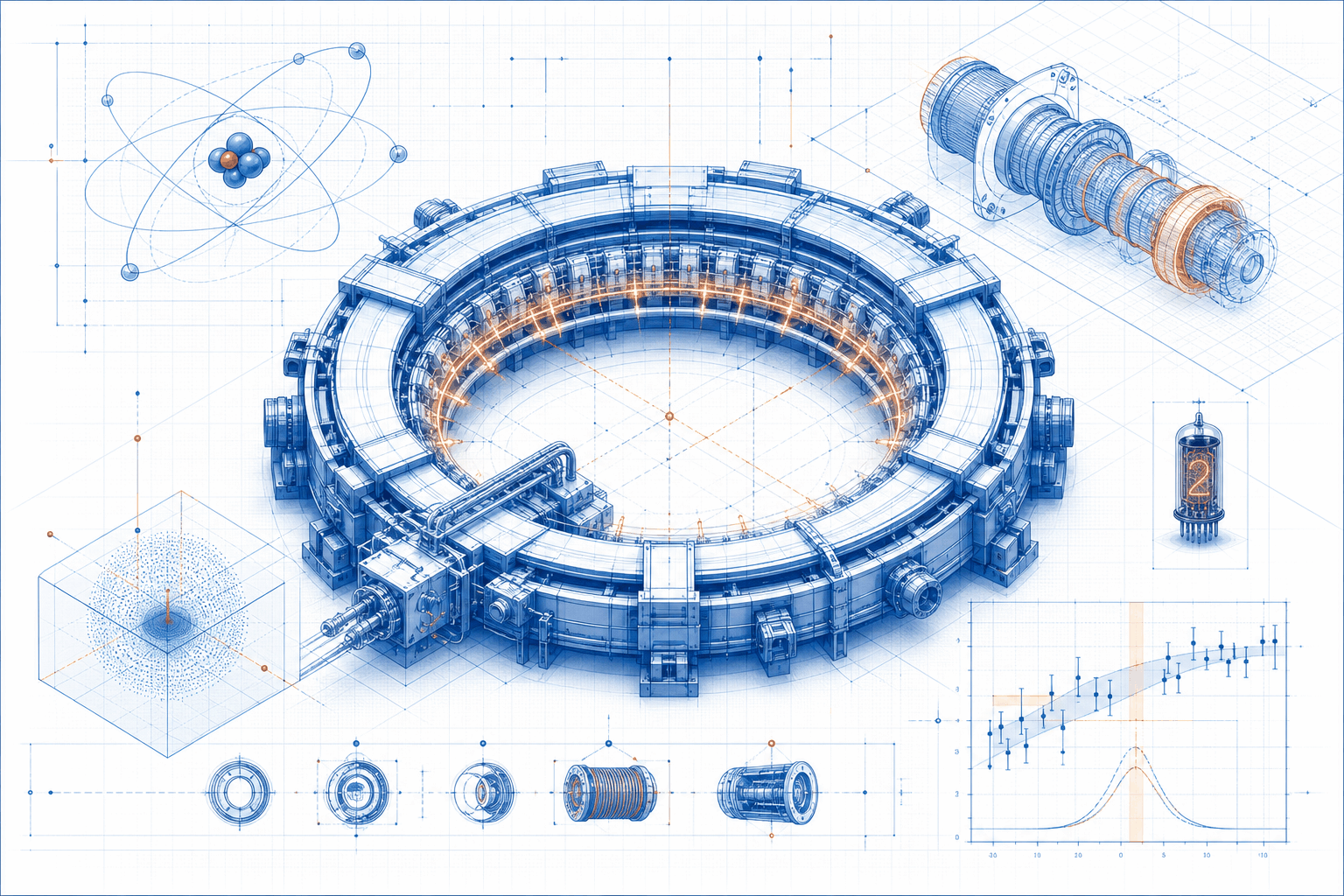
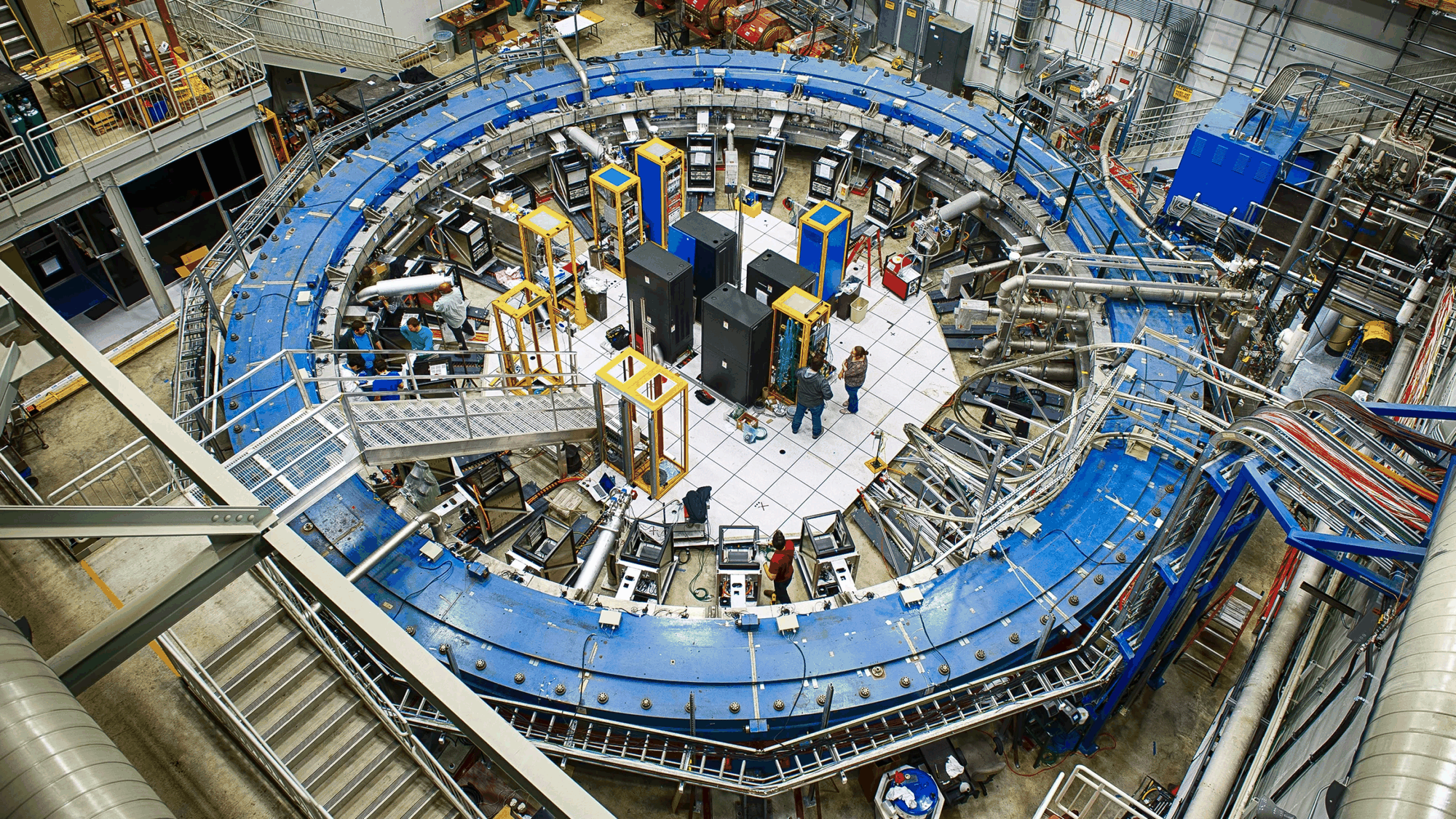 Figure: The central apparatus of Fermilab’s Muon g-2 experiment, a 15-meter diameter superconducting magnet ring. Credit: Reidar Hahn / Fermilab
A One-in-a-Million Crack
This story begins in 2001. That year, physicists at Brookhaven National Laboratory in New York conducted an experiment measuring the magnetic properties of a particle called the muon.
What is a muon? You can think of it as the electron’s heavier sibling—sharing identical electric charge, but 207 times more massive and short-lived, decaying in less than 2 microseconds. Like the electron, it wobbles like a spinning top when placed in a magnetic field. The magnitude of this wobble is described by a fundamental quantity called the g-factor.
According to the “bible” of particle physics—the Standard Model—the muon’s g-factor should equal precisely 2. However, quantum mechanics dictates that reality is far more intricate. A cloud of virtual particles constantly pops into and out of existence around the muon. This ghostly quantum chatter makes the muon wobble slightly more than 2. That tiny extra amount is known as g-2.
The 2001 Brookhaven experiment revealed something startling: this extra anomaly was larger than the Standard Model predicted.
By how much? Roughly one part in a million.
That might sound minuscule, but in the realm of particle physics, a one-in-a-million discrepancy is like discovering a fine crack in an otherwise flawless marble wall. Physicists were thrilled: because the Standard Model is the most rigorously verified theory in science, any genuine deviation could hint at undiscovered particles—perhaps even secret clues to dark matter.
Thus began a chase spanning more than two decades.
The Physicists’ Two Rulers
To determine precisely how much the muon should wobble, physicists relied on two distinct theoretical approaches.
The first is the data-driven approach. Simply put: if quantum chromodynamics calculations prove too intractable, turn to real-world particle collisions. By smashing electrons and their antimatter counterparts (positrons) together, their annihilation produces a spray of other particles, including quarks. The more quarks generated, the stronger their quantum coupling to the muon, indicating a larger g-2 wobble. The foundation of this method relies on decades of electron-positron collider data collected across the globe.
The second method is Lattice QCD (Lattice Quantum Chromodynamics). This is a purely first-principles calculation. Because the strong interaction between quarks is notoriously hard to calculate analytically, physicists devised a brute-force numerical strategy: discretizing spacetime into a four-dimensional grid (much like weather forecasting grids) and deploying supercomputers to simulate quark dynamics on the lattice. Because of the immense computational overhead, the precision of Lattice QCD historically lagged ten times behind the data-driven approach.
Here arose the first dramatic conflict. Following the 2001 Brookhaven result, physicists sought higher precision. In 2013, they transported Brookhaven’s massive 15-meter superconducting magnet ring across the country to Fermilab in Illinois—barged down the East Coast, around Florida, up rivers, and hauled by trucks in a spectacular logistics feat.
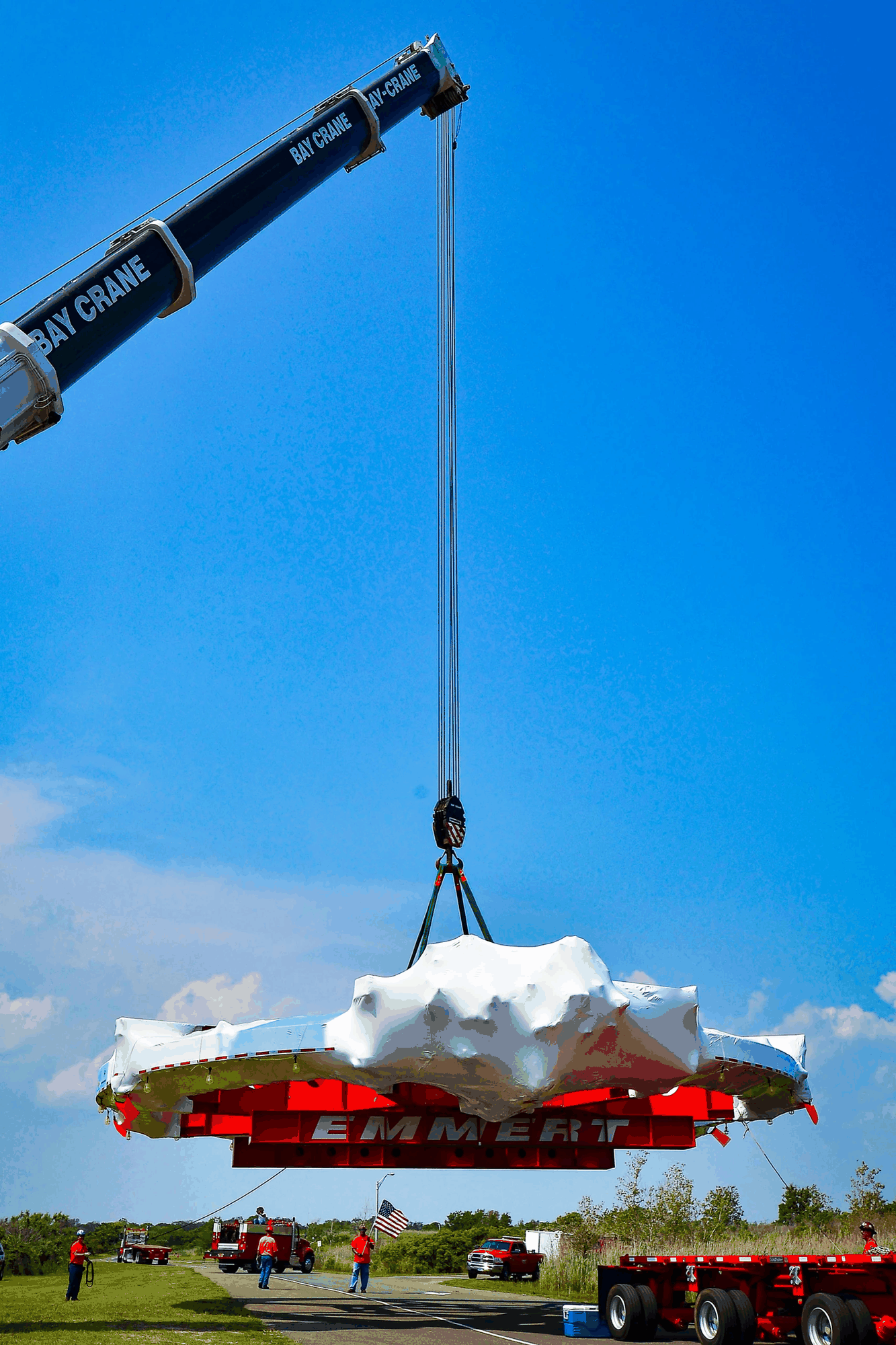 Figure: The Muon g-2 magnet ring transported from Brookhaven National Laboratory in New York to Fermilab via barge and truck. Credit: Fermilab
In April 2021, Fermilab announced its initial results: the muon’s g-2 anomaly was indeed larger than the Standard Model prediction from the data-driven method. The anomaly reached a statistical significance of 4.2 sigma—tantalizingly close to the 5-sigma gold standard required for a formal discovery of new physics.
Celebrations ensued. The crack in the Standard Model appeared undeniably real.
The Day a Single Paper Changed Everything
In an almost unbelievable twist of timing, on the exact same day Fermilab unveiled its experimental measurements, a groundbreaking paper was published in Nature.
A group of physicists known as the BMW collaboration (Budapest-Marseille-Wuppertal) presented new results from Lattice QCD. After a decade of refining algorithms and pushing supercomputers, they shrank the grid spacing sufficiently to achieve computational precision matching experiment.
Their conclusion? According to Lattice QCD calculations, the muon’s wobble matches the experimental measurement perfectly. There is no anomaly.
The implication was staggering: the 4.2-sigma “crack” that had energized physicists for twenty years wasn’t a sign of new particles after all. The fault lay not in the experiments, but in the previous theoretical predictions.
The narrative inverted instantly: physicists hadn’t found new physics; they had been misinterpreting the old baseline.
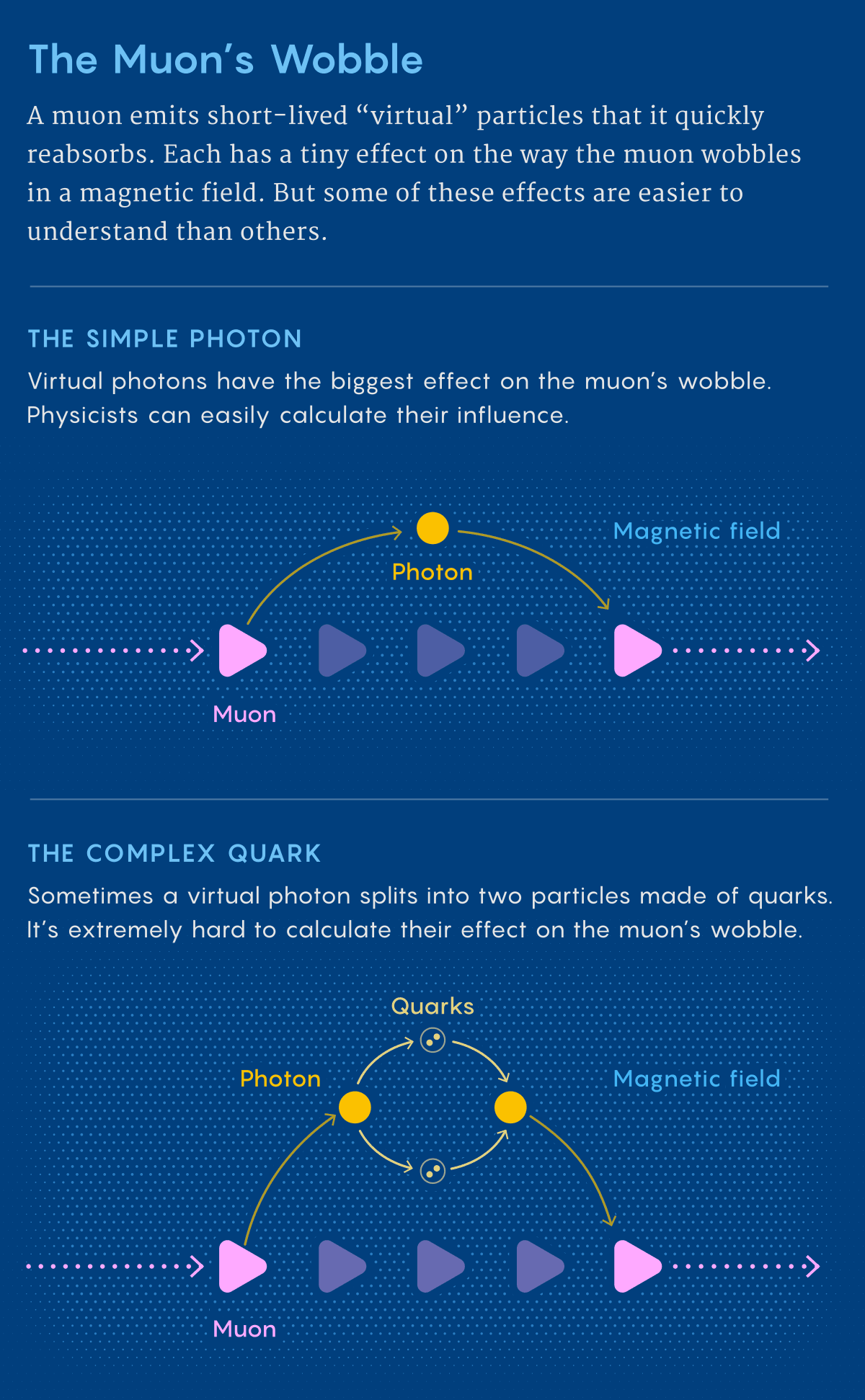 Figure: Schematic comparison between the three sets of Muon g-2 values. Credit: Samuel Velasco / Quanta Magazine
Three Mutually Contradictory Datasets
Physicists now face a conundrum involving three conflicting pieces of data:
- Fermilab’s Direct Measurement: This represents physical reality—how much the muon actually wobbles in nature. The experimental community widely accepts this measurement as robust.
- BMW’s Lattice QCD Calculation: The pure theoretical prediction from first principles, which agrees remarkably well with Fermilab’s measurement, indicating consistency with the Standard Model.
- The Data-Driven Prediction: Based on decades of electron-positron collision measurements summarized in 2020. This prediction yields a lower theoretical g-2 value, creating a sharp 4.2-sigma tension with Fermilab’s experiment.
If Lattice QCD is correct, then the data-driven approach—and the collider experiments behind it—must contain undetected errors. Yet the data-driven method relies on electron-positron collision data long considered among the most trustworthy in particle physics. If forty years of collider measurements cannot be trusted, what can?
The core mystery transformed: Why does the data-driven prediction diverge so sharply from Lattice QCD?
A Puzzle in Siberia
The clue to resolving this clash may originate in Siberia.
At the Budker Institute in Novosibirsk, a particle collider called VEPP-2000 has been colliding electrons and positrons. Operating at a fraction of CERN’s Large Hadron Collider energy, VEPP-2000 installed a brand-new detector named CMD-3 in 2010.
In 2023, the CMD-3 collaboration published new measurements of pion production (a key hadron product in e+e- collisions). Their measured rate was dramatically different from every measurement recorded over the previous forty years.
Physicist Fedor Ignatov noted: “It was a surprise. Nobody expected this.”
Intriguingly, the new Siberian measurement aligns closely with the BMW Lattice QCD calculations. But what about the older experiments? Landmark experiments such as KLOE in Italy and BaBar in California spent decades compiling data that consistently agreed with each other, but disagreed with CMD-3.
Physicists are left facing deep questions: Did multiple classic experiments suffer from uncorrected systematic errors, while the new Siberian measurement got it right? Or is CMD-3 flawed, and the classic consensus correct?
Or—even more tantalizingly—could an unknown new particle be subtly altering the collision processes themselves?
The original dream of discovering new physics has returned, disguised in a far more subtle form.
Why This Story Matters to Everyone
At first glance, this might look like an academic squabble over decimal places. Why should non-physicists care?
Because it exemplifies what makes science profoundly captivating: science is rarely a linear journey from question to answer. It is a messy, sprawling web. Resolving one knot often exposes three tighter knots behind it.
That is the true beauty of the muon story. Over two decades, physicists mobilized the world’s most sophisticated detectors and supercomputers, driving technological innovation to unprecedented heights. They solved the muon anomaly—only to uncover a 40-year systematic contradiction embedded deep within particle data.
As physicist Alex Keshavarzi candidly remarked: “We have 40 years of measurements, done in different ways, by different people, at different experiments, that draw completely different pictures. There’s so much work to do.”
The true antagonist in science is hubris. Every time we believe we are closing in on absolute truth, nature handed us a larger question mark.
Perhaps that is the ultimate wonder of fundamental physics: the harder we press for answers, the deeper the mystery becomes—and within those quiet discrepancies lie the universe’s greatest secrets.
References
- Quanta Magazine: Physicists Solve a Muon Mystery. Now, Old Results Don’t Add Up
- ScienceBlog: Muon g-2 calculations match Fermilab but clash with four decades of collider data
- Physics World: Muon g−2 calculation sets precision record and backs the Standard Model
- Wikipedia: Muon g-2
- Nature: Hybrid calculation of hadronic vacuum polarization in muon g-2 (2026)