Every year brings news claiming that “solid-state batteries will enter mass production next year.”
In 2019, they said 2021. In 2021, they said 2023. In 2023, they said 2025. Now in mid-2026, the battery inside your smartphone is still liquid-based.
This isn’t just one company making vaporware. QuantumScape, the most aggressive solid-state battery startup backed by Volkswagen, raised over $2 billion and saw its market cap surge past $50 billion after going public in 2020. Seven years later, it has yet to commercialize a single cell. Toyota has been demonstrating solid-state battery prototypes since 2012, promising “mass production next year” for over a decade, yet remains stuck in small-scale pilot trials.
Why are the world’s smartest engineers and most well-funded corporations struggling to produce a viable solid-state battery? Driven by this question, we analyzed the deep dive from Construction Physics and followed the hundreds of comments from engineers debating the issue on Hacker News.
Liquid Batteries Have Hit Their Physical Limit
To understand why solid-state batteries are so difficult to build, we must first look at conventional lithium-ion batteries.
The lithium-ion battery in your smartphone, laptop, or electric vehicle relies on a relatively straightforward architecture: two electrodes (cathode and anode) immersed in a liquid electrolyte. During charging, lithium ions swim through the liquid electrolyte from cathode to anode; during discharging, they flow back.
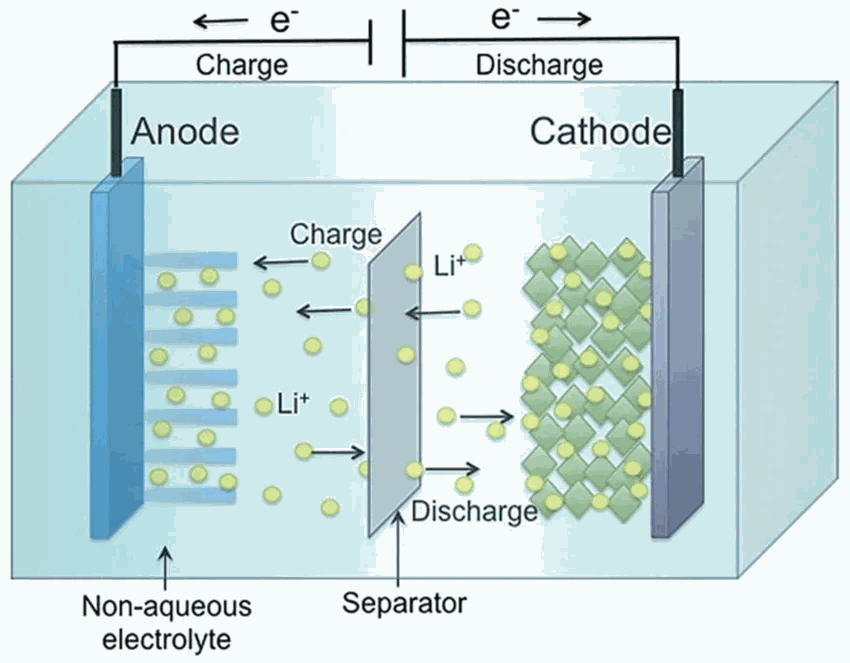 Schematic diagram of a conventional lithium-ion battery (Source: Construction Physics)
After three decades of continuous refinement, energy density has increased from less than 100 Wh/kg in early days to 250–300 Wh/kg today. However, this chemistry is approaching its fundamental physical limits. Two core vulnerabilities remain:
Liquid electrolytes are inherently flammable. The 2016 Samsung Galaxy Note 7 battery explosions and recurring EV fire incidents share the same root cause: if an internal short circuit occurs (such as lithium dendrites piercing the separator), thermal runaway is triggered, leading to fire or explosion.
Liquid electrolytes require massive dead weight. As highlighted in recent reviews, for every 1 gram of active lithium involved in the reaction, roughly 70 grams of supporting inactive materials (graphite anode, separator, current collectors, casing) are required. None of these extra materials generate energy, but they must be carried along—like running a marathon with a 70 lb backpack.
The promise of solid-state batteries is simple: replace the liquid, solving both safety and energy density in one stroke.
Why Is Replacing Liquid with Solid So Difficult?
An intuitive analogy explains the physical barrier.
A liquid electrolyte is like water: soft, fluid, and able to perfectly conform to every micro-scale imperfection on the electrode surface. Regardless of how the electrode expands or contracts, liquid continuously fills every gap.
A solid electrolyte is like an ice block: structurally stable, but rigid. Gaps inevitably form between the ice and its container, and ice cannot flow into microscopic crevices.
Obstacle 1: Interfacial Impedance.
Liquid electrolytes maintain intimate contact with electrodes, allowing lithium ions to cross with minimal resistance. Solid electrolytes and solid electrodes form a hard-against-hard interface, contacting at only a few points (actual contact area is under 1% of the theoretical interface). For lithium ions, crossing this boundary is like squeezing through a solid wall with tiny pinholes—the resistance is extraordinarily high.
Engineers attempt to improve contact by compressing solid electrolyte powders or semi-melting them before cooling. However, with every charge and discharge cycle, the electrode expands and contracts, continuously disrupting the painstakingly formed interface.
Obstacle 2: The Persistence of Lithium Dendrites.
Many assumed that substituting liquid with solid would stop lithium dendrites from growing. That turned out to be wrong.
Dendrites still grow inside solid electrolytes—they just take a different path. Lithium ions move much slower through solids than liquids (ionic conductivity is 10 to 100 times lower), causing local ion accumulation and localized stress concentration that eventually cracks open micro-fissures in the solid. This is even more dangerous than in liquids: while liquid dendrites can sometimes redissolve, solid fractures expand permanently over time.
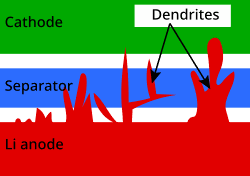 Growth process of lithium dendrites in the electrolyte, a main cause of battery short circuits and fires (Source: Construction Physics)
Obstacle 3: Manufacturing Processes Must Be Built From Scratch.
For thirty years, lithium-ion battery factories have operated on line designs optimized for liquid electrolytes: stacking electrodes and injecting liquid—a mature, high-throughput process.
Solid-state cells cannot use this process. Manufacturers must stack ultra-thin solid electrolyte layers and electrode materials layer by layer under cleanroom conditions with micrometer-level precision. This shifts manufacturing complexity from assembling a sandwich to layering a thousand-sheet pastry.
Consider the sulfide route favored by Toyota: sulfide electrolytes react violently with moisture in the air, decomposing within minutes into toxic hydrogen sulfide gas. As a result, the entire production line must operate inside moisture-free, oxygen-free glovebox environments. Building such a production line costs 3 to 5 times more than an equivalent liquid battery facility.
Three Technical Routes, Three Formidable Paths
Global R&D is currently split across three major technological approaches:
Polymer Route (Earliest, Lowest Ceiling). French company Blue Solutions mass-produced polymer solid-state batteries in 2011 for electric buses. However, room-temperature ionic conductivity in polymers is dismal; cells must be heated to 60–80°C to operate properly—making them impractical for smartphones and consumer passenger vehicles.
Oxide Route (Stable, Moderate Performance). TDK (backed by Apple) and China’s QingTao Energy follow this path. Oxides offer good chemical stability, air resistance, and relative ease of processing. However, their ionic conductivity remains an order of magnitude lower than liquid electrolytes. The pragmatic compromise has been “semi-solid” batteries (retaining a small fraction of liquid electrolyte to lower interface resistance). Nio’s ET7 semi-solid battery pack achieved 360 Wh/kg energy density, surpassing standard liquid cells.
Sulfide Route (Highest Potential, Highest Difficulty). Toyota, CATL, and Samsung SDI are betting heavily on sulfides. Sulfides offer ionic conductivity closest to liquid electrolytes, making them the most viable candidates for true “all-solid-state” cells. However, they face extreme moisture sensitivity, high manufacturing costs, and severe interfacial degradation.
In 2024, CATL Chairman Robin Zeng rated solid-state battery technology maturity at just 4 out of 9, remarking that “commercial viability has not yet been established.”
2026: Genuine Breakthroughs or Still Hype?
Despite the challenges, notable progress occurred in 2026:
- QuantumScape demonstrated cells with 844 Wh/L energy density (30% higher than top liquid cells), 80% fast-charge in 12 minutes, and over 1,000 cycle lifespans. However, its “Eagle Line” pilot facility only completed key equipment installation in early 2026; true high-volume production is not expected before 2028.
- Toyota launched a small pilot line in 2026 targeting initial mass production in 2027–2028, though initial batches will likely be reserved for hybrid models rather than pure battery electric vehicles.
- CATL plans to begin mass production of its semi-solid battery by late 2026, delivering 500 Wh/kg energy density and CLTC ranges exceeding 1,200 km. Note that this remains a “semi-solid” system containing liquid components.
- BYD is pursuing a dual oxide/sulfide roadmap, starting semi-solid Blade battery production in 2026 and planning small-batch all-solid-state demonstrations in 2027.
- USTC (University of Science and Technology of China) announced a manufacturing process breakthrough in early 2026 that reduces solid-state battery production costs by 20x, published in top peer-reviewed journals.
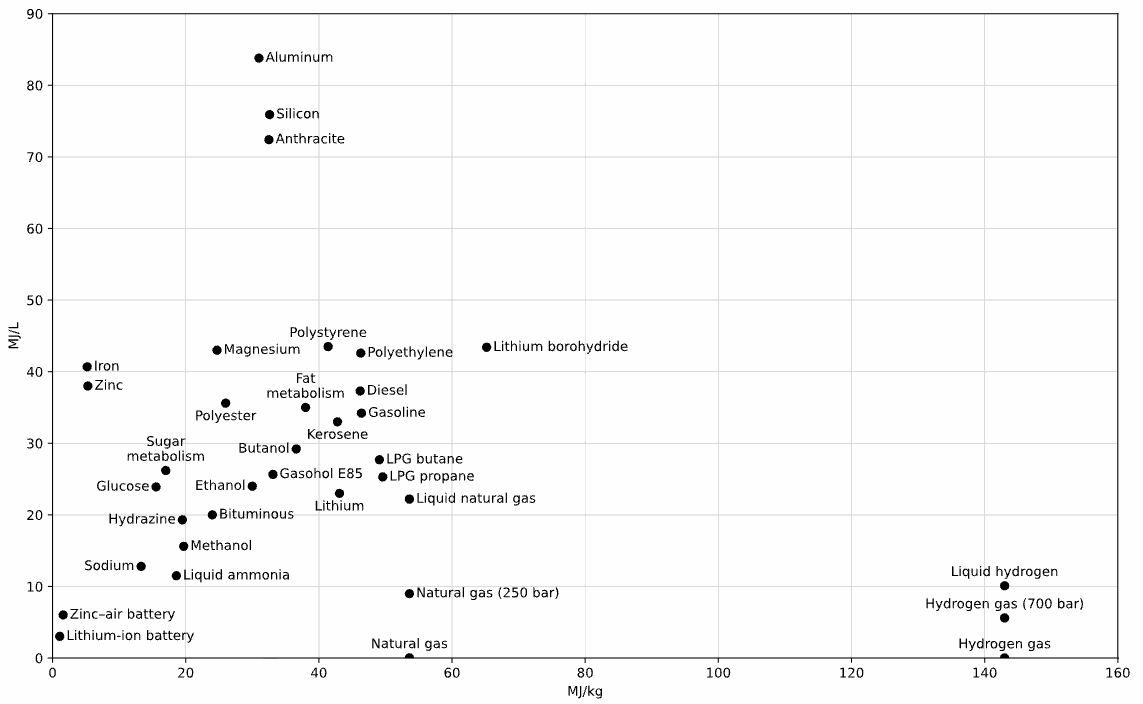 Energy density comparison across fuels and battery types; solid-state theoretical limits far surpass liquid Li-ion (Source: Construction Physics)
Examining these milestones reveals a consistent pattern: qualifiers like “semi-solid,” “small-scale,” “pilot line,” and “targeted” remain attached to every announcement.
True all-solid-state batteries—completely free of liquid electrolytes, offering double the energy density at cost parity with liquid cells—are not expected until after 2030 under optimistic projections. Market research firm IDTechEx forecasts that the global solid-state battery market will reach $10 billion by 2036, while conventional liquid lithium-ion batteries will still command a market worth hundreds of billions.
What Are We Waiting For?
If you are buying a smartphone or EV today, there is no need to wait for solid-state batteries.
You will almost certainly not be using them over the next five years. Yet technology development inherently follows this trajectory: the path from laboratory breakthrough to commercial scale requires extensive engineering accumulation rather than quick promises.
Liquid lithium-ion technology took 11 years to move from lab invention (1980) to commercialization (1991), and another 20 years to achieve widespread global adoption. Solid-state batteries face engineering challenges an order of magnitude more complex. Expecting a 10-year shortcut through a 30-year engineering timeline is simply unrealistic.
Behind every battery cell lie real physical and chemical hurdles waiting to be solved. Like any transformational hardware technology, solid-state batteries are waiting for their own “Moore’s Law moment”—gradually approaching commercial viability through iterative engineering trials.
When that day finally arrives, looking back at current anticipation and anxiety will likely feel like a natural chapter in tech evolution.
References:
- Why Is Everyone Trying to Build a Solid-State Battery? — Construction Physics
- Solid-State Battery Scoreboard 2025–2026: Who is Scaling — Intelligent Living
- Solid-State Battery 2026 Outlook: Certainties and Uncertainties — The Paper
- Diverse Technological Paths: Solid-State Battery R&D Deepens — Securities Times
- Solid-State Batteries 2026: Advances, Challenges & Applications — Bonnen Battery
- CATL 500Wh/kg Semi-Solid Battery Mass Production by Late 2026 — SMZDM
- Robin Zeng Pours Cold Water on Solid-State Batteries — Wallstreet CN
- HN Discussion (item?id=49109193)
Image credits: Original illustrations from Construction Physics (Li-ion battery structure, energy density comparison, lithium dendrite growth)