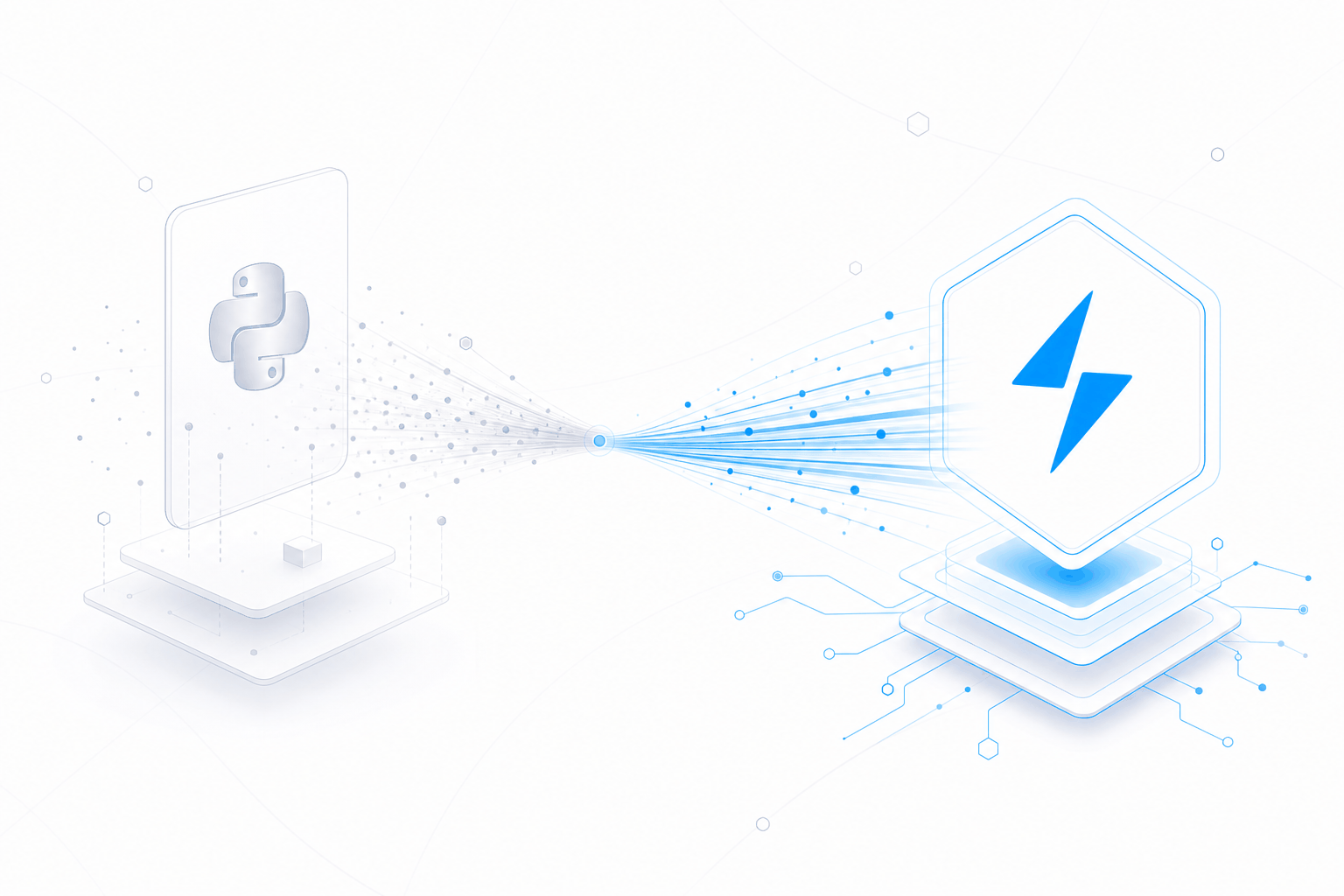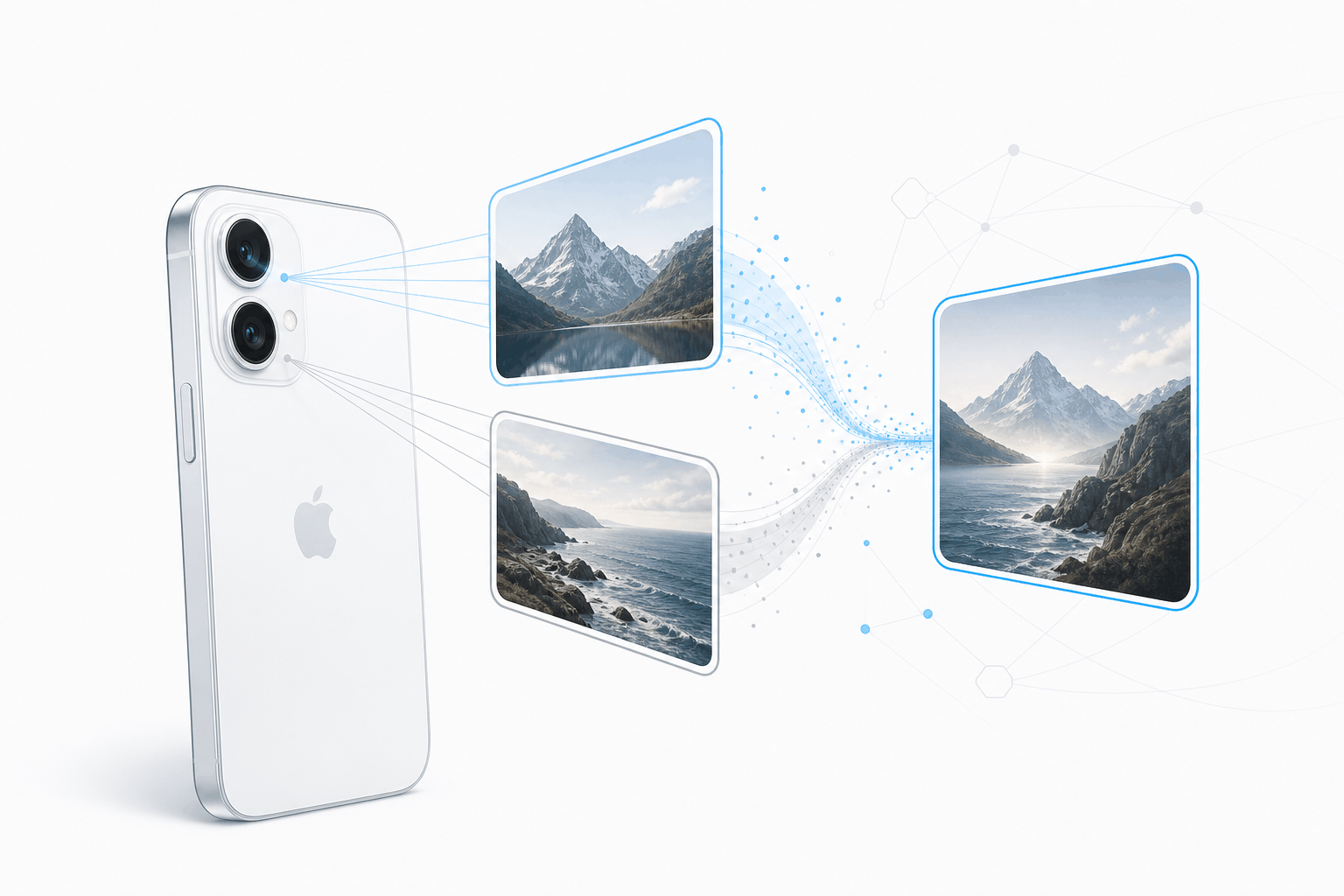
Most modern smartphones feature a array of rear cameras, yet every time you tap the shutter button, only one lens actually captures the shot. What are the other lenses doing? They might assist with depth calculation for portrait mode or step in briefly when zooming, but for the most part, they stay idle. A new camera app called Photosynthesis breaks this division of labor: it triggers two lenses simultaneously at the exact same instant and fuses the two exposures into a single photograph—using the sharper telephoto lens for the center region and the wider lens for the surrounding context. After being posted to Hacker News, the project sparked over 160 comments and intense discussion among developers and mobile photography enthusiasts.
Two Lenses Seated a Centimeter Apart See Slightly Different Views
To understand how two photos can be merged, it helps to start with the physical hardware. The lenses on the back of an iPhone are not stacked on top of each other; their optical centers are offset by roughly one centimeter. Because they occupy different positions in space, they view the exact same scene from slightly different perspectives. Foreground objects show a noticeable position shift between the two frames, whereas distant background elements look virtually identical.
This phenomenon is known as parallax. Human vision relies on parallax to perceive depth: each eye receives a slightly different image, and the brain compares the two to gauge distance. Smartphone portrait modes operate on the same principle—by analyzing the displacement between two camera feeds, the device calculates a depth map to determine what is near and far before applying a background blur. In other words, phones have long leveraged parallax, but almost exclusively for depth estimation.
Photosynthesis repurposes parallax for alignment: calculating the spatial offset between the two frames so they can be registered to a single coordinate space, stacked, and rendered as a single image.
One Lens for Breadth, One for Sharp Detail
The key to fusion lies in optical specialization. Different lenses on an iPhone serve different roles: the main camera offers a wide angle of view with standard detail, while the telephoto lens captures finer textures at a narrower field of view. On Pro models, the telephoto lens provides 2x, 3x, or even 5x optical magnification compared to the main sensor. This means the pixel detail density in that central crop can be several times higher than what the wide-angle camera alone could capture.
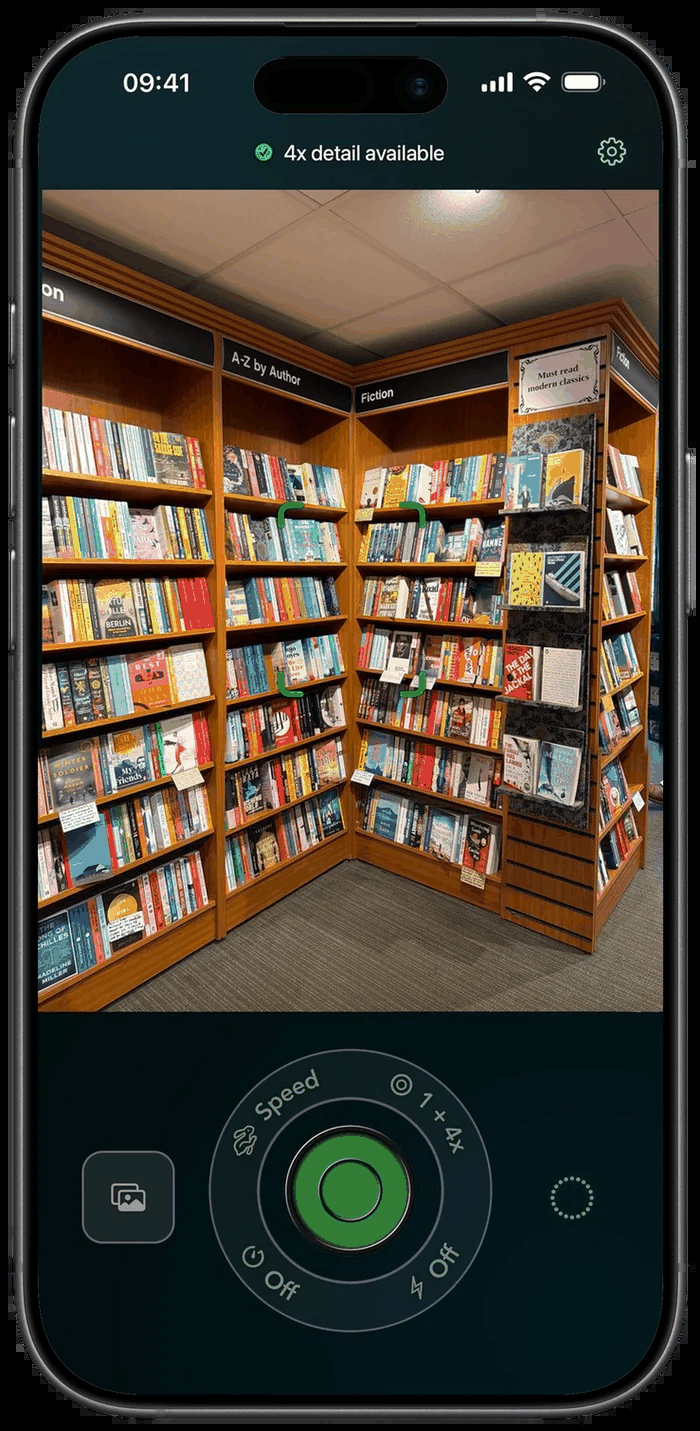 Figure: Green brackets in the viewfinder mark the central high-detail area managed by the telephoto lens—on Pro models, a 1x main paired with a 4x telephoto. Source: photosynthesis.camera
Photosynthesis divides the viewfinder into two distinct zones: the central area bounded by green brackets is delegated to the higher-detail camera, while the surrounding frame is captured by the main camera. When you press the shutter button, both sensors capture their respective images simultaneously. Even iPhones without a telephoto lens can participate in this workflow: the main sensor covers the central detail while the ultra-wide lens handles the surrounding context, merging “clarity” and “breadth” into one file.
This mirrors human visual architecture: the human eye possesses a wide field of view, but high-resolution foveal vision is concentrated in a tiny central spot. The brain compensates for this limitation through rapid saccadic eye movements. High central acuity paired with peripheral context is nature’s own imaging strategy—placing maximum detail precisely where the viewer concentrates attention.
 Figure: A bookshelf captured across an entire room with spine text remaining sharp and readable—the result of dual-lens fusion. Source: photosynthesis.camera
Fusing Two Images into One: Alignment, Selection, and Seamless Blending
The core technical challenge lies in the image fusion pipeline, which unfolds in three main steps.
First, alignment. Because the two lenses are separated by about a centimeter, a vertical post or object will appear at slightly different pixel coordinates in each image. Software must compute the disparity vector map to register the two layers precisely. Parallax is both a helper and a hurdle here: distant scenes exhibit minimal shift and align easily, but near objects exhibit severe parallax offset, making edges prone to misalignment.
Second, selection. The central region extracts high-frequency detail from the telephoto capture, while the surrounding area draws from the wider main (or ultra-wide) sensor. Each region utilizes the lens best equipped for it.
Third, seam blending. Transitioning directly from sharp telephoto detail to softer main-sensor pixels creates a visible seam, reminiscent of satellite map patches where high-res imagery meets low-res tiles. In the Hacker News discussion, the developer detailed the solution: feathering the boundary zone with a smooth alpha transition, accompanied by global color and exposure matching to eliminate tone discrepancies between the center and periphery.
Additionally, if the two shots are captured at different exposures, light and shadow information can be combined—preserving highlights from one frame and shadow details from the other to expand overall dynamic range, leveraging classic HDR techniques alongside dual-lens fusion.
Such a Simple Idea—Why Has No One Nailed It Before?
Commenters on Hacker News raised a straightforward question: “What are all those extra camera lenses on our phones actually for if not this?” Multi-camera fusion as a concept is not new. In 2017, the Light L16 camera packed 16 individual module sensors onto its back specifically to combine multiple focal lengths into one super-resolution file—a product ultimately discontinued due to software complexity and price. In 2019, the Nokia 9 PureView attempted a 5-camera array fusion, and Amazon’s Fire Phone experimented with multi-camera spatial sensing as early as 2014. The concept’s long history proves that the difficulty lies in execution.
The first major hurdle is synchronization: both lenses must trigger at the exact microsecond; a delay of even a few milliseconds causes severe ghosting on moving subjects. The second hurdle is geometric perspective: lenses with different focal lengths introduce distinct optical distortions that require complex warping algorithms. The third issue is parallax misalignment on close subjects: several HN users pointed out visible alignment artifacts along ear contours in selfie samples. The developer acknowledged in the thread that not every shot turns out perfect, and some users felt certain sample images looked less natural than stock iOS camera output due to aggressive tone-matching flattening contrast.
Another frequent comment observed: “Isn’t this just multi-frame super-resolution that pro cameras have been doing for years?” While similar in spirit, the mechanisms differ fundamentally. Traditional multi-frame exposure stacks multiple rapid shots from a single lens to suppress noise and boost dynamic range. Photosynthesis fires two different lenses at the exact same moment to solve a structural tradeoff: achieving both a wide field of view and high optical magnification at once.
Why Apple Doesn’t Make Dual-Lens Fusion the Default
Attributing Apple’s absence in this area to a lack of engineering foresight would be inaccurate. Apple has shipped multi-camera fusion algorithms at the system level since 2016, introducing Deep Fusion on the iPhone 11 in 2019 (stacking multiple frames from a single camera at the neural engine layer) along with Night Mode. The stock Camera app has long been doing multi-exposure computational photography under the hood, fully automated and invisible to the user.
Why, then, hasn’t Apple made dual-lens simultaneous fusion the default shooting mode? The standard camera system prioritizes absolute reliability across every possible shooting scenario. Dual-lens fusion remains vulnerable to alignment failures on close subjects or fast-moving targets, while running two camera sensors simultaneously incurs significant battery drain and ISP processing overhead. The tangible benefits are concentrated in specific niches: concert photography (keeping distant performers sharp while capturing the ambient crowd) or photos intended for aggressive cropping after the fact.
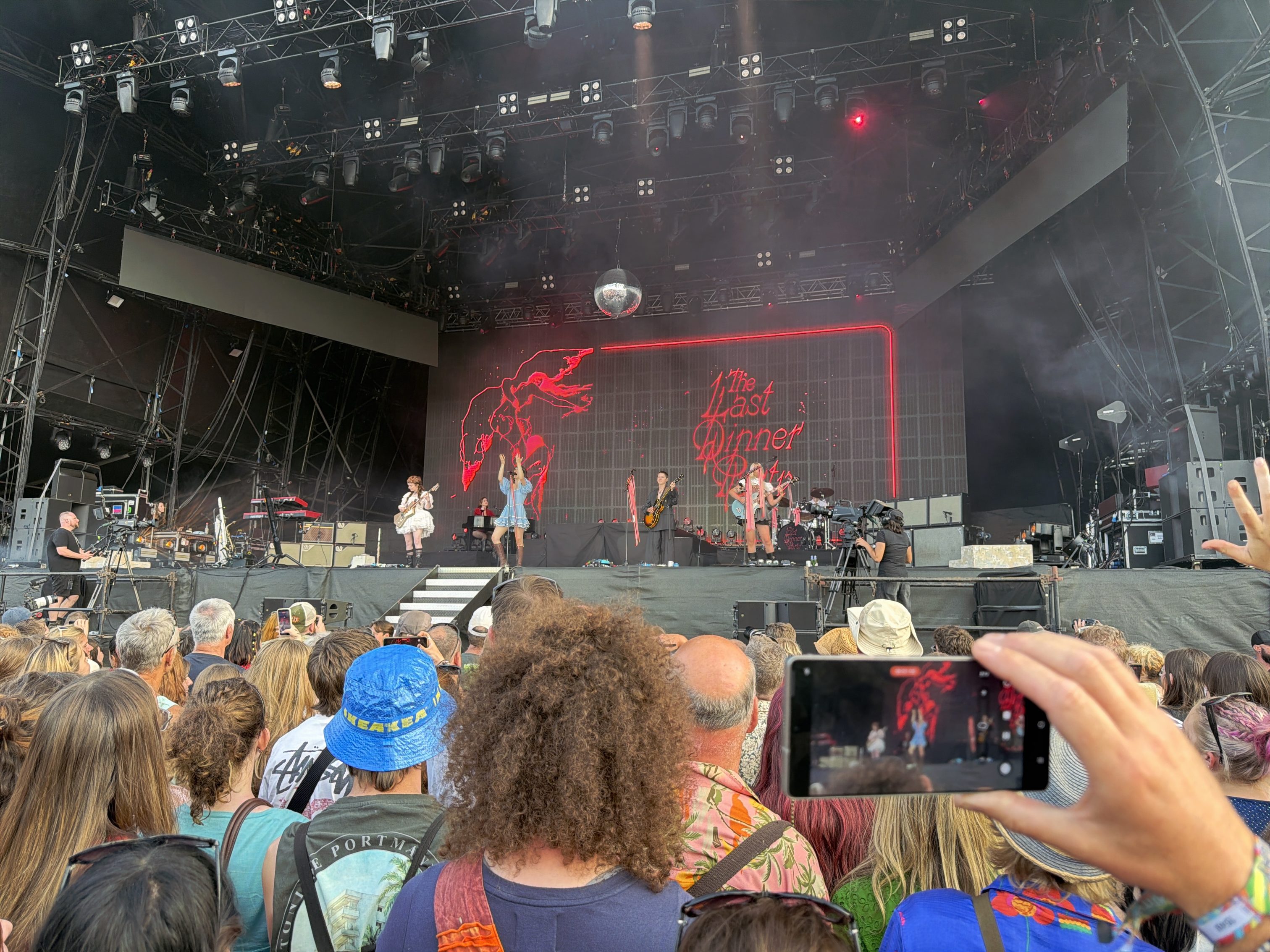 Figure: Concert stage sample—the distant band stays sharp while crowd atmosphere in the foreground is preserved. Source: photosynthesis.camera
There is also a technical timeline context: Apple only opened third-party developer APIs for multi-cam simultaneous capture in iOS 13 (WWDC 2019). For independent developers, building applications on this hardware interface has only been practically feasible for a few years. Photosynthesis takes the opposite philosophy of Apple: where Apple automates decisions quietly in the background, Photosynthesis gives control explicitly to the user—marking the high-resolution center clearly with green brackets.
The app is currently in early beta testing with a full public release planned for summer 2026. It operates on a subscription model, offering a free tier limited to exporting three photos per month—a pricing model that has become one of the most debated topics in the community discussion.
Final Thoughts
It is too early to pass final judgment on Photosynthesis. Its ultimate success depends on the polish of its production release. What makes this project noteworthy is a broader industry pattern: mobile hardware has long surpassed daily snapshot requirements, leaving powerful multi-lens camera systems waiting for creative software to unlock their full utility. Terms like parallax and dynamic range may sound intimidating, but in daily practice it comes down to a simple premise: shooting with two lenses at once to create a better composite photograph. The idea itself is straightforward—the real achievement is systematically engineering every small detail to work reliably.
Reference Links:
- Photosynthesis Official Site: Dual-lens simultaneous capture & fusion overview, sample comparisons
- Hacker News Discussion: “Show HN: iPhone app takes simultaneous images from 2 lenses, fuses into 1 photo” (Item ID 49226623, with responses from the developer)
- Apple WWDC 2019 Developer Video: Multi-cam simultaneous capture API open to third parties since iOS 13
- PetaPixel Review: Post-mortem on the 16-lens Light L16 camera