On the morning of August 11, 2026, commuters at London’s Victoria Underground Station tapped through the ticket barriers as usual. Few noticed the bright yellow cameras mounted around the concourse, and fewer still realized that starting that morning, every face passing through the frame was being scanned in real-time and cross-referenced against a police watchlist. The British Transport Police (BTP) announced that day the expansion of its Live Facial Recognition (LFR) trial—running for six months above ground—into the London Underground network. Victoria is the first station, with equipment scheduled to rotate across key rail and tube hubs through November.
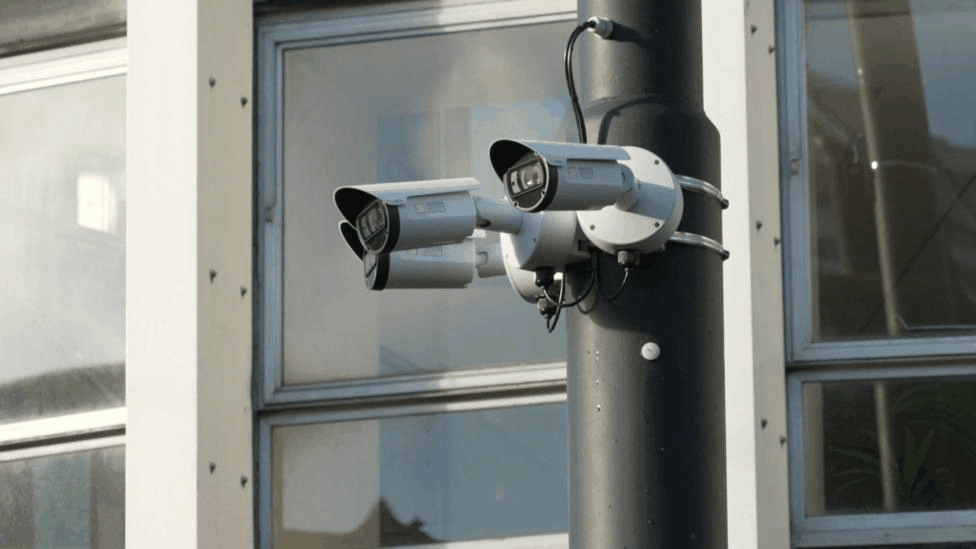 Image: In February 2026, the trial launched at London Bridge station with cameras mounted atop a police van. Source: bbc.co.uk (PA Media)
How the System Works
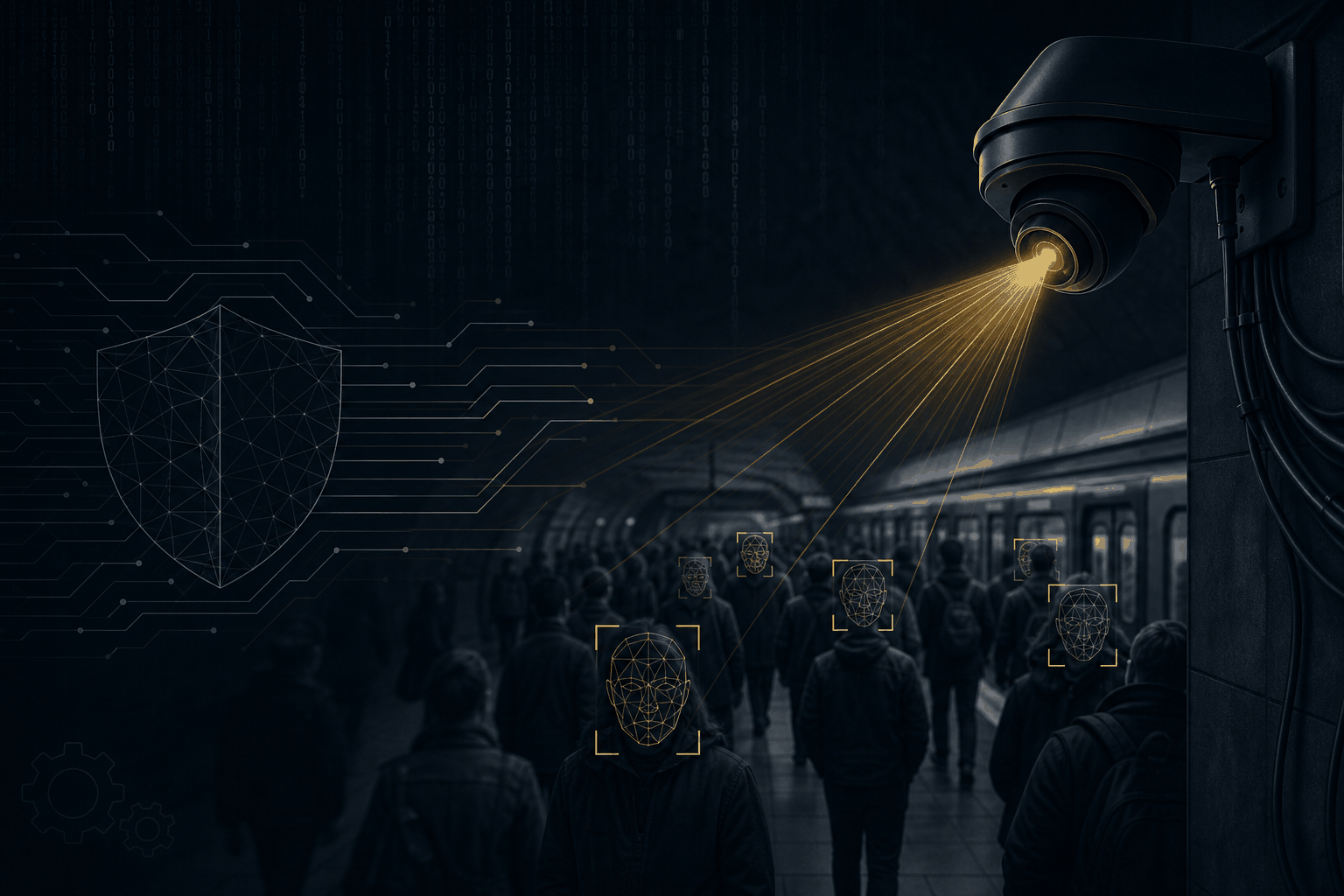
It is worth clarifying what the technology actually does. These dedicated cameras capture facial images and feed them immediately to an algorithmic matching engine—NEC’s NeoFace M40. The software extracts key geometric features from each face, such as the distance between the eyes, the spatial relationship of the nose and mouth, and cheekbone contours, converting them into a numerical vector. This mathematical representation acts as a “digital fingerprint” that the system compares against a database. The watchlist comprises individuals wanted by police or courts, including suspects of serious offenses as well as individuals in breach of bail conditions or court orders.
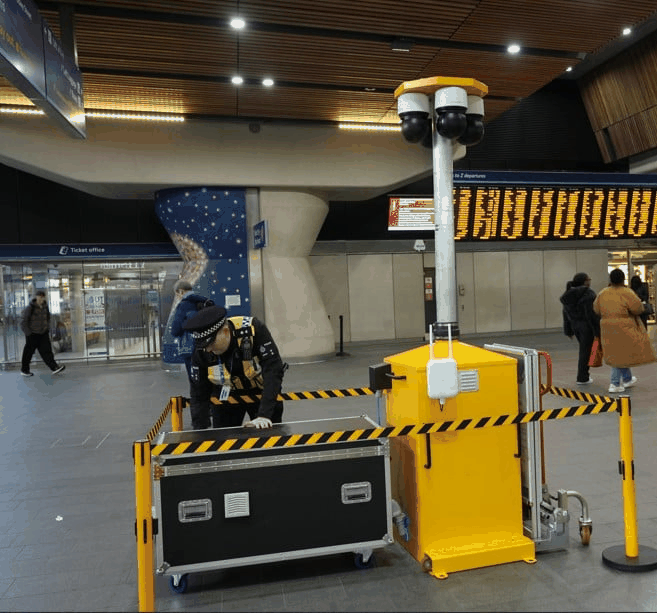 Image: LFR camera featured in British Transport Police press release. Source: btp.police.uk
A common misconception is that the algorithm functions like a human manual photo search. In reality, it compares abstract geometric feature vectors rather than asking “do these two photos look alike?” Because faces are compressed into compact numerical vectors, matching occurs in fractions of a second—hence the “Live” designation.
Real-World Accuracy vs. Laboratory Claims
Vendor accuracy statistics are almost universally generated under controlled laboratory conditions. A busy Tube station, by contrast, is a harsh proving ground: dense peak-hour crowds, flickering overhead lighting, commuters looking down at smartphones, face masks, pulled-down hats, and camera distances spanning two to three meters. Each factor degrades feature extraction quality. Independent research has repeatedly shown that algorithm accuracy drops significantly between lab benchmarks and crowded real-world environments. Furthermore, multiple studies have documented elevated false positive rates for individuals with darker skin tones. The UK’s National Physical Laboratory (NPL) conducted independent testing for this project, recommending specific parameter thresholds designed to minimize false positives and demographic bias, which the BTP committed to following. This underscores that official concern regarding false matches is very real, even if police rely on operational parameters to mitigate it.
Key Numbers Worth Thinking About
Participants in the Hacker News discussion highlighted official BTP deployment records: across multiple deployments so far in 2026, tens of thousands of faces were scanned per operation, yet only a single alert was triggered—and that turned out to be a false positive. This suggests the system operates under extremely conservative parameters in practice, virtually eliminating alerts. Proponents view this as responsible engineering (“better to miss than falsely accuse”), whereas critics argue that scanning tens of thousands of citizens for zero valid matches represents an inefficient deployment of public resources.
Another set of figures comes from the Metropolitan Police Service (Met): between January and mid-September 2025 across London, 801 arrests were classified as “directly resulting from facial recognition.” This indicates that outside the Tube trial, the technology has yielded concrete arrests at scale. Meanwhile, political debate has intensified; the Shadow Home Secretary recently called for expanded facial recognition deployment, noting that the police facial image database contains approximately 10 million photos—meaning roughly 1 in 7 UK residents (out of a population of 68 million) is included in the reference pool.
The Legal Framework: Sufficient Safeguards or Statutory Vacuum?
Under the UK GDPR framework, facial data is classified as biometric data under “special category” protection, establishing a significantly higher legal bar than standard personal data processing. The police maintain that the trial operates entirely within current law: deployment dates and locations are published in advance, clear signage is posted on-site, alternative routes are available for passengers who prefer not to pass through recognition zones, images of individuals not on watchlists are immediately and permanently deleted, and alert images are purged within 24 hours.
Opponents argue this administrative framework is fundamentally inadequate. Civil liberties group Big Brother Watch emphasizes that the UK still lacks specific primary legislation governing police facial recognition. In practice, police forces set their own operational rules—determining watchlist criteria, list sizes, and matching thresholds—without parliamentary debate or votes. The Met currently faces a High Court challenge brought by 39-year-old Shaun Thompson, who was stopped outside London Bridge station by an LFR unit in 2025. After refusing to provide fingerprints, he was detained for roughly 30 minutes. Thompson described the system as “stop and search on steroids.” At the High Court hearing in January 2026, police legal representation pointed to the 801 arrests as proof of efficacy, contending that privacy intrusion into the general public remains “minimal.”
Supporters: Precision Tool, Not Mass Surveillance
 Image: Four grey cameras mounted atop deployment vehicle aimed at passenger flow. Source: bbc.co.uk (PA Media)
To lay out the supporting arguments in full: police emphasize that the target population is narrow—individuals wanted for serious crimes or court order breaches. Furthermore, deployments are intelligence-led, focused on stations where intelligence suggests suspects may travel, rather than blanket city-wide monitoring. Transport for London’s (TfL) Chief Health, Safety and Environment Officer stated plainly that identifying high-risk offenders, including sexual offenders, aims to “stop crime before it happens.”
Supporters on Hacker News offered two pragmatic observations. First, Underground stations feature limited exits and enclosed layouts, making them natural police interdiction points; facial recognition simply replaces hit-or-miss manual observation with higher probability. Second, the technology itself is neutral; governance and workflow matter. The system includes human oversight—an alert does not trigger an immediate arrest; an officer on-scene must visually verify the match before taking action. The bright yellow cameras are overtly positioned, allowing objecting commuters to take alternative paths. Some ask: given that human police officers frequently misidentify suspects, why demand absolute perfection only from machine systems?
Opponents: The Slippery Slope of Biometric Normalization
The critique is equally structured. Big Brother Watch characterizes the deployment as “mass biometric surveillance of law-abiding passengers,” where every commuter is screened regardless of innocence, and the cost of false positives falls on ordinary citizens through uncomfortable detentions and questioning. A highly upvoted Hacker News comment took a broader perspective: Oyster transit cards and bank cards track every gate swipe, supermarket self-checkout cameras film your face, automatic number plate recognition (ANPR) logs vehicle movements, and ISPs log browsing histories under law… “Anonymous travel” vanished in the UK years ago. In this view, public privacy has been eroding slowly, and facial recognition simply accelerates the trend.
Critics also warn of a slippery slope: today’s watchlist targets wanted felons, but tomorrow’s could expand to tax debtors, political activists, or disfavored groups. Others caution that even with human verification, on-scene decision-makers operate under high stress. In 2005, Jean Charles de Menezes was shot dead in a London Underground station by officers who mistook him for a fugitive suspect—without any facial recognition software involved. That tragic history serves as a reminder that the human element in law enforcement can also fail under pressure.
The Trial Continues
Both perspectives draw on verifiable facts: high-risk offenders do use public transport, and police seek effective enforcement tools; yet screening millions of innocent commuters through automated matching was never submitted to a public vote. The current trial is bounded in time, concluding in November with a formal evaluation report. Until then, millions of passengers will continue passing daily before the bright yellow lenses.
Reference Links:
- BTP News: BTP expands live facial recognition trial into London Underground stations (Official BTP Press Release)
- BBC News: Police start live facial recognition trial at London stations (Coverage of Feb 2026 launch with operational details and public debate)
- Biometric Update: British Transport Police extends live facial recognition trial into Underground stations (Technical details on NEC NeoFace M40 and NPL testing)
- Hacker News Discussion (item?id=49255496) (198 points, 229 comments on technical and ethical tradeoffs)