Kitchen Stoves Cannot Spark Stellar Fires: How an Electrolysis Beaker Sparked a Thirty-Year Scandal
When you turn on a kitchen gas burner to cook dinner, the flickering blue flame reaches roughly 1,000 degrees Celsius. That is about the highest temperature an ordinary person ever encounters in daily life. Yet fusing two light atomic nuclei together to spark nuclear fusion demands tens of millions of degrees, even in the heart of the Sun. A household flame is cooler by a factor of ten thousand.
If someone claimed that sticking two metal rods into a bowl of water and flicking a switch could ignite a man-made star at room temperature, physicists would laugh it off. But in March 1989, chemists Martin Fleischmann and Stanley Pons held a press conference to announce that they had achieved tabletop nuclear fusion in a simple glass beaker. The claim created a worldwide media sensation, and hundreds of laboratories raced to replicate the result.
The follow-up experiments quickly poured cold water on the hysteria. Not a single laboratory across the globe could reliably detect fusion products. The original data turned out to be riddled with experimental errors. Cold fusion—the hypothesis of inducing atomic nuclei to fuse near room temperature and ambient pressure—swiftly fell from grace, descending into one of the most notorious scientific debacles of the twentieth century.
A Microscopic Stand-In Pulls Nuclei 200 Times Closer: Fusion Without the Hellfire
That debacle cast a long shadow over the entire field, convincing many that room-temperature fusion was pure science fiction. Yet deep inside the subatomic world, room-temperature fusion is entirely real. It has been reproduced and measured in laboratories for decades.
The mechanism is known as muon-catalyzed fusion (μCF). It relies on heavier particles to coax atomic nuclei together without needing extreme temperatures. Its secret lies in exotic atoms—subatomic configurations where conventional electrons or nuclei are replaced by unconventional particles. In an ordinary hydrogen molecule, two positively charged nuclei are held together by a shared electron cloud.
Because both nuclei carry positive electrical charges, the repulsive Coulomb force acts as an immense barrier, keeping them roughly 0.74 angstroms apart. At room temperature, ordinary nuclei have virtually zero chance of overcoming that repulsion. But physicists can swap out that molecular tether.
They replace the electron with a muon—an unstable subatomic particle that behaves like a heavy electron, packing roughly 207 times its mass. Because it is 207 times heavier, the muon’s quantum orbit hugs the atomic nuclei much more tightly, drawing the two nuclei nearly 200 times closer together. That staggering reduction in scale changes everything.
Subatomic particles are governed by quantum tunneling, allowing them to slip through energy barriers that classical mechanics would deem insurmountable. When the two nuclei are held in such intimate proximity, even gentle room-temperature thermal vibrations allow them to tunnel through the Coulomb barrier and fuse instantly. At the subatomic scale, room-temperature fusion is an established reality.
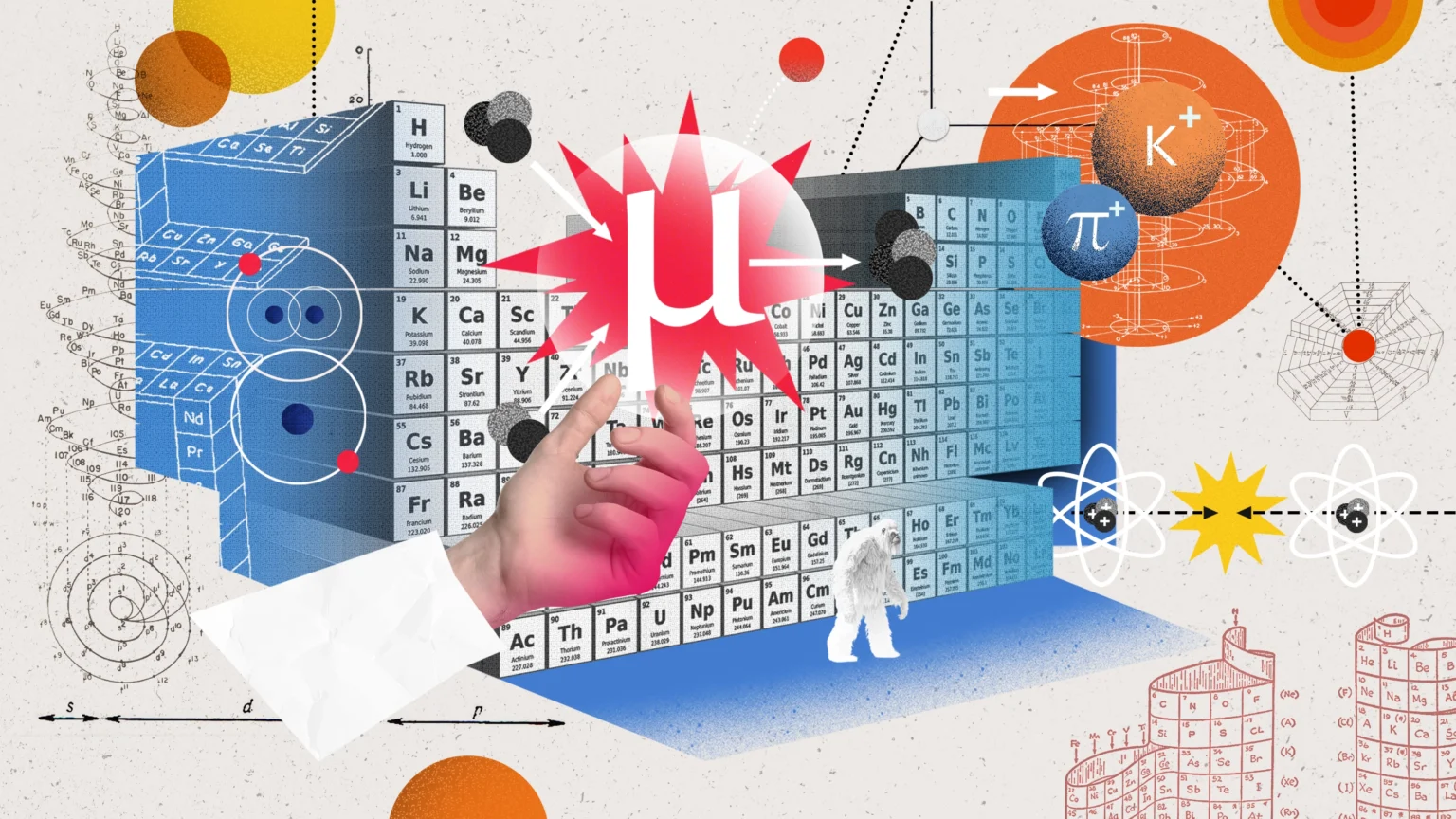 Figure: Quanta Magazine cover illustration depicting muon-catalyzed fusion within exotic atoms. Source: Quanta Magazine / Oleg Borodin.
A Two-Microsecond Lifetime and the Sticking Trap: Dead After a Hundred Reactions
If room-temperature fusion is already happening in laboratories, why hasn’t humanity harnessed it to solve the global energy crisis? The answer comes down to hard thermodynamics and particle physics. In μCF, the muon acts as a catalyst: it binds the nuclei, triggers the fusion reaction, and is ejected unharmed to seek out another pair of nuclei.
In an ideal world, a single particle cycling indefinitely could liberate a limitless torrent of energy. But the subatomic universe imposes a rigid countdown: a muon has an average lifetime of just 2.2 microseconds. In human terms, 2.2 microseconds is vanishingly brief—even light travels merely 660 meters in a vacuum over that span before the particle decays into an electron and a pair of neutrinos.
Compounding the problem, the muon faces a constant threat of capture. The fusion of deuterium and tritium produces an alpha particle—an energetic helium-4 nucleus consisting of two protons and two neutrons. Each time a muon facilitates a fusion event, there is roughly a 1% probability that it will stick to the newly formed alpha particle. Once bound to the helium nucleus, the muon is stripped from the catalytic cycle forever.
These two fundamental physical constraints deliver a fatal blow to commercial energy production. Between decaying away and getting trapped by alpha particles, a single muon can catalyze only 100 to 150 fusion reactions before disappearing. The total energy released by one muon is strictly capped, with no apparent way to scale it up.
Superconducting Sensors Pin Down Molecular Resonances: Half a Century of Quantum Theory Confirmed
Although commercial power generation remains out of reach, physicists have never abandoned their investigation of the underlying physics. On October 30, 2026, Quanta Magazine published an in-depth feature chronicling the renaissance of exotic-atom research, spotlighting a milestone achieved in April 2026 by an experimental team in Japan.
Researchers from the University of Tokyo’s Kavli IPMU and Japan’s Moonshot research program published their findings in Science Advances. The team tackled a long-standing challenge: measuring the resonant state that governs the formation rate of ddμ molecules (two deuterium nuclei bound by a muon).
For half a century, theoretical physicists had calculated the precise quantum states of these muonic molecules, yet experimental measurements persistently failed to line up with the models. To resolve the discrepancy, the team built an ultra-high-resolution X-ray spectrometer.
At its core sits a Transition Edge Sensor (TES) microcalorimeter—a superconducting device operating at millikelvin temperatures that measures energy by registering minuscule temperature shifts when a single X-ray photon is absorbed.
Using this cutting-edge detector, the team directly observed the resonant formation of ddμ molecules for the first time by capturing the characteristic X-rays emitted along the resonant pathway. The measured energy levels matched theoretical predictions from fifty years ago with extraordinary accuracy. Physicists could finally watch muonic molecules snap together in a fraction of a picosecond, fully vindicating decades of quantum mechanics.
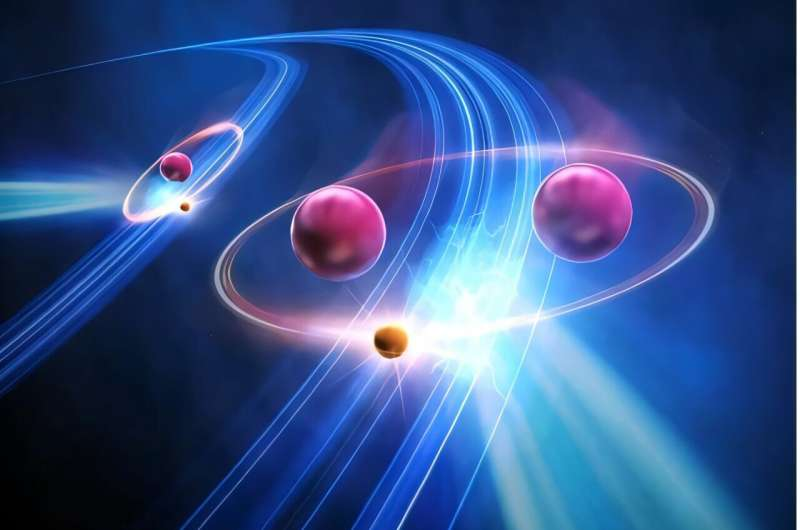 Figure: Schematic illustration of muonic molecule resonant formation captured by high-resolution X-ray spectroscopy. Source: Kavli IPMU, University of Tokyo / phys.org.
The Energy Balance Remains Deep in the Red: Science Discards the Hype to Keep the Truth
While advancing detection techniques have pushed low-energy nuclear physics to unprecedented precision, the harsh arithmetic of the energy grid remains unyielding. Producing a single muon inside a high-energy particle accelerator requires an investment of roughly 5 GeV (five billion electron volts).
The return on that investment is modest. A single deuterium-tritium fusion reaction releases approximately 17.6 MeV. Even if a muon achieves its upper theoretical limit of 150 catalytic cycles, the total energy harvested amounts to barely 2.6 GeV.
Spending 5 GeV to recover 2.6 GeV is a losing proposition—it is equivalent to spending five dollars on raw materials to manufacture a product that sells for two. No amount of engineering refinement can escape the fact that creating muons consumes more energy than the resulting fusion reactions can ever return.
In revisiting cold fusion, physicists have no interest in vindicating the flawed beaker experiments of 1989. Stripped of sensational claims and fraud, exotic atoms offer profound insight into the fundamental forces governing matter. Muon-catalyzed fusion will not solve the climate crisis or power our cities, but its true brilliance lies elsewhere: in the quiet, unrelenting pursuit of basic science.
Reference links:
- Is There More to Cold Fusion Than Failure and Fraud? — Quanta Magazine
- Muonic molecules critical to muon-catalyzed fusion directly observed — phys.org
- Direct observation of resonant formation of muonic molecules via X-ray spectroscopy — Science Advances