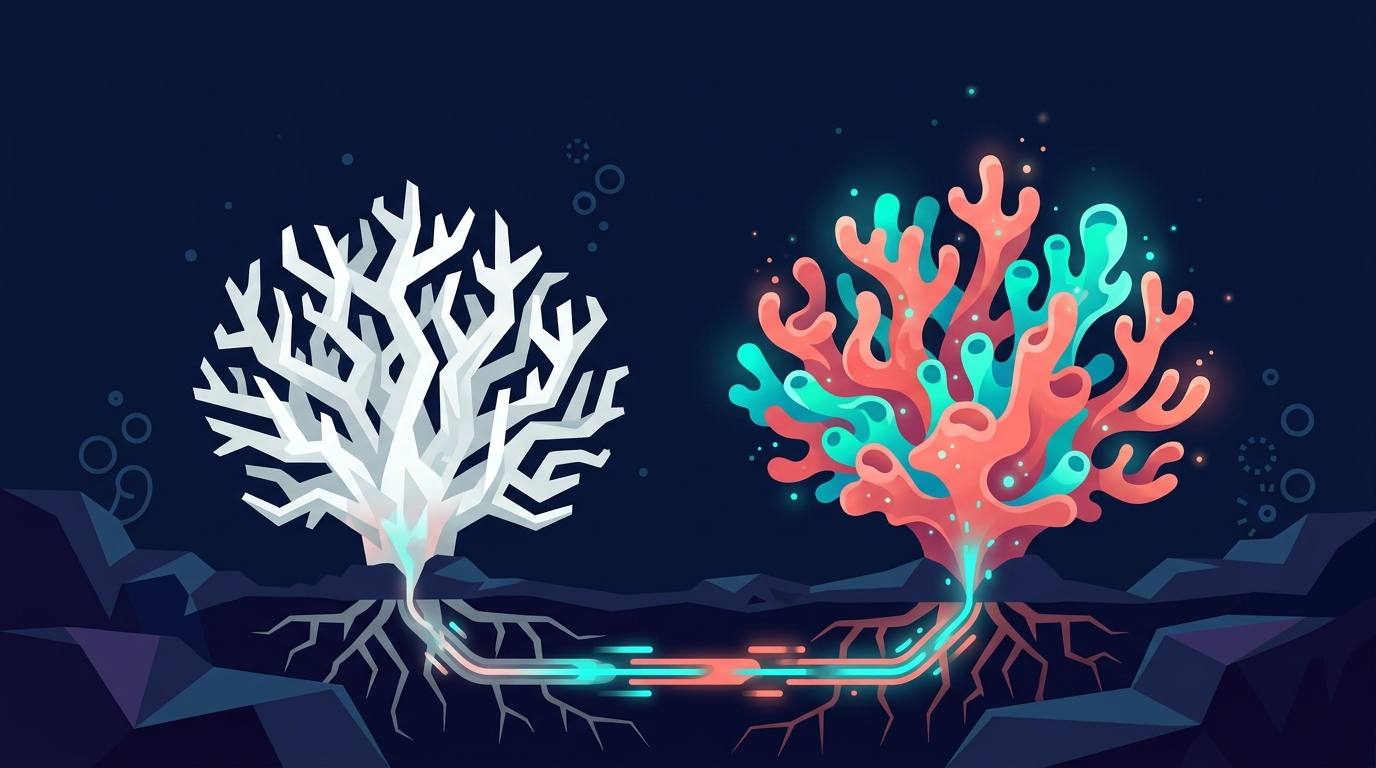
Gazing across a stark, ghostly white coral reef, most observers assume they are staring at an underwater cemetery. In reality, those drained coral polyps are often still alive—trapped in a state of severe starvation. On October 14, 2026, Nature highlighted an experimental breakthrough published in Science Advances (DOI 10.1126/sciadv.aeh1580): researchers placed bleached coral fragments into direct physical contact with healthy counterparts, restoring full color and physiological vitality within just eight weeks. As long as a genetically compatible “donor” is right beside them to lend a helping hand, seemingly doomed corals can pull back from the brink of death.
The discovery traces back to an accidental observation in early 2025. Marine biologist Stephen Palumbi at Stanford University’s Hopkins Marine Station noticed an unexpected phenomenon in their holding tanks: bleached corals that happened to touch healthy neighbors recovered markedly better. Doctoral student Danny Collins designed a controlled laboratory experiment to unravel the mechanism. Coral bleaching is fundamentally a state of starvation caused by the expulsion of symbiotic algae; healthy corals can rescue bleached partners within 8 weeks by channeling microalgae across tissue bridges; however, the strict barrier of clonemate compatibility severely limits its application in wild reefs.
Expelling Algae Cuts Off the Food Supply; Physical Contact Restores Health in 8 Weeks
Why do vibrantly colored corals suddenly turn pale white? Coral polyps are naturally transparent cnidarians. Their dazzling hues and daily energy supply rely entirely on microscopic endosymbiotic dinoflagellates belonging to the family Symbiodiniaceae, which generate organic nutrients for the coral host via photosynthesis. When ocean temperatures spike or water conditions degrade, stressed coral polyps expel these photosynthetic partners. Stripped of algal pigmentation and their primary source of nutrition, the coral’s translucent soft tissues expose the bright white calcium carbonate skeleton beneath—a crisis known as coral bleaching.
To determine whether healthy neighbors could replenish this severed nutritional lifeline, Danny Collins conducted controlled trials reported in the Science Advances paper, “Rapid coral bleaching recovery via symbiont transfer from healthy corals.” The team selected cauliflower coral (Pocillopora damicornis, a widespread reef-building species across the Indian and Pacific Oceans) as the study organism. Collins clipped branch fragments from a single parental colony (the same genet—a group of genetically identical clones derived from one fertilized egg). He then paired chemically induced bleached fragments with healthy ones across ten pairs: five pairs were placed in direct physical contact, while the other five served as an isolated control group separated by just a few millimeters of seawater.
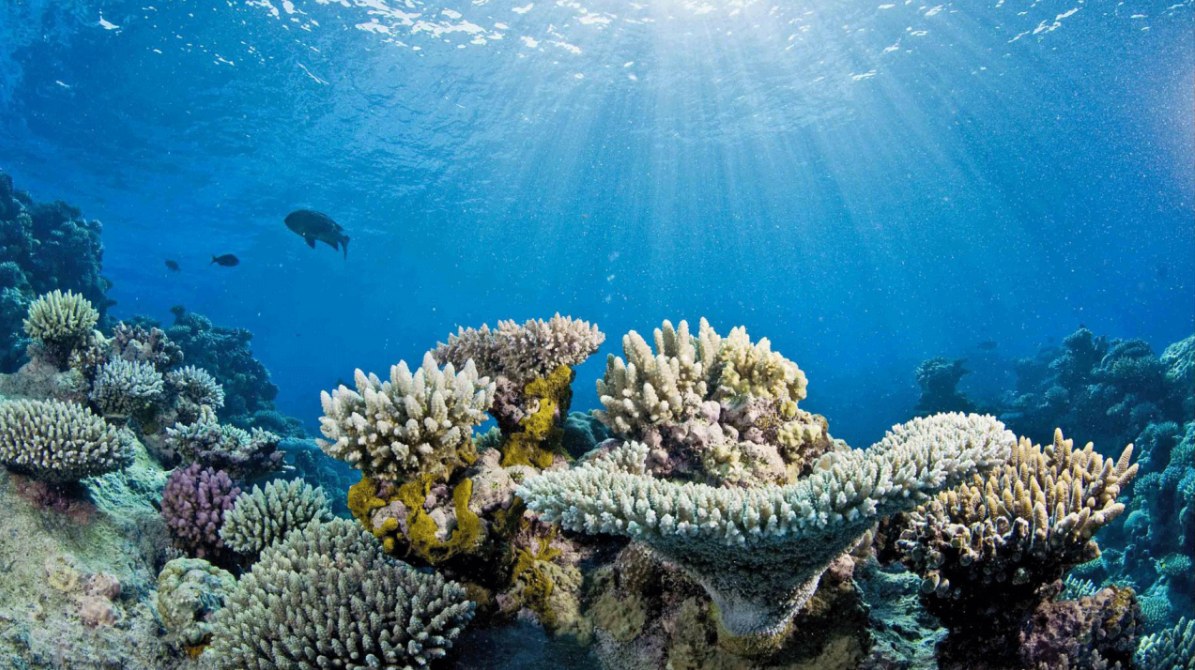 Figure: Bleached brain and staghorn corals at Sombrero Key Reef in the Florida Keys during the summer of 2023; expelling symbiotic algae leaves the white calcium carbonate skeleton fully exposed. Source: Ananda Ellis / NOAA (Public Domain)
That tiny gap of just a few millimeters proved to be the decisive boundary between life and death. All five bleached corals placed in direct physical contact with healthy donors fully regained their rich brownish-yellow pigmentation and physiological vigor within 8 weeks. Conversely, all five isolated pairs, separated by mere millimeters of water, perished after 20 weeks; their bleached skeletal remains became smothered under layers of filamentous turf algae and diatoms (unicellular microalgae with siliceous cell walls). A water gap of just a few millimeters left bleached corals to starve and become overrun by opportunistic turf algae within 20 weeks; only zero-distance physical contact established an inter-colony lifeline.
Tissue Bridges Form Under the Microscope; Symbionts Double Every 4 Days to Retake the Branch
Why does a millimeter-wide gap spell certain doom while physical contact sparks revival? Collins and his team placed the contact zones under microscopic observation. Where the healthy and bleached branches touched, their surface soft tissues actively fused together, constructing a living “tissue bridge”—a shared cellular conduit formed by the merging of epidermal layers from both coral fragments. Symbiotic microalgae residing in the healthy donor crossed this newly formed bridge, migrating directly into the vacant tissues of the bleached recipient.
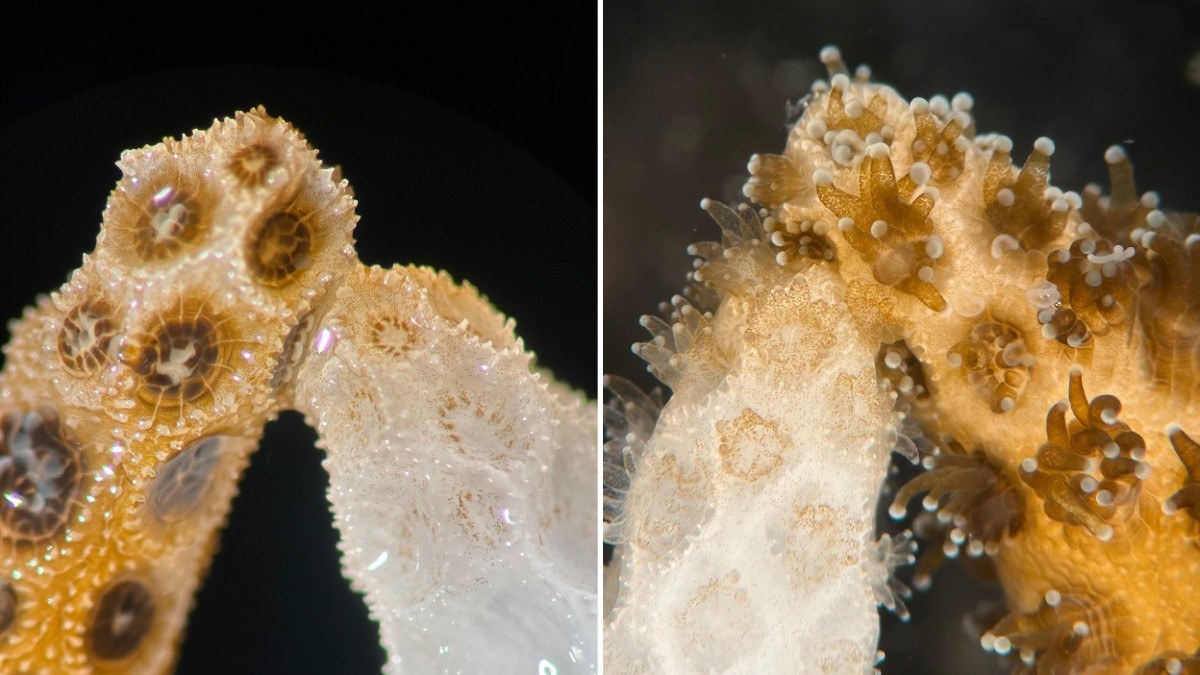 Figure: Composite paper imagery capturing the microscopic early recovery stage; symbiotic algae migrate across a soft-tissue bridge formed by epidermal fusion, moving from the healthy coral into the bleached fragment. Source: Danny Collins (Nature News / Science Advances)
Once the pioneer algal cells settled in across the tissue bridge, the symbiont population inside the bleached coral underwent exponential proliferation. Quantitative monitoring showed that by the second week of contact, the algal density within the bleached fragment was doubling every four days. Even more critical was the threshold duration of contact: bleached corals required just one week of physical contact with a healthy neighbor. Even when researchers separated the pairs after one week and cultured the bleached fragments in isolation, the corals fully recovered using the initial seed population of transferred symbionts. One week of physical contact coupled with a four-day doubling rate is sufficient to pass the symbiotic torch; the hurdle lies in forming that initial tissue bridge, after which autonomous algal division takes over the healing process.
Allorecognition Blocks Cross-Colony Rescue: Clonemate Restriction Constrains Wild Scalability
The ability to ignite recovery with a single week of contact and achieve full restoration in eight weeks immediately caught the eye of coral restoration researchers. Fiorenza Micheli from Stanford’s Center for Ocean Solutions remarked that the study demonstrates the feasibility of rapid, complete coral recovery, offering innovative directions for scalable reef restoration strategies. Yet before these benchtop breakthroughs can be deployed across open ocean ecosystems, a formidable biological rule stands in the way.
Coral tissue fusion relies on histocompatibility. In nature, seamless soft-tissue merging occurs almost exclusively between genetically identical clones (clonemates). If two corals of different species are pressed together, or even two distinct colonies of Pocillopora damicornis originating from different parental genets, their allorecognition systems immediately trigger an immune rejection response. Fusion fails to take place, preventing any tissue bridge from forming and halting symbiont exchange.
This barrier closely mirrors organ transplant rejection in human medicine: without matching genetics, no amount of physical proximity can forge an integrated cellular pipeline. While wave action frequently breaks branches and creates localized clonal clusters on natural reefs, whole reefscapes are typically genetic mosaics composed of diverse individual genotypes. The strict genetic identity requirement restricts the reach of inter-colony rescue; across genetically diverse wild reefs, simply strapping an arbitrary healthy coral to a bleached neighbor will not induce tissue bridging.
A Millimeter Gap Decides Fate: Coral Nurseries Represent the True Proving Ground
Marine biologists once hoped that bleached corals primarily recovered by capturing free-floating microalgae drifting in the ambient water column. The controlled trials by Collins and Palumbi in Science Advances—contrasting the 8-week full recovery of touching pairs against the 20-week mortality of separated controls swarmed by turf algae and diatoms—highlight the extraordinary efficiency of internal tissue bridging. The inability of corals separated by just millimeters to benefit from nearby donors underscores how inefficient ambient symbiont uptake can be; only direct cellular conduits can deliver an algal inoculant potent enough to drive four-day doubling cycles within a single week.
How much practical impact this mechanism can deliver ultimately hinges on how conservationists navigate the clonal genetic bottleneck. Expecting unrelated wild corals to spontaneously bridge and rescue one another across open ocean reefs is biologically unrealistic. In land-based and ocean nursery operations, however, practitioners routinely fragment identical parent genets into hundreds of clonal micro-fragments for propagation. When marine heatwaves strike and trigger localized bleaching, nursery managers can physically pair bleached fragments with archived, healthy clonemates for a single week. This intervention operates entirely within the biological constraints of the phenomenon. Coral bleaching represents a starvation crisis rather than an irreversible death sentence, and tissue bridges can reverse that famine within eight weeks; yet the scalability of this miracle remains tethered to clonal genetics, and translating lab success to seafloor restoration requires navigating the boundary of genetic compatibility.
References:
- Nature: ‘Incredible’: bleached corals thrive within days when touching healthy neighbour
- Science Advances: Rapid coral bleaching recovery via symbiont transfer from healthy corals
- Hacker News Discussion