Dumping an entire codebase or a dozen textbooks into a single prompt was long the ultimate fantasy of software engineers. Even when models technically advertised million-token windows, staggering VRAM footprints and compute bills drained budgets within minutes. DeepSeek has now released model weights for DeepSeek-V4.1-Flash-1017 on Hugging Face under the MIT license. This 763B-parameter behemoth stretches context length to 1 million tokens (the fundamental parsing unit of text processing, roughly equivalent to 750,000 to 1,000,000 words). Its accompanying technical report lays its primary ambition bare right in the title: DeepSeek-V4.1-Flash: Pushing the Limits of KV Cache Compression.
When AI labs unveil new architectures, the spotlight almost invariably falls on benchmark breakthroughs that claim to surpass human doctorates. This time, DeepSeek gave front-page billing to the unglamorous plumbing of cache compression. The core breakthrough of this release lies in driving down the operating cost of long-context inference: KV cache compression turns 1-million-token inputs from costly museum exhibits into pragmatic daily tools, shifting the developer’s bottleneck from context window size to cost management and engineering discipline.
 Figure: DeepSeek brand logo from the official repository; the newly released V4.1-Flash-1017 continues under the permissive MIT open-source license. Source: DeepSeek official GitHub repository
Squeezing KV Cache to the Limit: Fitting 1 Million Tokens into Standard VRAM
Why is processing long contexts so expensive for large language models? When a human reads a book, turning a page leaves only a general impression in memory. When an LLM generates a new word, however, it must keep the internal representations computed across hundreds of thousands of prior tokens directly inside GPU memory for cross-attention. This dedicated slice of VRAM reserved for memorizing conversational history is known as the KV cache (key-value cache; the intermediate states models store during inference to track prior context).
As conversations swell from several thousand words to 1 million tokens, the VRAM consumed by the KV cache balloons exponentially. Before the graphics card can even begin emitting new tokens, shuffling this mountain of historical cache across memory buses completely saturates hardware bandwidth. Many models advertising million-token capabilities crawl to a snail’s pace in practice or run up eye-watering single-request bills. Physical limits remain unyielding: without shrinking intermediate state footprints, ultra-long contexts remain trapped in pitch decks.
Despite its massive 763B total parameters, DeepSeek-V4.1-Flash-1017 trains its heaviest firepower directly on this memory wall. Its technical paper zeroes in on the theoretical limits of KV cache compression, while the official model card provides four precision formats: BF16, F32, F8_E4M3, and I8. Compressing KV cache sizes alongside low-precision weights slims down the memory overhead of a 1-million-token memory stream. Workloads that once demanded multi-million-dollar clusters now rest on a practical physical foundation for routine, high-frequency execution.
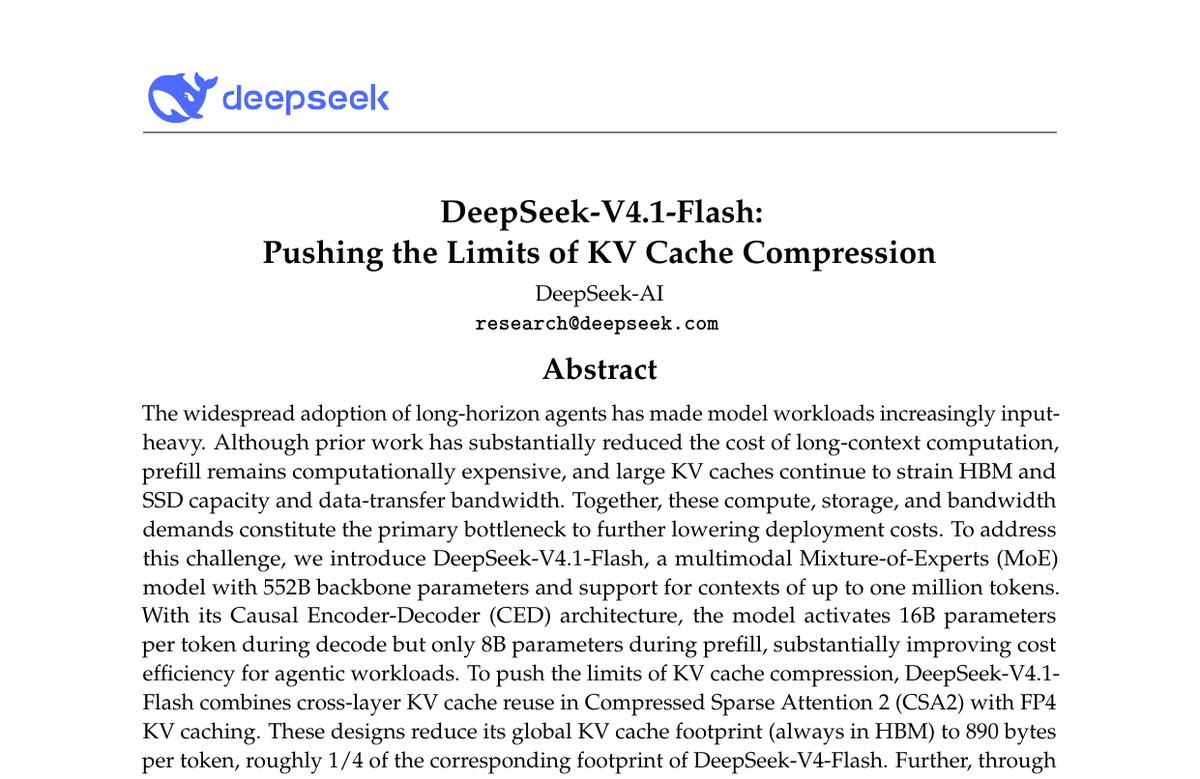 Figure: The technical report cover directly highlights “Pushing the Limits of KV Cache Compression,” underscoring the engineering goal of slashing long-context inference costs. Source: DeepSeek-V4.1-Flash technical report (Pushing the Limits of KV Cache Compression)
Terminal Benchmarks Jump 11.1 Points: Trimming Cache Frees Room for Iterative Debugging
Does relentless focus on compression and cost undermine model intelligence? Comparing benchmark scores on the official Hugging Face model card against prior releases (DS-V4.1-Flash, K3, GLM-5.3, GPT-5.6 Sol, and the closed-source benchmark Opus 5) reveals clear architectural priorities. On Humanity’s Last Exam (HLE) without external tools, the model scores 42.6 points, trailing Opus 5’s 56.3. On ProgramBench, which tests algorithmic coding, the model climbs from 20.3 to 29.1, still behind Opus 5’s 37.0.
Shift the benchmark setting to real-world engineering tasks requiring multi-turn tool interaction across long horizons, however, and the tables turn. On Terminal-Bench 4.0—using Claude Code as the execution framework—the model surges from 31.2 to 42.3 points. This 11.1-point leap closes the gap dramatically on Opus 5’s 51.8. On DeepSWE v1.1, a software engineering benchmark built on the Mini-SWE-V2 framework, scores climb from 74.2 to 77.0. In the Agents’ Last Exam test, the new model clocks in at 35.4 points, outright overtaking GPT-5.6 Sol’s 26.7.
Elsewhere, it registers 68.2 on NL2Repo-Bench for repository synthesis, 60.5 on Automation-Bench v1.0.6, and 72.1 on Apex Bench v1.1. On tool-assisted evaluations Chartography and BabyVision, it posts 83.0 and 92.5 respectively. Why do these tool-heavy, terminal-driven repository benchmarks show such dramatic gains? Because autonomous coding agents mirror human developers debugging issues: they run cycle after cycle reading error logs, parsing legacy source files, and executing shell commands. With every iteration, the context doubles. While closed-source flagships retain an edge in single-turn raw reasoning, inexpensive KV caching empowers open-source models to outlast difficult engineering bugs through high-frequency trial and error.
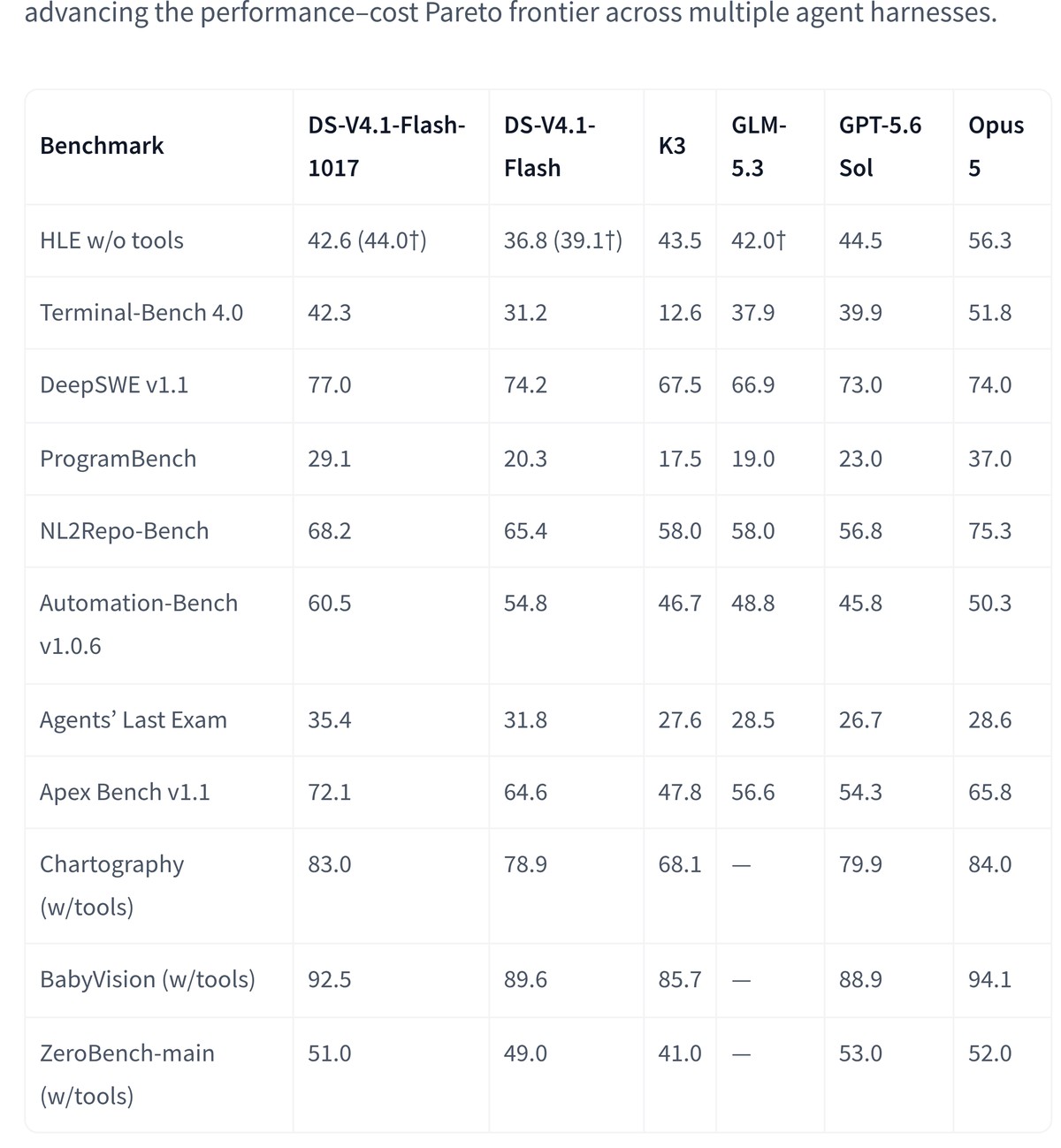 Figure: Official benchmark comparison from the model card, comparing V4.1-Flash-1017 with predecessors, K3, GLM-5.3, GPT-5.6 Sol, and Opus 5. Source: Hugging Face Model Card (DeepSeek-V4.1-Flash-1017)
Dropping Jinja Templates: 19 Community Quantizations Power Real-World Deployment
To ensure stable tool calls across ultra-long multi-turn sessions, DeepSeek executed a decisive interface simplification. Open-source models typically bundle Jinja chat templates—scripts that use text placeholders to concatenate multi-turn conversations into raw prompt strings. When prompts mix dozens of tool executions with voluminous source code, simple string concatenation frequently suffers from formatting drift. DeepSeek omitted Jinja templates entirely, delivering an official encoding reference implementation designed to translate Messages, Chat Completions, and Responses formats cleanly into native Conversation structures.
The model card also includes an intriguing sampling recommendation: setting both temperature (which regulates randomness) and top_p (nucleus sampling cutoff) to 1.0. Developers accustomed to clamping temperature down for deterministic outputs might find this counterintuitive. In long-horizon environments, however, preserving native probability distributions grants agents the exploratory flexibility needed to break out of dead ends during complex terminal debugging.
The broader ecosystem responded immediately. While DeepSeek refrained from hosting official hosted inference endpoints on the Hugging Face model page, the community promptly contributed 3 fine-tunes and 19 quantized variations (shrinking model sizes via lowered numerical precision for affordable consumer GPUs). DeepSeek closed long-context format vulnerabilities with robust encoding logic, while the open-source community mobilized 19 quantizations to bridge deployment compute. A viable, budget-friendly deployment pipeline is already running.
Burning Through $20 Subscriptions in Minutes: Engineering Discipline Governs the Bill
With 1-million-token contexts and compressed KV caches in hand, developer discussions quickly pivoted from “can it fit?” to “how long will the wallet last?” Across developer forums, chatter centered almost exclusively on unit economics. Multiple practitioners noted that feeding whole code repositories into iterative agent loops can exhaust a standard $20 monthly subscription tier in just minutes of continuous execution. Direct token-metered APIs, paying strictly for consumed resources, often prove significantly more manageable.
Expanding windows and cheaper unit costs have also surfaced subtle hidden expenses. Experienced engineers highlight that even when models notch 77.0 on DeepSWE v1.1 and patch bugs in terminal shells, the generated code often introduces redundant patterns and untested edge cases. Senior developers still spend billable hours reviewing code line by line, an engineering cost that remains non-negotiable. When windows capped out at a few thousand tokens, developers carefully curated relevant snippets. With 1M tokens on tap, many fall into the habit of dumping entire repos and vague requirements wholesale into the prompt.
Conservation laws apply to software engineering: whatever effort models save you during prompt drafting will be claimed back on infrastructure invoices and code reviews. DeepSeek-V4.1-Flash-1017 uses 763B parameters and breakthrough KV cache compression to demolish the context window wall, but it doesn’t offer a free lunch. KV cache compression elevates 1 million tokens from a lavish compute demo into everyday utility. When context limits disappear, the real winners will be those who curb reckless context dumping and enforce strict code review hygiene.
Reference Links:
- Hugging Face Model Card: DeepSeek-V4.1-Flash-1017
- DeepSeek-V4.1-Flash Technical Report (Pushing the Limits of KV Cache Compression)
- Hacker News Discussion