Zero Changes to the Recipe, Terminal-Bench Jumps 11.1 Points
On October 17, 2026, DeepSeek released weights for the V4.1-Flash-1017 snapshot. As explicitly stated in its accompanying technical report, the update introduced zero algorithmic changes—the optimization recipe was left completely untouched. Yet on Terminal-Bench 4.0, which evaluates real-world CLI and terminal operations, this minor iteration saw its score jump from 31.2 to 42.3.
An 11.1-point leap fundamentally shifted the competitive landscape. Within the same test suite, Claude Opus 5 still maintained leads on Terminal-Bench 4.0, ProgramBench, NL2Repo, and HLE; meanwhile, the 1017 snapshot overtook it across DeepSWE v1.1, Automation-Bench, Agents’ Last Exam, and Apex Bench. Remarkably, every fraction of that 11-point gain occurred without modifying a single line of training algorithm code.
DeepSeek described this release as “Wish-Driven Coding,” geared heavily toward end-to-end software engineering workflows. Showcase demos ranged from 3D modeling of the Forbidden City and web-based racing games to recreating classic games in Godot. Compared with prior iterations, the new model completes tasks faster and outputs significantly fewer tokens. Pruning redundant verbosity directly slashes accumulated latency across multi-turn interactions.
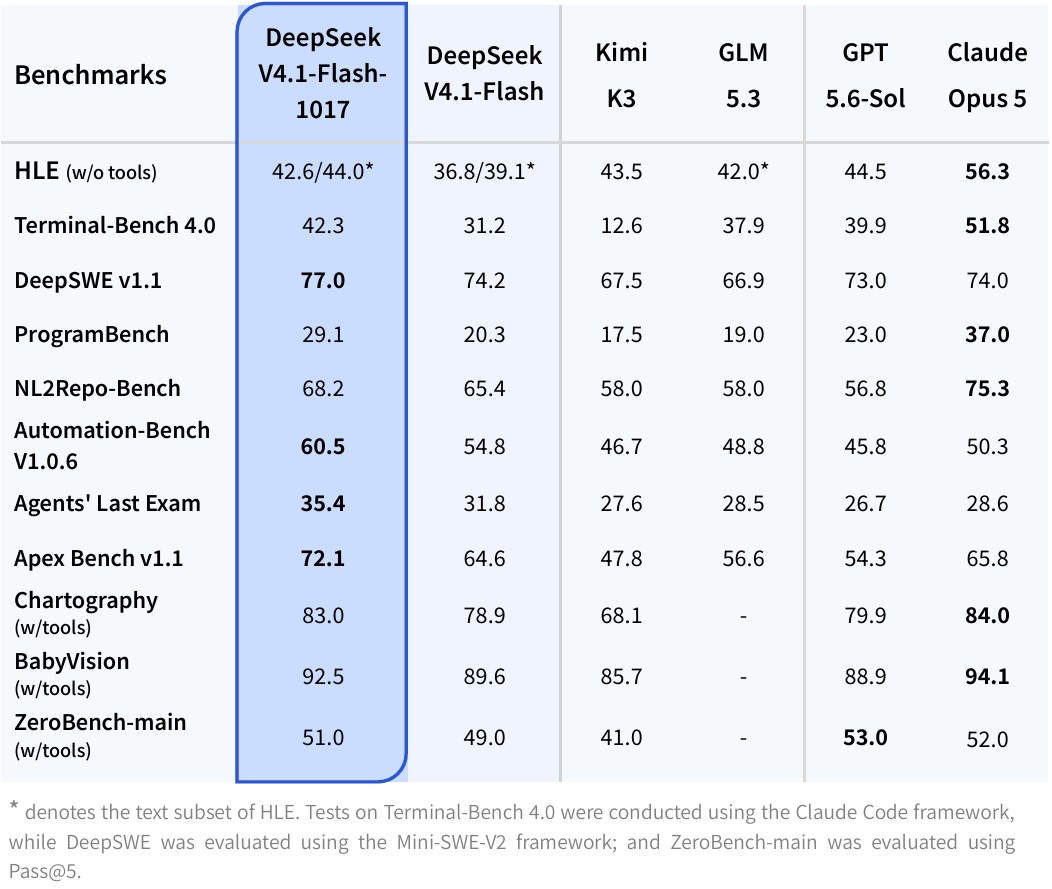 Figure: Official benchmark comparison table showing delta gains for the 1017 snapshot over the previous release. Source: DeepSeek official release announcement
Other agent benchmarks charted a similar upward trajectory. Evaluated inside the Claude Code environment, DeepSWE v1.1 resolve rates rose from 74.2% to 77.0%. ProgramBench climbed from 20.3 to 29.1, while Apex Bench v1.1 advanced from 64.6 to 72.1. The performance ceiling for automated software engineering benchmarks continues to rise.
Marginal Returns Shift to Environment Pipelines: Synthetic Tasks Fuel Long-Horizon Reasoning
Section 5.1 of the technical report outlines the engineering focus behind the benchmark surge. Post-training adhered strictly to standard pipelines of supervised fine-tuning (SFT), reinforcement learning (RL), and on-policy distillation. Instead of reinventing algorithms, the team redirected compute budgets into procedural task generation and synthetic interactive environments.
The report highlights a clear deduction: at this stage, marginal returns from data curation and environment pipelines far outpace algorithmic innovations. Static, human-labeled datasets quickly encounter diminishing returns in complex, multi-turn tool interactions. Terminal operations demand robust state rollbacks and error recovery, which can only be scaled through programmatic synthesis.
DeepSeek established automated pipelines to systematically generate diverse, verifiable execution environments. Every synthetic task undergoes strict deduplication, filtering, and difficulty calibration. Ground-truth verifiability provides RL agents with dense, reliable reward signals, effectively preventing reward-hacking exploits during policy exploration.
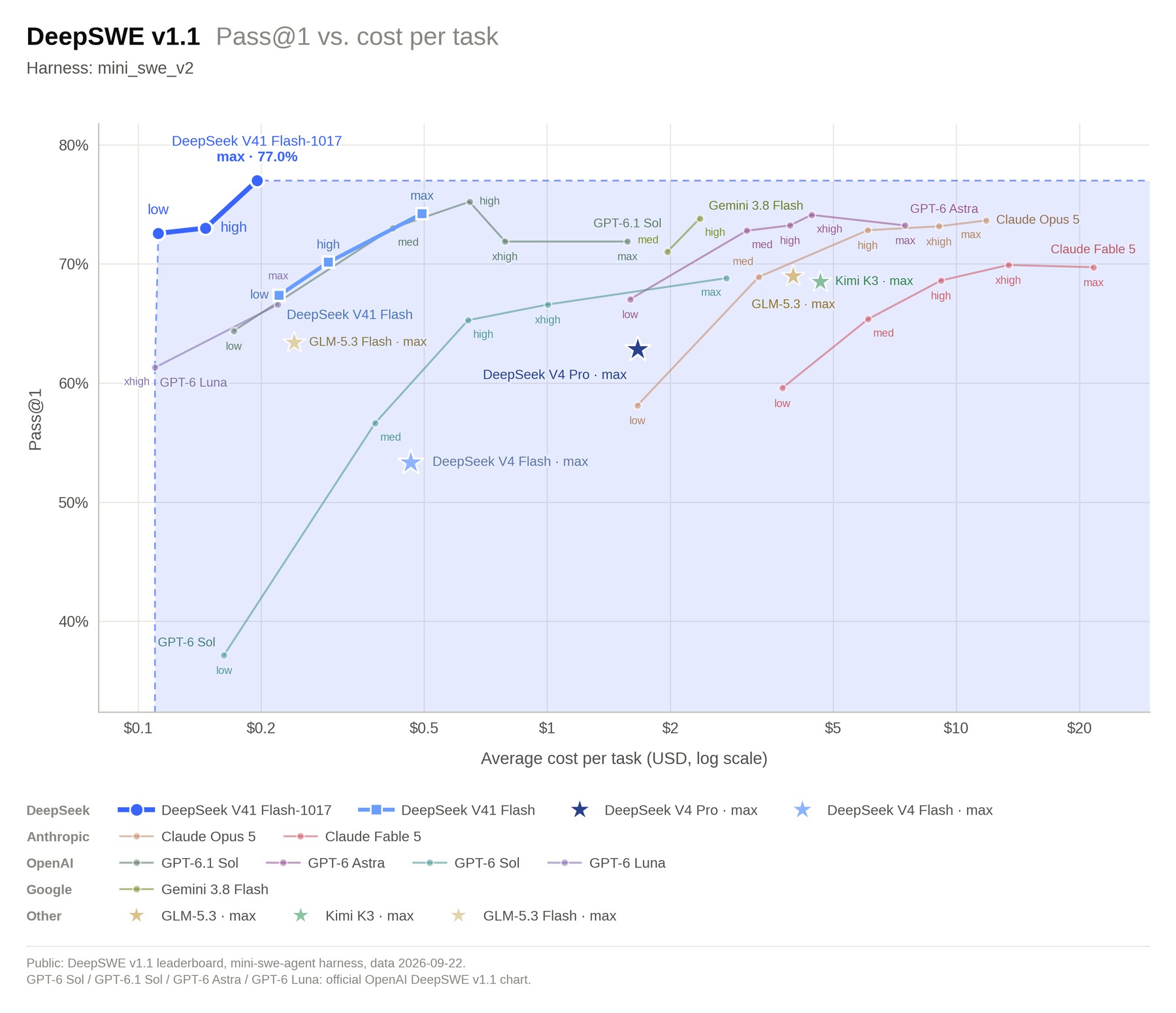 Figure: Official performance vs. cost curve illustrating per-task compute expense against DeepSWE v1.1 Pass@1. Source: DeepSeek official release announcement
Multimodal benchmarks corroborate the efficacy of this environment-centric approach. On Chartography with external tool calling, the score rose from 78.9 to 83.0. BabyVision increased from 89.6 to 92.5, and ZeroBench-main nudged forward from 49.0 to 51.0. Capability gains unlocked through authentic environment interactions spilled directly over into cross-modal perception tasks.
Squeezed to 890 Bytes per Token: KV Cache Establishes a Floor on Operating Costs
Agentic inference demands voracious amounts of context. Multi-turn tool execution constantly inflates conversation history, making VRAM bandwidth the first bottleneck to saturate. For long context to become the default standard, unit cache expenses must be driven into the floor.
The architecture of V4.1-Flash provides the underlying hardware support. Built on a causal encoder-decoder structure spanning 552B total parameters, the model ingested 45T multimodal tokens during pre-training. During inference, decoding activates 16B parameters, while prefill activates just 8B. Lightweight prefill dramatically cuts time-to-first-token (TTFT).
The physical breakthrough stems from combining CSA2 attention compression with FP4 caching. Layer-level reuse compresses global KV cache footprint to a mere 890 bytes per token. This footprint is one-fourth that of V4-Flash and a staggering 1/437th of the first-generation architecture.
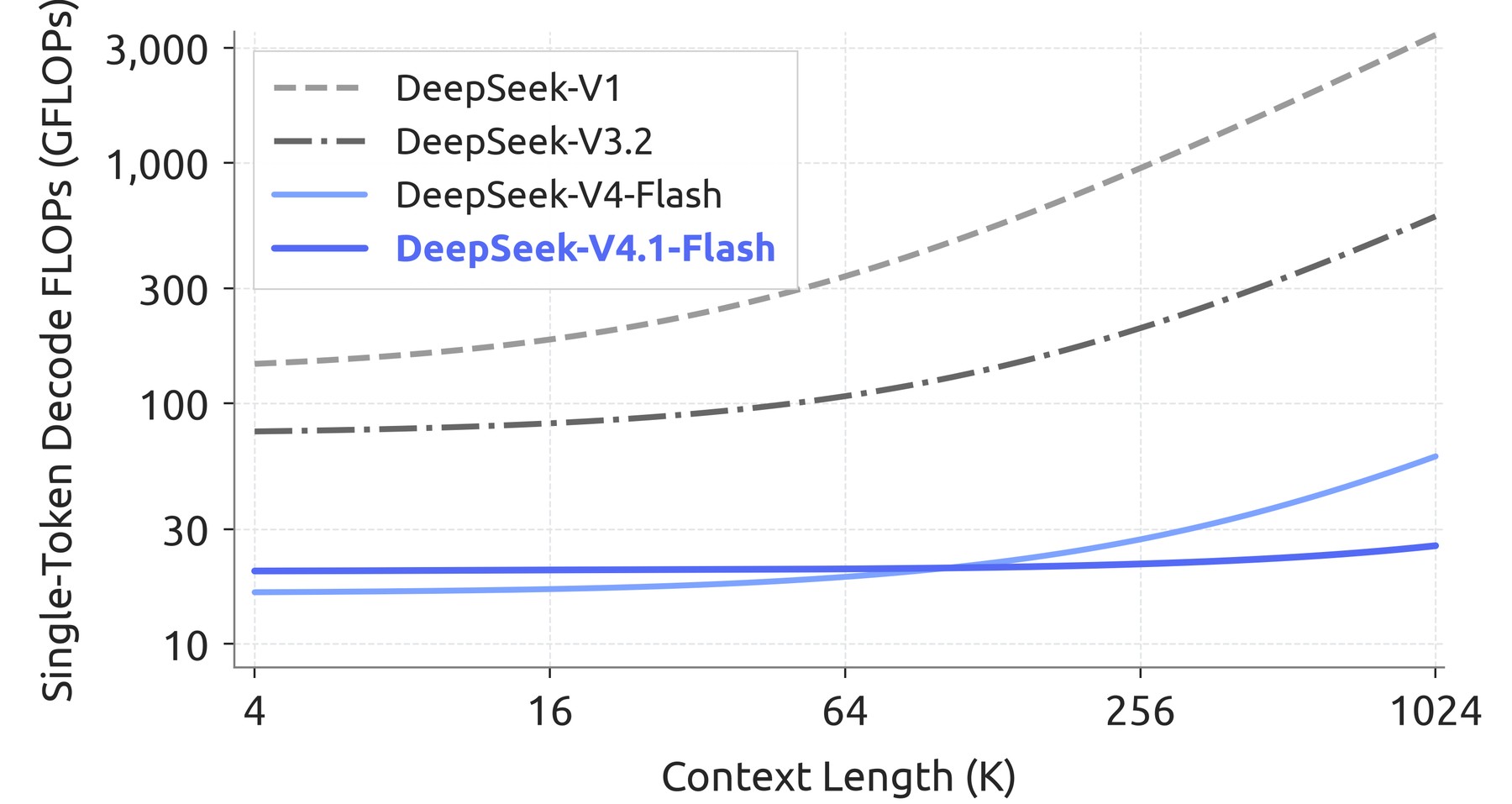 Figure: Compute FLOPs required for single-token decoding as context length scales up to 1M tokens. Source: DeepSeek-V4.1-Flash Technical Report
Paired with a sliding-window attention boundary replay mechanism, persistent caching demands dropped to one-eighth of the previous generation. The compute curve remains similarly flat: scaling context by 256x from 4K to 1M tokens increases single-token decoding FLOPs by merely 25%. Long context has officially transitioned from an expensive luxury into an everyday default.
Deprecating Jinja Templates: Engineering Rigor Yields to Automated Protocols
Cratering inference costs are forcing rapid evolution across the upstream developer toolchain. On the OpenRouter hosting platform, input pricing is set at $0.10 per million tokens. Output pricing stays at $0.50 per million, while cache reads plummet to an ultra-low $0.002 per million tokens.
DeepSeek concurrently opened access to its proprietary Search and Fetch APIs. Supporting hundreds of millions of external queries daily, endpoint calls are priced at $0.75 per thousand invocations. Across official tools and mainstream coding assistants, access remains free of charge through October 31, 2026. Cheap retrieval effectively liberates autonomous agents from static pre-training cutoffs.
Notably, this snapshot completely abandons traditional Jinja template files. The team instead ships a self-contained Python reference implementation alongside a native Rust library with Python bindings. The parser natively handles multi-turn dialogues, Chain-of-Thought (CoT) flows, mid-generation system prompts, and interleaved image-text formatting. Handling syntax at the engine layer eliminates prompt formatting drift entirely.
Recommended sampling parameters signal a clear philosophy: both temperature and Top-P are set to 1.0, with maximum output sequence lengths required to be no less than 256K tokens. Across million-token spans, models must strictly uphold long-range behavioral constraints. Structured communication libraries permanently remove parsing vulnerabilities that historically plagued template-based tool calling.
Interactive Environments Mark the New Frontier: Benchmark Battles Return to Engineering Throughput
The message from the 1017 snapshot is unmistakable: algorithmic optimization yields diminishing returns, whereas scaling verifiable execution environments and calibrating synthetic pipelines can deliver double-digit benchmark jumps on their own.
Meanwhile, an 890-byte cache footprint builds the foundational bedrock for scalable deployment. Only when read and write costs drop to near-zero does high-frequency trial-and-error become economically viable. The open-source battleground has shifted from raw parameter weights to environment pipelines and hardware-software co-design: whoever can continuously supply verifiable worlds at scale for minimal cost will claim the next frontier of intelligence.
References:
- DeepSeek-V4.1-Flash-1017 Official Release Announcement and Open-Source Model Weights
- DeepSeek-V4.1-Flash Technical Report: Pushing the Limits of KV Cache Compression
- Terminal-Bench 4.0 and DeepSWE v1.1 Benchmark Technical Specifications
- Hacker News Community Technical Discussion