On August 13, 2026, DeepSeek released its new model, V4 Pro 0813. The “0813” in its name marks today’s date.
On the exact same day, Alibaba launched Qwen3.8-max, and Elon Musk’s xAI released Grok 4.6. Having three top-tier AI companies roll out major updates within 24 hours would have been unimaginable just two years ago.
A developer (Hacker News user jklmnopqrstuvw) ran the exact same software engineering task through both DeepSeek and Grok. The results were striking:
- DeepSeek V4 Pro: Took 12 minutes 02 seconds, cost $0.12, but introduced a bug in the code.
- Grok 4.6: Took 3 minutes 18 seconds, cost $1.41, with clean, flawless code.
A 12x difference in price, paired with a noticeable tier difference in code quality. This snapshot perfectly illustrates the real-world trade-offs in today’s AI ecosystem.
How Is It This Cheap?
The root of this extreme cost efficiency lies in its architecture. DeepSeek relies on MoE—Mixture of Experts.
To put it simply: a conventional dense model functions like a company where every single employee works on every task. An MoE model operates like an organization maintaining hundreds of specialized experts, summoning only the few relevant specialists when a request arrives. While the overall parameter scale is massive, only a fraction of the network is active per query. Fewer active parameters translate to lower power consumption and drastically reduced compute costs.
V4 Pro 0813 also supports a 1-million-token context window (the volume of text the model can process at once). To put that into perspective, it’s roughly enough to ingest the entire Three-Body Problem trilogy in one go before answering your question. From an engineering standpoint, reading an entire book before responding was a privilege reserved for elite flagship models just two years ago.
VC subsidies cannot sustain prices like this. The savings stem directly from architectural design—a structural advantage rather than a temporary marketing promotion.
The second tier of cost reduction comes from prompt caching (reusing previous computation results). According to OpenRouter telemetry, 92.4% of DeepSeek’s input requests hit the cache—reusing results already computed for previous queries.
The financial impact is astonishing: while the list price is set at $0.435 per million input tokens (the smallest unit of AI billing), the average price users actually paid was just $0.036 per million tokens. That represents another 12x gap between the nominal sticker price and actual expenditure.
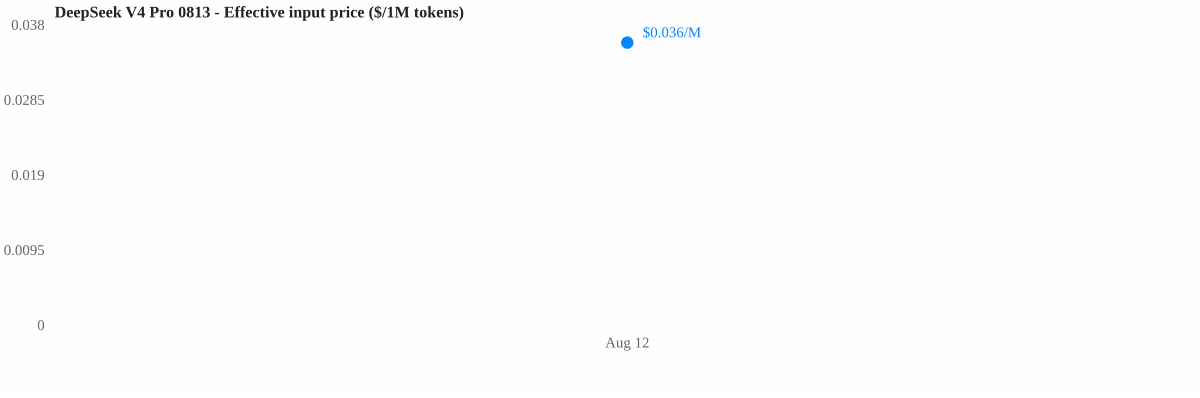
Chart: Actual paid input price for DeepSeek V4 Pro 0813 on OpenRouter, hovering near $0.036/M tokens on launch day. Source: openrouter.ai
Think of it like a food delivery kitchen: cooking a dish for the first time requires full effort, but reheating a pre-made meal takes seconds with near-zero marginal cost. In engineering terms, a 92.4% cache hit rate means most input requests are virtually free, revealing the secret behind their gross margin dynamics.
The third driver of low cost is open source. DeepSeek released the model weights completely, under a license that permits commercial use. A user calculated that spending $8,000 to buy two DGX Spark units enables running the full model locally at home. Open source shifts pricing power back to users: if cloud providers raise prices, developers can simply self-host.
A Release Cadence Like a CI Pipeline
Flash 0731 on July 31, Flash 0801 on August 1, and V4 Pro 0813 on August 13. The version names directly embed dates, with intervals measured in days.
Software engineers compare this rapid cycle to a CI (continuous integration) pipeline—where code changes trigger automated testing and deployment in a continuous stream. While traditional software vendors release major updates once a year, DeepSeek has turned model releases into a daily routine.
Discussions on Hacker News echo this sentiment. One user commented that “most workloads don’t need top-tier models anyway,” while others noted they were already using cheap models for heavy tasks, calling them “so cheap they feel virtually free.” Another user calculated the geometric mean score of leading models across benchmarks: GPT-5.6 Sol scored 65.5, Opus 5 scored 64.0, and DeepSeek V4 Pro 0813 achieved 62.5.
The engineering takeaway: the performance gap among top models has compressed from a “generational leap” down to a “few percentage points,” yet the price gap remains orders of magnitude wide. While performance parity is only a matter of time, the price advantage is already a reality today.
“China Time” on the Same Day
Alibaba’s Qwen3.8-max is priced at $2.00 per million input tokens and $6.00 per million output tokens, compared to DeepSeek’s $0.435 input and $0.87 output. Domestic Chinese model providers are competing aggressively on price among themselves, steadily pulling down the price anchor for the entire market.
Looking at all three releases together: Qwen3.8-max is a heavyweight 2-trillion parameter behemoth, Grok 4.6 prioritizes execution speed, and DeepSeek focuses on raw cost-efficiency. Each company played a different hand, yet all launched in the exact same week. At this level of competitive density, end users are the ultimate beneficiaries.
Some commentators suggested DeepSeek intentionally scheduled its launch on the same day to steal Qwen’s thunder, while others countered that xAI launched Grok 4.6 on the same day as well, indicating companies may simply be following their internal shipping cadence.
Regardless of motives, the center stage for frontier AI releases is no longer exclusive to Silicon Valley. That signal matters far more than any single model update.
The Flip Side of Cheap: How Does Quality Stack Up?
The empirical test shared by the developer sparked a heated debate in the comments.
Proponents argued that because the developer had repeated similar benchmarks over several months with consistent pass/fail results, the single-run outcome was trustworthy. Critics (such as user bigmadshoe) countered that an n=1 comparison is far from scientific and represents mere “vibes”—given the inherent stochasticity of LLMs, a single test run should not alter one’s judgment. Others added that simply re-prompting or re-running a failed attempt often resolves the bug.
Our take: both sides hold valid points. The cost advantage is structural—derived from architecture, prompt caching, and open-source availability, holding true across repeated runs. In contrast, the code quality gap observed in a single sample is a data point—a bug in a single run could well be attributed to variance or luck. Conflating a structural cost advantage with single-sample noise leads to unreliable conclusions.
To truly evaluate performance, one must run the exact same task suite across dozens of iterations to compute mean pass rates and variance. Some users in the comment section suggested running each model five times per task—a recommendation we strongly agree with.
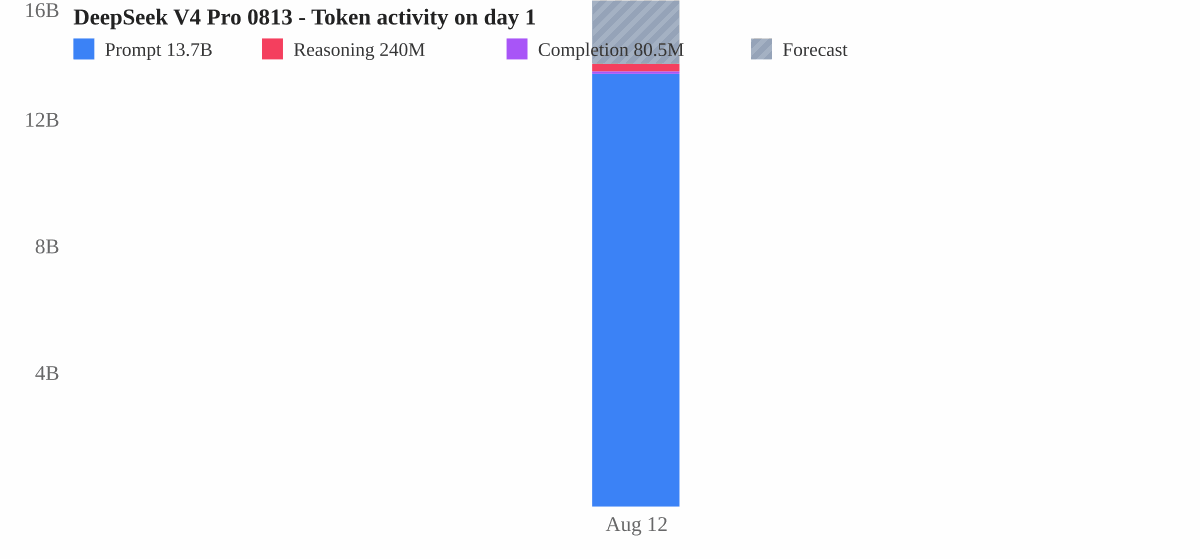
Chart: DeepSeek V4 Pro 0813 token usage on launch day: 13.7B input tokens, 80.5M output tokens. Source: openrouter.ai
There is another notable detail: some users noticed that DeepSeek officially began raising prices later that day. The low pricing might be a temporary phase—a classic tech playbook of capturing market share at low prices before raising rates. However, even with price adjustments, the price gap compared to equivalent US models remains multiple orders of magnitude wide.
What Does This Mean for Everyday Users?
Two years ago, top-tier AI was billed per interaction, costing several dollars per conversation. Today, $0.12 buys 12 continuous minutes of AI agent work.
For individuals, this means the AI assistants, writing tools, and translation software on your phone may be powered by newly released open models, costing a fraction of what they did a year ago. For businesses, integrating AI has shifted from a process requiring multi-layer budget approvals to a “try it first and see” decision—where the cost of experimentation is practically negligible.
The ongoing price war is transforming AI from a “luxury good” into a basic “utility.” You might pass on a tool because it’s too expensive, but you won’t miss out on an era when it becomes this cheap. Affordability enables accessibility—and for anyone looking to build with AI, that is unequivocally good news.
Reference Links:
- OpenRouter: DeepSeek V4 Pro 0813
- HN Discussion (item?id=49274600)
Image Note: The original OpenRouter page contained no inline image tags; all page images consisted of logos and favicons (openrouter.ai/brand/v2/nav-lockup-light.png, nav-lockup-dark.png, images/icons/DeepSeek.png, gstatic faviconV2 series, openrouter-dark.svg, openrouter-light.svg), which have been filtered out. The two data charts in this article were exported and converted from embedded SVG charts (recharts) on the page.