Bouncing Pinballs and the Un-trappable Quantum Wave
Imagine playing pool on a table packed with hundreds of randomly placed obstacles. If you strike a steel ball, it bounces repeatedly between the barriers. When the layout of obstacles is extremely complex, the steel ball often gets trapped in a tiny gap after a few collisions, unable to escape. In everyday classical physics, the more complex the geometry, the easier an object gets trapped in a dead end.
On August 12, 2026, Quanta Magazine reported a major breakthrough published in top mathematics journal Annals of Mathematics: 25-year-old MIT doctoral student Alex Cohen proved the fractal uncertainty principle (FUP) in higher dimensions—a mathematical theorem describing how quantum waves inevitably leak and diffuse across complex geometric paths.
This research arrives at a counter-intuitive conclusion: microscopic quantum waves never get trapped in geometric dead ends like classical pinballs. Even if a path is designed as an infinitely complex geometric maze, quantum waves are guaranteed to leak and spread out. The proof of the higher-dimensional fractal uncertainty principle reveals that quantum particles are more orderly in infinite chaos than classical objects.
Infinitely Magnified Mazes: What Exactly Is a Fractal?
To understand quantum wave motion, one must first grasp the peculiar structure of fractals—geometric shapes whose internal details and complexity remain unchanged no matter how much they are magnified. In nature, snowflake edges and coastlines exhibit fractal characteristics: looking at a small segment under a magnifying glass reveals a jaggedness nearly identical to the view from high above.
In mathematics, the classic fractal is the Cantor set (a fragmented point set created by repeatedly removing the middle third of line segments). If you punch increasingly fine square holes inside a square, you get the Sierpinski carpet (a planar fractal filled with infinite tiny perforations). Such geometric shapes are dense with holes, and their actual volume approaches zero in mathematical calculations.
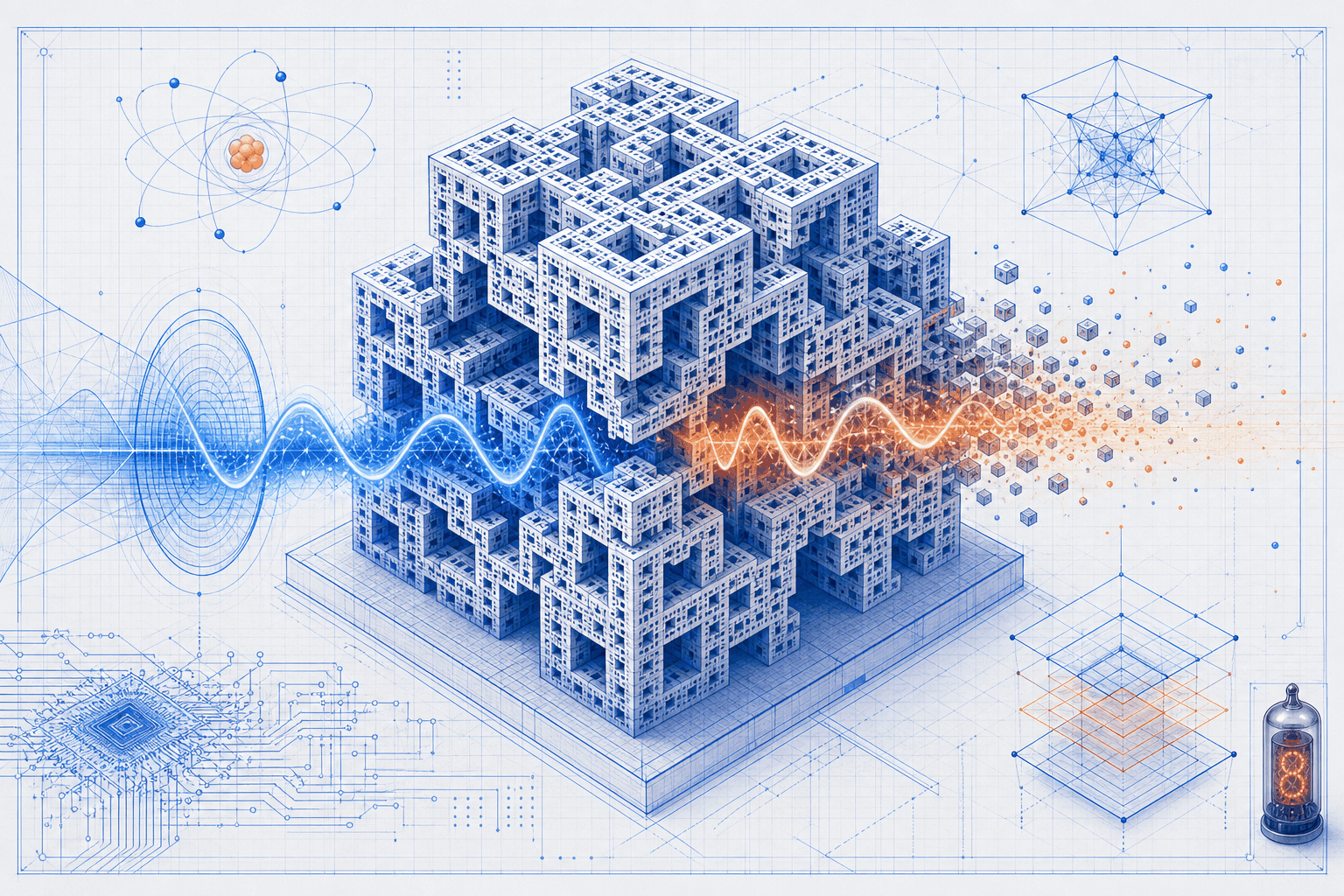
 Figure: Visual depiction of fractal structure and quantum wave diffusion. Source: Ada Zejun Shen/Quanta Magazine
Mathematically, the total length of the Cantor set converges to zero, yet the number of points in it is as vast as the entire original line segment. This structure is analogous to cutting away 99% of the fibers from a piece of cloth while the remaining empty frame still spans the entire space. When microscopic particles encounter such hole-riddled geometric grids, classical and quantum physics diverge completely.
Why Pinballs Get Stuck While Quantum Waves Leak
When classical billiard balls collide inside a chaotic system, their impact points form trajectories in space that condense into fractal dust (infinitely fine point sets formed locally by collision trajectories). Because a pinball is a solid particle, as long as it collides along specific angles, it will be confined inside the dead ends formed by fractal dust without any way out.
Microscopic particles exhibit wave-particle duality and are governed by a wave function. Measuring microscopic particles must conform to the uncertainty principle (a fundamental law in quantum mechanics stating that a particle’s position and momentum cannot be measured simultaneously with arbitrary precision). The mathematical foundation of the uncertainty principle relies on the Fourier transform (a mathematical tool that breaks complex waves into single-frequency waves).
If you trap sound inside a box perforated with fine slits, the sound will inevitably leak through the gaps. The Fourier transform mathematically proves that if a wave’s spatial position is restricted to extremely narrow fractal holes, its frequency and momentum are infinitely stretched. Quantum waves cannot be confined to zero-volume fractal skeletons; energy inevitably diffuses outward.
Secret Notes from a Passed Master: A 25-Year-Old Student’s Breakthrough
Back in 2016, MIT mathematician Semyon Dyatlov and the late Fields Medalist Jean Bourgain proved the fractal uncertainty principle for one-dimensional space. However, in two dimensions and higher, the mathematical community widely believed a proof would be extraordinarily difficult. Sorbonne University mathematician Frédéric Naud recalled attending a workshop in New Jersey where virtually no one believed the principle could ever be extended to higher dimensions.
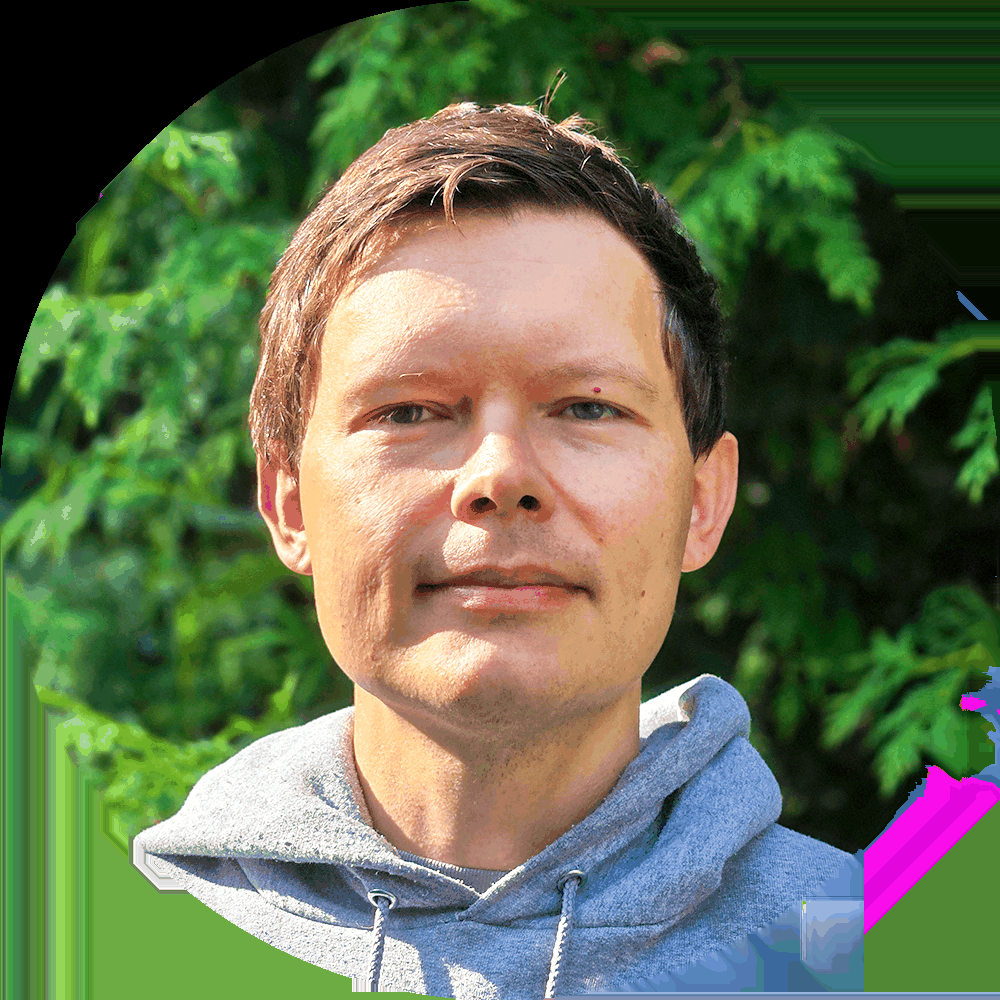 Figure: Mathematician Semyon Dyatlov. Source: Xuwen Zhu
The crucial turning point occurred after Bourgain passed away in late 2018, leaving behind unpublished manuscript notes. Dyatlov passed these notes to Alex Cohen, who had just entered graduate school. Cohen was profoundly struck by the manuscript. The suggested entry point in the notes was the Beurling-Malliavin theorem, formulated in the 1960s—a theorem in harmonic analysis studying function decay rates and Fourier transform properties.
 Figure: Mathematician Alex Cohen. Source: Hertz Foundation
Most senior researchers had previously attempted this route and concluded it was a dead end. Unaware of his predecessors’ setbacks, Cohen tackled the problem with immense confidence. The major obstacle in higher dimensions was that certain higher-dimensional fractals could contain continuous straight lines—and the Fourier transform of a line remains a line, breaking the conditions for the uncertainty principle. Cohen introduced “line porosity” (a geometric filtering condition ensuring no direction contains an entire straight line), successfully excluding fractals that violated the conditions. After uploading the proof to the arXiv preprint server in May 2023, Cohen’s paper was formally published in Annals of Mathematics in 2025, landing him an assistant professor position at New York University at age 25.
Monet’s Masterpiece in the Quantum Realm: Waves Diffusing Everywhere
The breakthrough in the higher-dimensional fractal uncertainty principle quickly sent ripples across other domains of physics and mathematics. In 2017, Dyatlov and Tsinghua University scholar Long Jin had used the 1D theorem to prove that waves can never be trapped on hyperbolic surfaces. In 2025, Harvard scholar Elena Kim and University of Oklahoma scholar Nicholas Miller drew on Cohen’s higher-dimensional result to extend this conclusion to higher-dimensional hyperbolic spaces. Peter Sarnak of the Institute for Advanced Study in Princeton called it the most spectacular practical application of the higher-dimensional theorem.
Dyatlov used Monet’s Impressionist paintings as an analogy for this quantum wave diffusion phenomenon. Viewing an Impressionist canvas up close reveals countless chaotic, intersecting brushstrokes; but stepping back a few paces, all the colors blend together harmoniously. The motion of quantum waves in chaotic space is like Monet’s brushstrokes: wildly complex on the microscopic scale, yet macroscopically diffusing evenly into every corner of space.
This conclusion marks a key milestone toward resolving the long-standing Sarnak-Rudnick conjecture regarding quantum unique ergodicity (the spatial distribution uniformity of quantum wave functions in chaotic systems). Peter Sarnak remarked that it is remarkably rare in academia for a graduate student to make such a foundational achievement in a PhD dissertation.
Chaotic Mazes Cannot Contain Quantum Waves
In classical physics, chaos is often accompanied by randomness and traps—a steel ball can easily get pinned down in a complex dead end. Under the reign of quantum mechanics, however, the uncertainty principle sets an insurmountable floor for microscopic particle behavior.
The proof of the higher-dimensional fractal uncertainty principle thoroughly clarifies how quantum particles move through complex geometric structures. Even infinitely layered, hole-riddled fractal paths cannot seal in quantum waves; waves inevitably leak and fill the whole space. In what appears to be microscopic disorder, the quantum world exhibits a firmness of order far greater than that of classical physics.
Reference Links:
- Quanta Magazine Report