Stronger than a Fridge Magnet: 4.5-Billion-Year-Old Rocks Preserve Early Magnetic Force
Sticking a note to a refrigerator door with a small magnet is one of the most mundane actions in everyday life. Yet more than 4.5 billion years ago, magnetic forces dictated whether our solar system would even come into being. Without a powerful magnetic field, the infant sun could never have drawn in enough surrounding gas to grow, and planets might never have condensed from the primordial nebula.
On August 24, 2026, researchers published new findings in the Proceedings of the National Academy of Sciences (PNAS). A team led by planetary scientist Cauê Borlina at Purdue University discovered direct evidence deep inside ancient meteorites. These seemingly unremarkable mineral grains recorded the earliest magnetic footprints from the dawn of our solar system.
The team examined samples recovered from a meteorite that crashed in the Nubian Desert of Sudan in 2008. This ancient stone preserved pristine calcium-aluminum-rich inclusions (CAIs), the very first white mineral grains to condense as the solar nebula cooled below 1,500 degrees Celsius. Because they solidified before the planets or even the sun had fully coalesced, Borlina notes: “They’re forming before everything else.”
These inclusions acted like time capsules sealed for 4.5 billion years. High-precision measurements revealed that the ambient magnetic field present when the inclusions formed reached several gauss (Gauss, a standard unit of magnetic induction; for comparison, Earth’s current surface magnetic field spans roughly 0.25 to 0.65 gauss). This primordial field was several times stronger than the magnetic field enveloping Earth today.
Why Gravity Alone Wasn’t Enough: Magnetic Braking in the Collapsing Nebula
For generations, astronomy textbooks assigned universal gravitation the starring role in solar system formation. The standard story depicted the protosolar nebula as a spinning, collapsing cloud of gas and dust. Gravity pulled mass inward toward the center, ultimately compressing enough matter to ignite the sun. In numerical simulations, however, pure gravity quickly runs into an insurmountable physical bottleneck.
Much like figure skaters spin faster when pulling their arms inward, gas rotating toward the center accelerates rapidly as it collapses. This violent compression also heats the gas dramatically, generating fierce outward thermal pressure. Compounded by outward centrifugal forces, this resistance halts incoming material midway, effectively stalling the growth of the young star.
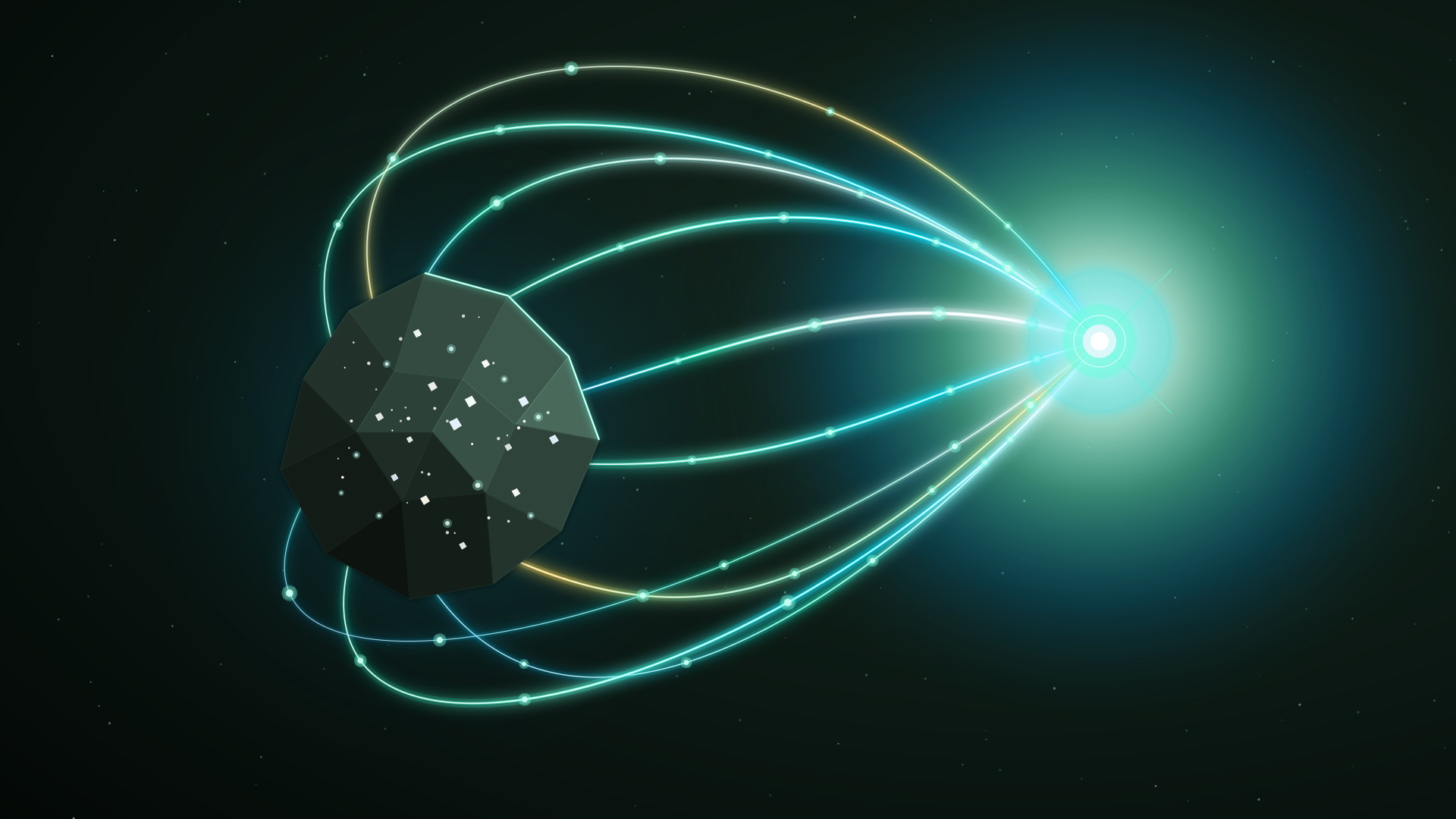
Astrophysicists recognized decades ago that another force had to siphon away rotational energy. That is where magnetic braking—the process where magnetic lines drag on ionized gas to shed angular momentum—becomes essential. The gas enveloping the nascent sun was highly ionized, meaning charged particles were forced to travel along invisible magnetic field lines.
A strong magnetic field acts like a cosmic brake, steadily channeling rotational angular momentum from the core outward into the surrounding nebula. By shedding this barrier, matter can break free of its orbital centrifugal trap and plunge smoothly into the growing protosun.
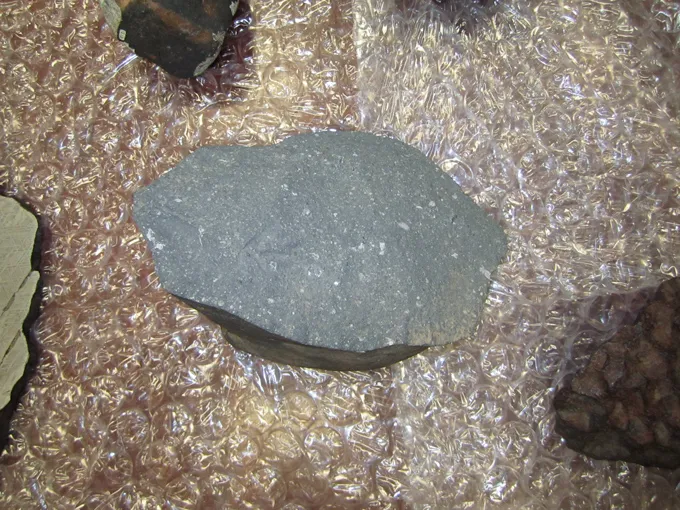 Photo of a meteorite showing speckled white calcium-aluminum-rich inclusions (CAIs). Source: Science News / Dmadeo, Wikimedia Commons (CC BY-SA 3.0)
Ancient Tape Recorders: Measuring Gauss-Level Magnetic Remanence in CAIs
While the theoretical mechanism was well understood, proving that a strong magnetic field actually existed 4.5 billion years ago had long lacked direct physical evidence. Early solar wind swept away primordial gas, and geological activity melted or altered the crusts of planets and large asteroids. Only primitive, unmelted meteorites preserved in the cold vacuum of space still retain the nebula’s earliest physical impressions.
Borlina’s team relied on principles of paleomagnetism, the study of ancient magnetic fields recorded by magnetic mineral grains. When CAIs cooled and crystallized, tiny iron-bearing minerals aligned themselves with the surrounding nebular magnetic field, much like magnetic tape records sound using magnetized iron oxide particles. As long as these minerals never experienced subsequent severe heating, that magnetic alignment remains locked in place for billions of years.
The researchers isolated five iron-bearing inclusions and probed them using superconducting magnetometers. The measurements confirmed that these ancient grains retained remanent magnetization corresponding to an ambient field of several gauss. This finding provides the first direct, physical measurement of the magnetic environment during the earliest stage of solar system formation.
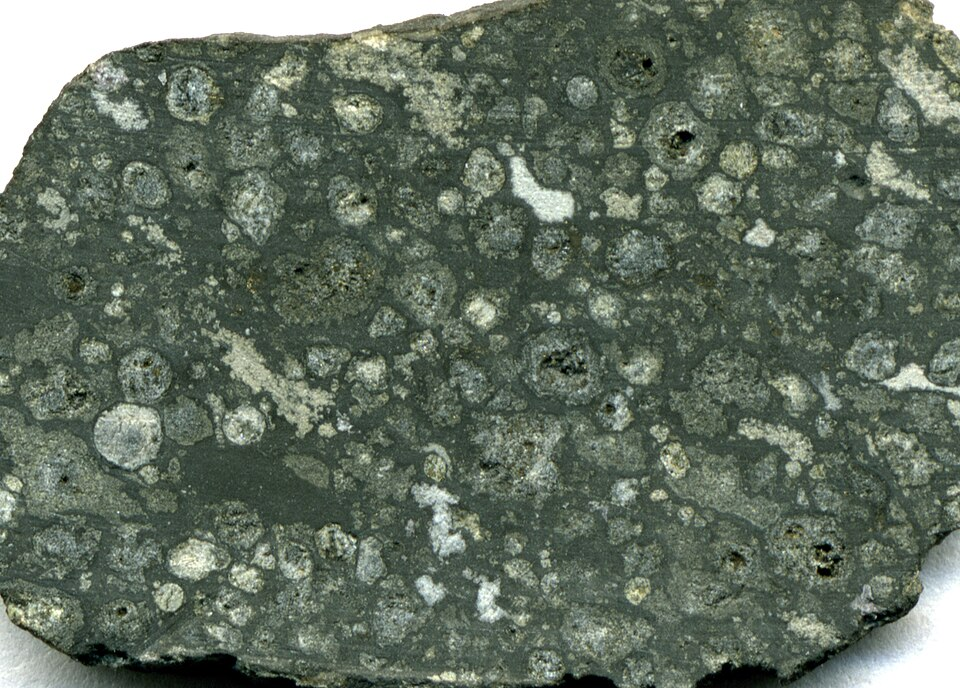 Close-up view of the Allende carbonaceous chondrite meteorite, with pale speckles of CAI inclusions clearly visible. Source: Wikimedia Commons (CC BY 2.0)
Gobbling Up Hundreds of Earths a Year: Magnetism as the Primary Feeding Engine
The earliest phase of stellar birth is known as the Class 0 phase, during which the protostar remains deeply shrouded within a massive envelope of infalling dust and gas. While previous research confirmed the presence of magnetic fields after the sun was largely formed, determining field strength during Class 0 had proven notoriously elusive. Measuring CAI inclusions fills this critical observational void in stellar evolution models.
In the dynamics of a vast nebular cloud, a field strength of several gauss represents immense driving power. Hydrodynamic simulations show that under such magnetic fields, the fledgling sun could have swallowed more than 300 Earth masses of gas every year. Put another way, the infant star was gobbling up an entire Earth’s worth of gas roughly every 28 hours.
This ferocious accretion rate—the rapid drawing-in of surrounding matter—ensured that the sun accumulated the bulk of its mass within a few million years. Theoretical astrophysicist Indrani Das of the Academia Sinica Institute of Astronomy and Astrophysics in Taipei, Taiwan, pointed out: “This is one of the first measurements that has been done of the Class 0 phase.”
Borlina emphasized that magnetism cannot be treated as an afterthought in stellar growth: “You can’t ignore the contribution of magnetism.” Rather than being a mere background bystander, magnetic fields served as the primary architect determining how matter was distributed in the early solar system.
Beyond a Single Meteorite: Reconstructing the Evolutionary Model of Star Systems
This discovery marks a pivotal breakthrough in deciphering the origins of our solar system, yet scientific rigor demands further confirmation. Das noted that five inclusions from a single meteorite cannot yet represent the entire primordial solar nebula: “We need a bigger sample size” to confirm whether such powerful magnetic fields were universal throughout the disc.
Even as scientists seek additional samples, this study fundamentally reshapes our understanding of how planetary systems emerge. The magnetic imprints locked inside 4.5-billion-year-old rocks make one thing clear: the solar system did not form through gravity alone. During the frantic feeding frenzy of the infant sun, magnetism was the indispensable engine that shaped our cosmic home.
Reference Links:
- Science News Coverage
- PNAS Original Paper