Four People in 1,700 Square Feet: Weighing Every Spoon of Salt
On a typical Friday evening back home, dinner takes thirty minutes to arrive at your door. Instant messages get replied to in two seconds, and opening a window lets in a crisp evening breeze. For four Americans in Houston, that entire slice of normal existence was completely severed for a year and two weeks.
On October 31, 2026, the four volunteers swung open the heavy sealed door and stepped out of NASA’s Johnson Space Center back into the real world. They had spent 378 continuous days living inside a 158-square-meter (1,700 sq ft) closed structure. The exercise was part of NASA’s CHAPEA project—Crew Health and Performance Exploration Analog. Its fundamental objective is calculating the baseline limits of human survival in a ground simulator, recreating a full calendar year on Mars before real crews embark.
Their home for the year was Mars Dune Alpha: a habitat 3D-printed from specialized concrete using industrial-scale printers. At 158 square meters, its floor area roughly matches a standard three-bedroom apartment. Inside, the space is partitioned into four private crew quarters, dedicated workstations, a medical area, a hydroponics farm, and shared galley and washroom facilities.
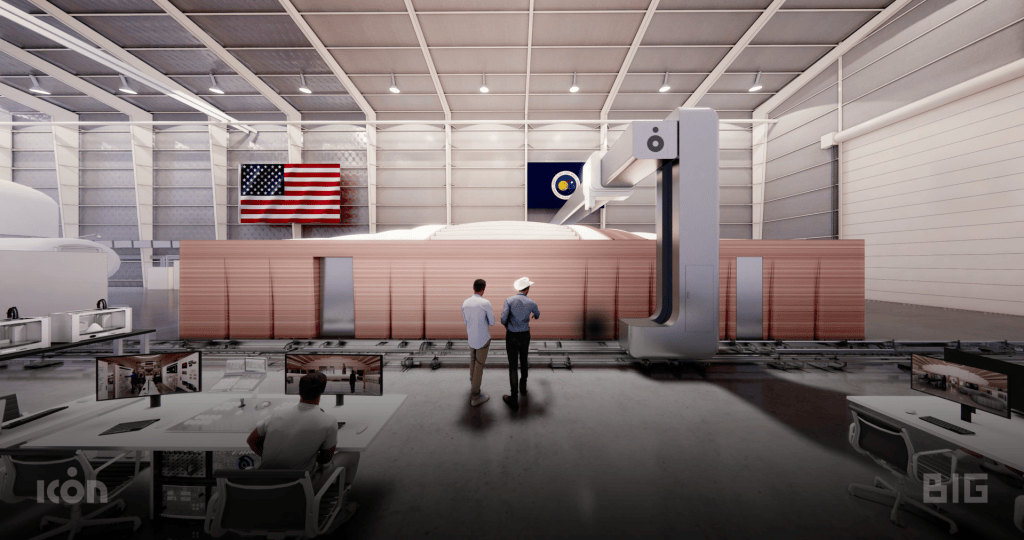 Figure: Exterior view of NASA’s 3D-printed Mars analog habitat. Source: NASA.
Living supplies inside the habitat operated under rigid rationing, with zero possibility of deliveries or emergency resupply runs. All water was reclaimed and purified through closed-loop filtration systems, making showers and sanitation matters of exact accounting. Every sip of water consumed and every single gram of salt sprinkled into a meal had to be precisely logged into a tablet.
A Single Message and a 44-Minute Wait
Mars is unfathomably distant. At their closest orbital approach, Earth and Mars are roughly 55 million kilometers apart; at their furthest, the separation exceeds 400 million kilometers. Even travelling at the speed of light, radio signals take up to 22 minutes each way.
In daily life on Earth, messages sent to friends receive an immediate ping back. From a Mars base calling Earth, a simple greeting takes up to 22 minutes just to reach flight control in Houston. Even if ground controllers respond instantly, another 22 minutes elapse before their voices return—a 44-minute round trip.
This pronounced latency fundamentally reshaped how the crew worked. Conventional real-time voice calls and video conferences simply cannot function across deep-space distances. Whenever an unexpected onboard alarm sounded, the crew had to diagnose and resolve the issue entirely on their own, without expecting timely intervention from ground support.
During the mission, mission controllers also introduced a two-week communications blackout, simulating a solar conjunction where Mars passes behind the Sun and violent solar activity cuts off radio signals entirely. The habitat stayed completely dark to outside comms for 14 straight days. Flight engineer James Spicer sent and received over 4,000 emails over the course of the year to maintain an emotional tether with his family.
Red Sand Marswalks and Fresh Tomatoes from Hydroponics
Confined to 158 square meters, the four crew members carried a demanding daily workload. Each brought deep operational expertise: Commander Ross Elder is a former Air Force test pilot, Medical Officer Ellen Ellis serves in the U.S. Space Force, Science Officer Matthew Montgomery is a hardware engineer, and Flight Engineer Spicer specializes in satellite communications.
Beyond equipment maintenance and biometric tracking, the team regularly donned heavy analog spacesuits for extravehicular activities (EVAs). Attached to the habitat is an enclosed 111-square-meter sandbox covered in red sand. Wearing bulky pressurized gloves, crew members drove robotic rovers, piloted reconnaissance drones, and collected geological core samples.
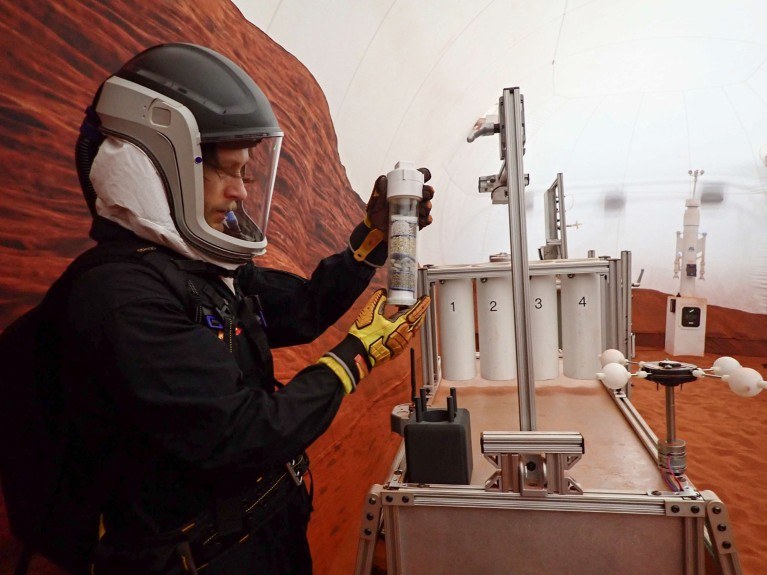 Figure: Crew egress during an analog EVA. Source: NASA.
Conducting these simulated Marswalks in full gear was physically grueling. Upon re-entering the airlock, the crew had to undergo meticulous decontamination to prevent abrasive dust from contaminating the living quarters. Repeating these high-intensity drills turned complex exploration workflows into second nature.
The vertical hydroponics farm became an invaluable psychological and nutritional anchor. Montgomery and his crewmates tended the crops daily, eventually harvesting fresh lettuce, peppers, and cherry tomatoes. While greens could not replace freeze-dried rations as the caloric staple, the crisp produce provided a welcome morale boost after months of pre-packaged meals.
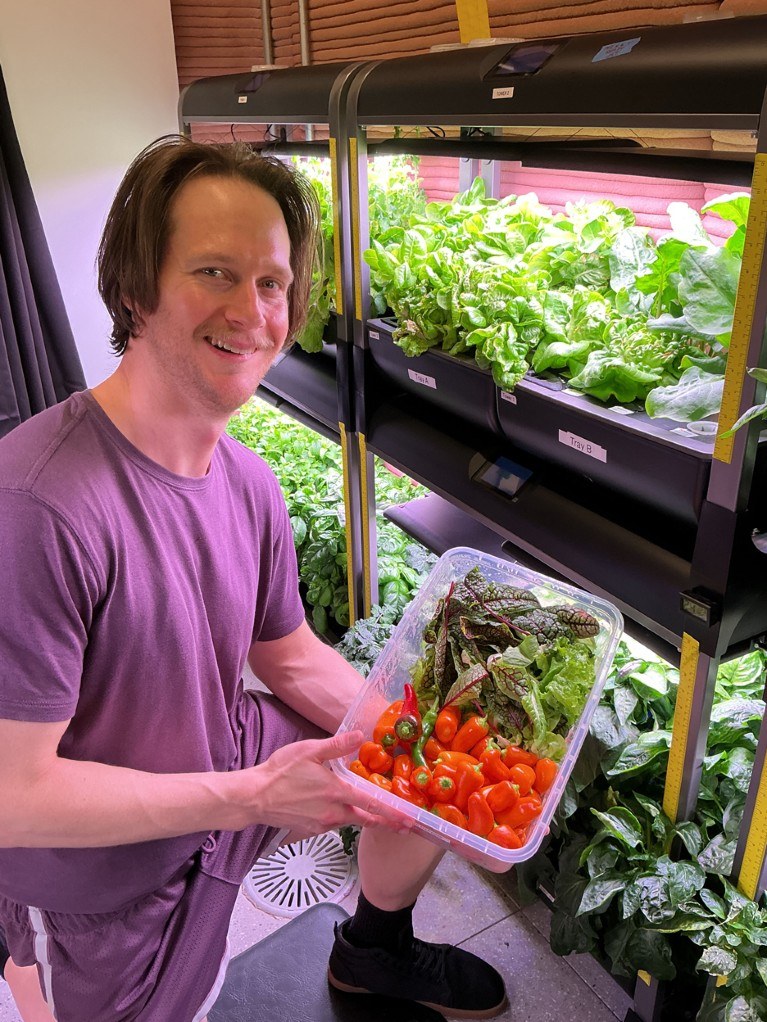 Figure: The science officer shows fresh vegetables grown in the habitat hydroponics bay. Source: NASA.
Surviving 378 Days of Silence: Relying on Teammates Over Battling Solitude
Many assume a deep-space habitat is constantly overwhelmed by buzzing electronics and klaxons. But after egress, the crew’s most striking observation was how eerily quiet it was. With no sound of passing traffic, wind, or rain outside, the only auditory backdrop was the steady, low hum of air ventilation systems.
To cut through the stifling monotony, Commander Elder routinely listened to film soundtracks on repeat. The crew also brought musical instruments into the habitat, forming an impromptu band in the narrow communal galley. Filling the silence with music and rhythm proved to be an effective antidote to sensory deprivation.
Outside the hangar, the world kept moving fast. Over that single year, the International Space Station completed two crew rotations, and crewed lunar exploration programs passed critical launch milestones. Inside Mars Dune Alpha, daily routines ticked forward like clockwork as the four volunteers executed their schedules step by step within their confined perimeter.
Reflecting on her mental state after stepping outside, Medical Officer Ellis noted that acute loneliness was rarely an issue—largely because three dependable teammates were always right beside her. Astronaut Jack Hathaway echoed the sentiment during the egress ceremony, underscoring that mission success rested squarely on mutual trust and emotional resilience.
Measuring the Survival Ledger on Earth Before Launching to Mars
It is natural to wonder why NASA chose to lock four people inside a Houston hangar for an entire year before any spaceship left the pad. This study was an analog mission: researchers build controlled terrestrial isolation environments to capture empirical physiological and psychological datasets under simulated deep-space stress. Its central value lies in turning life-or-death operational risks into quantifiable engineering metrics well before launch.
A human flight to Mars requires months of transit each way and costs tens of billions of dollars. Metal pressure vessels and propulsion stages can be modeled accurately in software, but living human beings remain full of variables. Until now, planners had little hard baseline data on daily per-capita water consumption and the exact onset of caloric deficits over prolonged confinement.
The records compiled from CHAPEA Mission 2 provide NASA with an empirical foundation for planning crewed Mars missions targeted for the 2030s. The next joint lunar-Mars simulation campaign is slated to kick off in August 2027, building directly upon these newly established benchmarks. Deep-space exploration now has an authentic baseline for astronaut health accounting.
The greatest hurdle for crewed Mars exploration is enduring the brutal psychological and physical isolation of deep space. Over 378 days, CHAPEA translated communication latency, resource scarcity, and acute confinement stress into hard, actionable data. This survival ledger, calculated inside a Houston hangar, sets the safety margins for humanity’s eventual voyage to the Red Planet.
Reference links:
- Nature News: Four volunteers exit NASA’s 378-day simulated Mars habitat
- NASA Johnson Space Center: CHAPEA Mission 2 crew reflects after 378 days on simulated Mars