Every year when annual checkup reports arrive, one specific symbol causes immediate dread: a plus sign next to urine protein. This unassuming marker often signals the earliest leak in the kidney’s delicate filtration barrier. Facing these findings, physicians have historically had few satisfying answers. Patients are typically advised to restrict sodium, tightly manage blood sugar and blood pressure, and brace for a lifelong regimen aimed merely at slowing the inevitable decline.
For decades, clinical dogma held that stiffened, damaged renal microvessels resembled shattered porcelain. Medical intervention could decelerate further cracking, but no one dared hope the broken fragments could heal themselves. Patients with chronic conditions watched their filtration markers slip year after year, marching steadily toward dialysis.
In October 2026, a groundbreaking clinical trial published in Nature Medicine upended this long-standing passivity. Led by researchers at the University of Washington, the team performed rigorous tissue biopsies to demonstrate an unprecedented reality: semaglutide—a GLP-1 receptor agonist widely prescribed for diabetes and weight loss—can physically remodel and repair damaged microvessels. This breakthrough offers hundreds of millions of chronic kidney disease patients tangible hope for microscopic tissue regeneration.
Proteinuria on a Lab Report Once Meant Waiting for Organ Failure
Inside human kidneys reside millions of microscopic filtering units. Known medically as glomeruli, these intricate clusters of looping capillaries bear the burden of purifying the body’s entire blood supply. Two healthy kidneys filter roughly 180 liters of blood each day—equivalent to circulating through 360 standard water bottles around the clock. Glomeruli operate with exquisite precision, flushing out metabolic waste while preventing vital proteins from escaping.
Chronic exposure to hyperglycemia and hypertension gradually warps this delicate mesh. Vessel walls thicken and harden as supporting fibrous tissue overproliferates. The once-tight filtration slits stretch and tear, allowing proteins to slip into the urine. This manifest clinically as urinary albumin—high-grade protein lost through compromised microvasculature.
According to the World Health Organization, chronic kidney disease (CKD)—defined as persistent kidney impairment lasting over three months—now affects 674 million individuals worldwide. That translates to one in twelve people globally living with steadily stiffening renal filters. Because microvascular scarring was deemed irreversible, conventional therapies acted purely as brakes, delaying dialysis for as long as possible.
The long-standing belief that microvascular sclerosis cannot be reversed formed an invisible ceiling over chronic disease management. For generations, doctors and patients fought tirelessly to maintain stable biomarkers, only to watch renal function inevitably slide down a one-way slope.
Kidney Biopsies Confirm: Hardened Microvessels Relax and Thin
Could newer metabolic therapies drive deeper structural repair? To find out, a team led by Katherine Tuttle at the University of Washington designed the REMODEL clinical trial. The study enrolled 106 patients suffering from both diabetes and kidney disease over a 52-week timeline, randomly assigning participants to receive either 1 mg weekly semaglutide or a placebo injection.
While conventional trials rely almost exclusively on blood and urine labs, REMODEL went a step further by conducting human kidney biopsies. Clinicians inserted fine needles before and after the 52-week intervention to extract millimeter-scale core tissue samples. Pathologists then tracked microscopic changes in vessel architecture directly under the microscope, providing undeniable physical proof straight from the organ itself.
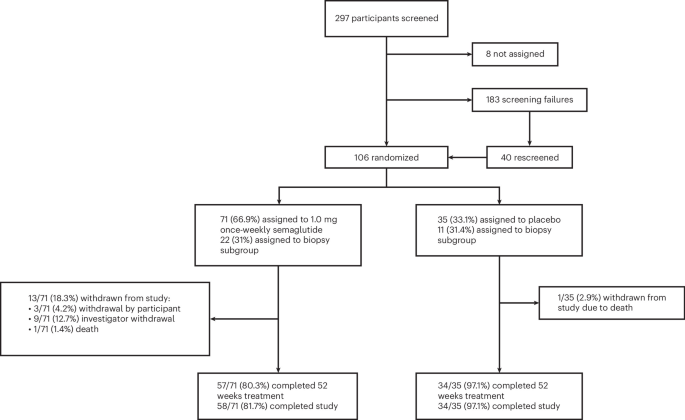 Figure: REMODEL trial design and 52-week follow-up protocol. Source: Nature Medicine (Tuttle et al., 2026)
The microscopic findings were striking. Following one year of semaglutide therapy, the wall thickness of diseased renal arterioles decreased by an average of 10%. Constricted, stiffened microvessels expanded and relaxed. Furthermore, participants experienced a 25% reduction in perirenal fat and a 13% decline in renal sinus fat, substantially relieving external mechanical pressure on delicate vasculature.
The thinning of arteriolar walls observed on tissue biopsies provided definitive evidence of physical microvascular remodeling in humans. Participants’ urinary albumin levels dropped by an average of roughly 40%, indicating that the perforated biological filter was sealing shut and restoring smooth microcirculatory hemodynamics.
Flipping the Inflammatory Switch: Immune Cells Halt Attack on Renal Filters
How does a metabolic molecule repair distant kidney tissue? The answer lies inside cellular genetic switches. Semaglutide is a synthetic analogue of glucagon-like peptide-1 (GLP-1), an incretin hormone originally recognized for regulating satiety and blood glucose. The medical community previously presumed kidney benefits were merely indirect byproducts of systemic weight loss and improved metabolic load.
Spatial transcriptomic profiling uncovered a far deeper direct mechanism. Inside glomerular capillary endothelial cells, gene expression underwent a fundamental shift. Genes driving chronic inflammation and metabolic stress were rapidly silenced, while signaling pathways governing basement membrane repair and healthy tissue morphogenesis were reactivated.
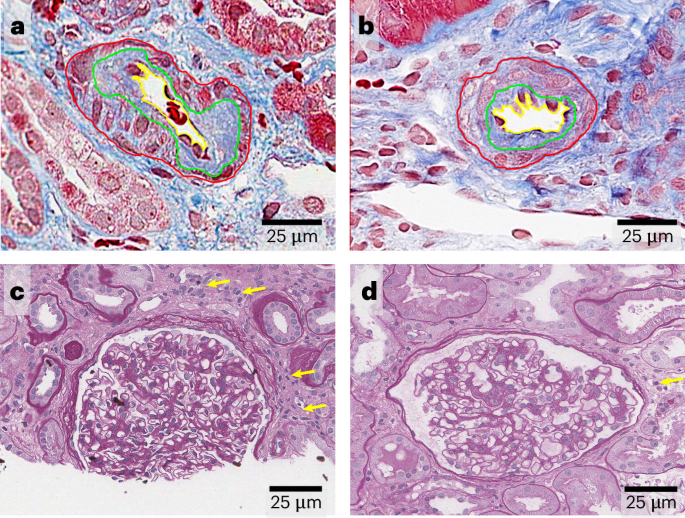 Figure: Spatial gene expression changes in glomerular microvessels and surrounding immune cells. Source: Nature Medicine (Tuttle et al., 2026)
As endothelial repair programs booted up, the surrounding microenvironment transformed. Pro-inflammatory immune cells that had congregated around injured vessels ceased their destructive activity. Chronic perivascular inflammation cooled down rapidly, granting the battered basement membrane filter an indispensable window to recover and rebuild.
Katherine Tuttle emphasized that damaged microvasculature exhibited unmistakable signs of genuine architectural repair. Northwestern University nephrologist Susan Quaggin noted the findings confirm potent direct endothelial protection. Halting the intracellular chronic inflammatory cascade provides diseased microvessels with the molecular leeway to reconstruct themselves.
Protection Strong Enough to Halt Clinical Trials Early
The cellular mechanisms unveiled by REMODEL also solved an earlier clinical puzzle. In 2024, The New England Journal of Medicine (NEJM) published results from the landmark FLOW trial, which monitored thousands of diabetic kidney disease patients globally. During an interim assessment, the independent Data and Safety Monitoring Board abruptly called a halt to the study.
The early stoppage was not due to safety hazards, but because semaglutide’s therapeutic benefits were overwhelmingly decisive. The drug slashed the composite risk of kidney failure and cardiovascular mortality so profoundly that the ethics committee deemed it unconscionable to keep control patients on an ineffective placebo.
A critical reality is often overlooked: renal decline and cardiovascular disease are intimately intertwined. The most frequent killer of CKD patients is not end-stage uremia, but fatal heart attacks and strokes. As renal microvascular filters mend, systemic inflammatory burdens diminish in tandem. Protecting the kidney’s microvasculature builds a robust defensive bulwark against catastrophic cardiovascular events.
Halting a clinical trial early due to overwhelming efficacy is a rare occurrence in evidence-based medicine. While the FLOW trial confirmed survival gains across macroscopic populations, the REMODEL study provided the missing microscopic physical proof of structural cellular remodeling.
Repurposing Metabolic Drugs as Organ Protectors Rewrites Chronic Disease Care
The histological confirmation that semaglutide repairs renal vascular filters marks the evolution of weight-loss drugs into bona fide organ-protecting therapeutics. Its actions reach far beyond appetite suppression and glycemic control. By switching off inflammatory genes inside diseased cells, it unlocks dormant vascular self-healing pathways.
For more than 670 million individuals worldwide living under the shadow of progressive renal deterioration, this discovery shatters a decades-old dogma of irreversible organ damage. Modern medicine now possesses a viable therapeutic path to soften rigid microvessels and mend biological filters. Chronic disease management is actively transitioning from passive deceleration toward proactive microscopic repair.
True microvascular reconstruction requires time. A balanced diet and lifestyle remain fundamental pillars of long-term organ health. Yet by providing rigid, compromised microvessels with an invaluable biological window for self-repair, deciphering these molecular switches fundamentally transforms how humanity confronts progressive organ failure.
Reference Links:
- Nature Medicine Research Article (REMODEL Trial)
- Science News Coverage (Semaglutide and Chronic Kidney Disease)
- The New England Journal of Medicine (FLOW Trial Early Termination Report)
- World Health Organization Global Epidemiology of Chronic Kidney Disease