On August 13, 2026, Elon Musk’s xAI officially released its latest AI model, Grok 4.6. On the very same day, Chinese competitors DeepSeek and Alibaba unveiled their own flagship models: DeepSeek V4 Pro and Qwen 3.8. Three leading AI powerhouses showed their cards simultaneously. On Hacker News, over 367 comments accumulated overnight, with users directly asking: was this coordinated release intended to counter DeepSeek?
What is Grok 4.6? In short, it is an AI built for sustained autonomous execution. Previous generations excelled at conversational Q&A; this generation focuses on “marathon tasks”—working continuously for tens of minutes to research a complex topic, synthesize unstructured documentation, or build a working software product from an initial concept. It feels like hiring an intern who never sleeps. This reflects a broader industry shift: AI is moving from interactive chatbots to autonomous agents executing real work.
How capable is it? Looking at independent benchmarks, Artificial Analysis aggregates 9 core capability tests into a single composite score known as the Artificial Analysis Intelligence Index (AAII). Grok 4.6 scored 61 points: tying OpenAI’s flagship GPT-5.6 Sol, gaining 5 points over Grok 4.5 (56 points), and trailing Anthropic’s Claude Opus 5 (63 points) by just 2 points. Independent evaluations place Grok 4.6 as the third most intelligent model globally.
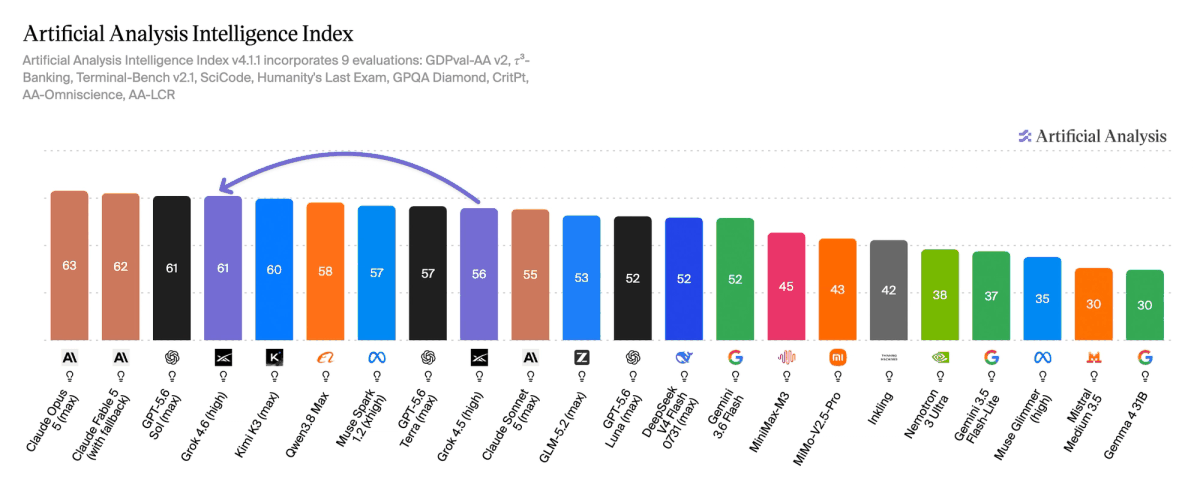
Figure: AAII benchmark comparison showing Grok 4.6 (61 points) tying GPT-5.6 Sol, with Fable 5 Max leading at 62 points. Source: artificialanalysis.ai
Does a score of 61 qualify Grok 4.6 as a top-tier leader or a mere contender? Hacker News discussions erupted in debate. Supporters argue that matching OpenAI’s flagship and securing a top-3 global rank undeniably defines top-tier status. Critics counter by pointing to granular sub-tests: on the coding benchmark DeepSWE, Grok 4.6 scored 65.9% compared to competitors’ 73%; on the computer operation benchmark Terminal-Bench, it scored 26% against rivals’ 34.6%. While aggregate scores appear close, specific domain gaps remain pronounced. Furthermore, benchmark difficulty scales rapidly: models scoring 90 last month might score 70 today against updated criteria. The core takeaway: while the absolute benchmark gap has narrowed to single digits, the 2026 AI battleground is decided precisely within these margins—where pricing, latency, and reliability determine real-world adoption.
A side-by-side real-world user test illustrates the practical trade-offs. Running identical complex tasks across both providers: DeepSeek V4 Pro completed the task in 12 minutes 02 seconds, costing $0.12, but left an unhandled bug. Grok 4.6 completed the task in 3 minutes 18 seconds, costing $1.41, and passed on the first attempt. That represents a 12x price differential alongside a clear quality delta. Long-context evaluations by independent benchmarkers confirm this pattern: for equivalent knowledge work, Grok averaged 53 interaction turns compared to Claude Opus 5’s 103 turns, while consuming only a quarter of the total context data. Fewer reasoning turns and reduced context volume translate directly to cost savings per completed workflow.
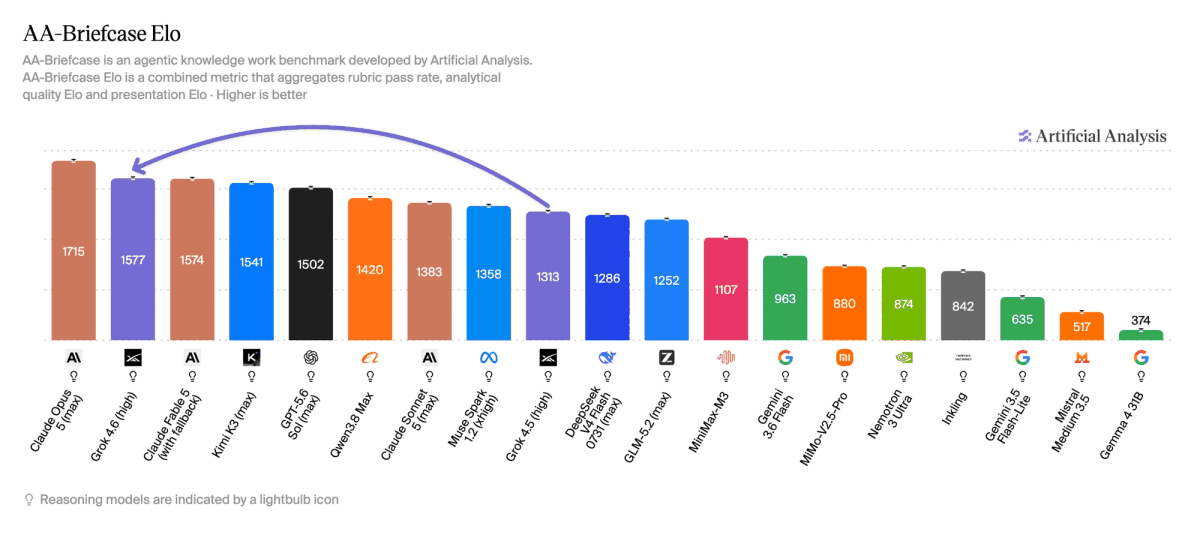
Figure: Long-context knowledge work (AA-Briefcase) score vs. efficiency comparison. Source: artificialanalysis.ai
The engineering implications of these metrics are clear: the premium option operates 4x faster with minimal rework, whereas the economical alternative saves 12x on API spend but may demand manual debugging. For individual developers, the decision hinges on the value of developer time; for enterprises, it is a transparent item on the infrastructure balance sheet. Notably, LLM pricing is evaluated per token (the atomic unit of LLM text processing), meaning price competition is waged on per-million-token unit costs rather than flat subscription fees.
Why is Grok fast yet expensive, while DeepSeek is slower yet economical? The answer lies in divergent engineering architectures. Grok relies on raw compute density: xAI constructed the Colossus supercomputer cluster in Memphis, recognized as one of the world’s largest AI compute deployments. Ample compute allows the model to explore deeper reasoning trees quickly, delivering rapid outputs at higher power costs. DeepSeek employs algorithmic frugality through Mixture of Experts (MoE)—decomposing a massive network into specialized sub-networks and activating only a small fraction per forward pass to maximize compute efficiency. Neither path is inherently superior; they represent distinct trade-offs between trading capital for time versus trading time for capital. On API pricing, Grok 4.6 charges $2.00 per million input tokens and $6.00 per million output tokens—over 60% cheaper than competing Western flagships. Even without explicitly advertising price cuts, xAI’s aggressive pricing strategy speaks for itself.
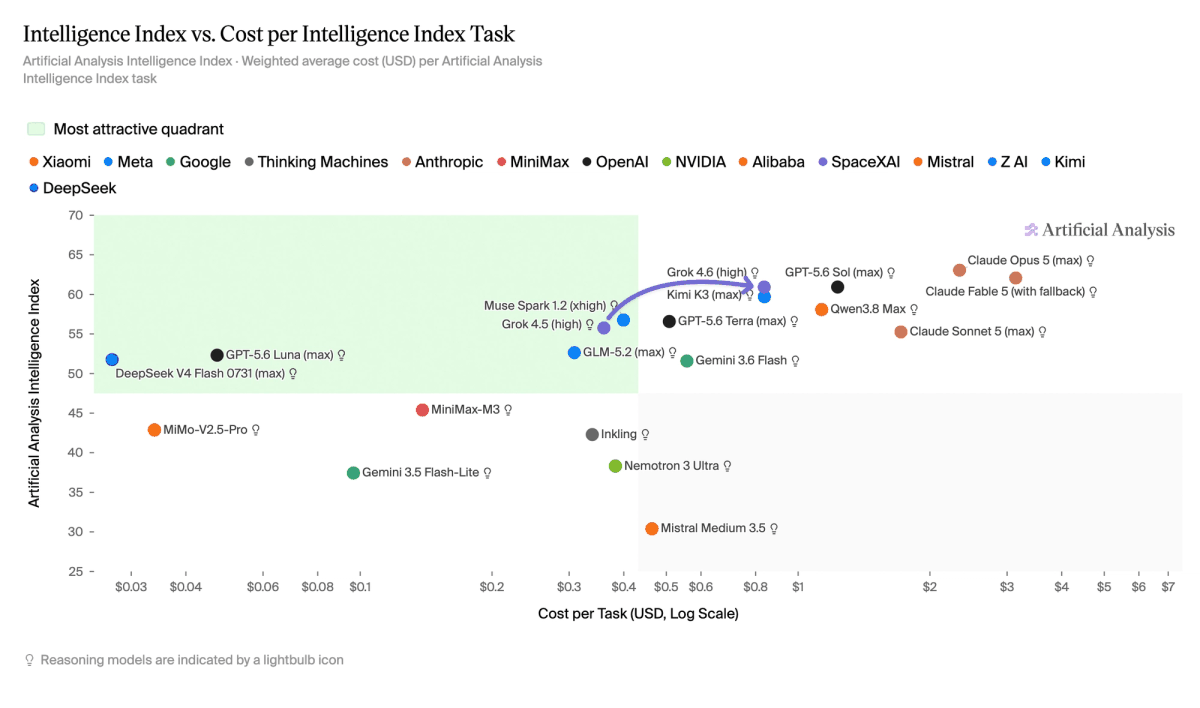
Figure: API pricing comparison: Grok 4.6 is priced at $2/$6 (input/output per million tokens), significantly lower than Claude Opus 5 ($5/$25) and GPT-5.6 Sol ($5/$30). Source: artificialanalysis.ai
Why is Elon Musk placing such massive bets on AI scaling? Because xAI’s ambition extends far beyond a conversational agent. Tesla vehicles require autonomous AI backbones; Optimus humanoid robots require spatial intelligence; and xAI recently acquired Cursor—reportedly backed by approximately $60 billion in SpaceX equity—leveraging daily interaction telemetry from millions of software engineers to train future Grok iterations. Compute, proprietary data, and real-world deployment channels are all vertically integrated. Musk is betting that frontier AI will become the underlying operating system for all modern industries.
The simultaneous launch of three frontier models highlights a pivotal trend: “China Time.” As Reddit and Hacker News commentators observed, DeepSeek’s release coincided almost to the hour with xAI’s announcement. Historically, US labs held a multi-month lead before Chinese teams responded; today, major releases coincide on the same day, shrinking the catch-up window from years to hours. Market strategies also diverge: Chinese labs emphasize open-weights (as demonstrated by Qwen 3.8) and ultra-low pricing, while US labs favor closed-source ecosystem integration with proprietary hardware and software platforms. For developers and end-users, this global competition has delivered a massive benefit: LLM inference costs have dropped by an order of magnitude within a single year, making intelligence increasingly cheap and accessible.
Scoring 61 is a milestone, not the finish line. While benchmark parity shows that the gap between US and Chinese frontier models has narrowed significantly, subtle performance nuances remain. For practitioners evaluating AI models: benchmark scores provide initial signal, but real-world reliability on specific, end-to-end tasks remains the ultimate test.
Reference Links:
- xAI: Introducing Grok 4.6
- Artificial Analysis: Grok 4.6 Benchmarks and Analysis
- Hacker News Discussion (item?id=49274027)
- Hacker News Discussion (item?id=49275385)
- VentureBeat: SpaceXAI debuts Grok 4.6