Silent Late-Night General Availability
At 11:00 PM on August 13, 2026, the model page in DeepSeek’s official API documentation was quietly updated, changing the model identifier to DeepSeek-V4-Pro-0813. DeepSeek held no online launch event nor posted any advance teaser campaign on social platforms. Nevertheless, the update rapidly surged to the top of Hacker News, gathering 692 upvotes and 246 community comments.
This silent upgrade strategy minimizes migration overhead for existing integrations. Developers calling the API do not need to modify any application logic, as requests are automatically routed to the newest 0813 checkpoint. Legacy model identifiers like deepseek-chat and deepseek-reasoner were already phased out in late July, mapping respectively to non-reasoning and reasoning modes of the Flash architecture. This quiet rollout signals that the API infrastructure has reached high-availability maturity, eliminating the need to stress-test system elasticity via sudden marketing traffic spikes.
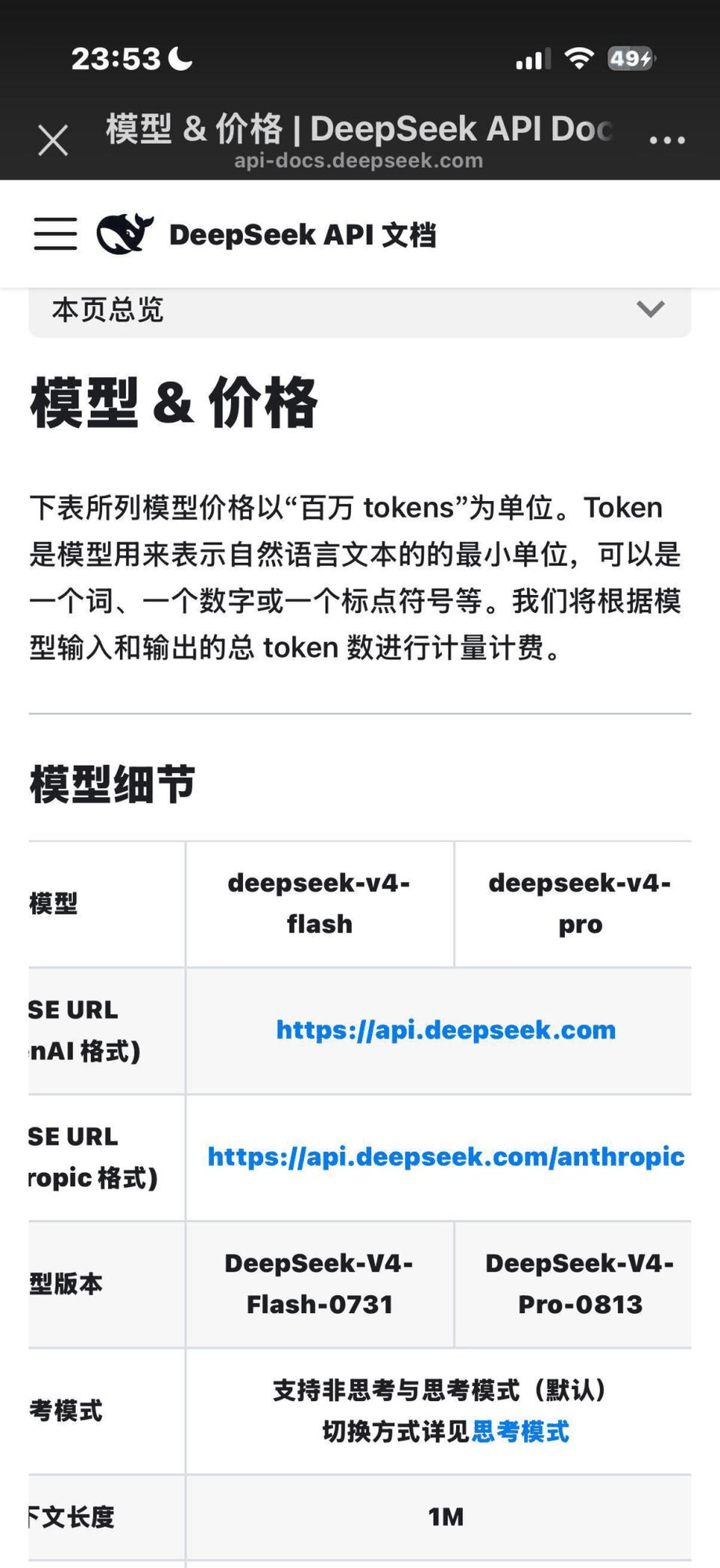 Figure: DeepSeek official “Models & Pricing” page, with model version updated to DeepSeek-V4-Pro-0813. Source: DeepSeek Open Platform
Agent Benchmarks Overtake Lightweight Flash Variant
Tracing the evolution of the V4 series, when the Preview phase was unveiled in April 2026, DeepSeek announced both the flagship Pro version with 1.6T parameters and the lightweight Flash version with 284B parameters. However, after V4-Flash-0731 reached general availability first on July 31, the lighter variant temporarily outpaced the flagship Preview version on benchmarks like Terminal Bench (82.7 vs. 61.8). The release of the 0813 GA build decisively re-establishes the Pro version’s performance leadership within the product lineup.
| Benchmark | V4 Pro 0813 | V4 Pro Preview | Fable 5 |
|---|---|---|---|
| HLE (No tools / Tool use) | 42.7 / 60.0 | 37.7 / 48.2 | 53.3 / 63.0 |
| Terminal Bench 2.1 | 87.9 | 72.1 | 88.0 |
| Cybergym | 83.3 | 52.7 | 83.1 |
| DeepSWE | 62.7 | 12.8 | 70.0 |
| DSBench-FullStack | 71.1 | 41.8 | — |
Official benchmark results highlight substantial improvements in agentic execution capabilities for V4 Pro 0813. Most notably, its DeepSWE score skyrocketed from 12.8 during Preview to 62.7, Terminal Bench 2.1 climbed from 72.1 to 87.9, and Cybergym surpassed Fable 5 with a score of 83.3. The nearly fivefold leap in DeepSWE demonstrates the model’s effective generalization when performing multi-step, long-horizon repository code repairs.
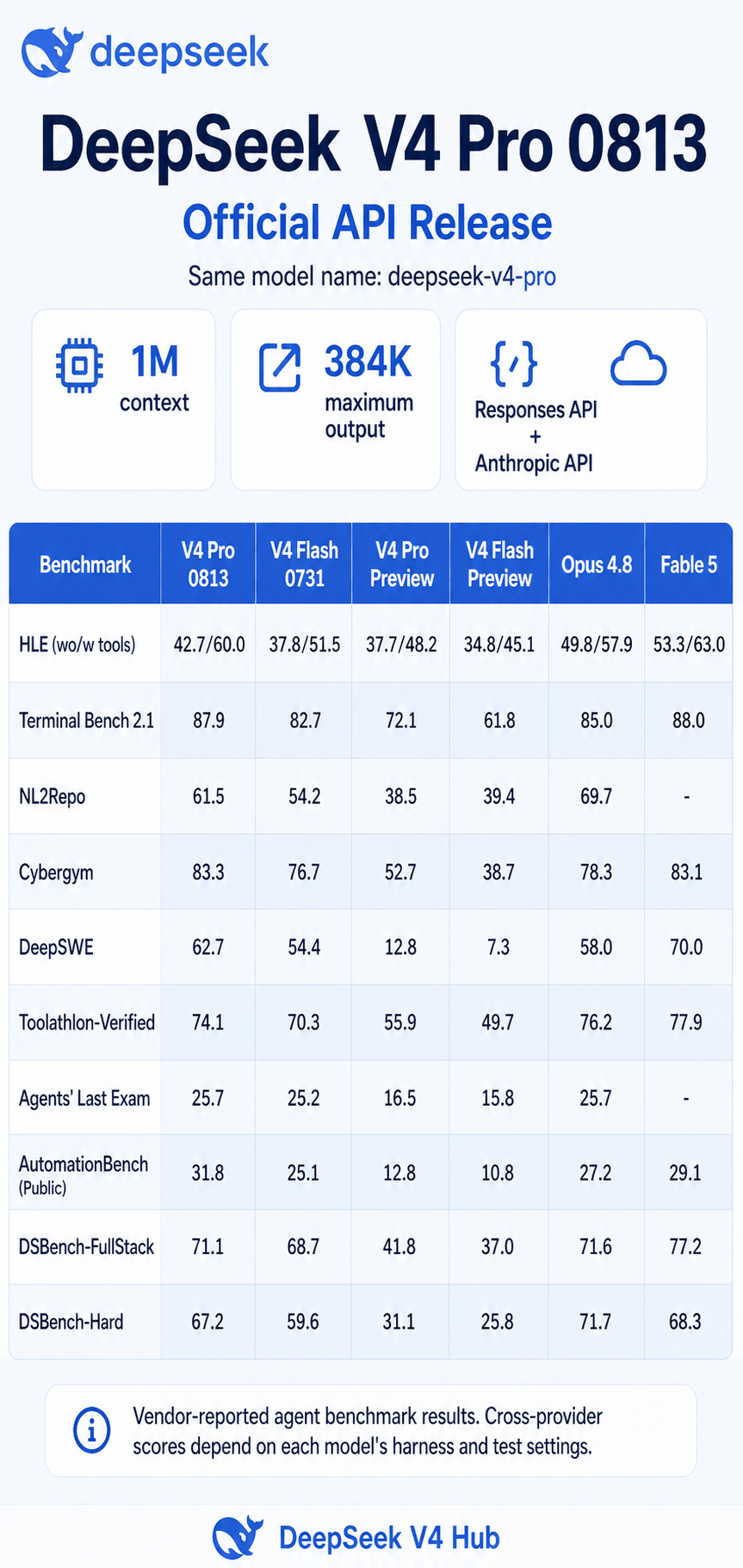 Figure: DeepSeek V4 Pro 0813 official benchmarks (Agent evaluation). Source: DeepSeek official release / compiled by deepseekv4pro.com
Naturally, these metrics reflect vendor self-assessments. In agentic evaluations, harness setups, prompt formatting, and step-budget allocations heavily influence final scores. In tool-free tasks like HLE or deep codebase reasoning, a noticeable gap remains between this model and Opus 4.8, requiring unbiased third-party verification from the developer community.
Architectural Additions and Pending Engineering Deliverables
On the engineering specification front, V4 Pro 0813 retains a Mixture-of-Experts (MoE) architecture with 1.6T total parameters, activating 49B parameters per inference pass. The model natively supports a 1M token context window, with a maximum single-completion output limit of 384K tokens. Regarding API features, the GA release fills previous gaps by adding Responses API support, Anthropic API compatibility, pre-fill prompt continuation, and Fill-in-the-Middle (FIM) code completion.
Despite the complete set of API endpoints, gaps remain in official tooling and ecosystem software. The self-developed agent framework “DeepSeek Harness,” eagerly anticipated by the community, was not launched alongside the GA model; official documentation still recommends third-party agent hosts like OpenAI Codex, Claude Code, or OpenClaw. Furthermore, the official API release announcement provided no clear indication regarding whether 0813 open weights will be released under the MIT license.
A 1M context capacity combined with a 384K output ceiling enables full-repository indexing for large enterprise codebases. However, the absence of an official execution harness forces enterprise developers to build custom context-truncation and state-management pipelines. The lack of a bundled official Harness architecture means enterprise developers must independently implement security sandboxing and context orchestration.
Commercial Segmentation Behind the 3x Price Gap
Along with product stabilization came a revamped tiered billing structure. According to the official pricing page, input cache-miss and output rates for V4 Pro 0813 are set at 3.00 RMB ($0.435) and 6.00 RMB ($0.87) per million tokens, respectively. Compared to Flash 0731’s rates of 1.00 RMB and 2.00 RMB, these baseline rates represent a sharp three-fold increase.
| Pricing Item | V4-Pro-0813 | V4-Flash-0731 |
|---|---|---|
| Input (Cache Hit) | 0.025 RMB ($0.003625) | 0.02 RMB ($0.0028) |
| Input (Cache Miss) | 3.00 RMB ($0.435) | 1.00 RMB ($0.14) |
| Output | 6.00 RMB ($0.87) | 2.00 RMB ($0.28) |
| Single-tenant Concurrency Cap | 500 | 2500 |
Beyond higher token costs, concurrency limits have been significantly tightened. The single-tenant concurrency ceiling for the Pro version is capped at 500—just one-fifth of the 2,500 limit allocated to Flash. Meanwhile, peak hours continue to trigger a 2x price multiplier. The combination of strict concurrency caps and a 3x price gap clearly delineates a dual-tier strategy: Flash targets high-frequency, large-scale automation, while Pro focuses on high-margin, complex reasoning.
An even clearer signal is embedded in the English footnotes of the official pricing page. The text explicitly states that DeepSeek plans to adjust overall API rates upward in the near future, hinting at a substantial price increase. Industry reports in early August had already leaked these price adjustment plans, which the official announcement now confirms. The notice of upcoming price hikes alongside concurrency caps marks the formal end of the era where high throughput was subsidized by ultra-cheap API rates.
Sunset of the Cheap API Era and New Rules of Frontier Competition
The general availability release of DeepSeek V4 Pro 0813 highlights the rapid engineering iteration of open-architecture frontier models in agentic benchmarks. Yet this is far from a simple technical enhancement—it marks a key transition node as DeepSeek accelerates commercial monetization.
As R&D costs and compute consumption mount, early market expansion strategies relying on loss-leader API volume are coming to a close. By instituting tiered pricing between Flash and Pro, DeepSeek directs low-cost, high-concurrency workloads toward lightweight models while reserving premium-priced flagship models for high-value complex tasks. The upcoming overall price increase will compel enterprise clients to rigorously evaluate the ROI of their API utilization.
In this new phase where API pricing normalizes toward sustainability, pure token price wars are losing their charm. Overall delivery quality, single-shot success rates on long-horizon agent tasks, and context-optimization efficiency will replace cheap token gimmicks as the new benchmarks for evaluating model providers.
Reference Links:
- DeepSeek API Docs: Models & Pricing
- DeepSeek V4 Hub: V4 Pro 0813 Arrives With Strong Agent Scores
- Chao News: DeepSeek V4 Pro GA Released: 1M Context + 384K Output, Priced 3x Higher Than Flash
- HN Discussion (49274600): DeepSeek V4 Pro 0813