In August 2026, DeepSeek released the initial developer preview of its open-source Agent Harness. Ten weeks later, that environment has been packaged into a double-click desktop application for macOS and Windows. Developer Kuyawa described it as “a beast” right after installing it on macOS: the underlying framework remains unchanged, but it now launches straight from the dock, with all settings and workspaces migrated seamlessly.
DeepSeek effectively turned its agent harness into Emacs. In its architecture, models, tools, sandboxes, filesystems, and even the user interface are pluggable extensions. The competitive frontier for AI agents is shifting toward the ability to reshape the runtime foundation itself. Packaging it into a desktop app strips away terminal configuration hurdles, ensuring distribution is no longer bottlenecked by developers’ local environments.
Swapping Hardcoded Logic for Runtime Plugins
The official site showcases several experimental plugins spanning team collaboration, automated code reviews, scheduled tasks, and terminal control. In Creator Mode, users can instruct the agent within chat to write an entirely new plugin. In an official demo, the system generated a floating Pomodoro timer in 5 minutes and 24 seconds—and even verified its installation autonomously.
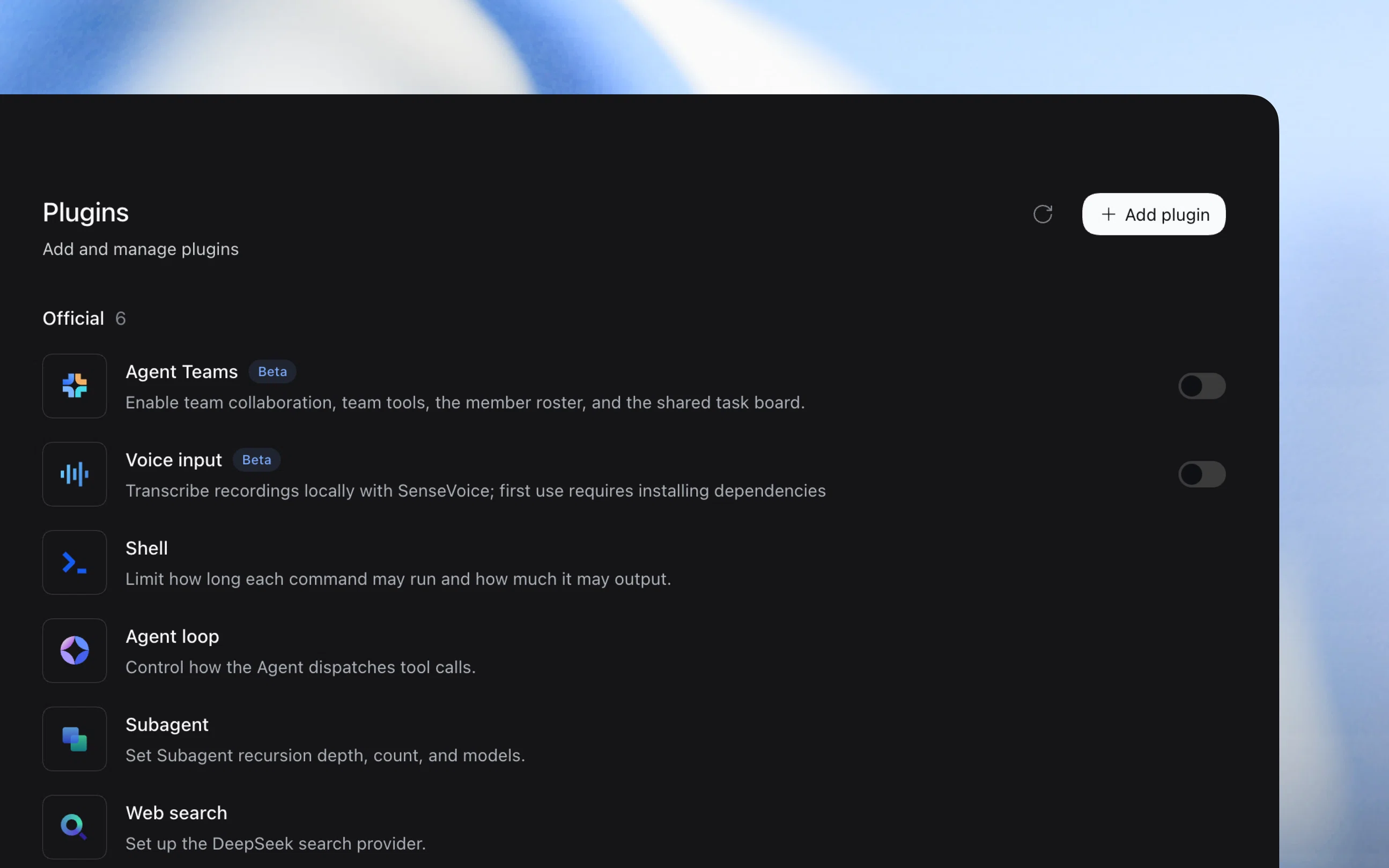 Figure: DeepSeek Harness Plugin Manager interface displaying official plugins and “Add plugin”. Source: DeepSeek official site
When a runtime can be freely assembled and disassembled, raw model capability is no longer the sole bottleneck. Community ecosystems and third-party clients dictate the ceiling of extensibility. Dedicated topics on GitHub are already seeing community-curated plugin directories, while developers have used Tauri to compile installers as small as 5MB.
Governing Plugin Lifecycles Through Academic Rigor
The system supports hot-swapping plugins without downtime. Under the hood, this relies on an academic paper on spatiotemporal composability (arXiv:2608.25512, submitted August 26) authored by researchers from Peking University and DeepSeek-AI. The paper splits the problem along two orthogonal dimensions: the temporal dimension dictates that every context transformation carries an inverse transformation managed by the runtime, while the spatial dimension mandates that context changes trigger component activation and deactivation based on declared dependencies. Developers reviewing the paper noted its strict standards: every plugin must manipulate shared context via fixed activate and deactivate functions, while explicitly declaring its service dependencies.
The core rule governs plugin lifecycles: any service provider must outlive its consumers when tearing down. Enforcing such rigid engineering constraints tackles dynamic loading’s biggest minefields—memory leaks and entangled dependency states. With this foundation, plugins achieve pre-activation dependency validation and on-demand lazy loading.
Long-Running Tasks Strip Away Synthetic Benchmark Hype
Community reception to this new architecture has been polarized. Some questioned whether official announcements leaned too heavily into marketing, while others critiqued the overuse of terms like “Pareto frontier.” Yet compared to static synthetic benchmarks, Harness’s true performance delta only becomes apparent in long-horizon tasks.
To combat the black-box nature of long-running workflows, DeepSeek provides a granular execution trace view. Developers can inspect raw prompts at every step, alongside tool-call breakdowns and latency metrics.
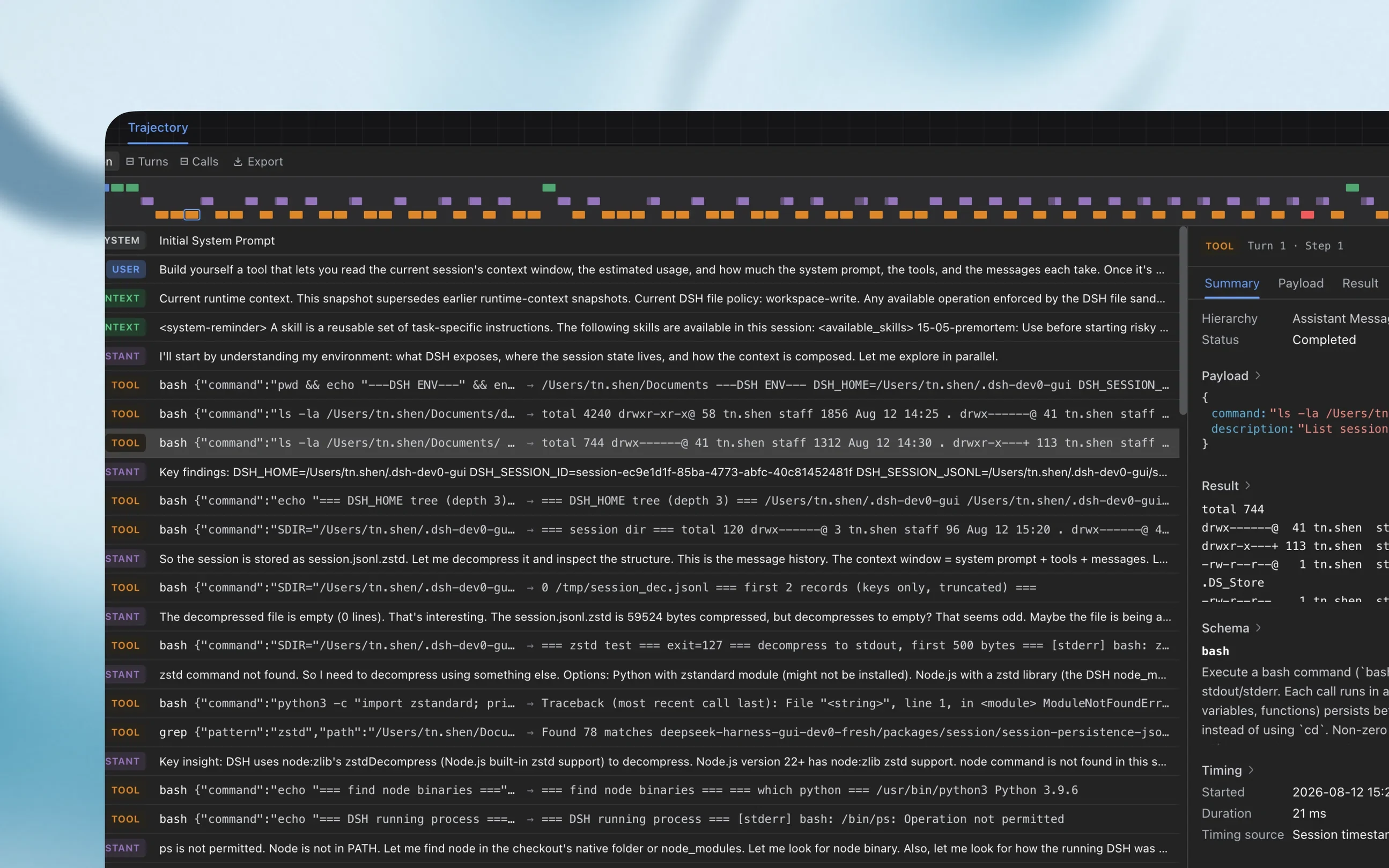 Figure: DeepSeek Harness execution trace view featuring timeline, tool calls, and execution details. Source: DeepSeek official site
For persistent agents, granular execution traces are far more informative than abstract leaderboard win rates. Developer cjbprime pointed to this deep observability support as the defining factor separating Harness from competing offerings.
Eliminating the Last Environment Hurdle on Desktop
According to the release notes, the desktop client manages and installs commands directly from the menu bar, removing dependencies on Node or pnpm. Previously, developers had to invoke npx commands in terminal to spin up the web interface.
Packaging developer tooling into a standalone client bridges the distribution gap between foundation model capabilities and non-backend developers. Concurrently, the DeepSeek API transitioned from flat-rate pricing to peak and off-peak tiers. Offloading heavy workloads to off-peak hours gives developers substantial flexibility in optimizing overall cost structures.
DeepSeek Harness provides a runtime foundation built for modular reconfiguration. By decomposing complex agent capabilities into hot-swappable plugins and smoothing the onboarding friction with a desktop app, traditional monolithic workflows are disassembled into agile components. The rules of the frontier race have shifted: models have become swappable commodities within a customizable system.
Reference links:
- DeepSeek Harness is now in public preview
- A Programming Paradigm for Spatiotemporal Composability