In September 2026, multiple independent developers and research teams almost simultaneously uncovered an undocumented hardware capability lurking inside the ubiquitous ESP32 microcontroller. By flashing custom firmware, engineers can bypass the chip’s hardwired Wi-Fi and Bluetooth modems to directly capture raw IQ baseband samples across the 2.2–2.7 GHz spectrum (and up to 6 GHz on newer variants). A dirt-cheap microchip originally designed for mundane smart-home gadgets has transformed into a high-bandwidth software-defined radio (SDR).
80 MS/s Cracks Open the Black Box: Turning Physical Isolation into Code
For years, the RF front end of general-purpose microcontrollers has remained a strict black box for embedded developers. Engineers were confined to high-level APIs for packet transmission and reception, while physical analog-to-digital signal conversion stayed sealed away inside proprietary hardware silicon.
The newly surfaced ESP32 features dismantle that boundary entirely. Benchmark data reveals the cheap silicon can support raw IQ sampling rates as high as 80 MS/s. To overcome the phase noise and throughput bottlenecks when streaming raw IQ data continuously to a PC, independent developer h0m3us3r coupled the ESP32 with an FPGA, forcing clock synchronization via the I2S master interface to handle the deluge of baseband samples.
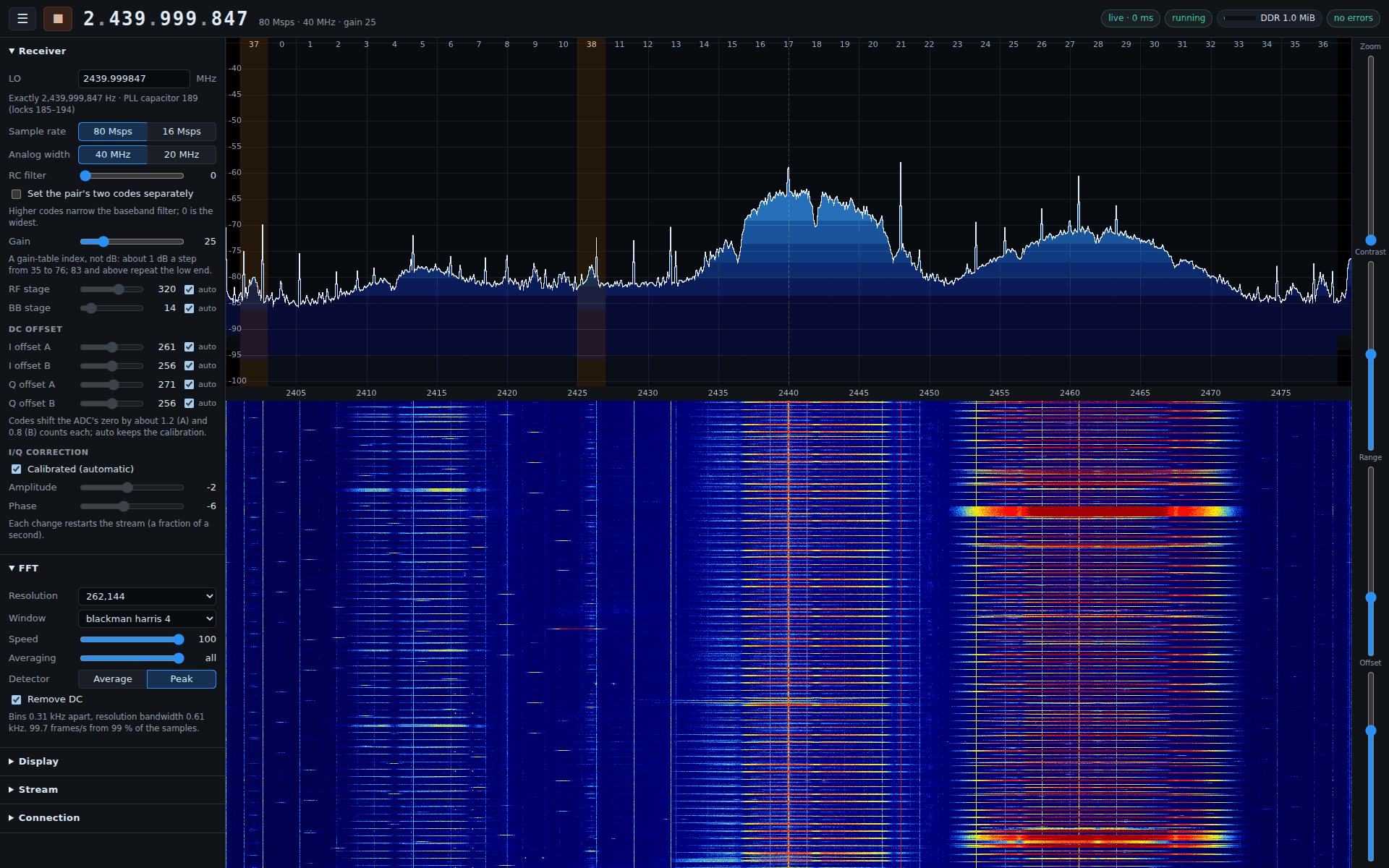 Figure: ESP32 raw spectrum output streaming into SDR++ at 80 MHz bandwidth, proving the IoT microcontroller can output usable IQ baseband data. Source: RTL-SDR.com
The walled garden of hardware-defined protocols has been breached. Fixed communication stacks are no longer an insurmountable barrier: once raw RF data is exposed to memory, any custom protocol can be reverse-engineered and reconstructed entirely in software. The newer ESP32-S31 can stream raw IQ data continuously at 16 MS/s over its Gigabit Ethernet interface, bridging the performance chasm between budget microcontrollers and specialized RF receivers.
How $5 Silicon Shatters Regulatory Frameworks: When RF Compliance Loses Its Physical Meaning
Regulatory certification for consumer electronics is predicated on the assumption that hardware functionality is strictly enumerable. When a lab tests a smart light bulb or IoT plug for compliance, technicians measure emissions within nominal operating bands. Nobody ever audits whether the chip secretly harbors full-spectrum IQ scanning capabilities.
The hardware array developed by the ESPARGOS team demonstrates the real-world stakes: they have achieved phase-coherent IQ capture across multi-antenna setups. The system bypasses standard Wi-Fi frames entirely, performing precise direction-of-arrival (DoA) tracking on arbitrary RF signals across the 2.4 GHz band. When an edge sensor can morph into an RF direction-finding interceptor within seconds, paperwork-based compliance testing becomes little more than security theater.
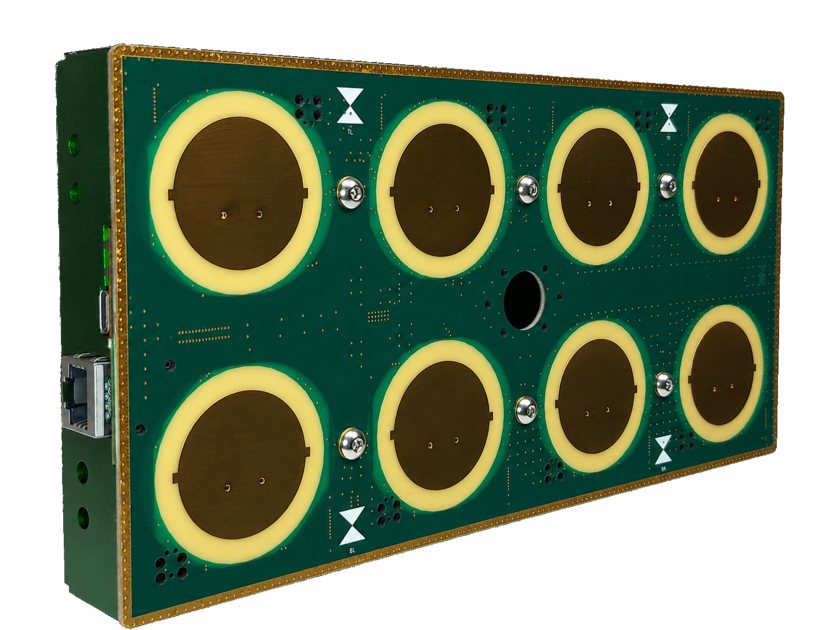 Figure: The ESPARGOS phased array testbed built from multiple ESP32 boards. This setup revealed the chip’s hidden RF capabilities and now performs phase-coherent radio direction finding. Source: espargos.net
IoT chips are deployed across the globe by the hundreds of millions. If every smart device quietly hummed in living rooms and factories possesses wideband baseband capture capabilities, distributed RF surveillance networks that once demanded millions of dollars in specialized infrastructure can now be stood up overnight at virtually zero hardware cost.
Self-Imposed Limits on Transmission: A Defense Guarded Only by Ethics
After thoroughly laying bare the chip’s reception capabilities, the ESPARGOS team deliberately hit the brakes. In their documentation, the researchers openly acknowledged that phase-coherent transmission is architecturally viable on existing hardware, yet they chose not to release transmission code to prevent malicious spectrum jamming and interference.
Leaving the perimeter of public radio security in the hands of hacker ethics is an implicit admission that architectural defenses have fallen. Withholding transmission code is merely buying time: now that the hardware registers and execution paths have been mapped out, completing the transmit chain is only a matter of time. The C5VRX project—which successfully demodulated 5.8 GHz analog FPV video using an ESP32-C5—underscores how rapidly community reverse-engineering is progressing beyond original expectations.
Silicon Redundancy and Architectural Overreach: The Collapse of Device Boundaries
Semiconductor designers routinely leave test registers and undocumented debug engines on-die to facilitate wafer-level validation and trim manufacturing costs. In an era when embedded compute was scarce, this practice carried minimal risk—the microcontroller lacked the horsepower to do anything meaningful with rogue data streams anyway.
That security equation implodes when a $5 piece of silicon packs enough compute and memory bandwidth to ingest tens of megahertz of raw radio spectrum. Regulation, compliance, and device classification all rely on the illusion that hardware form dictates function—an illusion shattered by a five-dollar chip. The boundary defining “what this device is” has evaporated. A device’s true capabilities are governed by whatever firmware resides in SRAM; its factory-molded plastic enclosure tells us almost nothing.
References:
- Hacker News Discussion (item?id=49922674)
- RTL-SDR.com
- ESPARGOS Project Homepage