
Sixteen billion years. Even if every one of the estimated three billion GPUs on Earth were replaced with top-tier RTX 5090s running at 100% capacity around the clock, brute-forcing a specific second-preimage hash collision against MD5—an algorithm long considered cryptographically broken—would still take longer than the current age of the universe. That is the brute-force cost boundary calculated by Scott Chacon, founder of GitButler and co-founder of GitHub. Yet in the real world, Git 3.0 is preparing to forcibly migrate its default object hashing algorithm from SHA-1 to SHA-256. To defend against an attack vector with an extraordinarily low return on investment—one that borders on purely theoretical in production engineering—the global code hosting and developer tooling ecosystem faces an extensive infrastructure tear-down. This costly forced migration lays bare the deep chasm between cryptographic compliance mandates and frontline software engineering realities.
A Multi-Thousand-Dollar Attack Sparks Overzealous Defense
Ever since the security research community demonstrated the SHAttered collision in 2017 and published the far more destructive “SHA-1 is a Shambles” research in 2020, SHA-1 has undeniably been broken from a theoretical cryptographic perspective. By spending a few tens of thousands of dollars to rent GPU compute clusters in public clouds, researchers or attackers can engineer two distinct files that share the exact same hash digest. Authoritative bodies like the National Institute of Standards and Technology (NIST) have long since issued formal advisories urging all modern applications to deprecate SHA-1. From the macro vantage point of compliance audits and long-term security posture, Git—as the bedrock supporting the global software development lifecycle—must keep pace with contemporary cryptographic standards. In terms of classical defense dogma, enduring one-time pain to secure decades of baseline certainty feels like a justifiable decision.
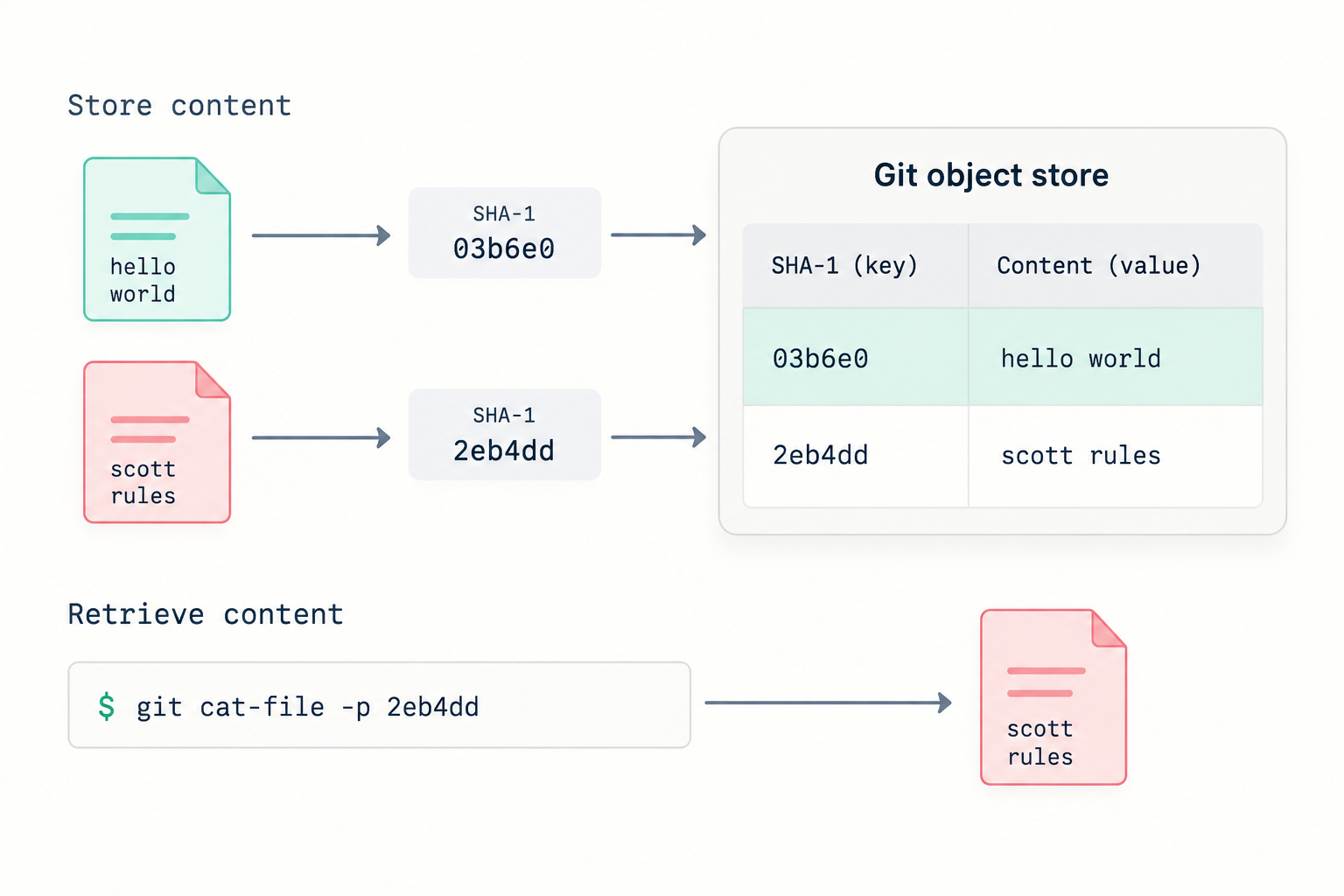 Figure: Git treats SHA-1 hashes as keys in a key-value object database. Source: GitButler Blog
However, real-world adversaries stalking production targets do not follow the academic flexes seen in cryptography papers. Across the intricate web of the open-source supply chain, the cheapest and most effective way to compromise a codebase has never been spending fortunes computing hash collisions. Attackers deploy social engineering to hijack the account or access tokens of an NPM package maintainer whose library is depended upon by millions of downstream projects. Once inside, they inject malicious logic directly into sources that already reside on approved allowlists. The open-source world is held together by unpaid volunteers running projects on personal enthusiasm, surrounded by third-party package registries that frequently lack automated security verification. In such an environment, burning tens of thousands of dollars in compute to forge a synthetic Git commit history is easily the clumsiest, least cost-effective attack path imaginable. Treating theoretical algorithmic flaws at the compliance tier as the center of daily defensive strategy results in a systemic misallocation of scarce security resources.
Developers Trust Distribution Platforms, Not Low-Level Formulas
Back in 2005, Git creator Linus Torvalds explicitly codified the system’s design philosophy on the Linux Kernel Mailing List: never treat SHA-1 as an infallible cryptographic shield. Real security always lives within the distribution and review pipeline. At its core, Git is a content-addressable key-value object database, and the hash function is merely the lookup key used to retrieve data efficiently. Identical file contents yield identical hash keys, ensuring that identical blobs are stored exactly once across the repository and dramatically optimizing disk footprint. The primary mandate of the hash algorithm within Git’s architecture is data integrity during network transit and local storage—not serving as an unforgeable identity verification mechanism for code authorship.
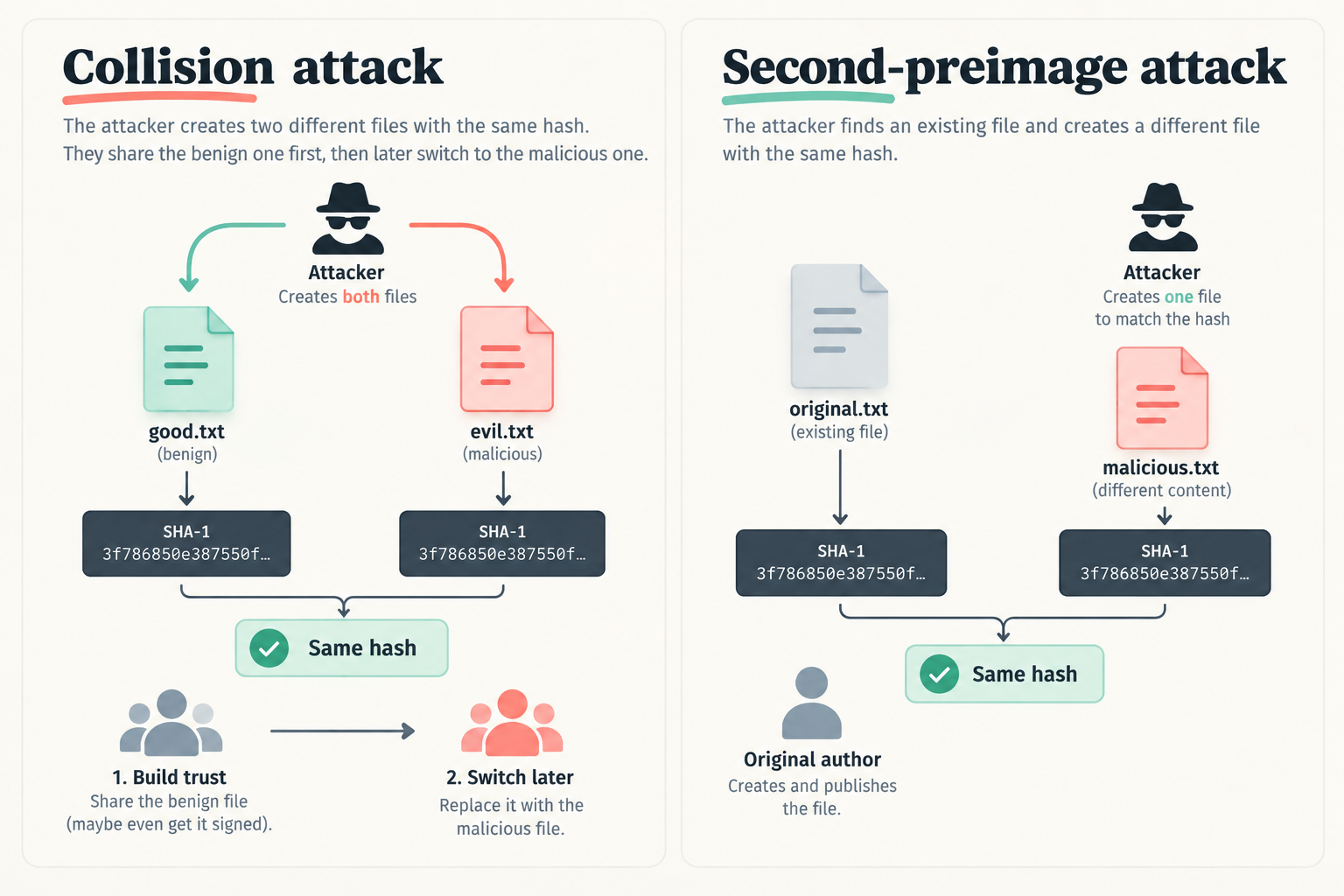 Figure: Collision attacks vs second-preimage attacks. Source: GitButler Blog
When engineers worldwide pull updates from centralized hosting platforms like GitHub or GitLab, their subconscious trust rests upon account isolation, two-factor authentication, and strict repository permission models. Developers trust that commercial hosting infrastructure is sufficiently fortified so that no external attacker can silently bypass maintainer reviews and force-push malicious modifications into the main branch. This hard-won engineering trust bears no functional correlation to the bit length of the commit hash. Strip away that verified platform layer, and even if Git were backed by post-quantum cryptographic primitives, no sensible developer would blindly pull and run code from an anonymous Tor hidden service or an unverified personal server. Security gates and review policies in distribution channels are the genuine foundation of modern code trust.
Forcing a New Format Shatters a 20-Year-Old Tooling Ecosystem
The moment Git 3.0 lands SHA-256 as its default configuration, every new project initialized through standard CLI commands risks becoming an incompatible island cut off from existing workflows. When unprepared developers attempt to push code to remote servers that have not yet enabled support for the new object format, they will be greeted by fatal protocol rejection errors. Millions of routine users will suddenly be forced to understand and manually specify low-level hash formats when initializing repositories, while verifying compatibility options across diverse cloud hosting providers. For a foundational utility that has achieved ubiquity precisely because it “just works,” offloading this cognitive overhead onto everyday developers severely degrades the frictionless developer experience.
Migrating legacy repositories presents even steeper friction. Switching the primary hash algorithm in an established repository containing tens of thousands of historical commits requires massive compute overhead to reconstruct every internal Git object from scratch. Worse, it invalidates all existing GPG and SSH commit and tag signatures overnight. If globally distributed collaborators fail to synchronize client upgrades simultaneously, commit histories will bifurcate into disastrous divergent lineages. Historical commit SHA links scattered across email threads, issue trackers like Jira and GitHub Issues, technical documentation, and chat archives will permanently break into unresolved dead pointers. To support both formats side-by-side, hosting platforms must maintain expensive bi-directional translation mappings, driving up background operational loads and storage footprints.
The blast radius across the peripheral developer toolchain will be equally severe. Because Git is distributed as a GPL-licensed standalone binary, its architecture has historically resisted clean library embedding. As a result, the ecosystem is populated by independent reimplementations—such as libgit2, JGit, and go-git—alongside bespoke custom parsers. Many community-maintained libraries that lack commercial backing have yet to fully implement the complex SHA-256 object format. Any deployment script, CI/CD pipeline, or static analysis tool that does not invoke the official Git binary via direct process fork-exec will crash when encountering a SHA-256 repository. Anticipating this cliff-edge compatibility hazard, senior Google engineers have publicly discussed internal overrides: configuring environment variables across internal workstations to force all newly created repositories to stick with SHA-1, keeping this disruptive infrastructure overhaul safely quarantined outside their perimeter for as long as possible.
Independent Tree Hash Headers: A Practical Route for Security Compliance
Faced with ongoing compliance mandates from NIST to deprecate SHA-1, completely replacing the repository-wide object format is not the only viable engineering path. Veteran practitioners like Scott Chacon have not only questioned this strategy but have implemented and benchmarked a lightweight compromise known as Independent Tree Hash Headers. Under this design, the system uses SHA-256 to independently calculate a full hash over the directory tree structure, embedding the resulting digest as an auxiliary verification header inside the existing commit signature payload. Through this dual-track architecture, the legacy SHA-1 engine continues to provide lightweight, high-performance content addressing and history traversal, while the supplementary SHA-256 header delivers robust, tamper-evident cryptographic validation. Computing an independent tree hash on modern hardware incurs negligible latency while preserving two decades of accumulated tooling compatibility.
This debate over hash migration exposes a fundamental philosophical rift in software infrastructure evolution. Proponents of an aggressive transition argue that core protocols must be proactively hardened against unknown future risks, advocating for a sharp, one-time disruption to eliminate long-term cryptographic liability. Conversely, pragmatists led by Chacon point out that over ninety percent of developers operate strictly within trusted enterprise platforms. They should not be forced to pay an exorbitant ecosystem tax to guard against an attack vector that currently exists only in theoretical security papers. When a 1% theoretical compliance edge case demands that the 99% majority rebuild their entire workflow, the software industry must re-evaluate where defensive perimeters genuinely belong. Forcing a global format change that fractures backward compatibility to seal an attack vector that no practical attacker would ever utilize simply trades massive engineering disruption for an illusion of security.
If the tech community abandons continuous investment in trusted distribution pipelines and instead chases an endless cryptographic arms race of raw hash lengths, the industry will inevitably face another painful, ecosystem-fracturing migration when quantum computing scales up to threaten SHA-256. True infrastructural resilience lies in recognizing and reinforcing the real-world nodes of the code distribution network, rather than placing all survival bets on a single low-level checksum formula. Reducing overall system security to the raw cryptographic strength of an underlying hash is perhaps the most dangerous engineering fallacy of this transition.
Reference Links:
- Git 3.0’s upcoming SHA-256 default will be a costly mistake
- Hacker News Discussion
- Lobsters Community Discussion