On October 1, Earendil officially released the 1.0 stable version of Pi, its “minimalist agent harness.” Over the past six months, most AI coding assistants have been chasing LLM release cadences on a weekly basis, frantically piling on features in an attempt to engulf the developer’s entire workflow. Pi took a deliberately counterintuitive path. For version 1.0, it incorporated only the handful of capabilities that proved their staying power. The team claims hundreds of thousands of regular active users and adopted a clear philosophy: throw features at the wall and keep only what sticks—and the list of dropped features turned out far longer than what remained. Launching in tandem with 1.0 is an independent experimental package, Pi Durable. This architectural separation directly reflects diverging developer expectations across different operational contexts.
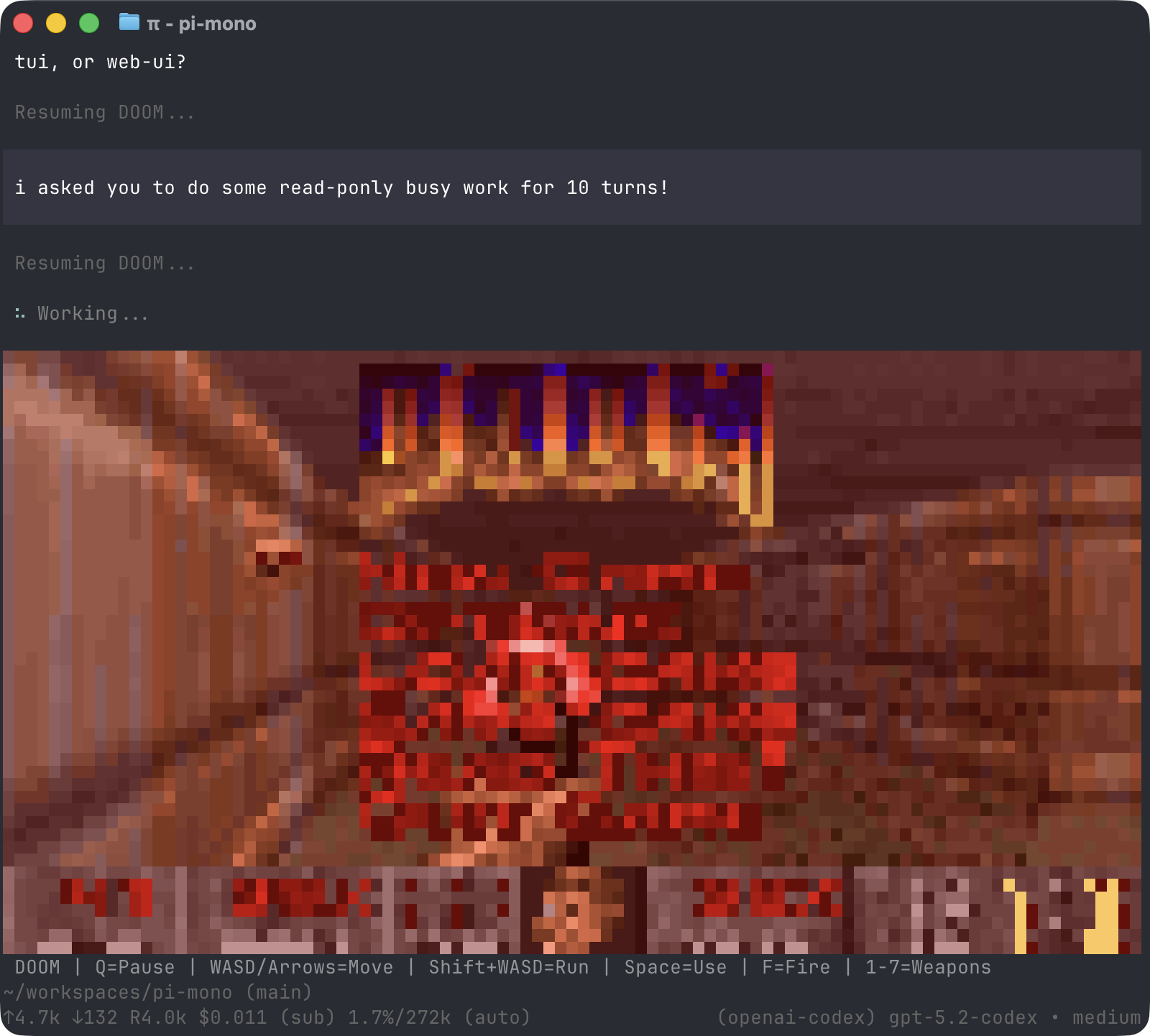 Figure: Screenshot from the official homepage showing Doom running inside Pi via its extension system. Source: pi.dev
More Features Fell Off the Wall Than Stuck
Pi 1.0’s feature changelog is strikingly restrained, revolving almost entirely around execution efficiency and runtime compatibility. Leading the official list is Codemode, featuring native support for the Model Context Protocol (MCP) as well as non-LLM and vision models like Jev. Low-level protocol compatibility allows developers to bypass heavy middleware and hook their terminal directly into local compute resources, avoiding convoluted port forwarding and permission configurations. Support for virtual models and mid-session system prompt updates significantly improves context adaptability during extended interactions, letting engineers switch underlying engines on the fly.
Deferred tool loading and Anthropic prompt cache warming tackle the chronic issue of sluggish cold starts. Bulky agent frameworks typically load their full suite of tools upfront, severely delaying time-to-first-token. Pi defers loading until the precise moment the model makes an execution decision. Paired with API cache warming, redundant context recomputation is drastically cut—leading to immediately noticeable drops in latency and API bills. For high-frequency, brief interactions, the performance gain is instantaneous.
Defaulting to full-screen mode and introducing new TUI themes represent virtually the only surface-level cosmetic changes in 1.0. This restraint pays off in an exceptionally small footprint. Even with these additions, Pi maintains strict single-responsibility design. If a tool isn’t lightweight, it cannot survive across multiple terminal panes; in automated CI/CD pipelines, server memory is at a premium, and unnecessary resident memory usage constitutes an architectural defect. Installing Pi requires nothing more than curl -fsSL https://pi.dev/install.sh | sh, with PowerShell one-liner support for Windows. Operating without a heavyweight pre-installed runtime is precisely why Pi thrives in the tightest crevices of modern server fleets.
Good Infrastructure Needs No Soul
In the Hacker News discussion that surged to the top spot, Pi’s minimalist design received overwhelming praise. Developer FacelessJim shared benchmarks from constrained local setups: when running large models on low-spec laptops, Pi was among the very few harnesses that ran smoothly. The key reason was Pi’s omission of bloated initial system prompts, sparing local models minutes of prefill overhead. Having run Pi unadorned for months with only basic custom extensions, he noted the setup remained rock-solid, offering a lifeline for local AI enthusiasts bottlenecked by compute.
Another user, RickS, described an even more telling experience. Having tried deploying openclaw, he was immediately repelled by the default configuration bloated with “soul” declarations and persona documentation. Such Byzantine complexity increases cognitive load and makes debugging an exercise in frustration. Stripping back to a clean Pi installation, the minimal and easily intelligible architecture provided an ideal baseline. He also noted that a contingent of users had migrated away from openhands simply because they grew tired of heavyweight Docker infrastructure and screens cluttered with emoji. In serious software engineering, flamboyant anthropomorphic packaging only gets in the way of deep work.
Names like openclaw, Claude Code, and Jev surfaced repeatedly throughout the comments. The perspective of end users is unmistakable: Pi’s competitive battleground is the minimalist glue layer, not the model layer itself. Developers do not want a chat companion with an artificial personality; they want a dependable execution engine free from prompt pollution. By stripping the framework down to bare bone, Pi hands maximum control back to the engineer.
The Terminal Single-Session Hits Its Ceiling
On the same day 1.0 landed, Earendil published @earendil-works/pi-durable. Pi Durable has an unambiguous mission: to serve as the foundational runtime for long-running, resilient, and malleable agent workflows. Single-session terminal coding agents inevitably hit a wall when tasks stretch over several hours. A system sleep cycle, dropped SSH connection, or accidental terminal close wipes out the entire session state. That fragility makes standard harnesses unsuited for multi-hour compiles, extensive codebase refactors, or long-running regression test suites.
Pi Durable introduces four core primitives: accept, drive, requestAbort, and inspectExecution. These primitives guarantee atomic inspection of execution states and provide reliable recovery mechanics. Developers can compose convenience methods like prompt and resume with custom wait strategies, turning robust task suspension and reactivation into a reality. This design draws inspiration from traditional operating system process scheduling.
Moving long-running task handling outside the core CLI signals an acknowledgment that the single-session model has hit its engineering ceiling. Shoehorning persistent storage and checkpoint-resume mechanics directly into a terminal utility would have turned Pi into the exact monolithic suite it sought to replace. Decoupling it into a standalone package preserves the CLI’s agility while offering pluggable extensibility for complex pipelines. Developers get the snappy responsiveness of Pi 1.0 for interactive work, alongside the ability to invoke Pi Durable when heavy lifting is required.
 Figure: The minimalist visual style of the Pi 1.0 release banner. Source: Earendil official blog
Durability Takes Over the Background
Community engineers are already putting Pi to creative use. User vergessenmir noted that combining Pi with cron jobs and event triggers replaced the bulk of their complex openclaw setups. RickS used a lightweight skill to bridge Obsidian task lists with a Tailscale chat interface, assembling an on-demand personal assistant in less than a day. When a tool hones its API surface cleanly, the community naturally builds the application ecosystem on top.
Inevitably, introducing new features into unconventional environments surfaced compatibility quirks. Several veteran users expressed frustration with the full-screen default: inside nested environments running GNU Screen and macOS Terminal.app, model streaming text produced vintage ANSI flickering. Hardcore users traced this transient rendering artifact to Screen’s internal logic and patched it themselves. Others reported cursor position jumps during long-context generation. When minimalist tools are embedded into complex developer environments, terminal fragmentation remains an inescapable reality.
Pi 1.0’s defining quality is not what was added, but the strict product discipline of minimalism. While most agent tools frantically chase the weekly hype cycle, Pi kept only what genuinely survived production scrutiny. By spinning out Pi Durable to handle background workloads, Earendil recognized that the single-session coding agent has reached its limits. The next phase of competition is no longer about making chat assistants sound clever—durability has become the real foundation for commanding the background.
References:
- Earendil Official Blog
- pi.dev Official Site
- Hacker News Discussion