In TPC-H benchmarks, DuckDB 2.0.0’s Command Line Interface (CLI) slashes the output payload that LLMs must ingest by 59%. Code-named “Cinnamon Teal” (Spatula cyanoptera), this long-term support release incorporates nearly 20,000 commits merged since version 1.5. An in-process analytical engine is now designed explicitly for machine callers, cloud object storage, and multi-year operations: DuckDB has officially transitioned from a local analytics tool into production-grade data infrastructure.
 Figure: DuckDB 2.0.0 LTS code name and support lifecycle. This version will be actively maintained through October 2027. Source: DuckDB Official Blog
For years, the developer consensus framed DuckDB primarily as a companion for data scientists working in local Python notebooks. With 2.0, its audience, data shapes, and deployment targets have shifted fundamentally. SQL queries are increasingly authored and submitted by coding agents; upstream data arrives as messy, semi-structured documents; and persistent storage has moved to remote object stores. Re-architecting the database engine around these new workloads forms the central narrative of this milestone release.
CLI Auto-Detects Agents, Cutting Output Volume by 59%
Today, the entity typing duckdb in the terminal is often an autonomous coding agent like Claude Code, Codex, or Cursor. While human operators appreciate ASCII-padded tables with borders, models billed per token see those spaces and delimiter characters as expensive noise. The default consumer of database interfaces is decisively pivoting from human eyeballs to model context windows.
When DuckDB 2.0’s CLI starts up, it automatically inspects whether its parent process is an AI agent and seamlessly transitions into agent mode. Under this mode, results render as compact Markdown tables, truncated result sets explicitly include truncation boundaries, and error messages format cleanly as structured JSON. Developers can invoke this mode manually via the -agent flag for debugging or force the traditional tabular output with -no-agent.
Beyond payload compaction, agent mode acts as a safety harness. Long-running queries estimate computational cost prior to evaluation, allowing the calling agent to decide whether to proceed. If a query runs amok, the CLI automatically trips a circuit breaker. Having the database engine proactively surface query costs and intercept runaway execution directly addresses a notorious engineering headache: agents getting trapped in blind trial-and-error loops that lock up terminal pipelines.
Asynchronous I/O Decouples Remote Reads, VARIANT Unlocks Semi-Structured Workflows
As agents and automated pipelines take over execution, data sources increasingly lie beyond the confines of local NVMe disks. Version 2.0 introduces native Asynchronous I/O across Parquet, CSV, and native DuckDB storage files. The I/O subsystem is cleanly decoupled from the query execution engine: background worker threads dispatch concurrent read requests without stalling foreground vectorized execution operators.
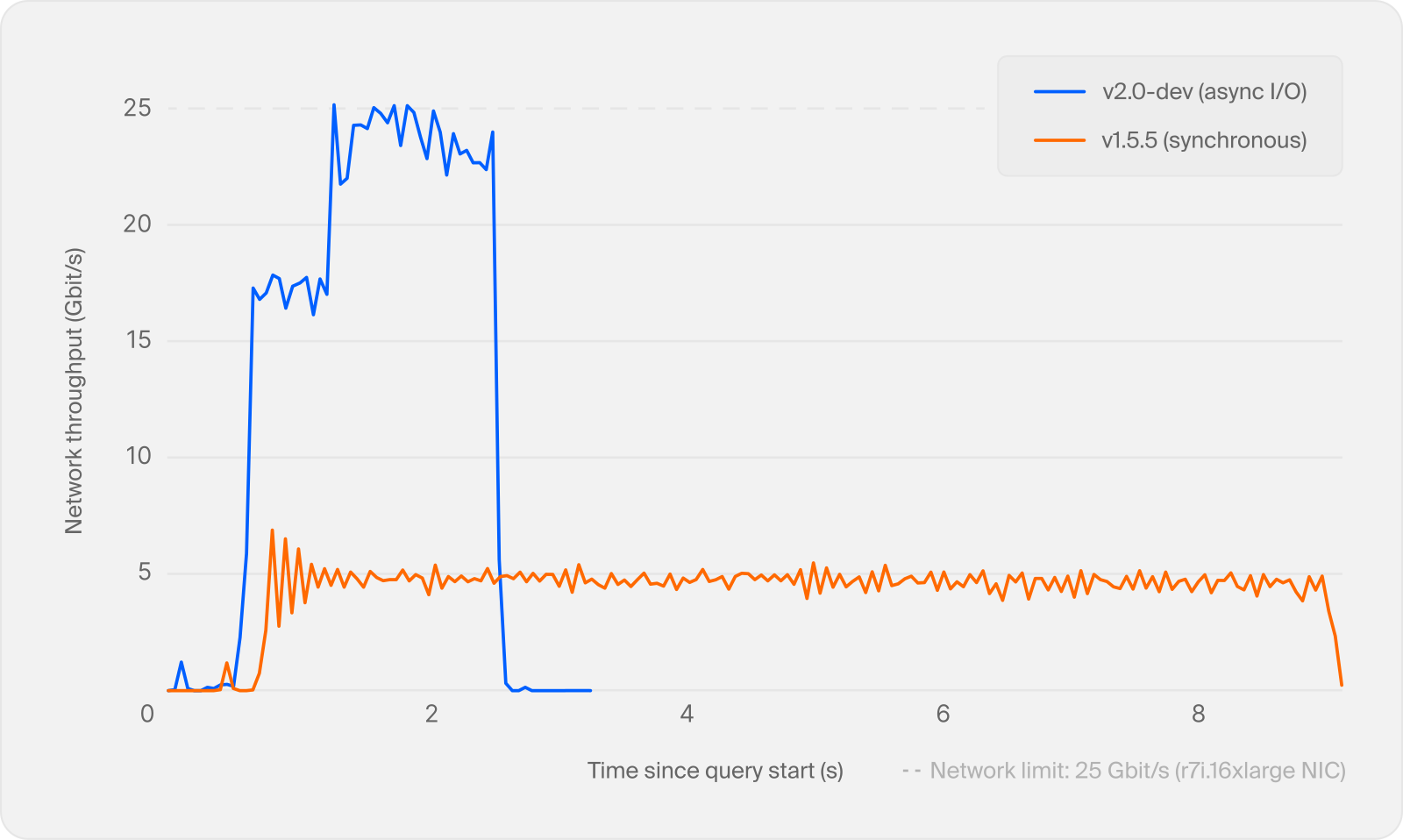 Figure: Enabling Asynchronous I/O significantly improves network bandwidth utilization during queries, eliminating throughput valleys caused by synchronous waiting. Source: DuckDB Official Blog
On local SSDs, synchronous wait times remain manageable. But over high-latency object stores like s3://, serialized synchronous fetches leave network interfaces underutilized. Asynchronous I/O dramatically ramps up network throughput saturation and reduces wall-clock execution times for cloud analytics workloads. Treating cloud object storage as a first-class citizen eliminates the cumbersome ritual of staging remote datasets onto local scratch disks before querying.
Upstream data paradigms have shifted in tandem. Production logs and API payloads arrive as schemaless JSON lines. While version 1.5 previewed the VARIANT type, 2.0 deeply embeds it into the columnar execution engine. The engine automatically analyzes shared schemas and performs columnar shredding on the fly. It supports full read/write interoperability with Parquet and adds dedicated utility functions like variant_type(payload) and variant_keys(payload). Processing schema-agnostic semi-structured data at columnar speeds wipes away the extraction and ingestion penalties between document stores and relational analytics.
The Quack Protocol and Triggers: Taking On Server-Side Responsibilities
Deploying DuckDB in production historically met friction due to the absence of a standardized server mode. In May, version 1.5.3 previewed the Quack protocol and quack extension; 2.0 refines this client-server architecture for production use. Launching a remote server requires only CALL quack_serve(token = 'my_token'), after which remote clients mount and switch databases via standard ATTACH combined with the new CONNECT statement.
For security, Quack server instances bind exclusively to localhost by default. Official guidelines recommend placing an authenticating reverse proxy with TLS termination in front of multi-node setups, reserving allow_other_hostname strictly for testing environments. Furthermore, CONNECT natively bridges DuckDB to PostgreSQL and MySQL instances, where a brand-new Remote Pushdown optimizer offloads compute directly to the remote source. This turns the in-process engine into an efficient federated query router, preventing network disasters where entire remote tables are transferred over the wire into local memory.
On the SQL dialect side, 2.0 introduces full CREATE TRIGGER support, accommodating BEFORE and AFTER triggers at both row and statement levels, alongside transition tables accessed via REFERENCING OLD/NEW TABLE. While certain combinations like BEFORE ... FOR EACH ROW and UPDATE ... FOR EACH ROW remain work in progress, the current implementation fully covers audit logging and incremental materialized view maintenance. For instance, attaching insert and delete triggers to an employee table allows maintaining real-time average age per nationality without scanning the entire table on each change. Native triggers empower DuckDB to handle lightweight state management internally, removing dependencies on external orchestration scripts.
PEG Parser and Self-Hosted Extension Repositories: Foundations for Long-Term Evolution
Stepping into core infrastructure roles demands resilient extensibility and supply chain hardening. Since its first commit in 2018, DuckDB relied on a YACC/Bison-generated LALR(1) parser derived from PostgreSQL. As the dialect expanded, minor grammar adjustments routinely clashed with existing rules, yielding shift/reduce conflicts.
DuckDB 2.0 establishes a new Parsing Expression Grammar (PEG) parser as default, keeping the legacy_parser extension available as a fallback. The PEG engine matches rules in prioritized order, isolating new syntactic constructs from unrelated parser branches and providing precise error highlighting. Third-party extensions can now attach custom syntax directly into the AST. Coupled with the concurrent release of C API v2, internal filesystems and table functions are now fully modular. Switching to a PEG parser clears the roadblocks for external teams seeking deep dialect customization without patching core engine sources.
To satisfy enterprise compliance, 2.0 also introduces self-hosted trusted extension repositories. Administrators run CREATE EXTENSION REPOSITORY to configure URL prefixes and register RSA public keys; DuckDB pins the key on creation and displays a SHA-256 fingerprint for verification. Simultaneously, DuckLake 1.1 received updates alongside the Iceberg and Delta extensions, with Iceberg gaining REST catalog mounting and Delta introducing table creation and time-travel querying. Community reactions to this expansion into server protocols, triggers, and enterprise repositories remain nuanced: some developers worry feature growth could bloat the lean analytical core, while others argue that consolidating recurring peripheral demands into official extensions and standard protocols is far easier to maintain than fragmented glue scripts.
From an engineering lifecycle perspective, DuckDB leadership made its roadmap commitments clear: 2.0.0 LTS will receive active maintenance through at least October 2027. Combined with the 1.5 branch maintained through March 2027 and the 1.4 branch supported through November 2026, DuckDB now runs three concurrent production streams. Although client libraries for Go, R, and Java will take a few additional days to finalize, this long-term horizon cements its identity. An in-process database engine has unified agent-first interfaces, asynchronous cloud I/O, columnar semi-structured processing, and multi-year LTS stability—setting its sights on becoming foundational bedrock for modern data stacks.
Reference Links:
- DuckDB 2.0.0 LTS Official Announcement
- Hacker News Community Discussion