On October 21, 2026, OpenAI and collaborating research teams published landmark findings: a fleet of 1,946 specialized AI agents worked collaboratively to complete an analysis of a whole-mouse-brain genetic atlas in just 32 minutes. The atlas captures cellular editing responses across millions of brain cells—a scale of high-dimensional data that typically takes human scientists years to decipher.
This is far more than a raw compute benchmark; the real transformation lies in the granularity of engineering decomposition. Confronted with massive biological datasets, monolithic foundation models routinely struggle with context window bloat, yielding bland, superficial generalizations. Instead of relying on a single mega-model to handle the entire analytical lifecycle, the researchers decomposed complex scientific inquiry into thousands of micro-tasks executed concurrently.
Compressing Years into 32 Minutes: What Were Nearly 2,000 Agents Computing?
The mouse brain consists of intricate cellular networks. Researchers deployed pooled CRISPR perturbation screens to systematically disrupt key target genes. As specific genes were silenced, downstream expression levels across thousands of companion genes fluctuated. The complete atlas tracked perturbations across millions of individual cells, generating astronomical data volumes.
Human biologists analyzing such datasets must cross-reference heatmaps and tabular readouts endlessly, often spending months digging through literature to formulate mechanistic hypotheses. The 1,946 agents running GPT-Rosalind never attempted to ingest the entire dataset in one bite. Instead, the architecture partitioned perturbation profiling and literature retrieval into standardized modular stages, assigning each agent to scrutinize a single microscopic question.
Across 32 minutes of pipeline runtime, the agent swarm synthesized 3,397 distinct biological inferences. Downstream algorithms assembled these building blocks into a unified reasoning graph. The pipeline operated without human hyperparameter tuning during inference; hypotheses were derived directly from raw gene expression matrices. All findings have been open-sourced on GitHub as a shared reference for neurodegenerative disease research.
Monolithic Models Cited 11 Papers; Granular Decomposition Unlocked 7,600
A scientific inference is only as credible as its evidentiary foundation. When presented with this massive task, a single monolithic LLM fed the whole dataset cited just 11 references. That omission highlights a fundamental bottleneck of monolithic models: as input load exceeds cognitive headroom, retrieval fidelity and attention focus deteriorate rapidly.
The distributed swarm revolutionized how information flows. Nearly two thousand agents took on specialized division-of-labor roles—retrieval, hypothesis formulation, and adversarial cross-examination. Each sub-population targeted specific gene anomalies across distinct cell types. According to the bioRxiv preprint, the distributed system retrieved and cross-verified approximately 7,600 academic papers for the exact same benchmark—a 711-fold increase in bibliographic coverage over the monolithic baseline.
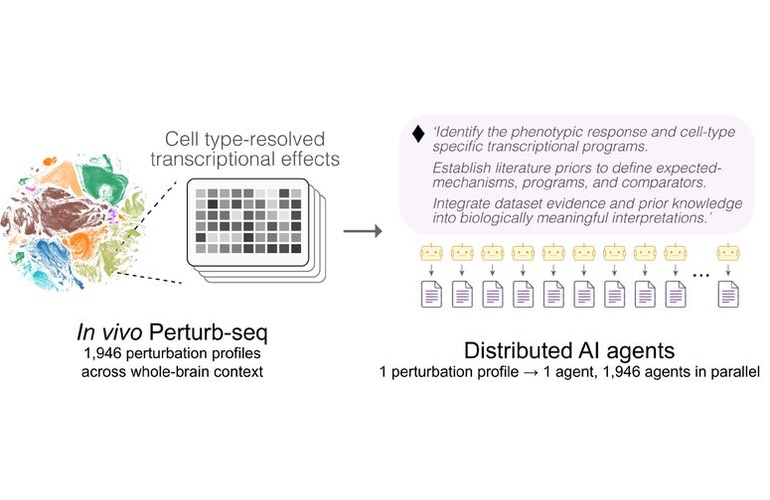 Figure: Tiered scheduling architecture of distributed agents, where each node independently conducts literature matching and counter-verification for single-gene perturbations. Source: R&D World (adapted from Sun et al., bioRxiv)
Dumping uncurated data into LLMs invites spurious correlations and hallucinations. By partitioning the pipeline and tasking thousands of agents with reading targeted excerpts in depth, the swarm constructed an airtight web of evidence. The depth of task decomposition directly governs the bibliographic breadth and empirical rigor of scientific reasoning.
30 Biology PhDs Run Blind Reviews: 48 Discoveries Replicated on the Spot
Generating AI hypotheses is easy; surviving rigorous peer scrutiny is hard. To validate output reliability, the team enlisted 30 biology PhDs in a double-blind evaluation. Reviewers scored the quality of inferences without knowing whether reports originated from humans or machine swarms.
The agents had never seen the original human study drafts. Yet under blinded testing, they independently reproduced 48 out of 55 landmark findings from the biological literature—an 87% replication rate. In qualitative head-to-head comparisons, human domain experts preferred the distributed agent reports in 75% of evaluation scenarios.
 Figure: Left shows the gene expression perturbation matrix across millions of mouse brain cells; right depicts the reasoning topology expanded concurrently by nearly 2,000 agents. Source: madrobot.blog
Single-model analyses frequently regurgitate textbook trivia without elucidating mechanistic interactions. In contrast, the distributed cluster enabled nodes to critique each other’s claims, proactively pruning speculative logic jumps. Engineered multi-agent cross-examination drastically slashes hallucination rates in scientific workflows.
Uncovering Hidden Gene Pathways: AI Delivers Leads Directly to the Wet Lab
Replicating established biology is merely step one. The real payoff lies in spotlighting blind spots human intuition misses. When examining the DCTN1 gene, the swarm flagged an unexpected anomaly: knocking out the gene triggered a notable surge in cholesterol biosynthesis pathways.
DCTN1 encodes a dynactin subunit closely implicated in neurodegenerative conditions like amyotrophic lateral sclerosis (ALS). Previous studies focused almost exclusively on impaired axonal transport, rarely linking the gene to cholesterol homeostasis. By synthesizing dozens of niche papers, the swarm pieced together a coherent mechanistic hypothesis.
The synthesis proposed that halted axonal transport prevents cholesterol recycling from reaching the soma. Sensing localized deficits, the neuronal nucleus activates SREBP regulatory pathways for compensatory synthesis, exacerbating neuronal toxicity. Precise modular decomposition bridged previously disconnected domains, delivering a novel therapeutic intervention target for neurodegenerative drug discovery.
Compute Solves the Hypothesis Bottleneck, but the Wet Lab Remains the Final Judge
Synthesizing thousands of biological hypotheses in 32 minutes is a technical triumph. However, the ultimate arbiter of life sciences remains the physical behavior of molecules. An expansive bibliography signals comprehensive literature search, not infallible ground truth. Unverified by Petri dishes, pipettes, and assays, every computational output is ultimately an educated lead.
Co-authors emphasized that hypotheses generated by agents must undergo wet-lab experimental validation. AI cannot replace physical pipetting, but it fundamentally redefines how scientific hypotheses originate. Where researchers once spent months isolating a single lead, algorithms now deliver heavily evidenced hypotheses right to the lab bench.
When scientific workflows are broken down into granular units, compute evolves into a true catalyst for discovery. The blueprint for biological AI is coming into sharp focus: rather than waiting for an all-knowing monolithic model, coordinating hundreds of specialized micro-agents through disciplined cross-examination forms a formidable scientific vanguard.
Reference Links:
- OpenAI Official Research: Scaling AI Research for Complex Biological Data
- bioRxiv Preprint: Distributed AI Agents Enable Scalable Synthesis of Biological Insights
- R&D World Coverage: OpenAI Deploys Nearly 2,000 GPT-Rosalind Agents to Generate Biological Research Leads in 32 Minutes
- GitHub Open Source: Distributed Agent Framework for Biological Reasoning