On July 10, 2026, hardware reviewer Jeff Geerling posted a video: he’s holding a palm-sized device up against his workshop wall, and the screen lights up with a pale blue blob — the 5 GHz WiFi signal from his own router. He turns it toward the neighbor’s house. Their WiFi pops into view too, painted in red and green.
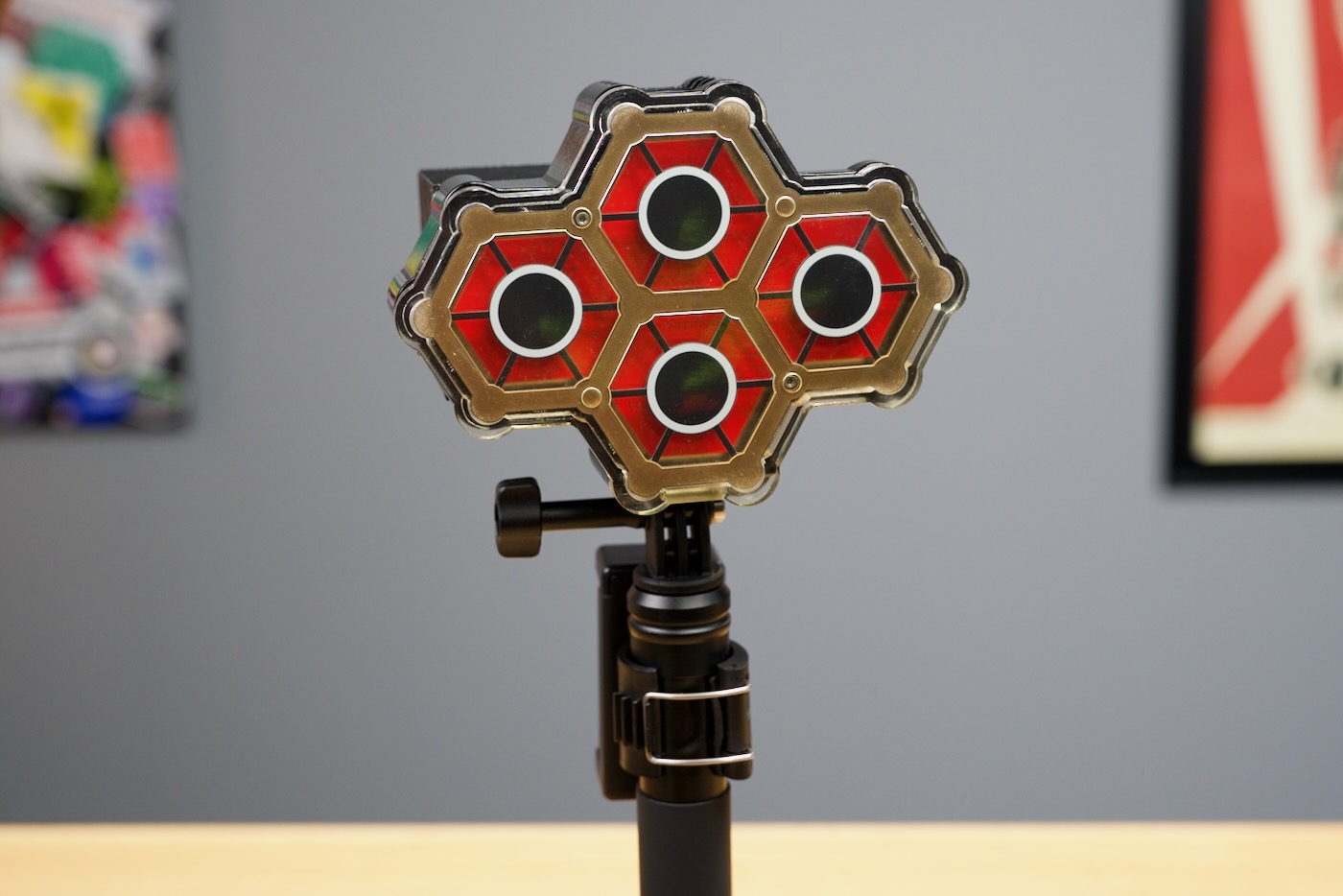 The QuadRF device, showing its 4-antenna array. Source: Jeff Geerling
The device is called QuadRF, crowdfunding at $499. I double-checked that price twice — not because it’s expensive, but because it’s absurdly cheap. The last device that could spatially locate radio signals was called a military phased-array radar.
It’s Not a Radio. It’s a “Radio Camera.”
Let’s be clear about what QuadRF actually does. It’s not a traditional radio — you don’t tune it to a frequency and listen to audio. It’s more like a camera, except the lens is pointed at radio waves instead of visible light.
The front of the device has four antennas arranged in a square array. All four receive the same signal from a single source. The trick isn’t the reception itself — it’s that the signal reaches each antenna at a slightly different time, measured in picoseconds (trillionths of a second).
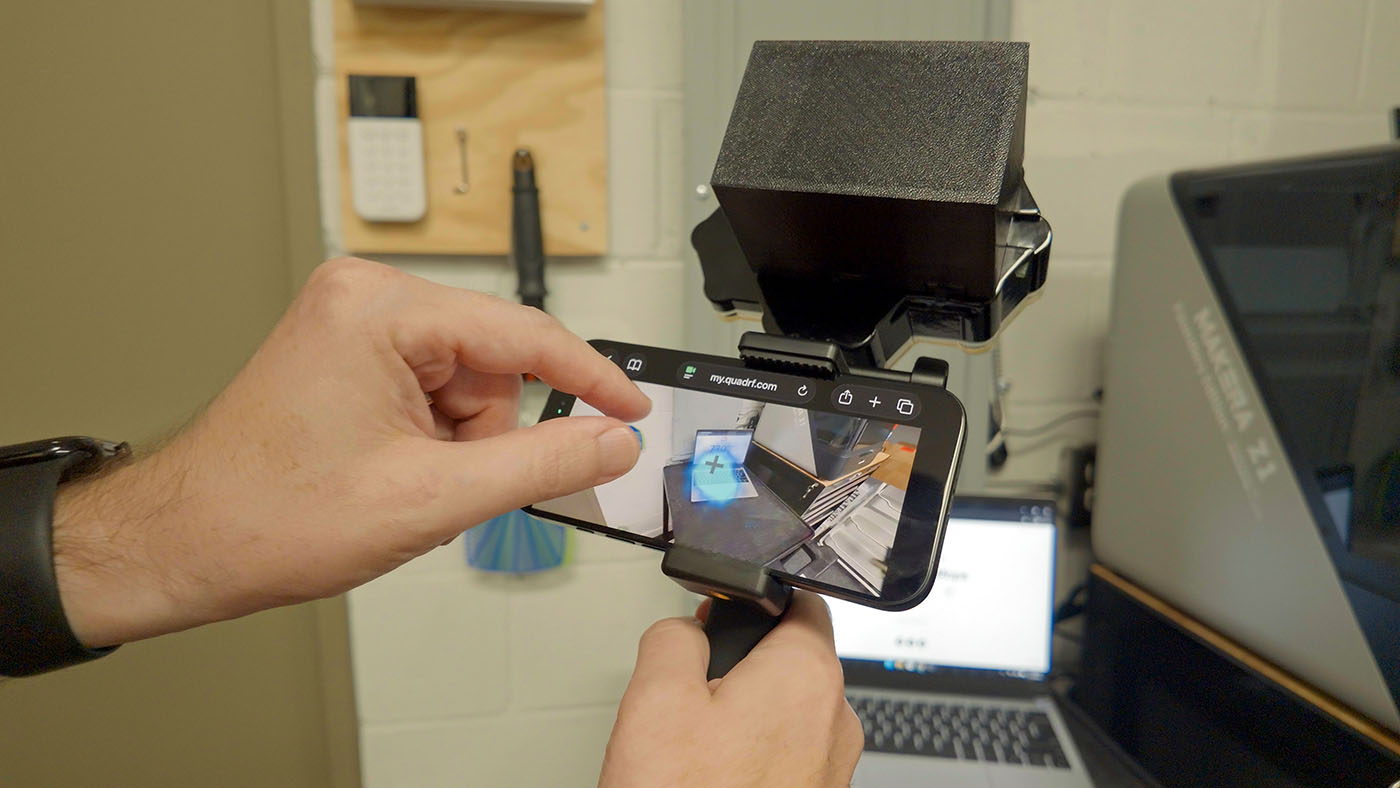 QuadRF’s augmented reality interface overlays detected WiFi signals as colored blobs onto the phone’s camera feed. Source: Jeff Geerling
Where does that time difference come from? The distance from the source to each antenna isn’t equal. Electromagnetic waves travel at the speed of light — 300,000 kilometers per second. If the signal source is off to the left, the wavefront reaches the left antenna slightly sooner than the right one. Those arrival-time deltas across the four antennas encode the source’s spatial direction. What QuadRF does is compute those timing differences and reverse-engineer where the signal is coming from.
The principle isn’t new. Radar has used it for decades. What’s new is cramming it into a handheld, Raspberry Pi-powered, open-source device with a $499 price tag.
Why It Can See Through Walls
WiFi signals already pass through walls — you use this fact every day. You’re scrolling on your phone in the bedroom while the router sits in the living room two walls away, and the connection still works. 2.4 GHz and 5 GHz electromagnetic waves penetrate brick, drywall, and wood framing reasonably well; they just attenuate in the process.
So QuadRF didn’t invent some “see through walls” black magic. It simply exploits the physical reality that WiFi already traverses walls, and then says: look, the signal is coming from that direction — even though the wall blocks your line of sight.
As Geerling wrote candidly in his post: “I’m not saying this to freak you out — governments have had similar tools for many years.” The subtext: QuadRF’s technology isn’t new. What it does is drag this capability out of the exclusive domain of governments and militaries and drop it into the consumer-electronics and open-source world.
There’s a sharp asymmetry at play here. In the physical world, radio waves have always passed freely through walls — a free capability provided by nature. But in the commercial and technological world, turning that capability into a tool normal people can afford requires breaking through a different kind of wall: the cost and complexity of phased-array antenna systems.
Traditional phased-array systems demand picosecond-level clock synchronization, multi-channel coherent signal processing, and complex beamforming algorithms. Each of those requirements means expensive custom silicon, proprietary RF front-ends, and closed software stacks. QuadRF’s approach is clever: it uses an FPGA for precision timing and pipes data through the Raspberry Pi 5’s camera interface — MIPI. Yes, the same ribbon-cable connector you’d use for a camera module.
The Pi 5’s MIPI interface delivers over 5 Gbps of bandwidth, supports low-latency full-duplex data transfer, and adds essentially zero extra hardware cost. The QuadRF team wrote something quietly profound in their documentation: “Cameras and displays are the ultimate forms of high-bandwidth signal transmission, and their standard digital interfaces turn out to be perfectly suited for moving radio data.” When I read that, I had a real “oh, of course” moment. Repurposing a camera interface for radio signals isn’t a hack — it’s a recognition that the two signal types share something fundamental.
It’s Not Just WiFi — That Drone Can’t Hide Either
Geerling and his father (a retired broadcast radio engineer) ran an even more interesting test. They flew a DJI Mini Pro 4 drone behind the workshop and pointed the QuadRF at the sky.
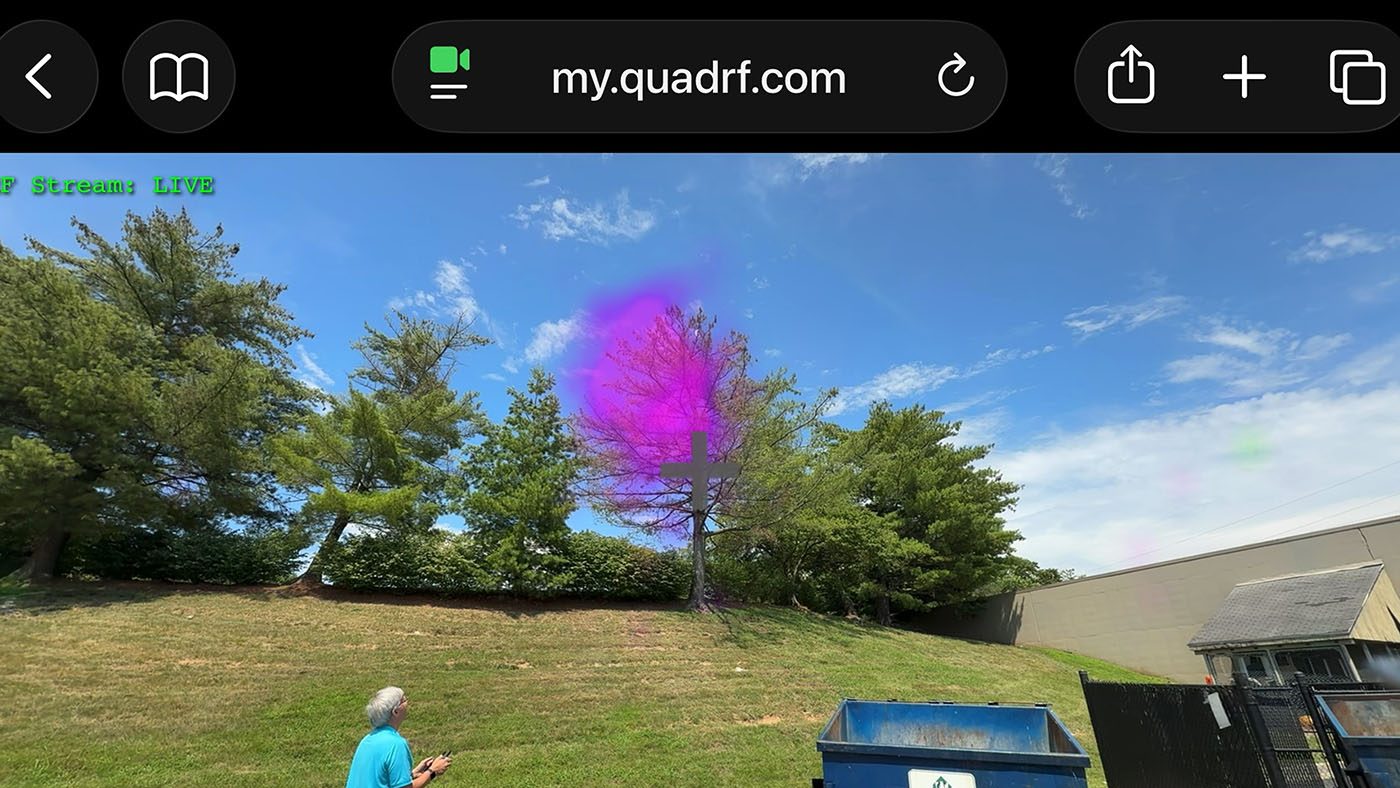 QuadRF in AR mode detects a drone mid-flight; the signal appears as a colored glow. Source: Jeff Geerling
The drone was picked up immediately — not by visual recognition, not by radar echo, but by the radio signal linking the drone to its controller. QuadRF operates from 4.9 to 6 GHz, which happens to cover the C-band frequencies most drones use for video transmission. As long as the drone is transmitting, QuadRF can tell you precisely where it is from the ground.
Geerling noted that as the drone flew farther away, he had to manually increase the receiver gain to keep tracking it. He thinks automatic gain control (AGC) would be a practical improvement — the current interface isn’t exactly polished. This reveals QuadRF’s real state right now: the hardware core works, but the UI is still a work-in-progress. Geerling’s words were “a little rough in the UI department.” From an engineering perspective, this says the team prioritized the signal chain first and pushed the interaction layer down the roadmap — the right call.
From Starlink to Open Source: A Device’s Pedigree
QuadRF didn’t emerge from nowhere. Its creator, Martin McCormick, previously worked at SpaceX and contributed to the development of the Starlink terminal — Dishy. That white dish antenna is itself a phased array: hundreds of tiny antenna elements working in concert to steer a beam precisely at satellites hurtling across the sky.
The difference is, Starlink’s phased array is locked inside a closed commercial system that does exactly one thing: connect you to internet satellites. After leaving SpaceX, McCormick decided to take the same core technology and make it open-source, programmable, and hackable. QuadRF thus carries two distinct genetic lines: precision RF engineering from the aerospace industry, and openness and modifiability from the open-source community.
And QuadRF is just the starting point. McCormick’s company, ScaleRF, ultimately wants to build a “lunar-class” antenna array — daisy-chaining multiple QuadRF modules into a giant phased array for Earth-Moon communication experiments and radio astronomy. Linked together, the effective radiated power would reach 1.15 megawatts (EIRP). Let me emphasize that number: 1.15 MW EIRP means the transmitted signal can reach the Moon’s surface and bounce back — that’s the energy threshold required for so-called moonbounce communication.
But the “lunar-class” roadmap and the current $499 consumer device share the same technology stack. This is fundamentally about one thing: bringing aerospace-grade RF capability down to a level consumer electronics can reach. It’s like GPS — originally a U.S. military navigation system, now a standard feature in every phone, decades later.
What $499 Actually Means
I’m not going to do the simple “wow that’s cheap” thing here. $499 is still a meaningful amount of money — roughly the price of a mid-range smartphone. It’s not impulse-buy territory.
What matters is the reference frame. Before QuadRF, if you wanted a device that could spatially locate radio signals — even at the lab-bench level — you were typically looking at tens to hundreds of thousands of dollars for professional instruments. Or you could build one yourself from parts, provided you were simultaneously fluent in RF circuit design, FPGA programming, digital signal processing, and antenna theory. Neither path was remotely accessible to normal people.
QuadRF drops that barrier from “you need a professional lab” to “you need a Raspberry Pi and a browser.” This isn’t a breakthrough in capability — it’s a breakthrough in accessibility. And in the history of technology diffusion, accessibility matters far more than spec sheets.
Geerling closed his piece with a line I find genuinely weighty: “I was initially skeptical about how practical and fun a handheld phased array could be, but after using it for a solid week, I can’t wait for my preorder to arrive.” That’s coming from an engineer who reviews dozens of hardware devices a year — more meaningful than any benchmark.
He also cautioned readers about the inherent risks of pre-production and crowdfunded hardware: QuadRF’s software interface is still evolving, the enclosure is currently 3D-printed (the team says they’ll switch to injection molding if crowdfunding exceeds expectations), and you should not expect next-day shipping. These are necessary reminders — crowdfunded hardware is not Amazon Prime.
Reference links:
- Jeff Geerling: QuadRF can spot drones and see WiFi through my wall
- Hacker News discussion: QuadRF can spot drones and see WiFi through my wall
- Hackaday: Seeing The World In Radio Waves With The QuadRF
- QuadRF official docs: [https://scalerf.com/docs/)
- QuadRF Crowd Supply page: [https://www.crowdsupply.com/scale-rf/quadrf)
- QuadRF GitHub repo: [https://github.com/dustinbowers/QuadRF)