
Unit token prices collapsed by 80% over four months, yet aggregate enterprise compute bills keep climbing. Once financial friction vanished, automated coding assistants began executing thousands of autonomous agentic loops in minutes. Inference compute has rapidly morphed into a consumable utility: the cheaper the token, the greater the aggregate consumption.
The underlying unit economics have stripped frontier models of their premium moat. In autonomous agent architectures, over 96% of runtime spend is concentrated in cache reads. With 29 independent compute hosters competing globally for every query and migration requiring just a single-line configuration change, closed-source giants find themselves locked out of ever raising prices to recoup their massive capital investments.
Four Cuts in Four Months: How Two Giants Triggered a Price War
Between June and September 2026, OpenAI and Anthropic compressed flagship model pricing by 80%. Outside observers often mischaracterize aggressive discounting as early-stage platform subsidization—a land grab designed to bleed rivals dry before hiking prices once a monopoly is secured. Real-world architectural economics tell the exact opposite story. Neither frontrunner commands the pricing power required for monopoly rents; both were pushed into an irreversible margin war with no path back to premium margins.
The price reductions unfolded on a weekly cadence. On June 26, 2026, OpenAI launched GPT-5.6 Sol alongside its lightweight counterpart Luna. Official billing rates spanned input per million tokens, output per million tokens, and cache read per million tokens: the two models were tagged at $5/$30/$0.50 and $1/$6/$0.10, respectively. Just four days later, Anthropic introduced Claude Sonnet 5 at $2/$10/$0.20, framing the aggressive undercut as a time-limited promotional window.
The tariff war escalated sharply by late July. On July 24, Anthropic shipped Claude Opus 5 ($5/$25/$0.50). Barely six days later, on July 30, OpenAI unexpectedly slashed GPT-5.6 Luna pricing by 80% down to $0.20/$1.20/$0.02, obliterating any lingering pricing moat for lightweight models. Anthropic capitulated on August 10, abandoning its scheduled price hike and converting Sonnet 5’s promotional discount into permanent baseline pricing.
Defensive repricing quickly calcified into industry-wide inertia. On August 21, OpenAI lowered GPT-5.6 Sol pricing by 20% to $4/$20/$0.40. Flagship token rates were halved repeatedly within a matter of months, puncturing the high-margin myth surrounding proprietary model development.
The Real Cost Lever: 90%+ of Spend Goes to Cache Reads
Casual observers evaluate LLM pricing by fixating on the input and output rate columns. In real-world agent deployments, however, enterprise invoices are governed almost entirely by the third column: prompt caching. The true financial leverage sits squarely in cache read unit economics.
When an engineer relies on an agentic coding assistant, every code edit requires bundling prior conversation turns, workspace indexing, and system prompts into the context payload. These repeated tokens do not require deep re-inference; accelerator memory simply retrieves pre-computed KV states. This mechanism, known as prompt caching, accounts for 96% to 99% of total token volume in agentic workflows, maintaining cache hit ratios between 90% and 100%.
As a result, nominal input and output rates cover less than 5% of actual workload volume. Whenever a provider discounts cache read rates by 75%, an enterprise customer’s end-of-month invoice plummets by 70% to 75%.
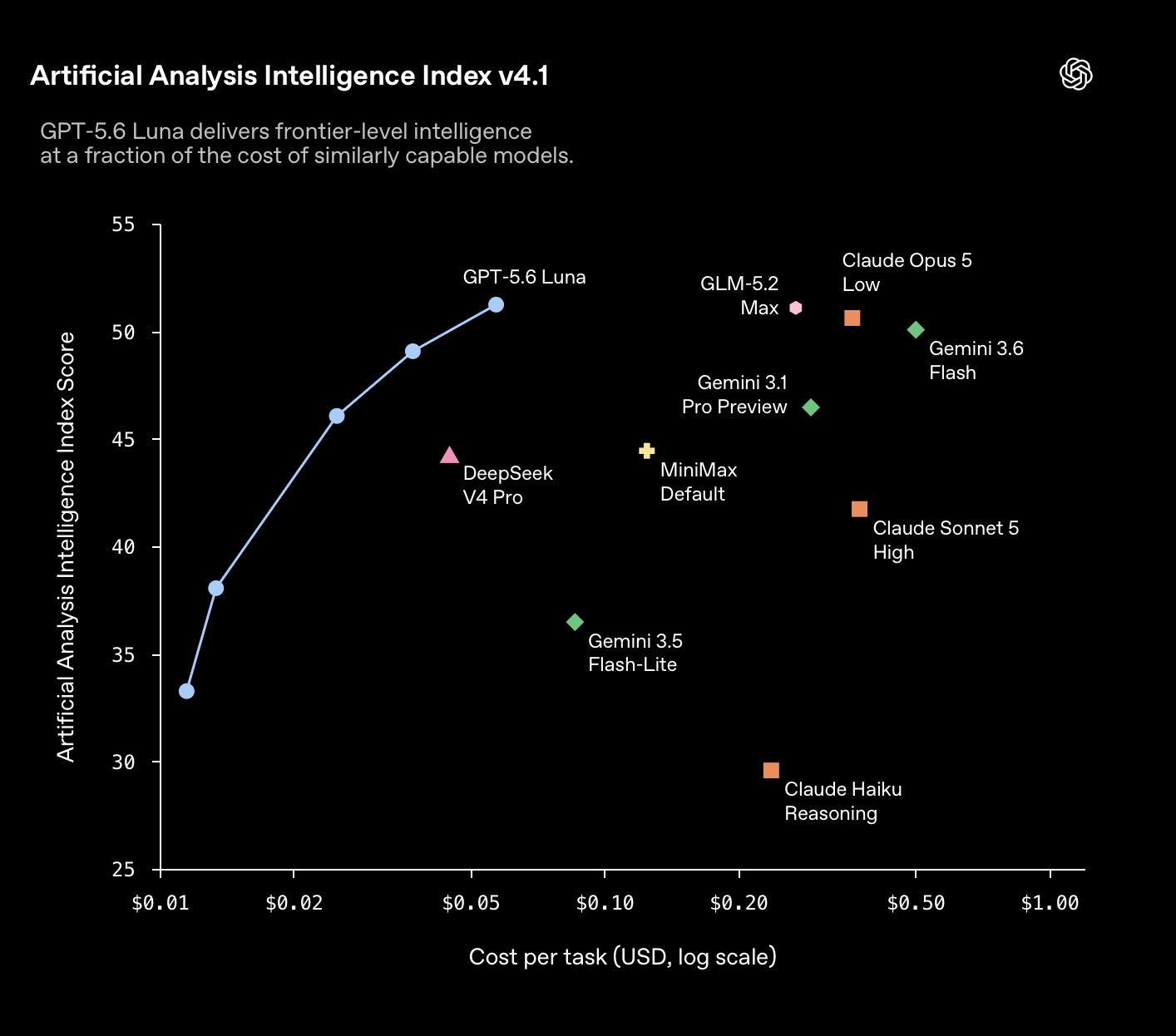 Figure: Post-80% price cut model quality vs. cost per task distribution. Source: OpenAI (via minimaxir.com)
The September showdown centered directly on this pricing lever. On September 1, Anthropic released Fable 5.1 ($10/$50/$0.25), slashing cache read costs by 75%. OpenAI countered on September 3 with the more capable GPT-6 Astra ($10/$50/$1), but its higher cache read toll left it economically uncompetitive in high-throughput agent benchmarks.
On September 22, the two competitors clashed head-on on the same day. OpenAI rolled out GPT-6 Sol ($2/$10/$0.20) and GPT-6 Luna ($0.10/$0.50/$0.01), with input and output pricing halved relative to previous discounted tiers. Anthropic concurrently debuted Claude Opus 5.5 ($4/$20/$0.20), openly stating that operational serving costs had dropped significantly, driving customer net spend down 40% to 60%. In early October, following feedback regarding GPT-6 Sol performance trade-offs, OpenAI rolled out GPT-6.1 Sol, dropping cache read costs further to $0.10—locking in a cumulative 75% pricing contraction across the board over four months.
29 Hosters Competing on One Model: Switching Takes One Line of Config
The aggressive discounting by proprietary giants was not purely altruistic; it was compelled by open-source alternatives and a sprawling network of inference hosting providers. Had closed-source providers held the line on margins, developer workloads would have migrated overnight.
The open-source ecosystem showed its pricing hand months earlier. When DeepSeek V4 Flash 0420 debuted in April 2026, it carried pricing of just $0.14/$0.28/$0.0028. Its cache read cost sat at a mere 2% of the input rate—drastically lower than the 5% to 10% ratios previously defended by the market leaders. By October 17, DeepSeek V4.1 Flash 1017 nearly doubled its benchmark throughput and quality while holding the line at $0.15/$0.60/$0.003.
The more pressing threat lies in compute distribution networks. In May 2026, only 13 independent hosting providers offered managed instances of DeepSeek V4 Flash. By the October refresh, that number had swelled to 29 independent providers. Platforms like Cloudflare and DeepInfra closed the pricing spread to within 10% of native provider APIs.
Moonshot AI’s Kimi K3.1 Pro added further pressure. Priced at $2/$10/$0.20, its performance closely matched Opus 5.5, with open-weights scheduled for release on November 4. Once model weights go public, dozens of compute aggregators stand ready to deploy matching inference capacity at baseline operational cost.
LLM client protocols have settled into universal standards. Switching foundational model vendors no longer demands rearchitecting core business logic or rewriting adapters. Developers simply update a single base URL in a config file. In a zero-switching-cost environment, any attempt to raise token rates guarantees immediate client attrition.
The Gateway Paradox: Token Prices Plummet, Spend Surges
The collapse of compute unit rates triggered an intriguing dynamic in production environments: as unit pricing hit historic lows, enterprise infrastructure spending expanded.
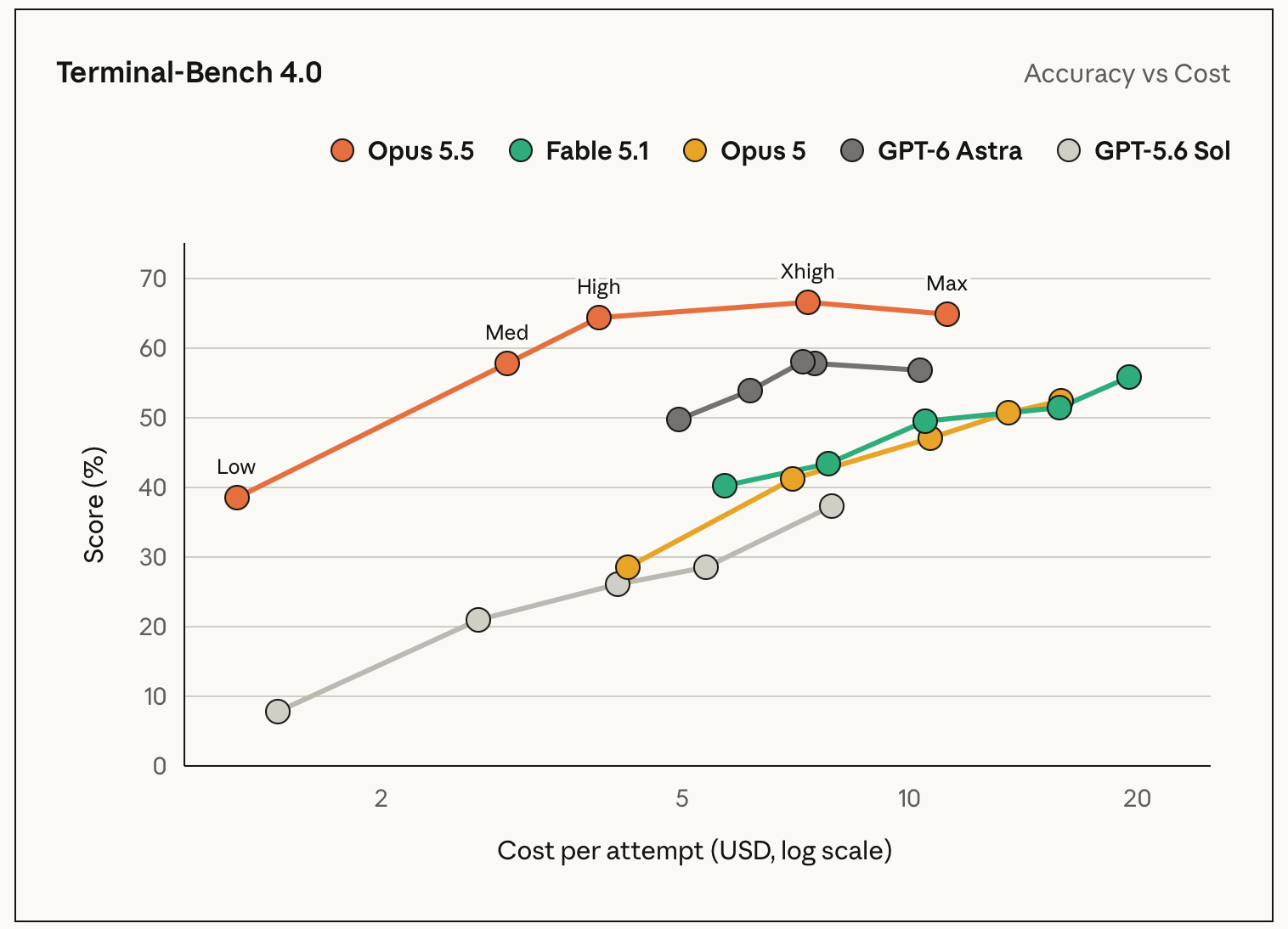 Figure: Claude Opus 5.5 performance and per-call cost distribution. Source: Anthropic (via minimaxir.com)
Telemetry from Vercel AI Gateway revealed that by September 2026, the average cost per token incurred by developers had fallen to 43.3% of its April baseline. Yet aggregate monthly spend across enterprise accounts over the same window trended steadily upward.
This paradox stems from a structural shift in consumption patterns. When token costs were punitive, engineers carefully throttled call volumes, spending engineering hours pruning context windows and condensing prompts. With cache reads priced at pennies, engineering teams unchained autonomous background agent workflows.
In modern agentic setups, systems routinely spin through hundreds or thousands of automated feedback loops: recursive code reviews, multi-candidate verification runs, and self-healing test execution. Drastic price reductions demolished usage barriers, replacing scarce queries with continuous streaming computation. Cheap compute created high-density automation. High-tier reasoning has officially transformed into a commodity as ubiquitous as power and water.
Buyers Take the Helm: Frontier Intelligence as a Utility
For two decades, consumer internet platforms followed an identical playbook: burn venture capital to undercut competition, establish market capture, and raise prices on captive users. That playbook has zero viability in LLM inference.
Intelligent inference is fundamentally a fungible, standardized compute workload. Open-source models provide a reliable performance ceiling, while dozens of global cloud operators deliver elastic serving capacity. No model lab possesses an insurmountable moat, and no vendor can lock customers in against their will.
Both market leaders recognize this commoditization trap. OpenAI and Anthropic are aggressively pitching long-term enterprise commitments while bundling raw models into vertical enterprise workspaces—such as OpenAI Dots and Claude Duet. Frontier labs hope proprietary data connectors and enterprise workflows will establish the switching costs their underlying APIs lost.
Yet so long as the underlying intelligence can be swapped across 29 independent hosters with a single configuration flag, technical margins will remain anchored to the raw cost of silicon and electricity. A 75% to 80% price rout over four months marks the definitive end of the AI windfall era. The compute economy has pivoted permanently into a buyer’s market.
References:
- minimaxir.com Technical Analysis Report
- Hacker News Community Technical Discussion