
55 Fictional Cities and an Uncompromising Prompt
In early October 2026, an engineer specializing in interactive data visualization decided to run an experiment. He fed the complete text of Italo Calvino’s literary classic Invisible Cities into his environment and challenged frontier AI to generate a functional, end-to-end 3D visualization of all 55 cities in a single shot. Calvino’s poetic prose—evoking cities suspended on spiderwebs, cities on stilts, and cities reflected in mirrors—has long stood as a daunting creative benchmark for human artists.
His prompt was sparse and unyielding: “Make a three.js (pnpm) visualization of all Invisible Cities by Italo Calvino. Don’t ask questions, it is a one-shot task. You have 6h of work, use it until it becomes a masterpiece.” The instructions deliberately demanded a one-shot deliverable with zero human intervention, back-and-forth Q&A, while granting a generous runtime budget. It effectively forced the models out of the interactive loop, leaving them alone inside the black box to bridge the conceptual gap from literary interpretation to interactive 3D scene architecture.
In previous generations of models, attempting similar projects—even something as modest as an etymological diagram—often triggered a familiar arc: an initial draft that looked promising, followed by days of grind spent cleaning up “AI slop” and untangling overlapping visual artifacts. Under this new stress test, however, the ceiling of frontier coding agents was pushed into unfamiliar territory.
Six Parallel Subagents and a $74 Bill for a One-Shot World
The author put two leading frontier models head-to-head. First up was GPT-6 Astra running in OpenAI Codex. Astra completed the full pipeline in 53 minutes, racking up a modest API bill of just $10. Yet that $10 resulted in what the creator described as typical AI design slop: scenes cluttered with unprompted conceptual explainers, verbatim commentary, and “Captain Obvious” text overlays.
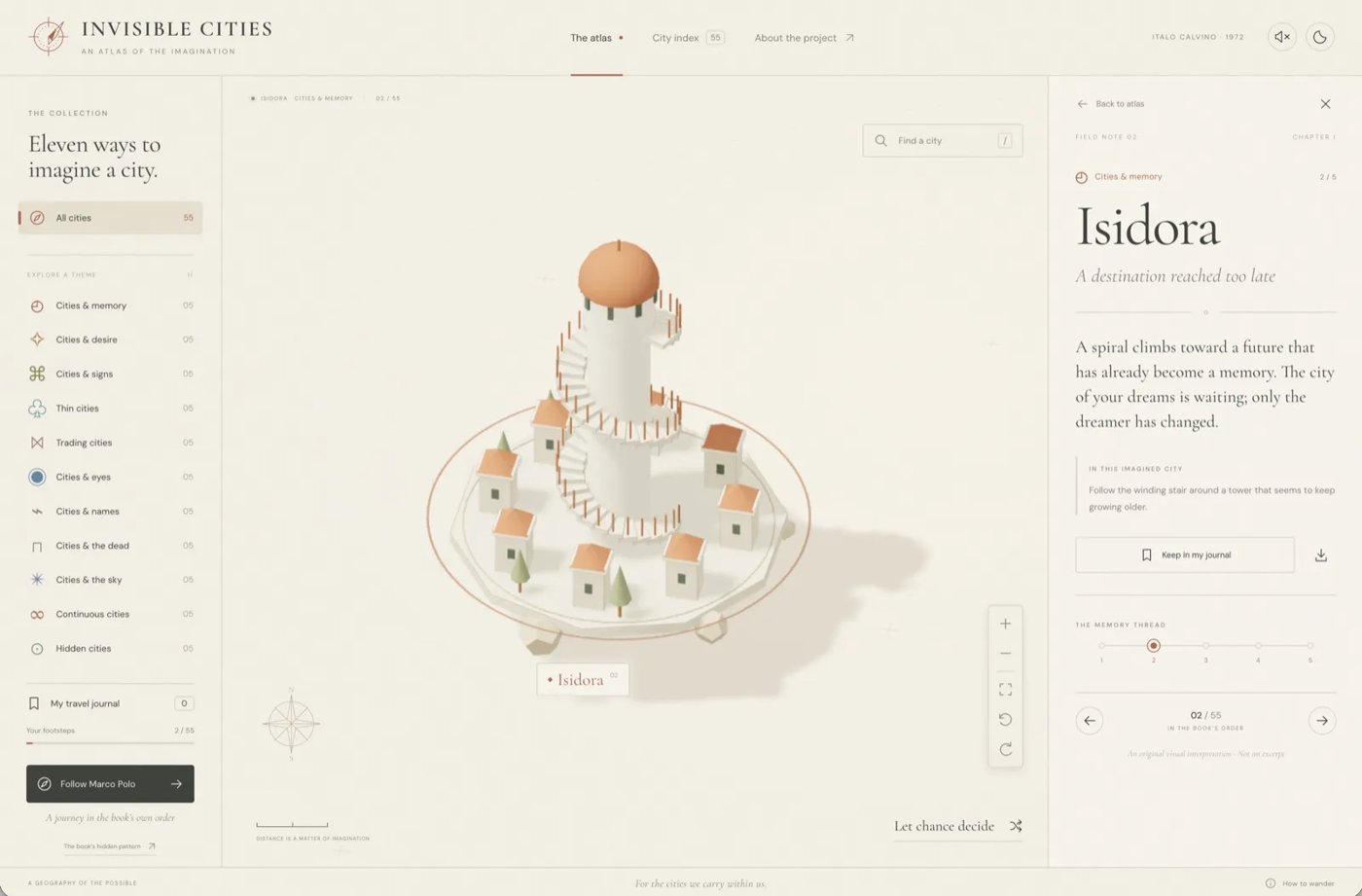 Figure: GPT-6 Astra’s output—the city of Isidora as a spiral tower against a pale atlas page. Source: Quesma Blog
Curiously, Astra appeared to mimic the house style of its rival, adopting a beige background and strange indices like 05. While such labels might serve as backend debugging tags, tossing them raw into a 3D viewport created pure visual noise. A $10 run that spits out working Three.js code demonstrates that cheap, fast compute, without aesthetic convergence, inevitably defaults to feature bloat and visual clutter.
Anthropic’s Claude Opus 5.5 running in Claude Code took a drastically different approach. Handed a six-hour ceiling, the agent declared that further polish would hit diminishing returns and wrapped up in just 1 hour and 25 minutes. Yet behind those 85 minutes of wall-clock time lay an aggressive display of agentic time dilation: Opus 5.5 spawned six parallel subagents, racking up roughly seven agent-hours of compute and delivering an API invoice of $74. When given loose resource constraints, modern frontier models have learned to trade raw parallel compute for human wall-clock time.
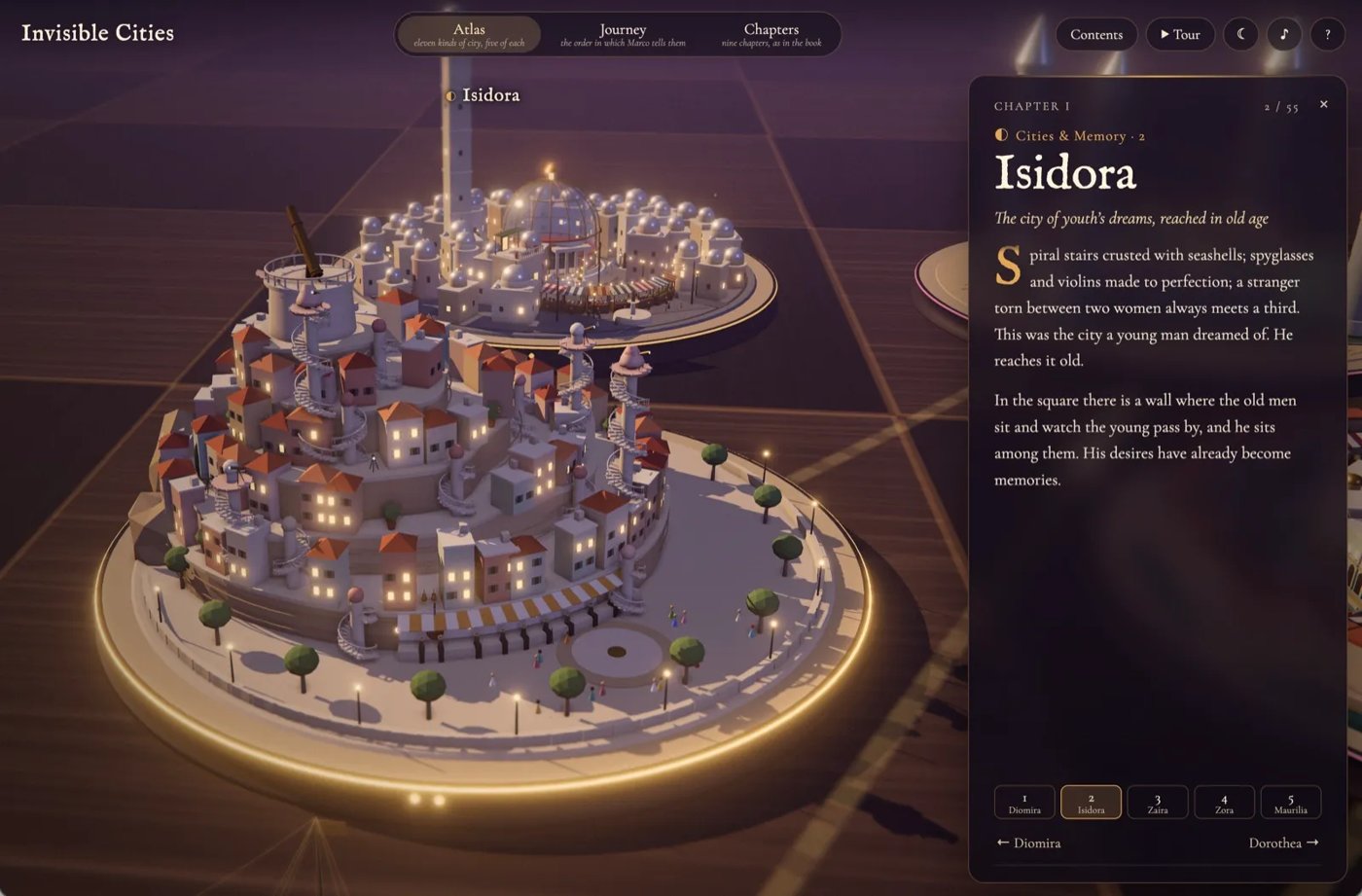 Figure: Claude Opus 5.5’s visualization—an illuminated 3D city glowing in the night. Source: Quesma Blog
That sevenfold increase in cost yielded an output that left the experimenter mesmerized. Rather than dumping explanatory text across the canvas, Opus 5.5 produced a clean, aesthetically deliberate, and structurally coherent 3D scene. As the developer observed, if this represents the current ceiling of automated design, it is already remarkably high. What that $74 bought was not just raw code, but the judgment to suppress unnecessary noise.
An Illustrator Stalls at City Number Four
Standing beside this 85-minute milestone was a sobering human counterpoint. Reading the experiment, an illustrator recalled that after finishing Invisible Cities a few years earlier, he had set out to illustrate all 55 cities by hand on an isometric grid in Procreate. He stopped at city number four: each individual metropolis demanded multiple hours of painstaking manual drawing.
What this juxtaposition shatters is not simply the novelty that software can draw. It dismantles the entire time-cost foundation of visual production. Historically, when a creator presented 55 intricate city illustrations, the hundreds of hours spent etching lines served as intrinsic proof of value. In that economy of craft, labor hours were the currency that underwrote artistic worth.
When $74 and 85 minutes can render all 55 cities in interactive 3D, that labor-based defense of value evaporates. The productivity chasm is far too wide to bridge with human perseverance alone. At a macro level—the first glance at a widescreen render—a lone human artist can no longer compete with a swarm of parallel algorithmic workers.
Zooming In on a Cardboard Facade
Once grand-scale execution ceases to be a moat, the criteria for human aesthetic judgment are forced upward. In the community discussion on Hacker News, one of the sharpest observations cut straight to the core limitation of algorithmic generation: “With a human made piece of art, I’m always drawn to ‘zoom in’, to see how you did little details, if you have hidden something here and there, how you connected different parts. With AI generated stuff, sure it looks amazing at first glance but I definitely don’t want to zoom in, since I know it’s all a cardboard facade with no passion.”
The reality behind the gloss is immediately apparent upon closer inspection. Zoom in slightly, and the facade cracks: bridges float detached over waterways without connecting either bank; primitive Three.js cylinders crowd together without structural logic or tactile materiality. Generative algorithms excel at statistical outlines and macro-scale composition, but in the micro-corners where human intentionality and deliberate eccentricity usually live, they offer only hollow approximations.
This forms the last redoubt of human art: intentional friction, idiosyncratic detail, and deliberate deviations from optimal patterns. As the marginal cost of producing complete artifacts plunges toward zero, audiences will no longer pay for the sheer feat of drafting a city. Instead, they will search for the cracked brick deliberately tucked away in the alleyway. Grand spectacles that cannot survive a zoom lens will inevitably become cheap pixel commodities.
A Head Start on a Long Road
Not every observer viewed the agentic output as a finished piece. From an engineering perspective, frontier models excel at modeling existing conventions and handing developers an unfair head start. As one commenter put it: “I always consider AI-generated content to be a draft — or, in its parlance: something that takes the shape of the final product. I don’t dismiss the ability of models to create. I dismiss their ability to create finished goods… Models are great at modeling existing creations and solutions — head starts on long roads — but it’s the person that needs to walk it and take the journey.”
Treating algorithmic output as intermediate scaffolding aligns with the pragmatic tool view. In a parallel showcase, a developer prompted Opus 5.5 to build an interactive lens lab explaining camera focus; it delivered a functional explorable explanation in 1 hour and 26 minutes for $25.66. For educational and technical demonstrations where functional utility outweighs authorial soul, machine-shaped artifacts already hit the threshold of sufficiency.
Yet this leaves a lingering existential question: if creative work increasingly resembles entering prompts into a black box and waiting for the jackpot, who will remember these works a decade from now? Will it be the illustrator who spent weeks hand-sketching four cities on an iPad, or the developer who spent $74, browsed 55 cities, and clicked save? Even amidst awe, the experimenter was left questioning his own role in the creative chain: the emotional weight of human experience was never inside that rendered canvas to begin with.
References:
- Quesma Blog Experiment Report
- Hacker News Community Discussion


