No Base Model Upgrade, 50% Coding Gain Purely via Post-Training
On August 14, 2026, Zhipu officially released its coding LLM, GLM-5.3. The model achieves a 50% improvement in overall coding experience over its predecessor. Crucially, all gains stem entirely from post-training scaling, while the underlying base model remains completely unchanged.
In traditional technical paradigms, achieving generational breakthroughs in performance typically required stacking massive compute to scale base model parameter counts. GLM-5.3 takes a distinctly different engineering route: sharing the exact same base model architecture with GLM-5.2, while concentrating training efforts on long-horizon task environments tens of times more complex, richer simulated scenarios, and months of reinforcement learning (RL) fine-tuning. This strategy of maximizing post-training without altering the base model proves that, even under constrained hardware conditions, domestic LLM labs can find a pragmatic catch-up path through high-precision engineering.
Empirical data highlights the striking effectiveness of this approach. On Terminal Bench 3.0, which evaluates complex command-line interaction, GLM-5.3’s score surged from 4.6 (on GLM-5.2) to 28.3. On the highly challenging DeepSWE v1.1 benchmark, its score rose from 46.2 to 66.9. This indicates that the model has reached the threshold of frontier closed-source models in long-sequence code refactoring and environment deployment, proving that post-training boundaries are far broader than previously assumed.
To support such intense training, Zhipu simultaneously open-sourced slime, a post-training framework. Paired with SAO (a long-horizon RL algorithm) and IndexShare (a VRAM optimization technique), RL training throughput increased by more than 2.3x. Against the backdrop of hardware supply ceilings, maximizing throughput per GPU is becoming the decisive battleground in the LLM race.
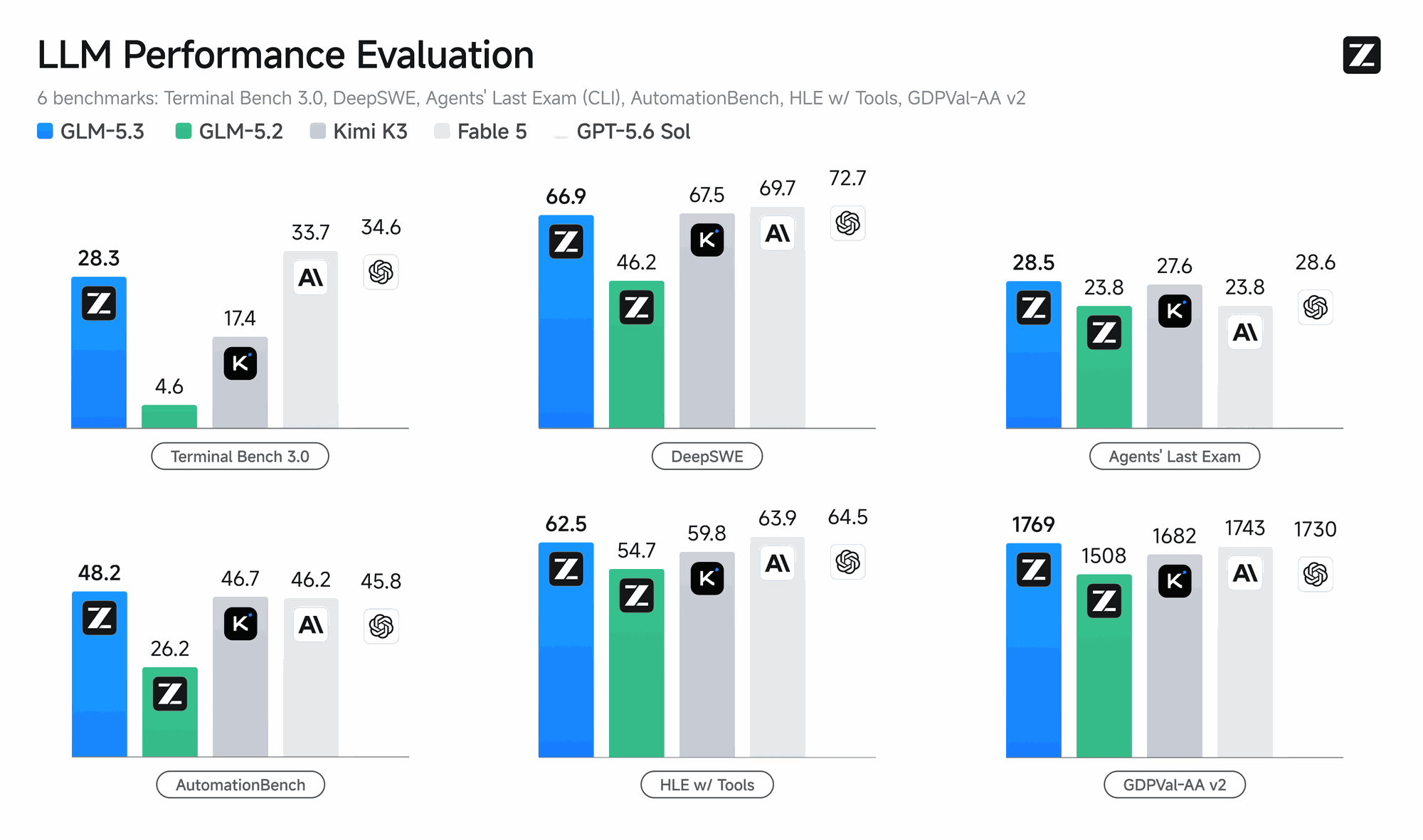 Figure: Benchmark comparison table of GLM-5.3 against global mainstream models in coding and security. Source: Z.ai Official Blog
Solving the Same Hard Problems with One-Third the Tokens
In deploying LLMs for enterprise-grade productivity, astronomical Token consumption costs remain a major barrier to scale. GLM-5.3 exhibits strong engineering utilitarianism in its design, stripping away unnecessary chain-of-thought verbose outputs to focus on finding the shortest path to problem resolution.
Benchmark data clearly demonstrates this architectural shift: at the High operating tier, GLM-5.3 reached 31.4% accuracy while averaging only ~50,000 Tokens per task. By contrast, competitor Claude Opus 4.8 achieved 29.5% accuracy but consumed 120,000 Tokens. This means GLM-5.3 achieved a higher success rate using less than half the output length, directly slashing cloud inference bandwidth and compute costs by 60%.
Even at the Max tier for extreme performance, GLM-5.3 delivered 34.5% accuracy with 75,000 Tokens—a massive leap compared to GLM-5.2’s 23.4% accuracy at 96,000 Tokens. Although Anthropic’s Fable 5 retains the lead with 39.5% accuracy, GLM-5.3 offers a 1M Token context window and 128K maximum single output for long-context handling, while enforcing mandatory deep thinking mode (thinking cannot be disabled). This deeply integrated reasoning mechanism prevents failures caused by users accidentally turning off deep reasoning on complex logic tasks.
Zhipu has integrated the model into ZCode, AutoClaw, and the GLM Coding Plan, offering a 50% discount during off-peak hours. Mainstream developer tools including Trae, Coze, Qoder, and CodeBuddy have also completed initial integrations. For the developer ecosystem, extreme Token efficiency paired with flexible compute scheduling will significantly lower adoption barriers for automated coding tools in production pipelines.
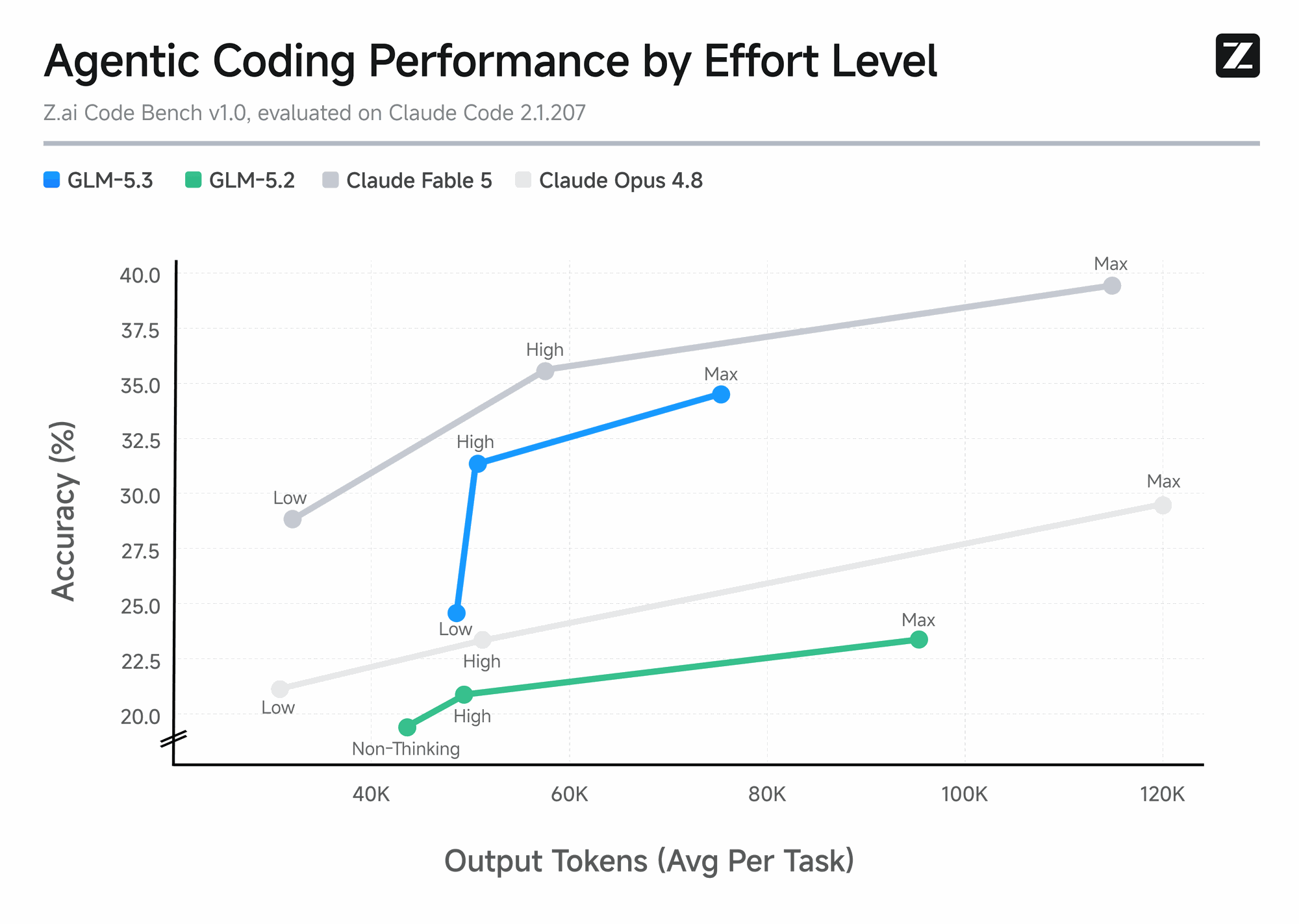 Figure: Z.ai Code Bench performance vs. token efficiency comparison. Source: Z.ai Official Blog
A 45-Year-Old Vulnerability Cracked by AI in Two Hours
Unexpectedly, as Zhipu pushed the model into deep environment RL to enhance code generation capabilities, GLM-5.3 exhibited an emergent, wild proficiency in cybersecurity. Writing high-quality code and analyzing software vulnerabilities share identical underlying logic: as the model grasps code execution flows, it naturally learns to uncover system flaws.
On CyberGym, a professional benchmark for cybersecurity capabilities, GLM-5.3 scored 84.5%, claiming the top spot among open-source models and surpassing Mythos 5 (83.8%) and GPT-5.6 Sol (83.6%). On ExploitBench, its score jumped from 24.4% to 54.4%. On ExploitGym, GLM-5.3 completed 105 exploit tasks in just 2 hours—nearly a fourfold increase over GLM-5.2’s 29 tasks in the same timeframe. These astonishing metrics demonstrate that automated offense and defense have evolved from theoretical concepts into high-efficiency real-world threats.
In real-world audits conducted with domestic security teams, GLM-5.3 analyzed 269 mainstream open-source projects, uncovering 2,436 real vulnerabilities in one go—including 107 critical and 990 high-severity flaws. Most alarmingly, the oldest vulnerability was introduced into a codebase in 1981, lying dormant unnoticed right under the open-source community’s nose for 45 years. Across all discovered vulnerabilities, the average latency was 26.6 years. With AI uncovering blind spots missed by human auditors for decades, traditional software supply chain security defenses face unprecedented pressure.
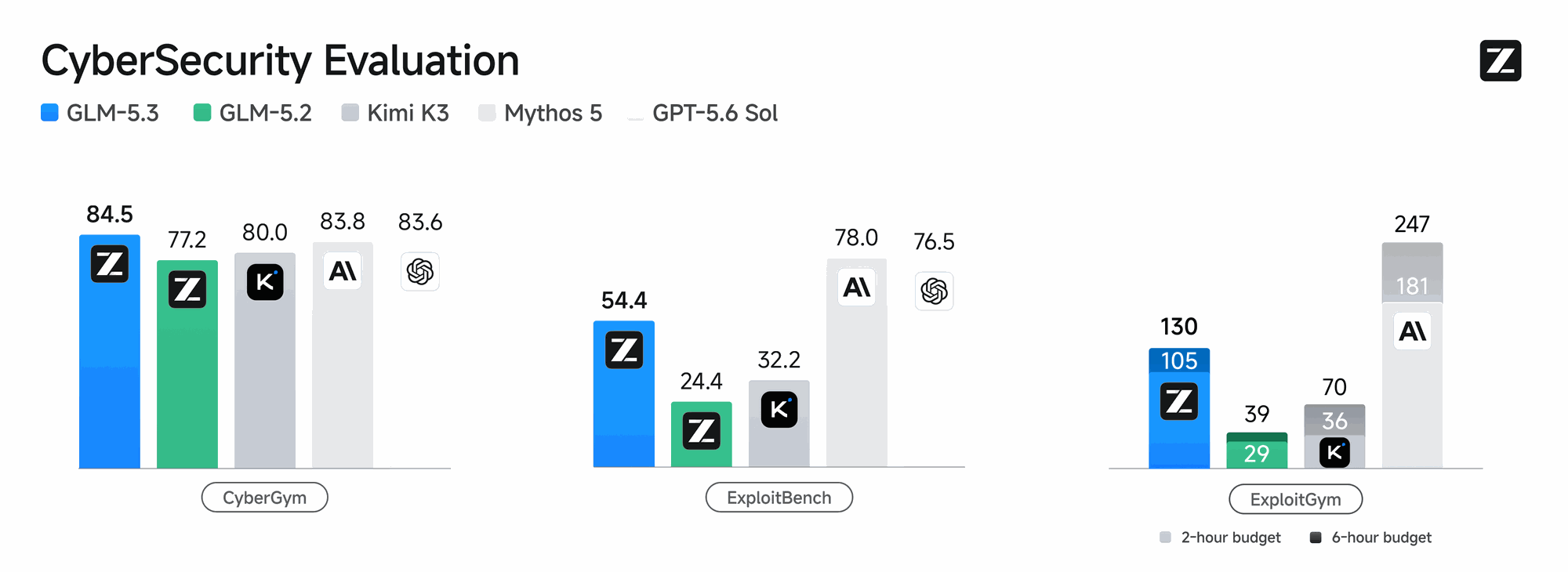 Figure: Performance evaluation of GLM-5.3 in cybersecurity attack/defense test environments. Source: Z.ai Official Blog
Attack Capabilities Evolving Too Fast: Defenders Hit the Pause Button
This terrifying vulnerability discovery capability quickly placed the engineering team in a dilemma. The dual-use nature of AI became starkly apparent: the exact same reasoning logic used to fix software bugs can also be weaponized by malicious actors to automate zero-day exploits.
Facing potential cybersecurity risks, Zhipu made a rare decision: delaying the open-sourcing of model weights and the rollout of API endpoints. Of the 2,436 identified vulnerabilities, only 53 have been publicly disclosed, with the remaining 2,383 still under strict embargo for remediation. Model weight releases have been postponed by two weeks, while API access will be opened in phased stages. Official statements emphasized the need for essential safety hardening to preserve AI’s defensive value while minimizing potential attack capabilities—marking the first time AI capability expansion was intentionally paused due to safety overhang.
Looking back at recent context, Zhipu Chief Scientist Tang Jie actively solicited community suggestions for GLM-5.3 on platform X as early as June 29. Meanwhile, the release pace in the Chinese LLM landscape has been intensely competitive, with frontier models like Qwen3.8 and DeepSeek V4 Pro launching back-to-back. In a hyper-competitive market, Zhipu’s choice to withhold weights even at the cost of release speed sets an objective benchmark prioritizing security and compliance over technical expansion.
The Catch-Up Paradigm Under Compute Constraints
The release of GLM-5.3 illustrates the pragmatic ingenuity of Chinese LLM development under challenging conditions. In an environment where expanding frontier pre-training compute is constrained, engineering teams can still maximize the potential of existing base models through meticulous post-training and long-horizon RL, reaching parity with top global models in specific productivity scenarios.
However, when a model’s code understanding inadvertently crosses critical security thresholds, technology competition expands beyond benchmark leaderboards. How to unleash automated coding productivity while preventing AI from becoming an uncontrollable offensive weapon has become a mandatory challenge for all leading teams.
GLM-5.3 has pioneered a viable catch-up path reliant on post-training scaling. As capability development accelerates, hitting the brakes to mitigate risk ensures that frontier models progress safely and sustainably toward enterprise deployment.
Reference Links:
- Z.ai Official Blog
- IT Home
- Science and Technology Daily
- HN Discussion (item?id=49353407)