In October 2026, Moderna and Merck unveiled a pivotal dataset from a clinical trial enrolling 1,137 patients who had undergone surgical resection for high-risk melanoma. After two years of adjuvant treatment combining an individualized mRNA vaccine with immunotherapy, the risk of recurrence or death dropped by 42%. As a landmark Phase 3 topline readout, this result establishes a definitive new milestone for personalized oncology in solid tumors.
Unlike conventional vaccines, this formulation cannot be mass-produced and stockpiled on warehouse shelves. Each vial must be custom-manufactured from the patient’s own resected tumor sample. One patient, one drug—engineered specifically to train the immune system against mutations unique to that individual’s cancer.
For decades, clinical oncology has relied heavily on organ-of-origin classifications. Patients presenting with the same stage of lung cancer or melanoma were routinely prescribed identical regimens of chemotherapy or monoclonal antibodies. Individualized mRNA vaccines overturn this therapeutic paradigm. By leveraging high-throughput genomic sequencing to identify private neoantigens, the treatment drafts a bespoke hunting map tailored specifically for the patient’s own immune cells.
Lingering Threats: Dormant Cancer Cells After Melanoma Resection
Cutaneous melanoma remains among the deadliest forms of skin cancer. Even after complete surgical resection of the primary lesion, patients diagnosed with stage IIB through IV disease face a daunting risk of relapse. A scalpel can excise visible macroscopic lesions, but it cannot purge microscopic tumor cells that have already sloughed into the vascular or lymphatic circulation.
These circulating micrometastases linger invisibly in distant organs, primed to reignite disease progression at any moment. The current standard of care in the adjuvant setting relies on immune checkpoint inhibitors. Merck’s anti-PD-1 therapy, Keytruda (pembrolizumab), works by releasing the molecular brakes that tumors impose on the immune system, thereby reinvigorating host defenses.
Yet single-agent checkpoint blockade remains an incomplete shield. Follow-up data demonstrate that even on Keytruda monotherapy, approximately 30% of patients experience disease recurrence or death within two years. Without predefined targets, immune cells struggle to differentiate elusive, deceptive tumor cells from healthy tissue.
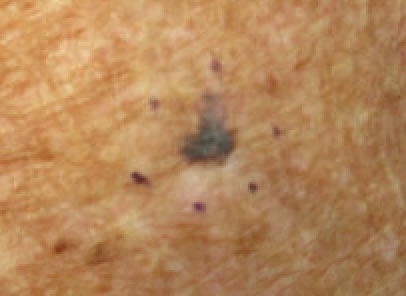 Figure: Malignant melanoma lesion on the left forearm. Source: Wikimedia Commons (CC BY-SA 4.0)
Targeting 34 Private Neoantigens: A Precision Wanted Poster for T Cells
Intismeran (investigational designation mRNA-4157), co-developed by Moderna and Merck, fundamentally re-engineers this antitumor attack. Following surgical resection, the patient’s tumor tissue alongside a baseline healthy blood sample are rushed to the sequencing facility. High-throughput platforms perform whole-exome sequencing, comparing tumor and germline DNA to isolate point mutations and structural variations.
Bioinformatics algorithms analyze thousands of candidates to identify somatic neoantigens exclusively expressed on the surface of malignant cells. The system selects up to 34 neoantigens predicted to possess the highest HLA-binding affinity and immunogenicity. Automated synthesizers then encode the genetic instructions for these 34 peptides into a single synthetic mRNA strand, assembling a fully customized vaccine.
The synthetic mRNA is encapsulated in lipid nanoparticles (LNPs) and administered via intramuscular injection. Once dendritic cells take up the mRNA, they translate and present these 34 neoantigens across their surface via major histocompatibility complexes. Clear markers separating self from non-self are established: CD8+ cytotoxic T cells are primed, mobilized, and directed against lingering micrometastases harboring matching mutational profiles.
This vaccine works in close biological synergy with Keytruda. The individualized mRNA vaccine issues a high-fidelity “wanted poster,” spotlighting the mutational signature of malignant cells. Meanwhile, Keytruda lifts the immunosuppressive brake, preventing tumor microenvironments from shutting T cells down. Immune defenses gain both the exact coordinates to strike and the unhindered freedom to execute.
 Figure: An mRNA vaccine and syringe in preparation. Source: Ars Technica (Getty Images)
42% Risk Reduction at Two Years: Phase 3 Trial Validates Adjuvant Efficacy
The global Phase 3 randomized trial enrolled 1,137 patients with completely resected high-risk stage IIB to IV cutaneous melanoma across multiple clinical centers worldwide. Participants were randomized 2:1 to receive either the mRNA-4157 combination with Keytruda or Keytruda plus placebo.
Two-year follow-up data delivered compelling evidence. In the combination cohort, 82% of patients remained disease-free without recurrence, compared to 70% in the Keytruda monotherapy arm. The combination regimen lowered the risk of recurrence or death by 42%. This 12-percentage-point absolute improvement in recurrence-free survival (RFS) constructs a vital protective barrier for high-risk postoperative patients.
The regimen demonstrated equally robust efficacy in curbing distant metastasis. At the two-year landmark, 88.5% of patients in the combination arm were free from distant recurrence, versus 80% receiving monotherapy, corresponding to a 38% decrease in the risk of distant metastasis. Suppressing distant dissemination preserves critical survival windows for patients who historically faced dismal prognoses.
The combination demonstrated manageable safety and tolerability without unexpected toxicities. Dr. Dean Y. Li, president of Merck Research Laboratories, described the results as a pivotal milestone since the dawn of immuno-oncology, establishing a new benchmark in adjuvant melanoma therapy. Stéphane Bancel, CEO of Moderna, emphasized that this clinical milestone signals a decisive turning point for tailor-made mRNA therapeutics.
Phase 3 Readouts vs. Phase 2b: How Real-World Cohorts Shape Data
A longitudinal look at the clinical program highlights the expected statistical dynamics of drug development. The earlier Phase 2b trial followed 157 patients over five years, yielding striking efficacy figures: a 49% reduction in recurrence or death and a 59% drop in distant metastasis. In contrast, the Phase 3 results reflect a modest moderation, reporting hazard ratio reductions of 42% and 38%, respectively.
This moderation stems naturally from substantial differences in trial size and observation windows. While the Phase 2b study tracked 157 patients across half a decade, the Phase 3 trial expanded nearly tenfold to 1,137 patients across diverse, multinational clinical centers, with current data reflecting the two-year landmark.
A larger and more heterogeneous patient population naturally introduces greater biological variability. Yet even with a 7-percentage-point adjustment, the 42% protective benefit substantially resets standard-of-care expectations in adjuvant oncology. Complete findings have been accepted for publication in The New England Journal of Medicine (NEJM), and both companies have initiated formal regulatory discussions with health authorities worldwide.
The rollout of the data also featured an unexpected twist. Originally slated for presentation on Saturday at the European Society for Medical Oncology (ESMO) Congress in Madrid, an oncology trade news outlet broke the press embargo early. In response, Moderna and Merck moved quickly to issue a joint announcement on Thursday morning, publicly disclosing the topline results ahead of schedule.
Beyond the Assembly Line: On-Demand Manufacturing Reshapes Oncology
The commercial trajectory carved out by this vaccine fundamentally shifts the manufacturing logic of modern biopharma. Traditional pharmaceuticals rely on bioreactors and automated production lines running continuously to churn out thousands of identical doses per batch. Individualized medicine, by contrast, demands an end-to-end cycle completed within several weeks: from biopsy and sequencing to algorithmic prediction, in vitro transcription, lipid formulation, and sterile fill-finish—all executed for a batch size of one.
The entire supply chain must maintain rigorous standards across sequencing depth, chemical fidelity, and aseptic controls. Computational algorithms must accurately predict high-affinity neoepitopes among dozens of candidates. While technically demanding, this model bypasses years of hit-and-miss target discovery by anchoring therapeutic defense directly inside the patient’s idiosyncratic immune landscape.
Melanoma, characterized by its exceptionally high tumor mutational burden, served as the ideal proof of concept. Parallel trials evaluating customized mRNA vaccines in non-small cell lung cancer (NSCLC) and pancreatic ductal adenocarcinoma are already well underway. The oncological perspective has fundamentally shifted: a tumor is no longer seen simply as a rogue growth in a specific organ, but as a systemic pathology driven by unique genetic mutations.
Cancer therapy is moving past the era of generic molecular lotteries. Patients’ own immune systems are being trained into elite defense units equipped with personalized recognition capabilities. As genomic sequencing and enzymatic synthesis turnarounds continue to compress, custom-built mRNA vaccines are stepping directly into the clinical front lines.
References:
- Ars Technica In-Depth Report
- Merck & Moderna Joint Press Release
- Manuscript Accepted by The New England Journal of Medicine (NEJM)
- European Society for Medical Oncology (ESMO) Congress Presentation