Injecting a test solution into a rabbit’s ear vein and monitoring rectal temperature spikes with a probe: first developed in the 1940s, the rabbit pyrogen test still hums along on pharmaceutical quality-control lines across the globe. Thirty years ago, medical researchers pioneered in vitro assays based on human blood cells. The European Pharmacopoeia debated the switch for fifteen years before formally recognizing the alternative in 2010. Even today, tens of thousands of rabbits worldwide remain confined to laboratory cages.
Technological breakthroughs do not automatically dislodge entrenched legacy protocols. In laboratories, microfluidic chips and computational simulations consistently outperform live animal testing in predicting human biology. Yet once out of the petri dish, emerging technologies slam directly into a massive regulatory apparatus. Mountains of costly re-validation keep non-animal alternatives locked in an agonizing tug-of-war.
A Clear Plastic Chip Catches 87% of Animal-Missed Toxicities
Drug development has long wrestled with an uncomfortable truth: compounds that appear perfectly safe in mice can prove lethal in humans. Biotech firm Emulate put this to the test in a rigorous toxicology benchmark. When challenged with toxic small molecules that harm human livers while slipping undetected past animal screens, Emulate’s human liver-on-a-chip flagged seven out of eight. The vast majority of drug-induced liver injuries overlooked by in vivo trials were caught on the microfluidic chip.
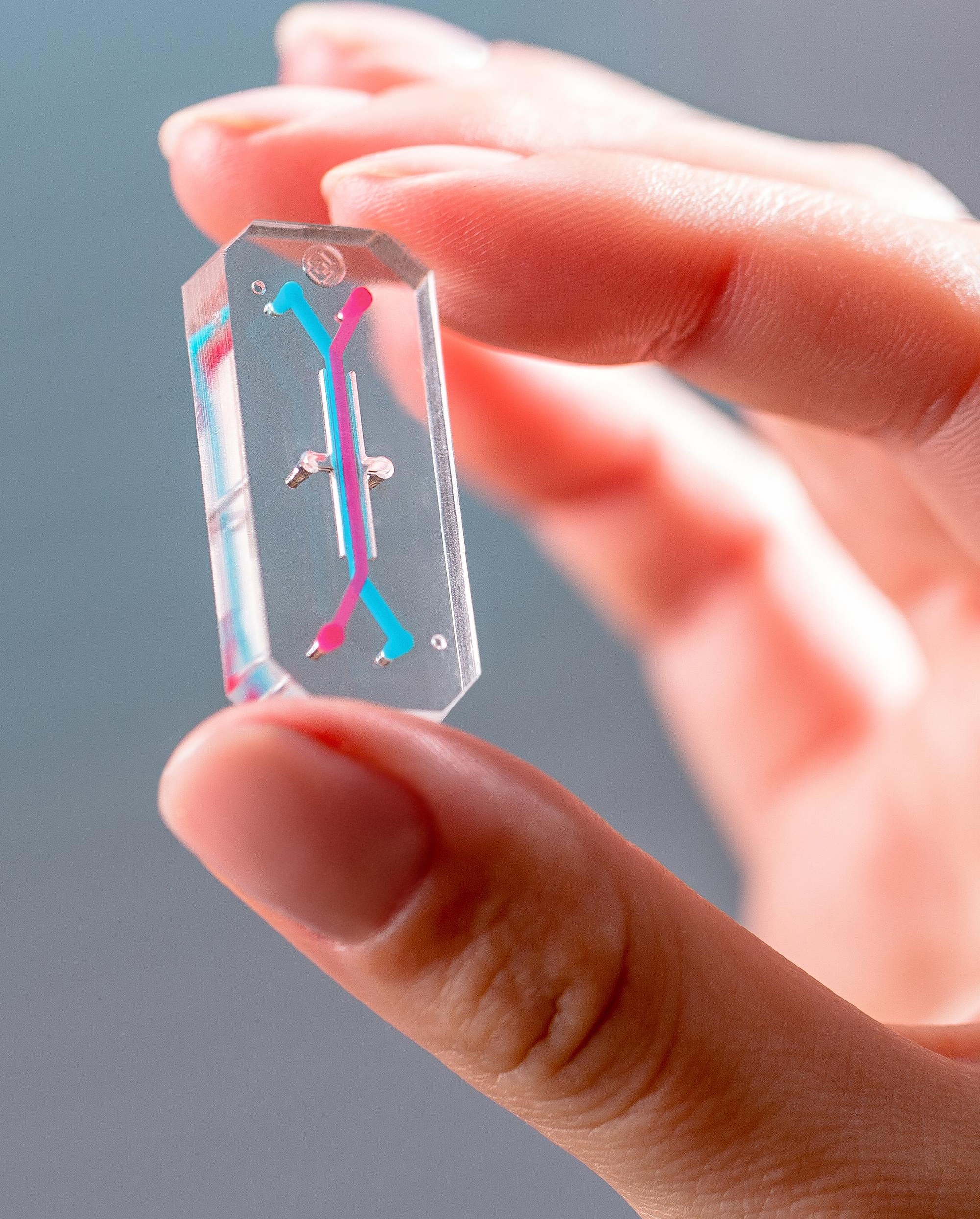 Figure: Researchers hold an organ-on-a-chip. Its internal microfluidic channels simulate the physical shear stresses and biochemical microenvironment of human organs. Source: IEEE Spectrum
The chip’s ability to bridge this blind spot stems from recreating a dynamic mechanical environment. In traditional petri dishes, cells lie static on flat plastic, deprived of physiological flow. Emulate cultures human liver cells inside microchannels, pumping fluid through with micron-level precision. The resulting physical shear stress prompts cells to differentiate into their natural in vivo states. Crucially, their metabolic enzyme expression patterns mirror the human body far more closely than flat plastic dishes or living animals ever could.
Pure in silico approaches have notched comparable victories. Teams from Oxford University and Johnson & Johnson’s pharmaceutical division built an electrophysiological computational model of human cardiomyocytes. When screening compounds that risk triggering fatal arrhythmias, the algorithmic simulation achieved an 89% accuracy rate, compared to just 75% for traditional animal models. By sidestepping interspecies differences, the digital model evaluates cardiotoxicity directly across human ion channels.
Clinical Failure Hits 95%: Live Animals Misjudge Human Biology
The modern pharmaceutical industry operates under a staggering trial-and-error tax. The overwhelming majority of candidate molecules entering US clinical trials fail to earn marketing approval. In high-stakes arenas like oncology and neurodegenerative diseases, Phase II clinical failure rates climb as high as 92% to 95%.
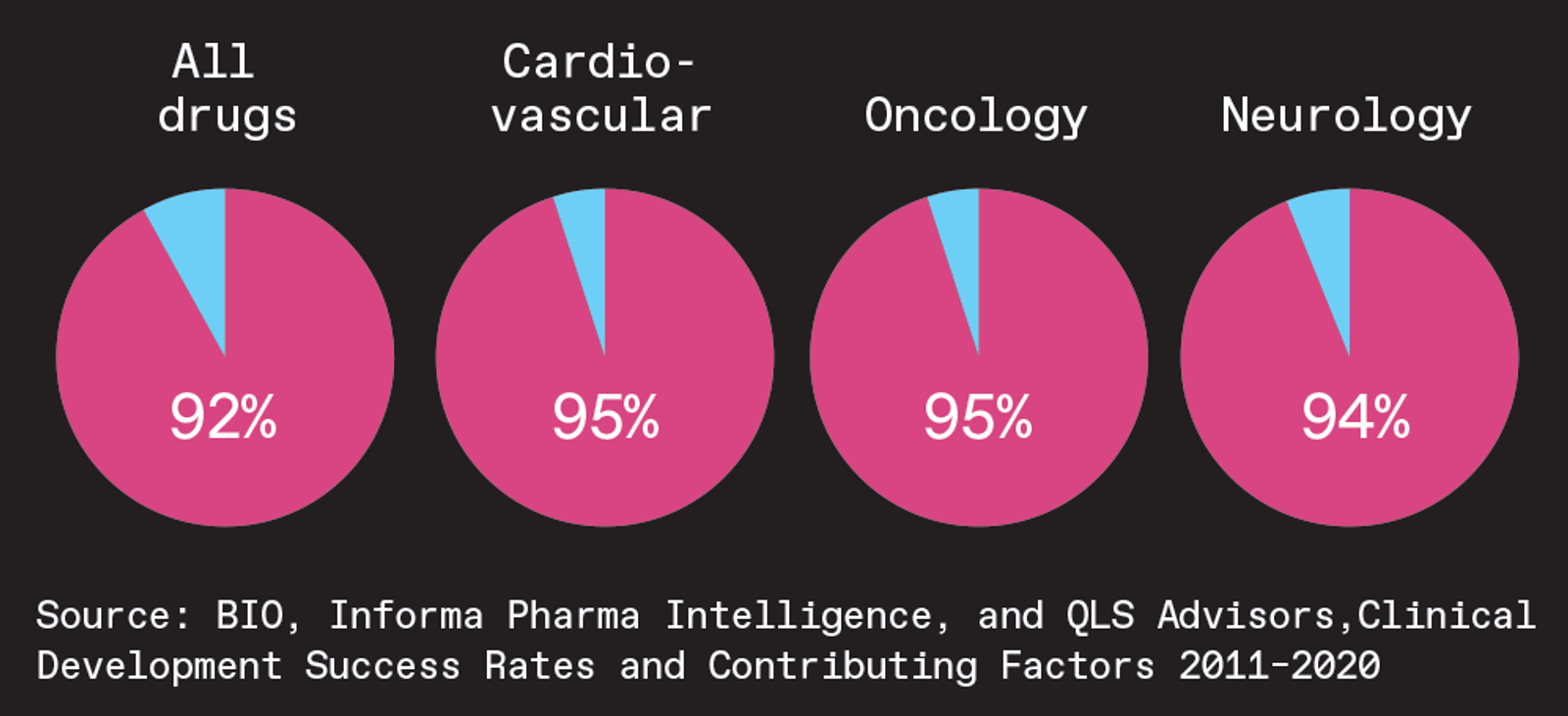 Figure: Phase II clinical failure rates across major therapeutic areas; in several disease categories, over 90% of pipeline therapies are eliminated once tested in humans. Source: IEEE Spectrum
Such massive attrition shatters the myth that animals serve as miniature stand-ins for humans. Traditional pharmacology has long treated beagles and rodents as downscaled replicas of human physiology. Yet across evolutionary timescales, species have diverged radically in receptor architecture and metabolic pathways. A detoxifying enzyme active in mice may barely express in human hepatocytes. Conversely, a metabolite well tolerated in dogs can trigger acute necrosis in human tissue.
While animal models excel at providing an intact whole-body circulatory loop, they routinely deliver misleading signals at the molecular target level. Pharmaceutical companies spend tens of millions of dollars charting animal tolerance curves that collapse in clinical trials. Animals pay with their lives, while research teams swallow failure rates exceeding 90%.
16 Weeks and 16 Researchers: New Methods Hit Financial Roadblocks
If organ chips are demonstrably more accurate, why haven’t pharmaceutical giants adopted them wholesale? The answer lies in prohibitive development economics. To validate its liver chip, Emulate burned through 870 individual units—a testing effort requiring the equivalent of 16 full-time scientists working around the clock for 16 weeks. Kathy Archibald, founder of the UK-based Safer Medicines Trust, notes that this scale of investment is far beyond what small and mid-sized biotechs can absorb.
An even tougher obstacle is the fragmented, use-case-specific regulatory landscape. Agencies do not grant blanket approvals for alternative testing platforms. Validating a chip for small molecules does not carry over to large-molecule biologics or monoclonal antibodies; teams must start the validation cycle from scratch. This piecemeal certification keeps the cost of technology adoption unsustainably high.
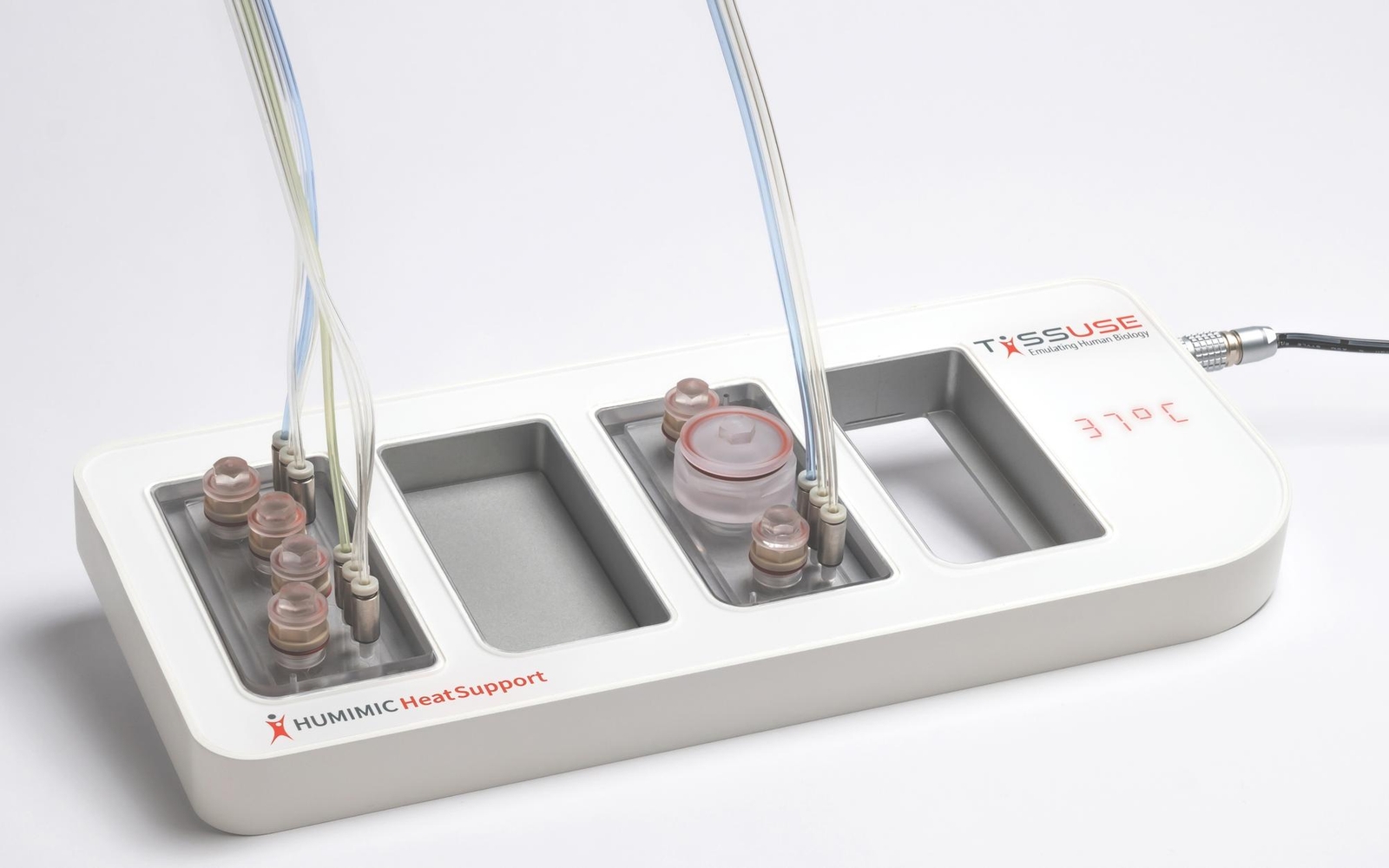 Figure: Organ chips housed inside automated incubation and perfusion units. Each chip demands highly precise microfluidic control and specialized consumables. Source: IEEE Spectrum
Compounding the problem is an acute shortage of head-to-head benchmarking data. German computational biologist Christian Maass emphasizes that the scientific community has yet to produce undeniable comparative benchmarks. The smartphone industry experienced an overnight epiphany when it discarded physical keyboards; drug testing on chips has yet to achieve that unifying watershed moment. Behind this lies a high data wall: multinational pharmaceutical firms treat animal toxicology and clinical data as proprietary commercial assets. Without open-access reference databases, constructing independent, rigorous benchmarks remains an uphill battle.
Rules Sunset for 30 Years, Yet Regulators Still Demand Rabbits
Beyond capital expenses lies an even more stubborn obstacle: institutional inertia within the scientific community. The trajectory of the rabbit pyrogen test offers a cautionary tale. In vitro monocyte activation tests (MAT) using human blood cells were already mature by the mid-1990s. The European Pharmacopoeia did not formally recognize MAT as an alternative until 2010. More than a decade later, routine quality-control audits still frequently ask manufacturers for rabbit temperature charts.
A similar dynamic plays out in marine biology. To test injectable therapeutics for bacterial endotoxins, the medical industry has bled wild horseshoe crabs for their distinctive blue blood. Synthetic recombinant Factor C (rFC) was developed thirty years ago and commercialized two decades back. Yet the US Pharmacopeia did not grant rFC legal parity with horseshoe crab blood until May 1, 2025. A proven, non-animal technology spent three decades stranded on the regulatory fringe.
As Johns Hopkins researcher Kathrin Herrmann observed: “The formal requirements may disappear, but informal expectations remain.” Her surveys illuminate the dilemmas early-career researchers face. Relying solely on microfluidic chips often earns proposals a high-risk label from grant and journal reviewers. To ensure funding and publication, young researchers feel compelled to run redundant animal experiments just to provide reviewers with a sense of security.
Shifting Scientific Inertia Takes Generational Change
Demanding an immediate, across-the-board ban on animal experimentation runs counter to pharmaceutical reality. Cosmetics can outlaw animal testing because topical formulations interact primarily with epidermal tissue. Systemic pharmaceuticals, however, circulate through the bloodstream, engaging complex immune pathways and posing risks of chronic cumulative toxicity. In capturing systemic physiology that chips cannot yet simulate, in vivo models still serve as a last line of defense.
Consequently, the retirement of animal experimentation will not happen by fiat, but through a gradual generational transition. Early signs of change are emerging in education. An open online course on animal-free methodologies hosted by Johns Hopkins has already trained over 12,000 scientists. Joseph Wu, director of the Stanford Cardiovascular Institute, points out that younger researchers trained on modern platforms are increasingly launching their own independent laboratories. Only as this new generation takes the helm will deeply entrenched regulatory paradigms finally yield.
Scientific progress is never purely an engineering problem. The technology is already here: plastic microfluidic chips forecast human drug toxicity with accuracy that leaves traditional animal testing behind. What is really stalling the evolution of modern medicine is an institutional trust architecture built over half a century ago.
Reference Links:
- IEEE Spectrum Deep Dive
- Hacker News Community Discussion (item?id=50150927)
- United States Pharmacopeia rFC Guidelines
- European Pharmacopoeia Monocyte Activation Test Standard