A Single Gulp of Seawater, Big Enough to Fill a Classroom
Just days ago, Rhys Morgan, a refinery worker from Pembrokeshire, Wales, launched his drone while out sea fishing with friends. What drifted into the lens was something he later described as “pure luck”: a fin whale—the second-largest animal on the planet, second only to the blue whale—lunge-feeding in shallow waters right off the coast, flanked by dolphins.
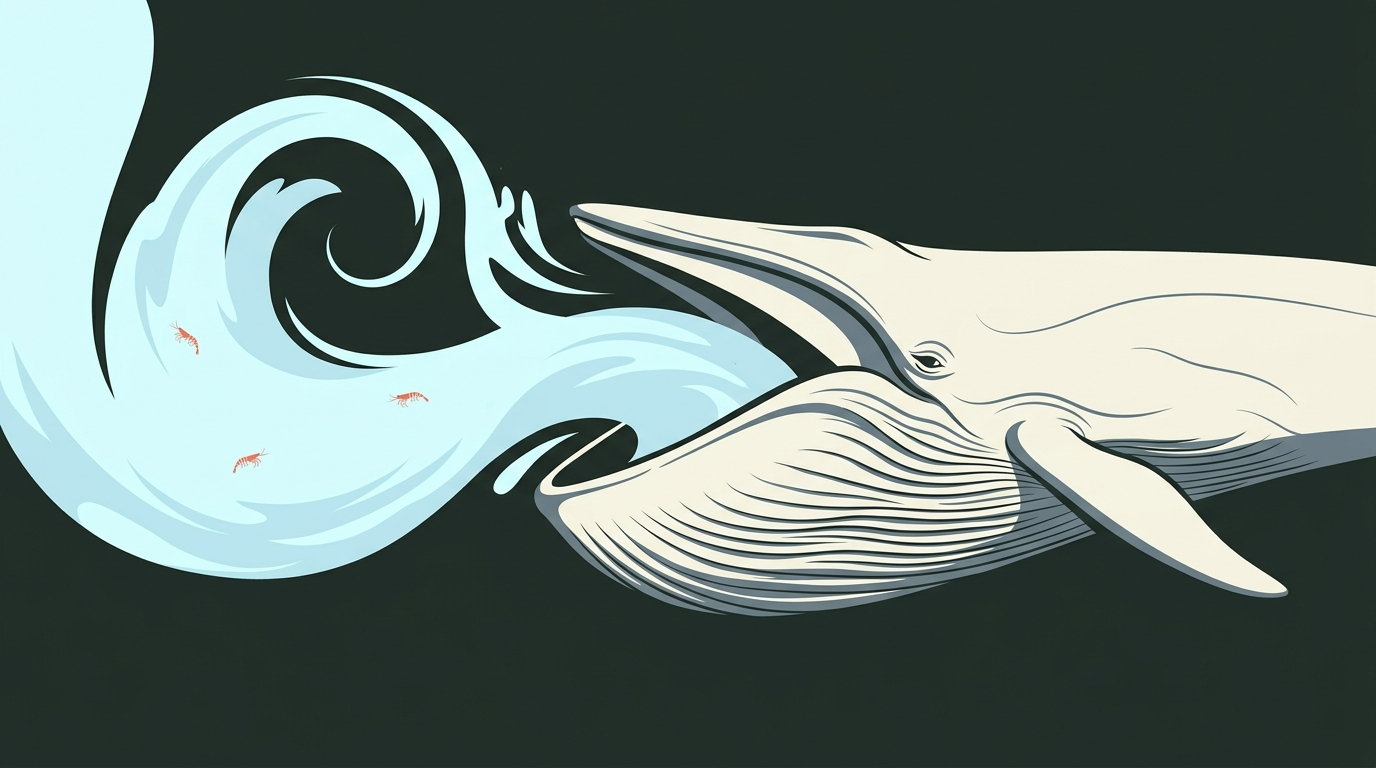
The most breathtaking moment in the footage is the instant its jaw drops open: engulfing up to 18,000 gallons of seawater—roughly 68 cubic meters. To put 68 cubic meters in perspective, that is approximately the volume of an entire standard school classroom. In other words, with every single mouthful, this whale effectively floods a full classroom with water, then filters out tiny krill from the deluge.
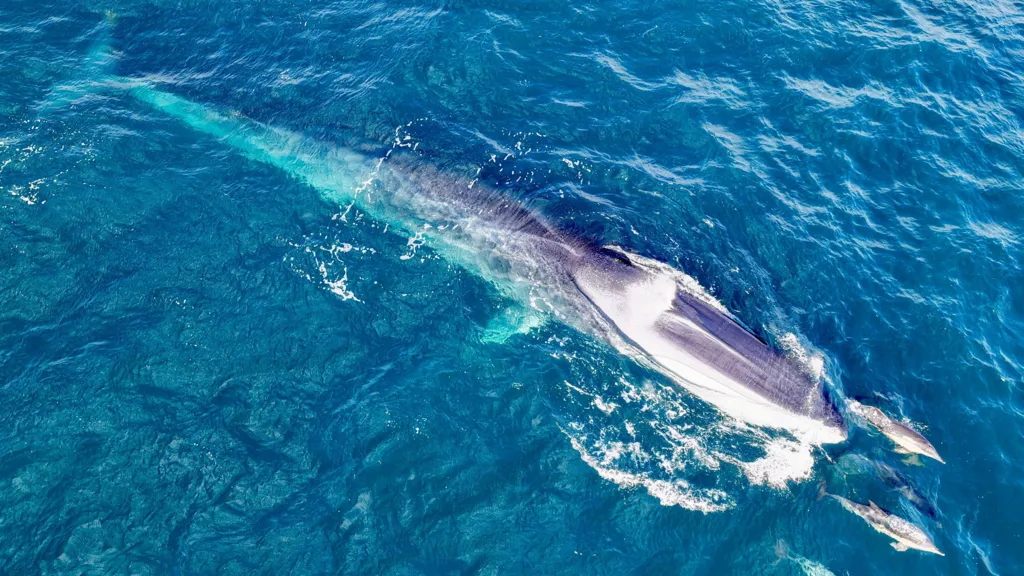 Photo: Notice the dolphins alongside—the sheer contrast in scale reveals just how colossal this whale is. Source: Rhys Morgan / BBC
Stretched to the Limit: A Mouth the Size of a Room
A fin whale can stretch up to 24 meters in length and weigh 70 tons—roughly the mass of a commercial regional airliner. Yet its entire diet relies on tiny, centimeter-long krill and small schooling fish. Feeding the largest mouth on Earth with some of the smallest prey in the sea means the disparity must be bridged purely through astronomical volume.
This predatory maneuver is known as lunge-feeding: the whale accelerates toward dense swarms of prey, then drops its lower jaw wide open. The accordion-like grooves along its throat and belly—known as ventral pleats—expand drastically, ballooning the oral cavity into a gigantic water sac. Seawater and krill rush in simultaneously before the whale contracts its pleats, expelling the water through baleen plates while trapping the food inside.
The biomechanical toll of this move is staggering. Lunge-feeding demands maximum acceleration, and once the cavernous mouth opens, the body acts like an enormous parachute dragging through water, sending hydrodynamic resistance through the roof. Research led by ecologist Jeremy Goldbogen has long shown that this is one of the highest-energy actions per unit time in the entire animal kingdom. After each lunge, the whale must linger near the surface for minutes just to catch its breath and recover. Every single gulp is an all-or-nothing gamble—swallow too little krill, and the whale operates at an energetic loss.
Up to Two Tons a Day, Fought for Gulp by Gulp
While the volume per mouthful is mind-boggling, sustaining that intake day after day is relentless work. Because krill are so tiny, a fin whale can spend hours feeding each day, consuming up to 2,000 kilograms of food—equivalent to the weight of a passenger car, assembled purely out of minuscule crustacean prey.
This reality dictates its evolutionary strategy: since every single lunge burns a massive burst of energy, the whale must push each engulfment to the absolute structural limits of its body. Expanding its mouth to nearly a third of its body length to maximize each gulp is the only way to justify the grueling metabolic recovery time. Earth’s second-largest animal survives by putting its entire physical anatomy on the line every time it eats.
Why a 24-Meter Behemoth Is Rarely Seen
Intuitively, an animal 24 meters long should be hard to miss across the oceans. In reality, most people will go an entire lifetime without ever spotting a fin whale. Speaking to the BBC, Dr. Marianna Chimienti, a marine ecologist at Bangor University, noted that while surface feeding is typical behavior, seeing a fin whale this close to the Welsh shoreline is “quite unusual”—adding that “theoretically they should have migrated already.”
The answer once again traces back to feeding ecology. Krill and schooling baitfish aggregate in highly dynamic, nutrient-rich corridors; fin whales gorge in high-latitude cold waters during warmer months and migrate toward lower latitudes during winter to breed, moving strictly where the food leads. Furthermore, their migratory pathways vary substantially between individuals—unlike humpback whales, which reliably navigate well-defined coastal highways each year, fin whale movements remain far harder for scientists to map. A pelagic giant chasing unpredictable krill swarms out in the open ocean is, by definition, an elusive sight.
Capturing this footage required a rare alignment of circumstances: the whale ventured unusually close to shore, happened to lunge-feed at the surface, and crossed paths with an angler carrying a drone. As Morgan himself put it: “Out at sea, it really puts into perspective how small you are.”
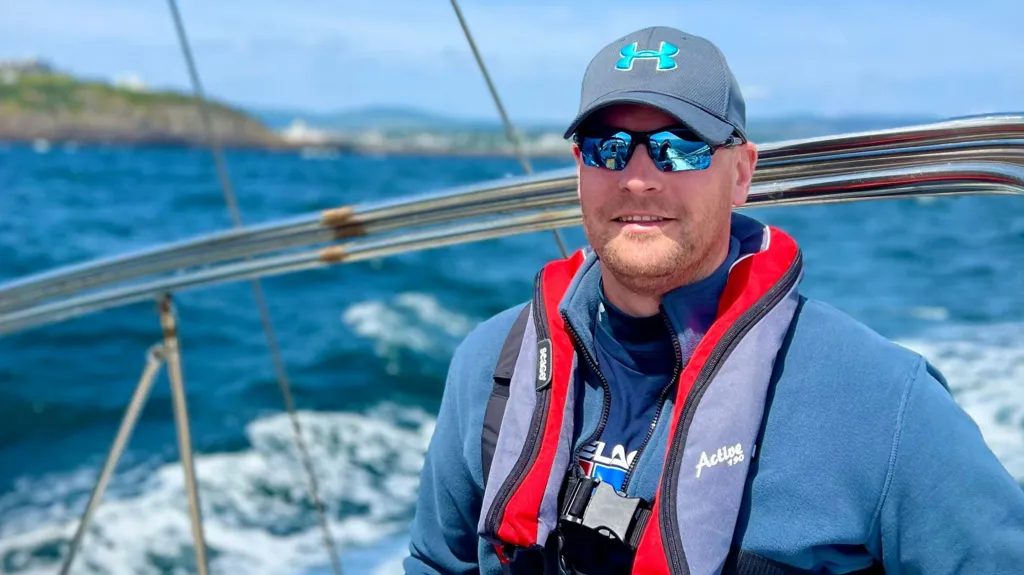 Photo: Captured not from a research vessel, but from a small recreational fishing boat—historic observations often come from amateurs. Source: Tomos Thomas / BBC
The High-Stakes Feast: Life or Death in a Single Gulp
It circles back to those 68 cubic meters of seawater that could fill a classroom. Every time a fin whale opens its jaws, it executes nature’s most biomechanically expensive maneuver: sprinting at top speed, ballooning its throat pleats, dragging a massive water sac through the ocean, and slowly surfacing to recharge. This all-or-nothing feeding strategy allows a 70-ton titan to thrive on krill, but it also anchors the species far out in offshore waters, shadowing volatile swarms.
That is why the footage captured off Wales is so extraordinary—those fleeting dozens of seconds show a leviathan pushing its body to the edge, with a drone lens perfectly positioned to catch the splash.
Reference links:
- BBC News: Fin whale lunge-feeding captured off Welsh coast
- BBC Video: Drone footage of fin whale feeding