Beachgoers typically gaze at the breaking surf or stretch out across sunlit sands. Rarely does anyone cast a second glance at the muddy grasslands lying seaward of the dikes—submerged at high tide, slick with clinging silt at low tide, and easy to slip on. Yet these intertidal zones have a formal name: salt marshes, coastal grassy mudflats submerged once or twice a day by the tides.
In the autumn of 2023, a Dutch research team excised an entire section of this wild grassland—306 square meters, roughly three-quarters the size of a regulation basketball court—loaded it into sealed trucks, and transported it into a 300-meter-long artificial flume. Then, they battered it with two-meter-high storm waves continuously for 21 hours.
On October 21, the findings were published in the journal Nature. The takeaway boils down to a single striking metric: after 21 hours under punishing waves, the living surface composed of mud and vegetation had lowered by an average of just 7 millimeters.
Inside the World’s Largest Wave Machine
The facility behind the test is the Delta Flume, situated in Delft, Netherlands, and recognized as the world’s largest artificial wave flume. Measuring 300 meters long—nearly the length of three soccer pitches laid end-to-end—and 9.5 meters deep (roughly three stories high), its wavemaker piston drives water back and forth with immense force, generating artificial waves up to 5 meters tall. The 300-meter flume length is intentional: waves require sufficient runway to develop from ripples into full-scale storm swells.
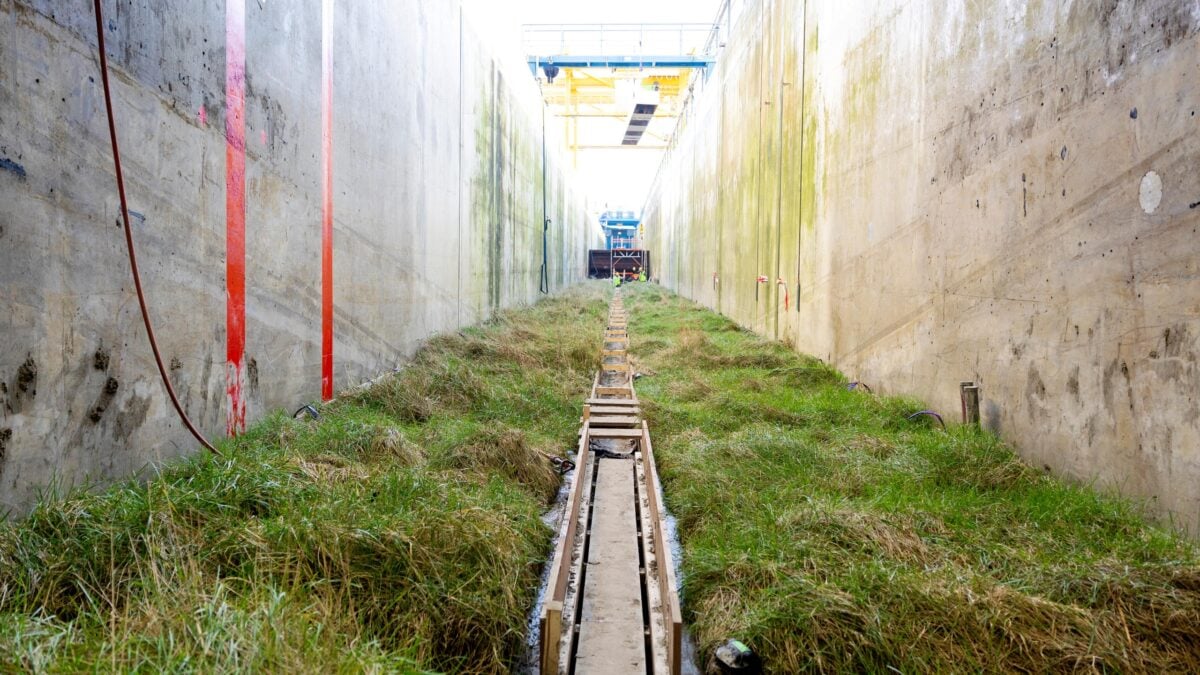 Figure: Intact blocks of wild salt marsh installed in the Delta Flume—the mud and vegetation were cut directly from the wild as a living system. Credit: Guus Schoonewille / Deltares
Why go to such lengths? A salt marsh’s resilience is rooted in countless subtle, intricate interactions between muddy sediment, root networks, stems, and canopies. Computer simulations fail to accurately capture the hydrodynamic nuances of such a living, flexible system. The only way to find out how a real marsh responds under extreme storm conditions was to bring the real thing indoors.
Between September and October 2023, the team traveled to the Peazemerlannen nature reserve in the Wadden Sea—a UNESCO World Heritage intertidal wetland spanning the coasts of the Netherlands, Germany, and Denmark. Like slicing a gigantic cake, they carved intact blocks of salt marsh along with their underlying soil. Each block retained 0.4 to 0.7 meters of undisturbed root-bound sediment, weighing between 3 and 6 metric tons—comparable to an adult Asian elephant. Sealed trucks transported the living cargo 250 kilometers to Delft, where workers assembled the slabs into a continuous, 306-square-meter marsh platform along the bottom of the flume.
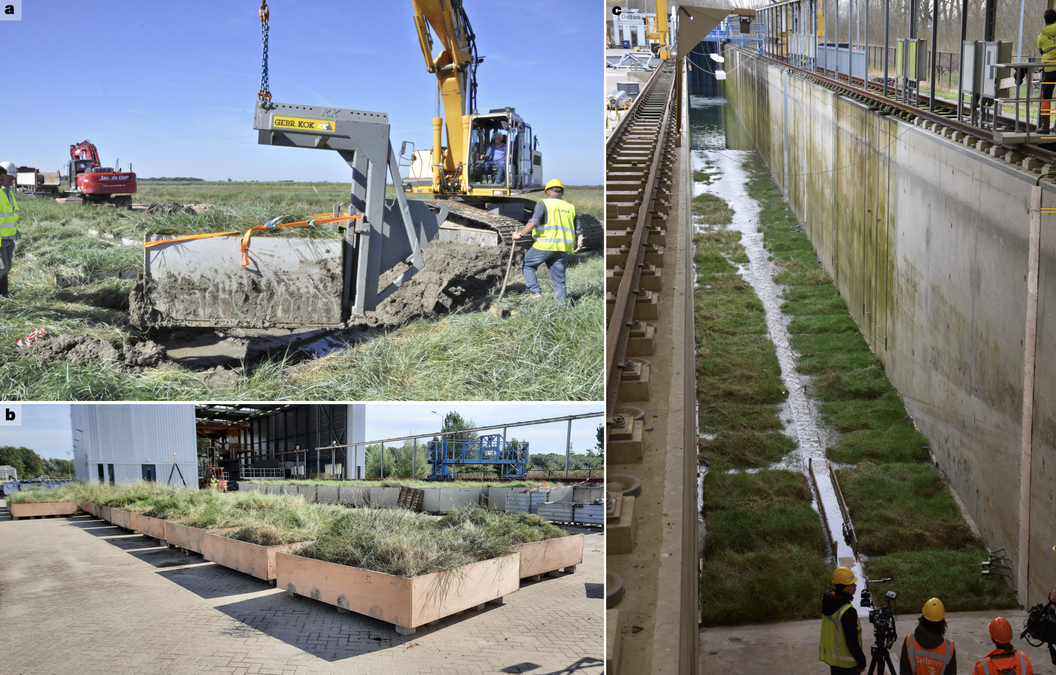 Figure: The three-step process—excavating intact field blocks (a), storage beside the flume (b), and full-scale submerged wave testing (c), keeping root systems and sediment alive throughout. Credit: Willemsen et al., Nature, 2026
After 21 Hours of Storm Waves, Just 7 Millimeters of Erosion
The waves did not peak immediately. The researchers started with 0.75-meter waves, progressively stepping up the intensity until reaching 2 meters—swells standing 30 to 40 centimeters taller than an average adult, representing storm forces approaching a 1-in-1,000-year event for such an environment. Across multiple wave series, the marsh endured approximately 21 hours of direct, sustained wave battering over a 29-hour test cycle. In nature, a severe North Sea gale typically rages for half a day; this experiment subjected the sod to the equivalent of two or three back-to-back extreme storms without a break.
The outcome was the figure highlighted at the start: the marsh surface dropped by an average of just 7 millimeters—thinner than four one-dollar coins stacked together. Considering that this bed consists of soft marine clay and vegetation that conventional wisdom assumed would be stripped away layer by layer under relentless hydrodynamic forces, 21 hours of two-meter breaking waves scraped away barely a fingernail’s depth of soil.
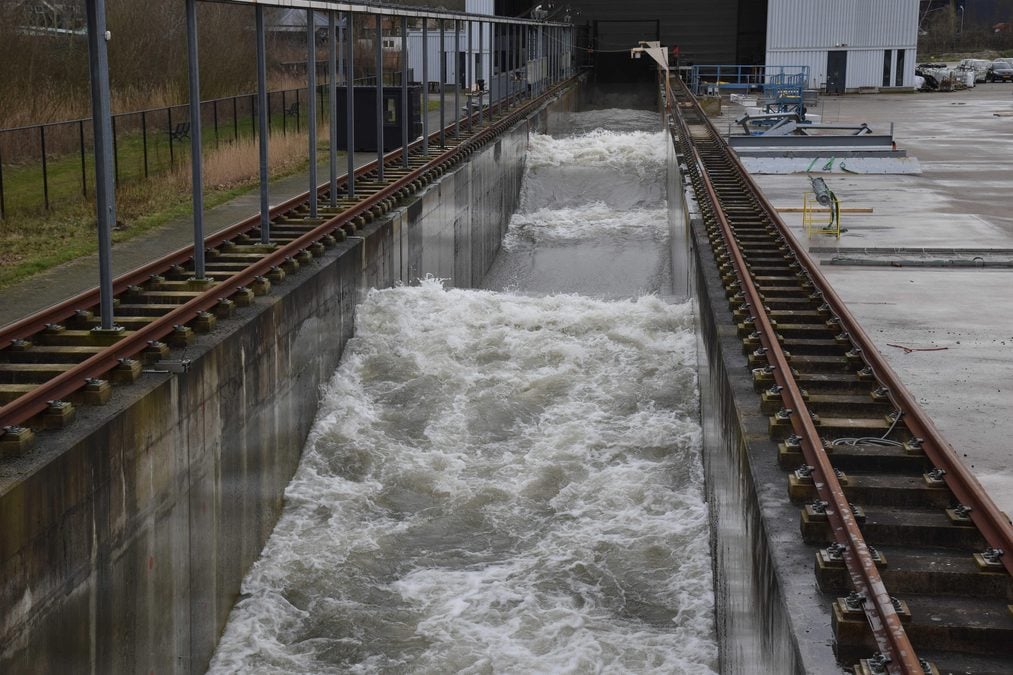 Figure: Giant waves driven by the wave piston surge down the flume toward the test section—the exact mechanism used to hammer the salt marsh. Credit: Deltares
Lead author Pim Willemsen noted in an interview: “It shows that vegetation can contribute to wave attenuation under a wide range of conditions. The marsh is even stronger than we anticipated.” Co-author Victoria Mason from the Royal Netherlands Institute for Sea Research (NIOZ) added: “The marsh plants were able to withstand the waves and broke surprisingly little.”
The Bigger the Waves, the Smaller the Relative Vegetative Damping
While vegetation clearly helps dissipate energy, its relative contribution diminishes as wave height climbs. Under 0.75-meter waves, the stems and foliage attenuated an additional 6% to 22% of wave energy compared to bare sediment; at 2-meter waves, that vegetative contribution narrowed to at most 6%. Extrapolating the findings to coastlines worldwide revealed a consistent pattern: in lower-energy environments where wave heights stay below 1 meter, vegetation routinely absorbs more than 10%—and up to 50%—of wave energy. Once waves exceed 1 meter, the canopy’s added damping effect drops below 10%.
These thresholds clarify the true operational sweet spot of salt marshes. Most shorelines around the world face waves under 1 meter for the vast majority of the year, exactly the regime where vegetative friction performs best. During once-in-a-generation tempests, the grasses may not eliminate the brunt of giant breakers, but their crucial virtue lies elsewhere: the system itself does not collapse. Although the initial wave train sheared off roughly a third of above-ground biomass, the total canopy loss after all 21 hours averaged only about 30%, with stem lengths reduced by 47%. The dense root network remained intact, anchoring the soil beneath. Once the storm passes, the marsh simply regrows.
Concrete sea walls fracture and demand expensive repairs; broken marsh grass regenerates on its own. They represent two fundamentally different engineering philosophies and cost structures.
Millions of Euros Already Saved in the Netherlands
The engineering payoff of these findings has already been demonstrated in practice. Along the Koehool–Lauwersmeer dike reinforcement project in the northern Netherlands, conventional engineering guidelines called for replacing the outer dike revetment—the heavy armor of concrete blocks or riprap facing the sea. After field and experimental data verified that the foreshore salt marsh significantly damped wave loads, authorities determined that portions of the revetment did not require replacement or could be built to less stringent load ratings, saving millions of euros.
Bas Borsje, associate professor of nature-based flood protection at the University of Twente and corresponding author of the study, put it plainly: “Until now, salt marshes barely counted when assessing the safety of a dike. It means we can start designing the marsh and the dike as one system.”
Saving millions of euros is no trivial matter. Ecological restoration initiatives are frequently dismissed by hardline infrastructure planners as well-intentioned gestures lacking structural reliability. Yet here, in a country where roughly a quarter of the land sits below sea level and coastal engineering is honed to perfection, engineers modified formal design standards to account for wild marshland. Its flood-protection value is now verified directly on the public balance sheet.
Concrete Walls Cannot Grow; Living Marshes Can
Salt marshes possess another vital capability that static concrete revetments can never replicate: they grow vertically. Silt and organic matter brought in by incoming tides settle among the vegetation, gradually raising the platform’s elevation. Provided they have sufficient room and sediment supply, marshes can theoretically keep pace with rising sea levels. Simultaneously, these same wetlands act as nurseries for fish, crabs, and shrimp, while functioning as high-efficiency carbon sinks that lock organic carbon into waterlogged sediments. It is a single defensive barrier delivering multiple ecological and economic dividends.
The tragedy is that they are rapidly vanishing. Between 2000 and 2019, the world lost 719 square kilometers of salt marshes—an area roughly equivalent to the entire landmass of Singapore. Each vanished hectare dismantles a self-sustaining, self-healing, height-adjusting coastal barrier that costs nothing to maintain.
The most profound insight from this study is distilled into that single modest figure: two-meter waves hammered a 306-square-meter living marsh for 21 hours, and the surface eroded by just 7 millimeters. The next time you walk along a coastal sea wall, take a closer look at the muddy, weed-strewn flats below. Beyond the concrete lies a living sea defense capable of withstanding the fiercest tempests—requiring no maintenance contracts, only that we refrain from paving it over.
References:
- Nature News: Salt marsh transplanted into the world’s largest wave flume
- Willemsen et al., Nature research paper
- University of Twente (UTwente) press release: Salt marshes are proving to be powerful allies in building a climate-resilient coastline
- ScienceAlert report: Scientists transplanted 306 square meters of wild salt marsh into the world’s largest wave machine