Even Capping Warming at 1.5°C Cannot Halt Antarctic Ice Sheet Loss
Strolling along coastal boardwalks on a weekend, people often perceive sea-level rise as a distant scientific projection. Yet a new study published in Nature Geoscience draws a stark, non-negotiable baseline. Even if the global community achieves the most ambitious target of the Paris Agreement by limiting warming to 1.5 degrees Celsius, net ice loss from the Antarctic ice sheet throughout this century has already become locked in.
Antarctica harbors Earth’s largest ice reservoir. If completely melted, its ice sheet would raise global sea levels by approximately 58 meters (190 feet)—equivalent to submerging a 19-story building beneath the waves. Even losing a minuscule fraction of that frozen expanse exerts tremendous hydrostatic pressure on coastal seawalls and defense infrastructure worldwide.
Historically, scientists struggled to calculate the absolute lower bound of Antarctic ice loss because running a single comprehensive physical ice-sheet simulation consumes vast supercomputing resources. Now, a collaborative team of glaciologists, oceanographers, and data scientists has harnessed machine learning to overcome this computational bottleneck. Their findings confirm that a minimum baseline increment of sea-level rise is already locked in.
AI Explores Millions of Futures, Calibrated by Satellite Gravity Data
To evaluate countless possible futures within finite computing time, the researchers introduced machine learning—training algorithms on massive simulation datasets to identify governing physical dynamics. Drawing from ISMIP6 (the Ice Sheet Model Intercomparison Project for CMIP6, an international archive compiling simulations from dozens of physical models worldwide), they built a physics-informed machine learning model.
Simulations that previously tied up supercomputers for days were compressed by the new surrogate model into fractions of a second. This leap in computational throughput allowed the team to explore millions of parameter combinations and evaluate hundreds of thousands of plausible future scenarios.
Once these projections were generated, the researchers established a rigorous observational threshold: only scenarios capable of reproducing real-world measurements from the GRACE satellites (Gravity Recovery and Climate Experiment, twin orbiters that effectively weigh Earth’s ice sheets from space by sensing micro-gravitational variations) since 2002 made the cut.
Scenarios failing to match what satellites observed were eliminated. The surviving hundreds of thousands of validated projections converged on a singular conclusion: throughout the 21st century, the volume of ice Antarctica loses through melting will inevitably outpace any gains from fresh snowfall.
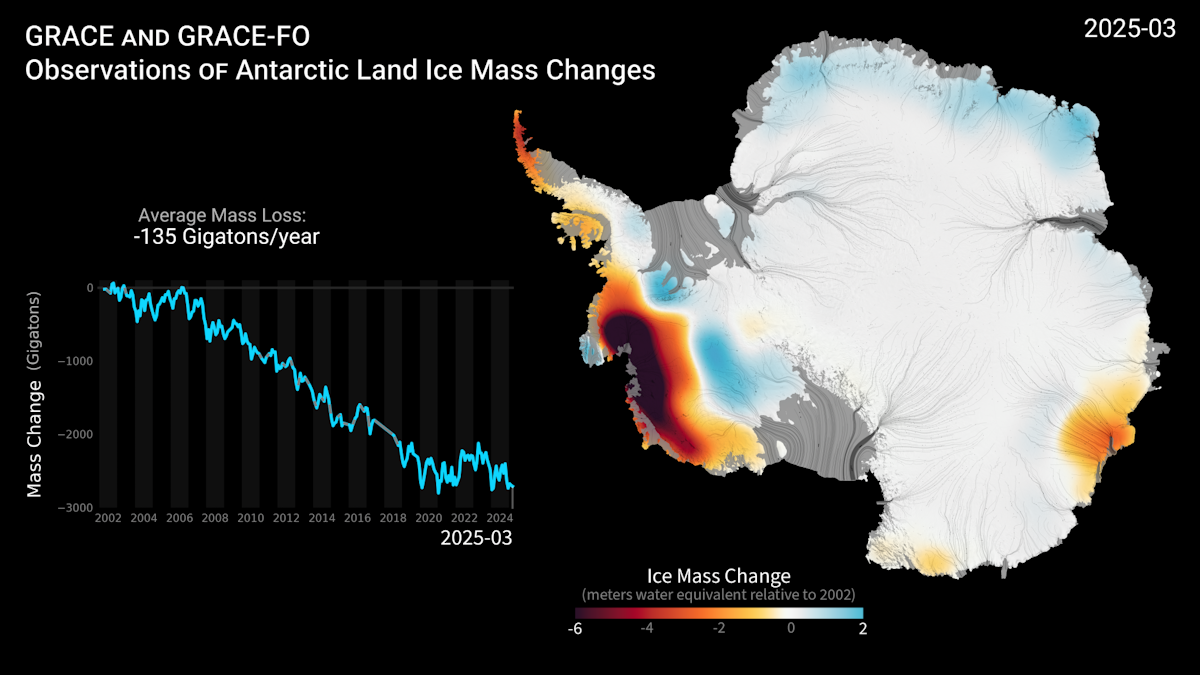 Figure: Antarctic ice sheet mass loss recorded from orbit by NASA’s GRACE satellites through gravimetric measurements. Source: The Conversation / NASA
Extra Snowfall Cannot Offset Melting Ice Shelves
In past climate debates, an ostensibly optimistic hypothesis persisted: as global air temperatures rise, a warmer atmosphere holds more moisture, leading to increased precipitation and heavier snowfall over Antarctica. Some theoretical projections posited that accumulation from new snow could counterbalance the mass lost to a warming Southern Ocean.
The latest findings thoroughly refute that premise with empirical data. Satellite observations and subsurface oceanic measurements demonstrate that warm seawater melting the underbelly of ice shelves outpaces accumulation from summit snowfall by a wide margin.
Basal melting driven by warming ocean currents dominates the mass balance equation. Calibrated against satellite observations, the data confirms that extra snowfall will not save Antarctica; a net deficit in ice sheet mass is already sealed by physics.
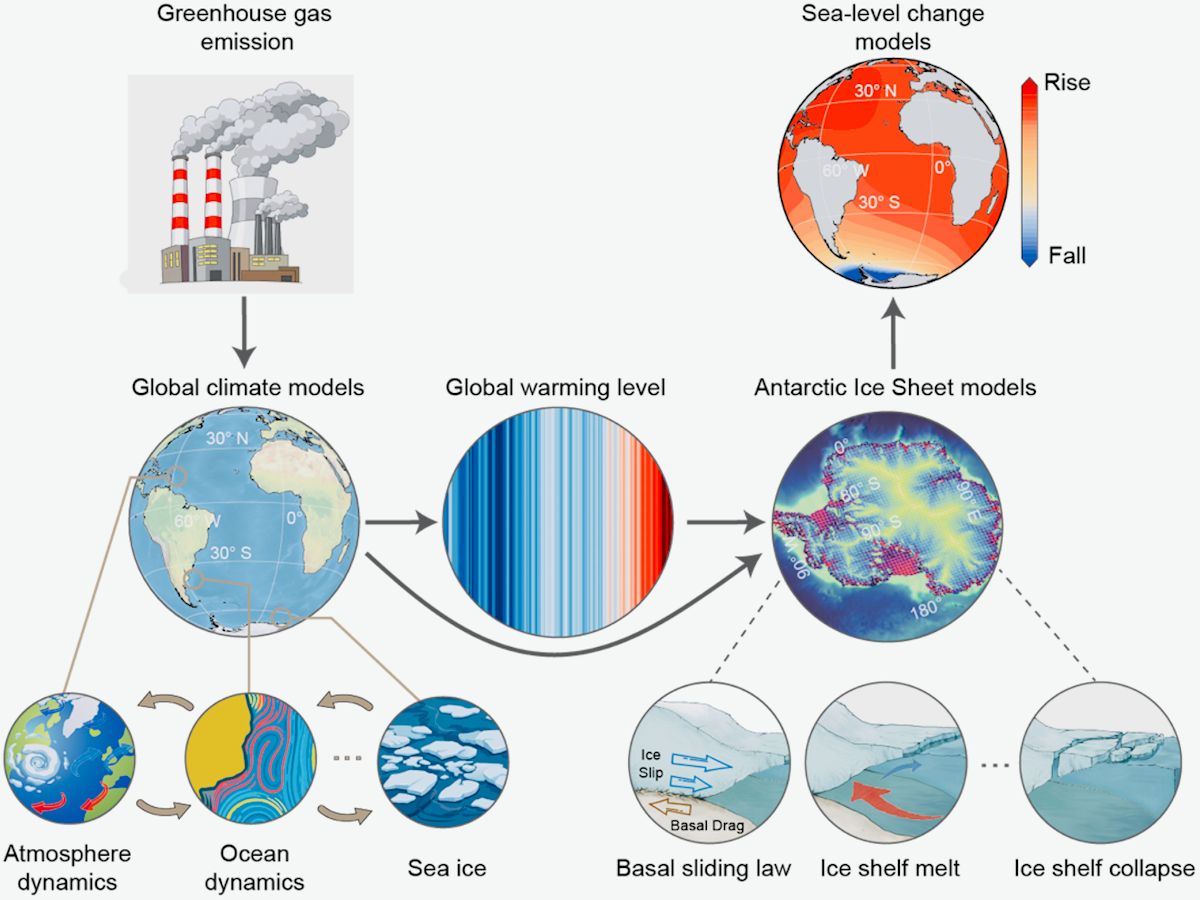 Figure: The cascading mechanism linking ocean warming, ice shelf thinning, and accelerated glacier discharge. Source: The Conversation, Illustration by Yucheng Lin
A 25-Centimeter Rise Threatens Tens of Millions in Coastal Communities
Warm ocean water thinning the ice shelves fringing the continent triggers a destructive domino effect. As buttressing ice shelves thin or collapse, inland glaciers lose their natural barricades and slide toward the sea at accelerated velocities. Each stage of basal melting makes subsequent collapse arrive that much faster.
Under a very high-emissions trajectory, melting from the Antarctic ice sheet alone could contribute up to 25 centimeters (10 inches) of global sea-level rise by 2100.
Twenty-five centimeters might seem modest—roughly the height of an adult’s calf. But from an engineering and coastal defense perspective, every 10-centimeter rise in sea level doubles the frequency of severe storm-surge flooding. Today, approximately one billion people reside in low-lying coastal areas, with 100 million living within just one meter of sea level. That 25-centimeter contribution from Antarctica alone is sufficient to permanently inundate areas home to more than ten million people.
Every Avoided Ton of Carbon Buys Precious Time for Coastal Cities
The authors also note that current simulations remain inherently conservative. Key physical mechanisms—such as structural ice fracturing and the dynamic hydrology of subglacial lakes—have yet to be incorporated into the equations, meaning real-world ice loss could unfold even faster than projected.
Accepting that minimum ice loss is locked in does not mean giving up on emissions reductions. On the contrary: every ton of greenhouse gas emissions avoided today slows the melting rate of the ice sheets, granting coastal cities indispensable breathing room to reinforce seawalls and adapt infrastructure.
While the 1.5°C climate target cannot reverse committed ice loss, it dictates the ceiling of future sea-level rise. The lower threshold is fixed by the laws of physics, but the upper boundary remains entirely in human hands and our trajectory of global carbon emissions.
References:
- Nature Geoscience Original Research Paper
- The Conversation Research Report