Stepping into the Shade to Beat the Heat, Yet Canopies Run 10°C Hotter Than the Air
On a sweltering summer afternoon, drenched in sweat after walking under the blazing sun, nearly everyone instinctively ducks into the deep shade of towering trees. As dense foliage overhead blocks out the harsh sunlight, your skin feels an immediate wash of cool air. Many people have come to regard these soaring woods as nature’s non-stop air conditioners. The soothing chill under the canopy fosters a quiet intuition: no matter how scorching it gets, ancient trees will always keep their cool.
During relentless heatwaves, however, even giant canopies cannot shield themselves from the sun, and the trees’ own temperatures climb dangerously high. Needle surfaces running significantly hotter than surrounding air represents an unavoidable survival dilemma for trees in extreme climates. When ambient temperatures shatter human comfort zones, the massive living organisms above are enduring their own severe physiological stress.
In a September 2026 study published in the Journal of Geophysical Research: Biogeosciences (JGR: Biogeosciences), researchers from the University of California, Davis (UC Davis) demonstrated that when outdoor temperatures approach 40°C (104°F), redwood needle temperatures can soar up to 10°C above the ambient air. When air temperatures hit 40°C, sun-exposed foliage can climb close to 50°C (122°F). That rivals the burning surface of a dark car hood parked under direct sunlight—a state of intense, severe overheating for living plant tissues that depend entirely on delicate moisture and cell function.
Shutting Pores at 40°C to Save Water Cuts Photosynthesis in Half
The investigation centered on the coast redwood (Sequoia sempervirens), an evergreen coniferous titan native to the Pacific Coast of North America and the tallest known tree species on Earth. Mature redwoods can reach over 115 meters into the sky—rivalling a 40-story skyscraper. Thanks to their colossal biomass and thousand-year lifespans, they have long been celebrated as some of the most formidable natural carbon sinks on land—planetary warehouses absorbing and locking away vast reserves of atmospheric carbon dioxide.
These ancient titans absorb enormous volumes of greenhouse gases through photosynthesis—the foundational biochemical process where leaves harness sunlight to convert water and carbon dioxide into energy and sugars, essentially serving as a tree’s primary feeding mechanism. Through photosynthesis, trees produce the sugars required to fuel growth while locking atmospheric carbon securely into dense trunks and root networks. Yet UC Davis laboratory data revealed that as ambient temperatures climbed from 30°C to 40°C, the rate of photosynthesis in redwood needles plummeted by approximately 50%.
A halved photosynthetic rate means the tree’s daily efficiency in converting sunlight into sustenance is slashed in two. While their nutritional intake plummets, respiration and energy consumption under extreme heat continue unabated. At 40°C, redwoods effectively see their feeding rate cut in half, forcing one of the planet’s most potent carbon sinks to tap the brakes.
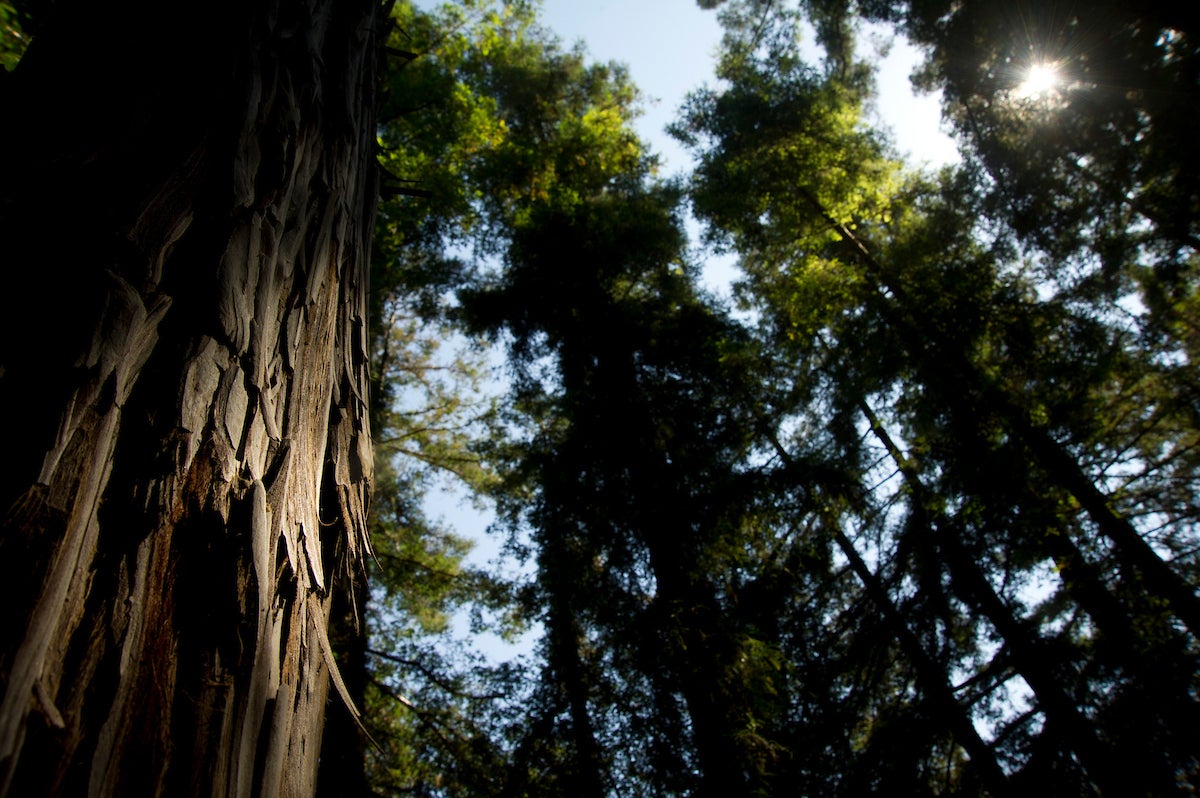 Figure: Sunlight piercing the dense canopy of a coastal California redwood forest. Source: UC Davis
Scaling a Truck Bed to Clip Needles: Unlocking Metabolic Slowdowns in the Lab
To measure how these giants behave physiologically under real-world conditions, scientists needed live foliage. Redwoods routinely soar dozens or hundreds of meters into the air, far beyond the reach of standard ladders. The study’s lead author, UC Davis doctoral candidate Lily Klinek, adopted a decidedly hands-on approach: standing atop the roof of her pickup truck with an extendable pole pruner to snip live lower-canopy branches roughly 5 meters above the ground.
Between July 2022 and October 2024, Klinek and her colleagues repeatedly collected samples from a redwood preserve in Mendocino County, California, capturing two distinct heatwaves that swept through the region during that window. Harvested branches were promptly plunged into water-filled vials and transported back to the laboratory for physiological testing. There, researchers clamped needles inside specialized gas analyzers, using precision sensors to record respiration and metabolic output across controlled temperature gradients.
Under scorching field conditions, trees initiate an emergency lockdown to retain moisture. Plant leaves are covered in microscopic pores called stomata—tiny valves through which moisture and atmospheric gases flow, functioning much like pores for breathing and perspiration. Plants normally shed heat through transpiration, evaporating water through open stomata to cool their surfaces like sweat. But when heatwaves strike and the atmosphere turns arid, needles tightly seal their stomata to prevent dehydration. With evaporative cooling shut down, leaf temperatures spike rapidly, soaring nearly 10°C above the surrounding atmosphere.
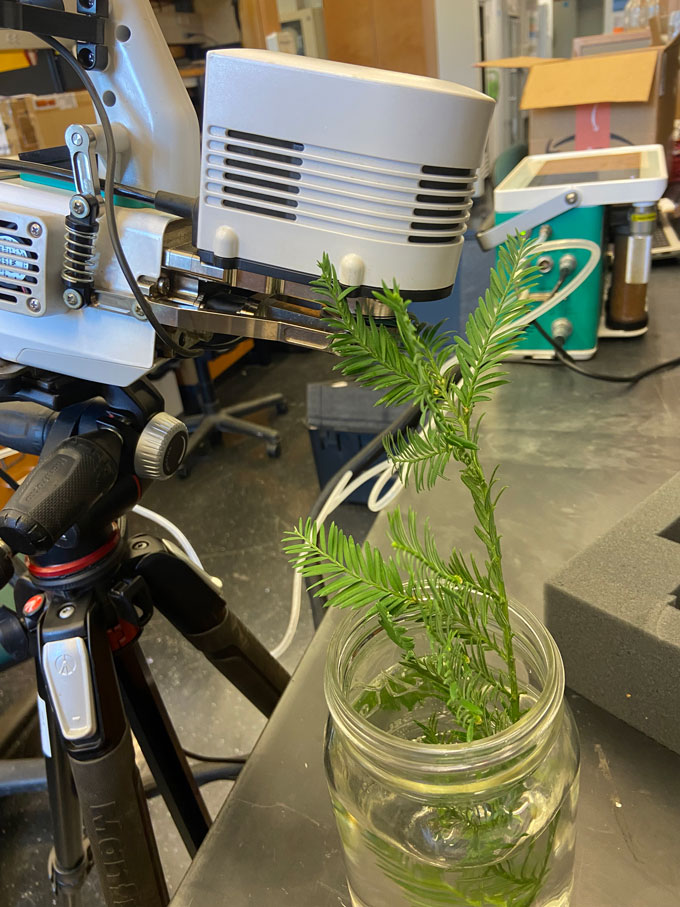 Figure: Redwood branches submerged in water in the laboratory, with gray analytical instruments clamped onto needles to record real-time gas exchange rates. Source: Science News (Photo by Lily Klinek)
Starving Even in Water: Extreme Heat Penetrates Core Cellular Metabolism
Ecologists previously assumed that the sharp slowdown in redwood photosynthesis during heatwaves was simply due to stomatal closure shutting off carbon dioxide intake. If physical gas pathways are barricaded, leaves lack the raw ingredients for the photosynthetic reaction, leaving the process stalled. Under that logic, provided there is abundant soil moisture and open stomata, giant trees ought to buffer heatwaves through their immense reserves.
Klinek’s team conducted a counterintuitive controlled experiment to test that assumption. They submerged harvested redwood branches in water and continuously pumped carbon dioxide directly into the leaf chambers—ensuring fully open stomata and an inexhaustible carbon supply. Even in these ideal conditions devoid of any drought stress, raising chamber temperatures from 30°C to 40°C still triggered a roughly 50% plunge in photosynthetic rate.
The results proved that beyond the physical threat of desiccation and suffocated gas exchange, high temperatures directly depress plant metabolic pathways—the network of chemical reactions that keeps cellular machinery running. As Klinek noted in the study, when trees cannot assimilate sufficient carbon, they are essentially starved. Heat directly curbs the metabolic efficiency of plant cells; even when water and carbon flow without restriction, the giants still go hungry in the sweltering heat.
Disappearing Marine Fog: California’s Natural Carbon Vaults Lose Their Cooling Shield
Coast redwoods have endured across evolutionary history largely thanks to the temperate, hyper-local maritime climate along California’s coastline. Their native range is exceptionally narrow, confined to a thin coastal strip running from central California to southern Oregon. Historically, summer temperatures across these forests averaged around 15°C (59°F), offering mild marine breezes in which ancient trees flourished.
During those cool eras, thick marine fog rolling off the Pacific Ocean served as the redwoods’ most critical hydration lifeline. The giants capture fog droplets with high needles to maintain their massive hydraulic equilibrium. Yet as heatwaves grow increasingly frequent and severe, summer temperatures in parts of the redwood range have repeatedly broken past the 40°C threshold, and blistering winds rapidly burn away the morning fog blankets redwoods rely on.
Even more concerning is that scientists have so far only sampled branches at 5 meters off the ground. The upper canopies towering nearly a hundred meters into the sky endure relentless, direct solar radiation and searing winds all day long, bearing thermal strain that likely exceeds what low branches experience. Because science has yet to pinpoint the exact thermal threshold where irreversible tissue necrosis occurs in redwoods, an unknown ceiling of damage hangs over the ancient forest.
This sounds an urgent alarm for climate strategies relying on forests to sequester greenhouse emissions. When 40°C heat cuts redwood photosynthesis in half and leaf temperatures 10°C above ambient force cellular metabolism to downshift, nature’s towering carbon sponges risk transforming from resilient climate shields into starving organisms struggling for survival. Relentlessly rising global temperatures threaten to strip Earth’s most majestic natural carbon vaults of their ability to buffer the warming world.
References:
- Science News coverage
- UC Davis news release
- Journal of Geophysical Research: Biogeosciences paper