140 Lines Cut to 7: A Veteran Project Shuts the Gate
On September 24, 2026, QGIS—an open-source geographic information system with more than twenty years of continuous development—submitted pull request PR #387. The move was unprecedented: maintainers purged 140 lines of existing policy text and added just 7 new lines, condensing the entire document from 148 lines down to 15.
Gone were all the gentle recommendations and compromise clauses. The new provision laid down a single, uncompromising rule: the QGIS repository will no longer accept any code contributions assisted by LLMs, AI, or agents. If someone is later found to have used such a workflow, their contribution will be reverted, and their contributor permissions will face sanctions. The proposal was swiftly merged, backed by overwhelming community support.
No LLM, AI or agent assisted code contributions are allowed in the qgis repository. If we subsequently discover that you have used an AI, LLM, or any agent-based workflow for your contribution, you will be subject to code reversion and contributor rights sanctioning.The document jumped from version 1.0 to 2.0, with attribution shifting from an individual maintainer to “All contributors to the QGIS project.” By cutting over ninety percent of its governance text, the project ratcheted its enforcement up to unprecedented levels. The former gentleman’s agreement, which relied on voluntary compliance, was replaced by a non-negotiable red line.
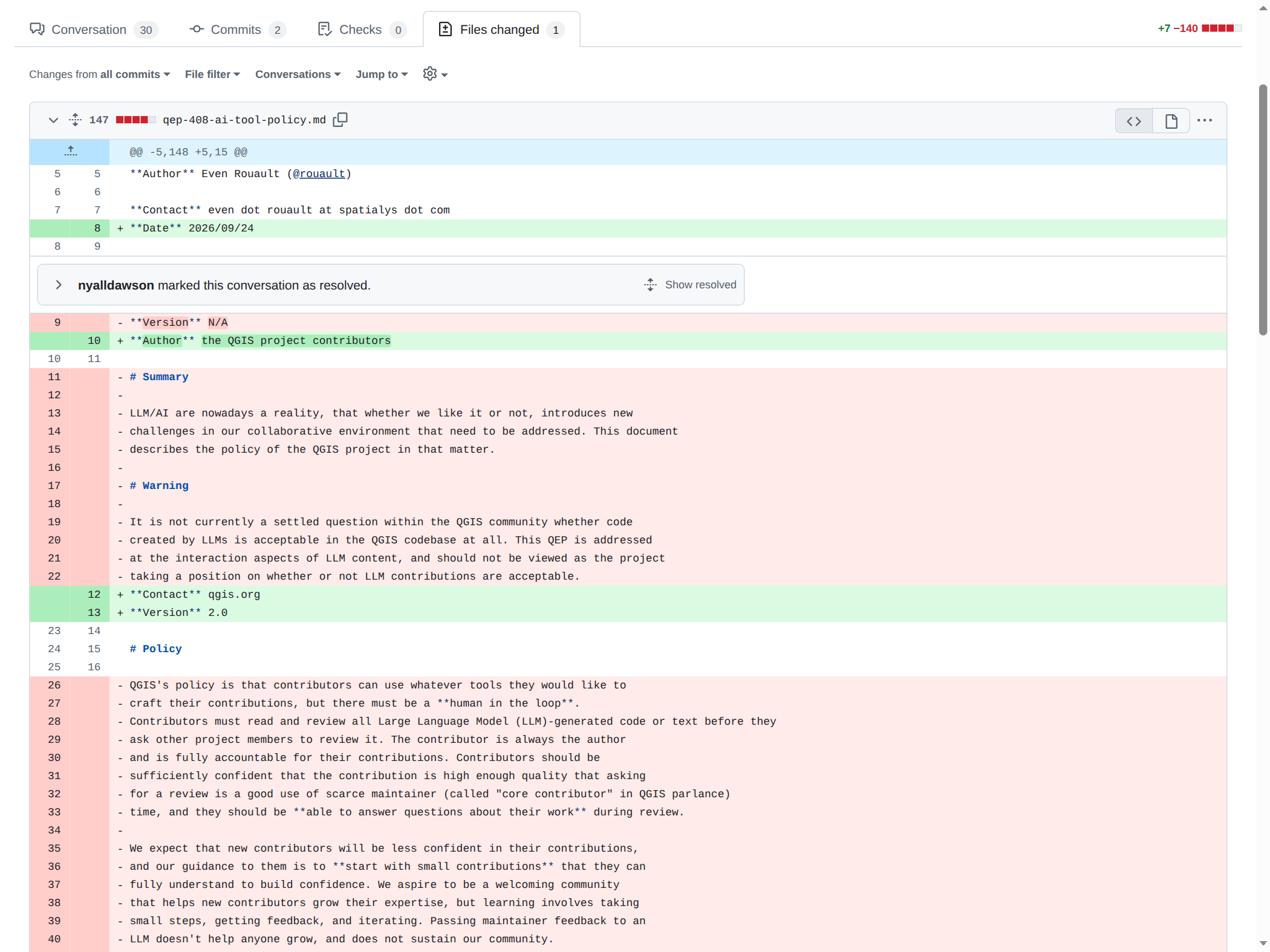 Figure: Diff view of the proposal: an entire policy document stripped down to a single concise paragraph. Source: GitHub (QGIS-Enhancement-Proposals PR #387)
The discarded legacy policy had actually been remarkably lenient: contributors were free to use whatever tools they wished, provided a “human in the loop” remained intact—they had to personally read and review every scrap of LLM-generated code and text before submitting, take full authorship responsibility, and transparently declare tool usage in commit messages. That earlier document had even explicitly noted that the policy merely governed collaboration workflows, without taking any philosophical stance on whether LLM-generated code was inherently acceptable.
A few months later, that lengthy document collapsed under real-world pressure. Maintainer timlinux summarized the change bluntly: the beauty of switching to this 7-line rule is that it removes all ambiguity.
Code Takes Three Seconds to Generate; Humans Must Review Every Line
The anxiety gripping veteran open-source projects boils down to verification costs. Hitting Enter produces hundreds of lines of code in seconds, but reviewing that output hasn’t gotten any faster.
It is like dumping a truckload of pre-shredded potatoes into a restaurant kitchen: machines spit them out in seconds, but human quality inspectors must lean over the bin potato by potato to check for rot. QGIS deals with geospatial datasets and complex geometry; a coordinate projection offset by a single decimal point or a subtle memory leak buried deep inside a loop will not trigger a compiler error. Generation costs have dropped to near zero, while verification costs haven’t budged by a cent—and the resulting deficit can only be paid in human hours.
Maintainer haubourg laid out the rationale most clearly in the discussion thread. He pointed out that external contributors using AI place a massive, unsustainable burden on maintainers—a workload that was already grueling long before LLMs entered the picture. The proliferation of these tools has brought no relief; it has merely amplified upstream output volume and dumped it downstream.
He outlined two inevitable outcomes: when incoming code outpaces the human capacity to review it, the project either piles up an endless backlog of neglected pull requests, or merges unvetted code into the repository. Neither outcome is acceptable for an industrial-grade foundational tool.
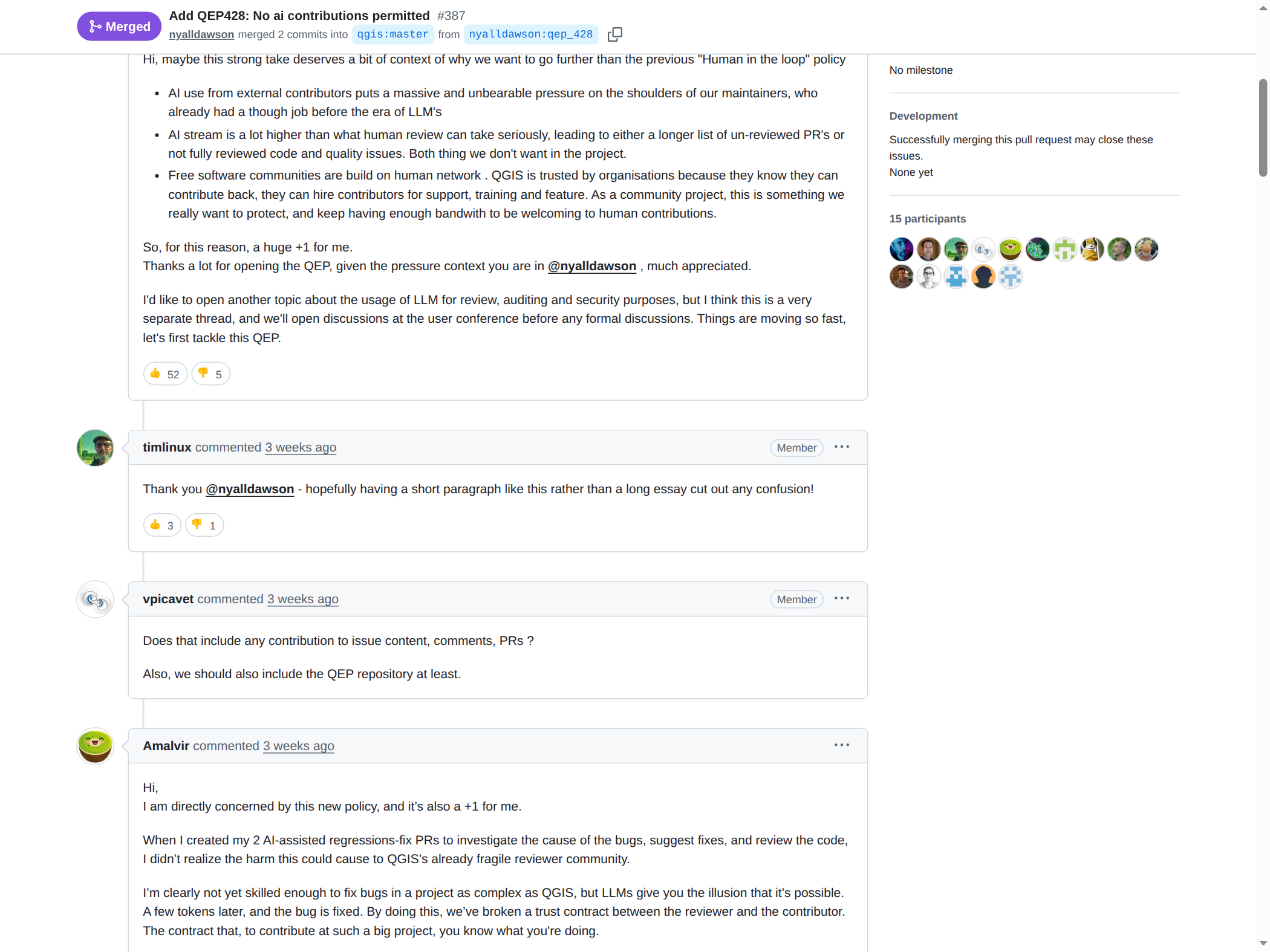 Figure: Maintainers explaining the decision to close the gate in the proposal’s discussion thread. Source: GitHub (QGIS-Enhancement-Proposals PR #387)
Arguing with Models via User Accounts: Maintainers Are Grading AI Homework
haubourg highlighted a second, even more fundamental point: the foundation of free software communities is a human network. Organizations place their trust in QGIS because they know they can give back, hire people for support, training, and custom feature development. Every single one of these premises rests on the assumption that there is an accountable human on the other side of the screen who can genuinely communicate.
Maintainers on the receiving end are the ones paying the bill for that broken premise. Around the same time, a discussion gained traction on Hacker News around the theme that “AI coding agents produce more code, not more software.” The comment section turned into a raw field journal for maintainers: Plotly noted that three-page unproofread issues paired with “plausible-looking but fragile” patches were devouring review time, forcing the team to consider turning away drive-by contributions; Hatchet remarked that recent PR reviews felt like “arguing back and forth with Claude through someone else’s account”; PgDog shut down code contributions entirely, accepting only issues; and Godot developers, harassed by AI-generated PRs, could offer little more than weary apologies.
haubourg’s concern goes beyond immediate triage. If external contributions become flooded with synthetic noise, genuine newcomers eager to learn will be drowned out, severing the pipeline of future contributors. That bandwidth is precisely what he intends to protect: conserving enough energy to welcome human beginners willing to start from small, honest improvements.
Closing the Gate Is Institutional Policy, Not a Technical Indictment
A common misconception about the QGIS decision is to interpret it as a rejection of the technology itself. The resolution specifically targets code submitted by external contributors. Maintainers are not writing off AI wholesale. haubourg made clear that using large language models for review, auditing, and security screening deserves a dedicated discussion of its own, which he plans to introduce at user conferences before taking it to a formal proposal.
That distinction matters. In the hands of gatekeepers, the same tool serves as a defect scanner; mixed into the flood outside the gate, it is silt and debris. Institutional policy is designed to block unaccountable output, not the underlying tool.
Reverting from 140 lines of accommodating guidance to a 7-line hard ban is an extreme manifestation of that reality. As generation accelerates at breakneck speed without parallel advances in verification, defenses built on voluntary etiquette inevitably crack first. The bottleneck is no longer writing code; it is verifying what the code actually does. Shutting the door is an effort to preserve the very thing open source relies on: meaningful human dialogue.
Reference Links:
- QGIS Proposal PR #387 (QEP428)
- Discussion thread and maintainer statements on QGIS PR #387
- Hacker News: AI coding agents produce more code, not more software
- Public feedback from maintainers of Plotly, Hatchet, PgDog, and Godot