Widely acknowledged across gaming history as the work that defined 3D movement and control, Super Mario 64 was forged by a core team of only 15 people. When work began, retail N64 hardware did not exist, nor did a controller with an analog stick—Mario originally moved across an SGI workstation emulator.
Retrospective acclaim often attributes seminal leaps to sudden flashes of auteur genius. Yet Giles Goddard, a core programmer on the project, painted a vastly different reality during a 2001 interview with NGC Magazine: it was a brutal, unending marathon of trial and error. By the time the game shipped, two participating programmers decided they would never touch game development again.
A Crew of 15, Flying Blind Without Real Controllers for Six Months
The team count stood at roughly 15 by the end. As Goddard recalled, “It probably wasn’t as many as people think”—an extraordinarily small outfit compared to the sprawling credits of The Legend of Zelda: Ocarina of Time.
The entire production began life on an SGI Onyx simulator, which simulated the software API rather than the physical silicon. The very first engineer to make Mario walk was lead programmer Nishida, who would steer the technical direction throughout. Operating strictly against an emulator meant genuine hardware bottlenecks were pure guesswork; no one could predict where the silicon would choke once retail units materialized.
For the first six months, the team had zero N64 controllers. All they possessed was a serial cable running out of the emulator board. They hooked up modified Sega controllers, and most of the early technical exploration was done through them—dialing in the tactile weight of a landmark 3D game using a rival’s 2D peripheral.
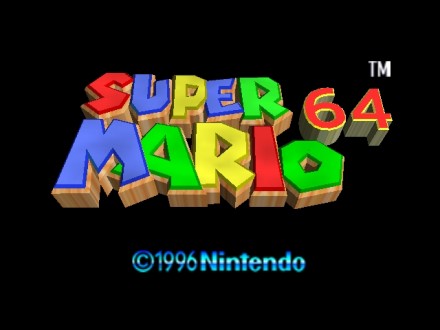 Figure: Dialing in 3D movement mechanics through modified hardware and relentless parameter tuning. Source: NGC Magazine interview / pixelatron
Goddard’s own assignment back then was the interactive, stretchable Mario face on the title screen. Conceived as little more than a visual filler during loading intervals, it morphed into an exploratory testbed for real-time vertex deformation. Most games simply shifted rigid vertices via transformation matrices; Goddard set out to calculate and deform individual points on the fly.
100 Controller Prototypes, Thousands of Camera Rewrites
A D-pad provides only eight discrete directions, but true 3D spatial navigation demands smooth, stepless analog input. To calibrate resistance and throw, Nintendo produced at least 100 physical controller prototypes, constantly tweaking stick travel and the contour of the surrounding gate. They eventually landed on an octagonal gate, though circular variants were also vetted.
While this layout became an enduring industry benchmark, Shigeru Miyamoto himself remained lukewarm on aspects of it. Years later, he remarked that symmetric D-pads on both the left and right would have felt better, and he never particularly liked the yellow C-buttons. Yet that stands as mere hindsight: at the time, the crew had to establish a working standard from zero.
Even more punishing than the stick was the camera system. Takumi Kawagoe, an engineer who had previously worked on the canceled SNES version of Star Fox 2, spent virtually the entire project dedicated to a single problem: the camera. Miyamoto was equally unaccustomed to directing a camera in 3D space. Consequently, the camera logic churned through thousands of iterations—toggling endlessly between tight locks, free tracking, hybrid tracking, and direct player control.
More than 90% of development effort was poured into locomotion and camera work. Miyamoto’s primary day-to-day role was sitting beside programmers, testing builds in real time, and fine-tuning movement curves until the tactile feedback felt intuitive. Bob-Omb Battlefield took less than six to seven months from scratch to running state with enemies patrolling—a remarkable pace considering Nintendo internal teams had never built a 3D title, and artists were still figuring out how to transform raw models into interactive game entities.
Crushed on Raw Fillrate by Sony, Surviving Through Deceptive Level Geometry
The N64 was not inherently fast. SGI pitched it on pixel quality: every rendered pixel received dedicated texturing, precise lighting, filtering, and anti-aliasing. Sony’s PlayStation, in contrast, boasted vastly higher raw speed and primitive throughput, albeit with rougher, wobbly pixels. Nintendo and SGI chose rendering fidelity over raw throughput, and the burden of that trade-off fell squarely on the shoulders of level designers.
To fabricate the illusion of an expansive, open world, the levels relied on extreme visual sleight of hand. While players felt Peach’s Castle was grand and panoramic, the geometry was carefully folded into narrow, convoluted corridors. Almost no viewpoint offered an unoccluded view across the entire map.
Distant objects were culled the instant they drifted outside the viewing frustum, freeing precious fillrate for the immediate foreground. Underwater segments were constructed with no water surface textures at all—early water textures obscured player vision and disrupted gameplay clarity, so the team simply discarded them. The infinite staircase was never an infinite loop: cross a trigger point, and the engine silently teleported Mario back to the exact start coordinate so fast the human eye couldn’t perceive the jump. Physical realism took a back seat to playability—whatever felt right took precedence.
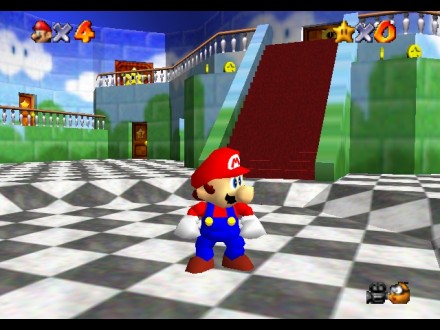 Figure: Folding geometry and aggressive frustum culling to sustain stable frame rates. Source: NGC Magazine interview / pixelatron
A Silenced Office with Zero Internet Access
Hardware and compute bottlenecks mirrored the strict environmental discipline of the office floor. Nintendo headquarters featured an open-plan layout, yet conversations were forbidden. Whenever staff gathered to talk, a manager would walk over, shoot a silent glance, and everyone would sit back down in silence. It was typical of traditional Japanese corporate culture at the time, starkly contrasting with Western dev environments.
Information security went even further: the building had no internet connectivity. When the N64 was unveiled to the public at Shoshinkai 1995, not a single core developer from the team attended. Nintendo intentionally barricaded the creators against outside noise and early commentary.
This monastic setup produced an undistracted, razor-focused strike team, but it meant every blind corner had to be navigated entirely within those four walls.
Shipping a Masterpiece on Schedule, Leaving the Industry Forever
The N64 retail launch was an immovable deadline, and the software had to ship. Nevertheless, Nintendo’s director-driven structure allowed breathing room: production was treated as an organic, evolving process where leads could lobby for an extra two to three weeks of polish rather than adhering rigidly to fixed schedules. Even so, the final sprint was intense and chaotic. Yet organizational discipline held firm, game-breaking bugs remained minimal, and the core gameplay loops locked in on time.
On June 23, 1996, the game launched in Japan. It went on to sell over 11 million copies worldwide, cementing analog stick navigation and dynamic camera control as universal industry baselines. Yet the interview closes on an overlooked detail: two programmers on the project decided to leave the video game industry altogether right after release—not because they lost their love for games, but because the ordeal had thoroughly burned them out.
Refining a controller across 100 physical iterations, rewriting the camera code thousands of times, and tucking away half the world geometry just to deliver a grand illusion: the golden rules that the games industry built upon for decades were extracted from the physical and mental exhaustion of fifteen people.
Reference Links:
- NGC Magazine 2001 Interview (Giles Goddard uncut full transcript)
- pixelatron complete blog archive
- Hacker News discussion