A 19.2% All-Pass Rate: Good Enough for a First Draft, Far from a Signable Opinion
19.2%—that is the end-to-end pass rate achieved when slotting a domestic AI model into a law firm’s operational pipeline. On October 12, 2026, Zhipu AI unveiled GLM-Legal, an agent model tailored for legal workflows. Evaluated on the Harvey LAB benchmark spanning 24 practice areas, this score represents a 12.5 percentage point improvement over its foundational model. Even with that leap, more than 80% of complex tasks remain beyond its reach.
This “all-pass” metric demands zero degradation across an entire multi-step task chain. The 12.5-point jump demonstrates that specialized domain post-training is genuinely effective; the 19.2% ceiling, however, draws a sobering boundary. The model can assemble structurally sound compliance first drafts, but it cannot deliver a legal opinion ready for an official stamp and signature.
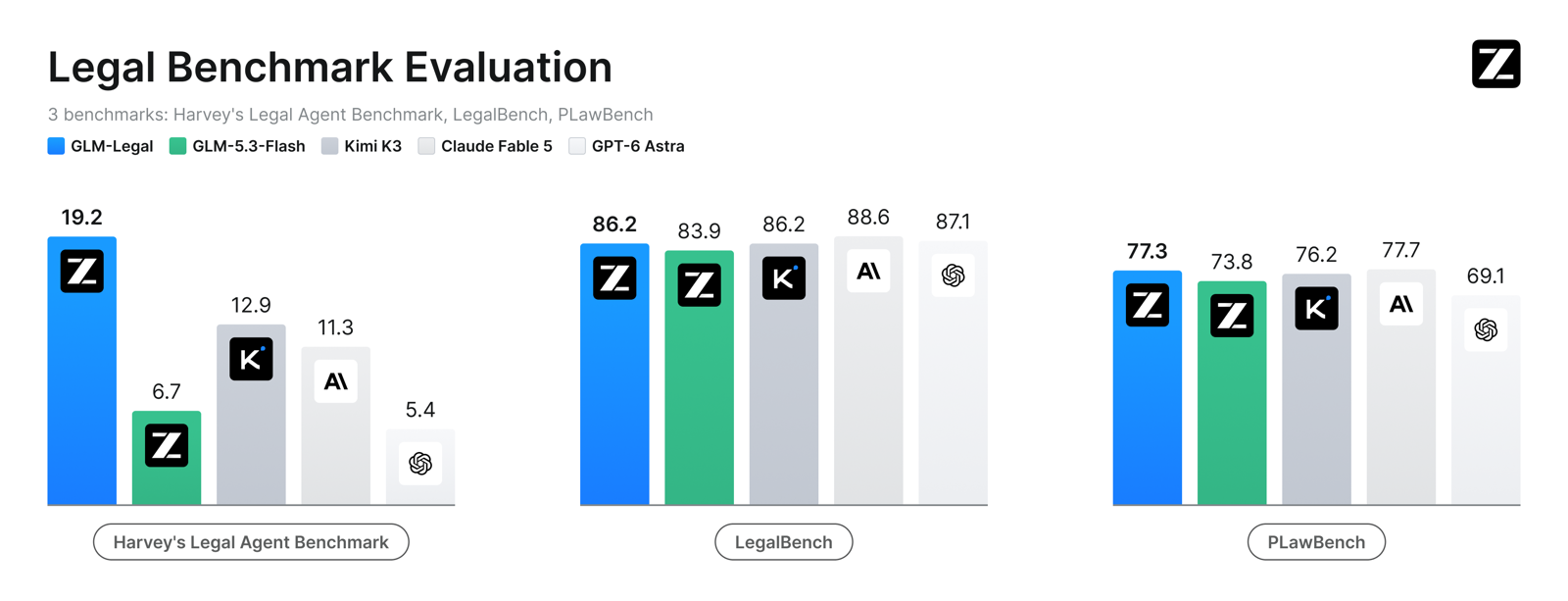 Figure: GLM-Legal official benchmark performance across complex execution, legal reasoning, and real-world drafting. Source: Zhipu z.ai official blog
Vendors frame these capabilities as “professional collaboration.” In Zhipu’s published benchmark charts, GLM-Legal trades blows with top-tier frontier systems across three core axes: complex execution, legal reasoning, and real-world drafting. While production costs on the generation side are collapsing, the person bearing the brunt of the risk remains the one holding the pen.
The Legal Workflow Cannot Tolerate a Single Hallucination
Errors in software development are relatively straightforward to catch: the program either crashes with an exception or gets flagged by test suites. In litigation, however, missing a statutory deadline or reversing the burden of proof can cost an entire lawsuit.
Flaws buried within contracts are even more insidious. A poorly drafted indemnification clause causes no immediate harm upon signing; the damage only surfaces years later when disputes arise. This delayed blast radius drives the accuracy requirements of legal practice far above nearly any other form of knowledge work.
Zhipu summarizes legal tasks as an unbroken four-stage chain: facts, statutory rules, reasoning, and deliverable. All four links must form a closed loop. The system must extract disputed issues from hundreds of pages of discovery, construct a defensible legal argument, and finally format the output according to strict task specifications. A breakdown at any single stage renders the entire deliverable worthless.
Benchmark results underscore the sheer difficulty of this pipeline. On LegalBench, which assesses contract analysis, M&A filings, and judicial opinions, GLM-Legal matched leading closed-source frontier models; it placed similarly near the top on PLawBench, a benchmark for Chinese legal consultation. Crucially, it matched these benchmark scores with a far leaner parameter footprint.
Reinforcement Learning on a Lean Base: Turning Statutes into Actionable Checklists
GLM-Legal is built atop a lightweight foundation, GLM-5.3-Flash, with the team emphasizing its significantly smaller parameter scale. A compact footprint lowers the barrier to on-premise private deployment and keeps compute costs predictable for routine law firm workloads.
During mid-training, the team expanded high-quality legal corpora to reinforce deductive links across the “facts–rules–conclusions” framework. In post-training, the model underwent reinforcement learning across tens of thousands of simulated real-world legal environments, co-evolving alongside its runtime orchestration framework (Harness)—the framework exposed model weaknesses, while the model revealed systemic bottlenecks in the framework.
Practitioners established four rigorous acceptance criteria: comprehensive coverage of core issues and edge cases; sound, verifiable citations and arguments; strict alignment with deliverable specifications; and immediate usability by downstream teams without rework. That final standard is the most unforgiving: it turns subjective opinions on drafting quality into quantifiable rework costs.
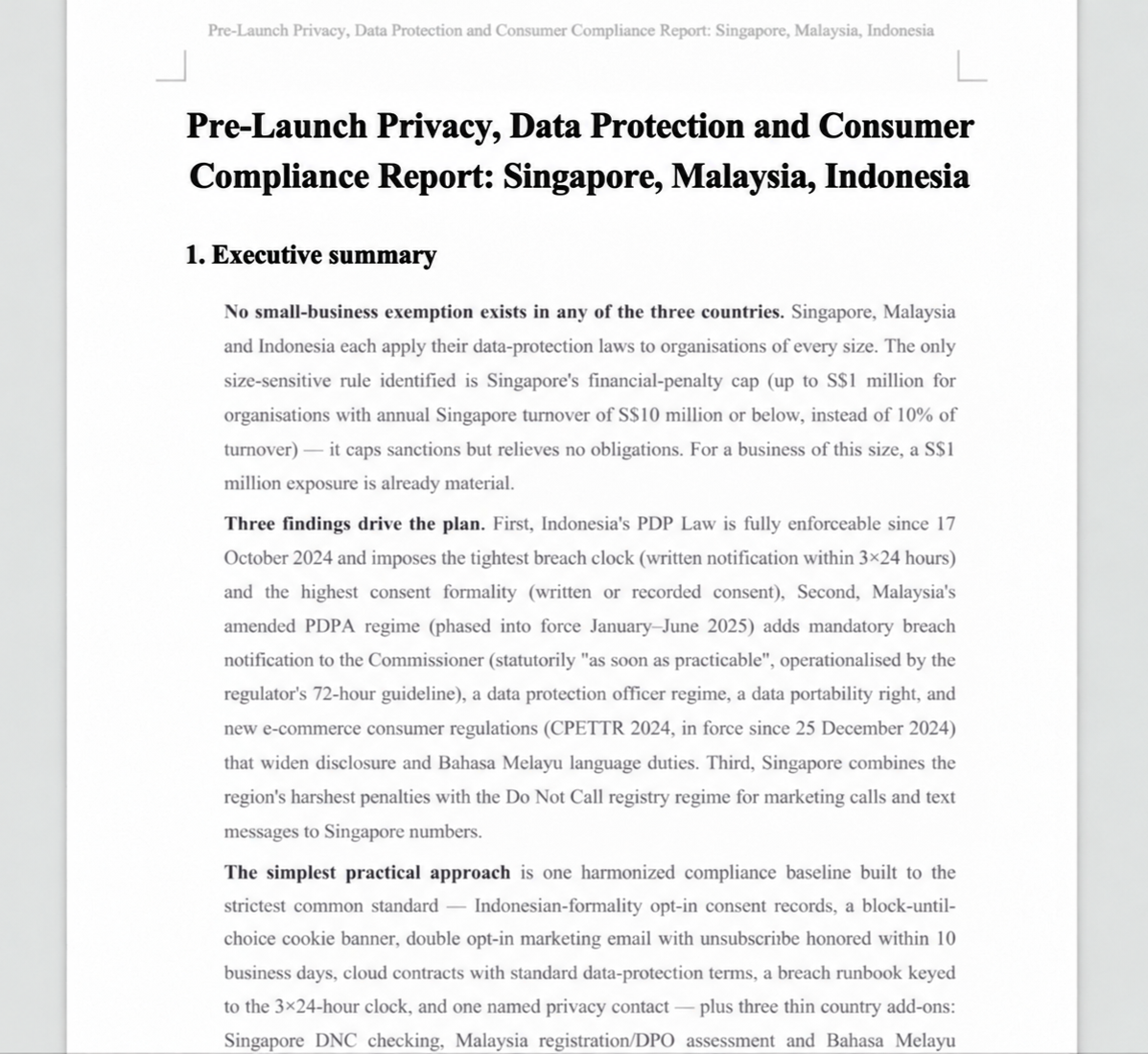 Figure: The cross-border privacy compliance checklist translates abstract legal clauses into concrete action items. Source: Zhipu z.ai official blog
The sample above illustrates a real-world deployment: cross-border privacy compliance requirements parsed into actionable steps by jurisdiction, paired with a P0 checklist. Powered by AutoClaw, users provide business context and receive work orders ready for immediate delegation.
Models Don’t Lose Their Licenses for Making Mistakes; Signing Attorneys Bear Full Liability
As technical benchmarks climb, real-world tensions in legal practice remain unresolved. In community discussions, a client recounted paying a $500 monthly minimum retainer to a major firm, only to receive status update emails clearly generated by AI without disclosure—frequently omitting or garbling critical case details.
Even more perilous is the hallucination of case law and judicial holdings. Models occasionally invent nonexistent precedents. If a reviewing attorney fails to catch the fabrication before filing in court, judicial sanctions follow swiftly. The model’s only response: a polite admission that “you are correct, I should not have fabricated a nonexistent case.” At the end of the liability chain stands a human; the code bears no responsibility.
Some compare tools like GLM-Legal to legal research databases of decades past, arguing that current risks are overblown. But the difference lies in their positioning: databases merely surface candidate materials, leaving the analytical architecture to the attorney. An agent delivers a finished product, handling everything from retrieval to narrative synthesis. Citations, formatting, and conclusions may all originate from the model—yet liability rests entirely on the individual whose name is on the signature line.
Marginal Drafting Costs Approach Zero, but the Signing Pen Grows Heavier
The marginal cost of drafting long-form legal documents is rapidly dropping toward zero. The direct consequence is an explosion in draft volume landing on attorneys’ desks, while review time cannot be compressed by a single second. Output generation can accelerate indefinitely, but verifying correctness cannot.
Some predict AI will usher in an effortless era for attorneys, but others foresee the opposite: once baseline quality is commoditized, competition shifts to volume. Law firms will push lawyers to sign off on more matters—personal liability remains intact, while review windows shrink. Reading less and signing more is the most perilous trap of this paradigm.
GLM-Legal’s 19.2% pass rate is a genuine engineering achievement, proving that dedicated smaller models, through targeted data curation and reinforcement learning, can produce workable first drafts in zero-tolerance domains. Yet the true gravity of this technology has always rested on the allocation of liability.
The legal validity of a document has never depended on how quickly it was generated. Behind every binding legal opinion is an attorney staking their professional license. The machine provides the draft, but the human bears the consequences. Until accountability can be shared, the hand holding the signing pen will only grip it tighter.
Reference Links:
- Zhipu z.ai official blog
- Harvey LAB Benchmark Overview
- Hacker News Community Discussion