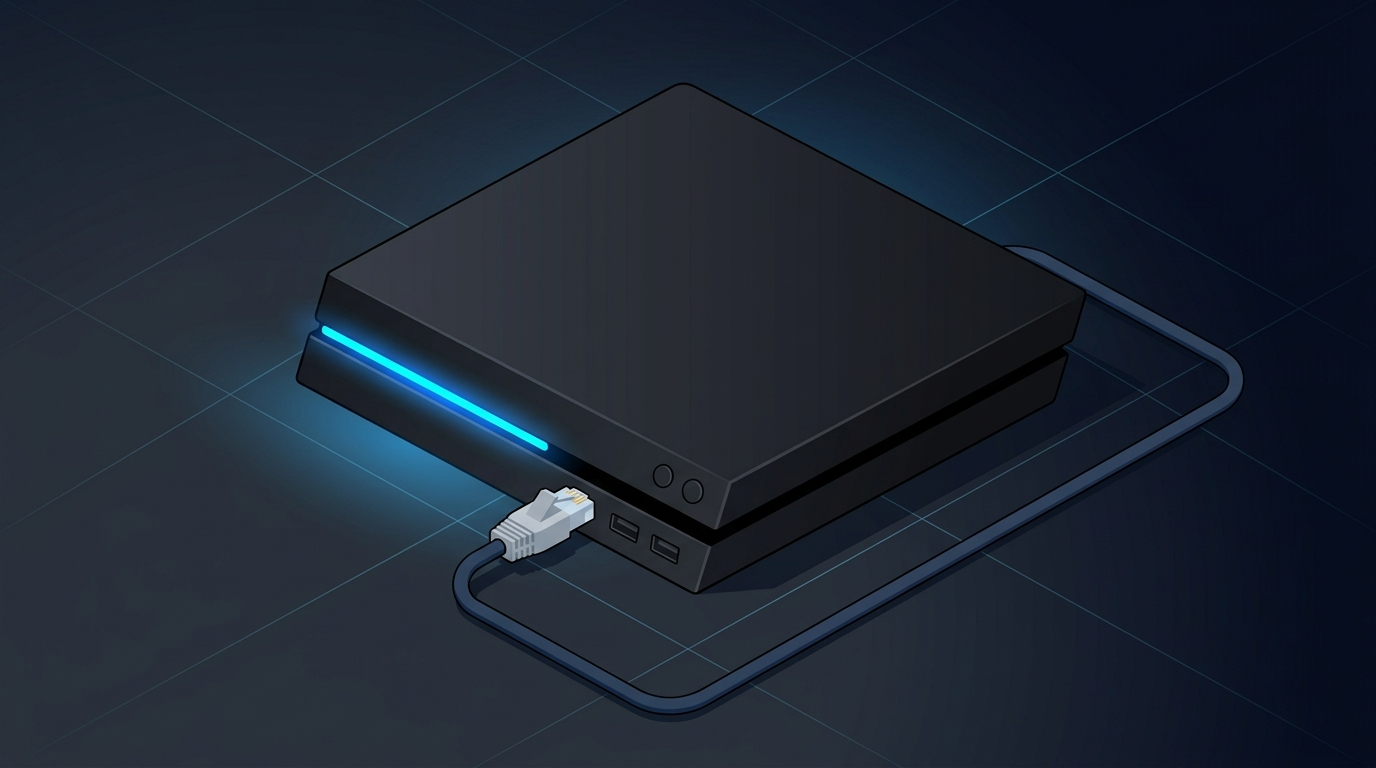
Slicing an 11.44 GiB Device Heap from 16 GB Unified Memory
On October 16, 2026, developer cobanov released PS5LM v0.9.0, an open-source project that brings llama.cpp natively to the PlayStation 5 nearly six years after the console’s launch. By tapping directly into the system’s built-in RDNA 2 GPU for model inference, the project turns a living-room gaming console into a local inference node equipped with 11.44 GiB of usable VRAM.
At the core of PS5LM’s engineering is establishing a direct path between unified memory and the graphics processing pipeline. The PS5 features 16 GB of GDDR6 memory shared across CPU and GPU on a unified bus boasting 448 GB/s theoretical bandwidth. Using the open-source ps5-payload-dev toolchain for cross-compilation, PS5LM packages llama-server as a natively installed console title (title ID PPSA99581), moving away from earlier, memory-constrained payload architectures.
This architectural shift directly dictates the memory ceiling. When executed as a transient payload, developers could only access around 64 MiB of video buffers, locked out of both the 12 GiB direct memory pool and direct GPU access. Packaging the server as a native title unlocked direct VRAM allocation, making local execution of 27B-parameter models viable.
For compute pipeline acceleration, the project introduces an unofficial RADV Vulkan driver reconstructed from Mesa, operating alongside the ggml-Vulkan backend. The RADV driver exposes the console’s shared pool directly as a single 11.44 GiB GPU device heap. Unified memory eliminates the high-latency PCIe bus transfers required by traditional discrete GPUs. Once mapped into memory, weights load at speeds bound strictly by the internal NVMe SSD and system bus.
Comparable consumer PC graphics cards in the same price range typically offer only 8 GB of VRAM—a barrier that frequently prevents large local models from booting at all. The 11.44 GiB pool on the PS5 dismantles that physical limitation for larger model architectures.
Benchmarking 27B Models: 20 tok/s with a 64k Context Window
Testing on PS5 Slim hardware reveals distinct performance tiers across parameter sizes. At a 4096-token context window, the 0.8B Qwen3.5 consumes just 0.5 GB of VRAM while decoding at an impressive 207 tok/s. A 9B model takes up 5.3 GB of VRAM and sustains generation speeds of 55 tok/s. These lightweight checkpoints deliver outstanding throughput on console hardware, handling interactive chat with ease.
The upper practical ceiling lands squarely on 27B-class models. Benchmarks show Qwen3.8 27B UD-Q2_K_XL allocating 9.2 GB of VRAM and achieving sustained decoding speeds of 20 tok/s. Ample remaining memory allows the system to support context lengths up to 64k tokens. A decoding rate of 20 tokens per second crosses the critical usability threshold for real-time conversational AI.
Quantization formats heavily influence real-world throughput on the console. While 27B in IQ2_XXS format conserves memory, decode speed hovers around 15 tok/s. Spending slightly more memory on UD-Q2_K_XL yields 20 tok/s alongside noticeably crisper output quality. For lightweight vision workloads, d1 Omni 600M allocates 1.1 GB of VRAM and completes 3 image queries in just 0.3 seconds.
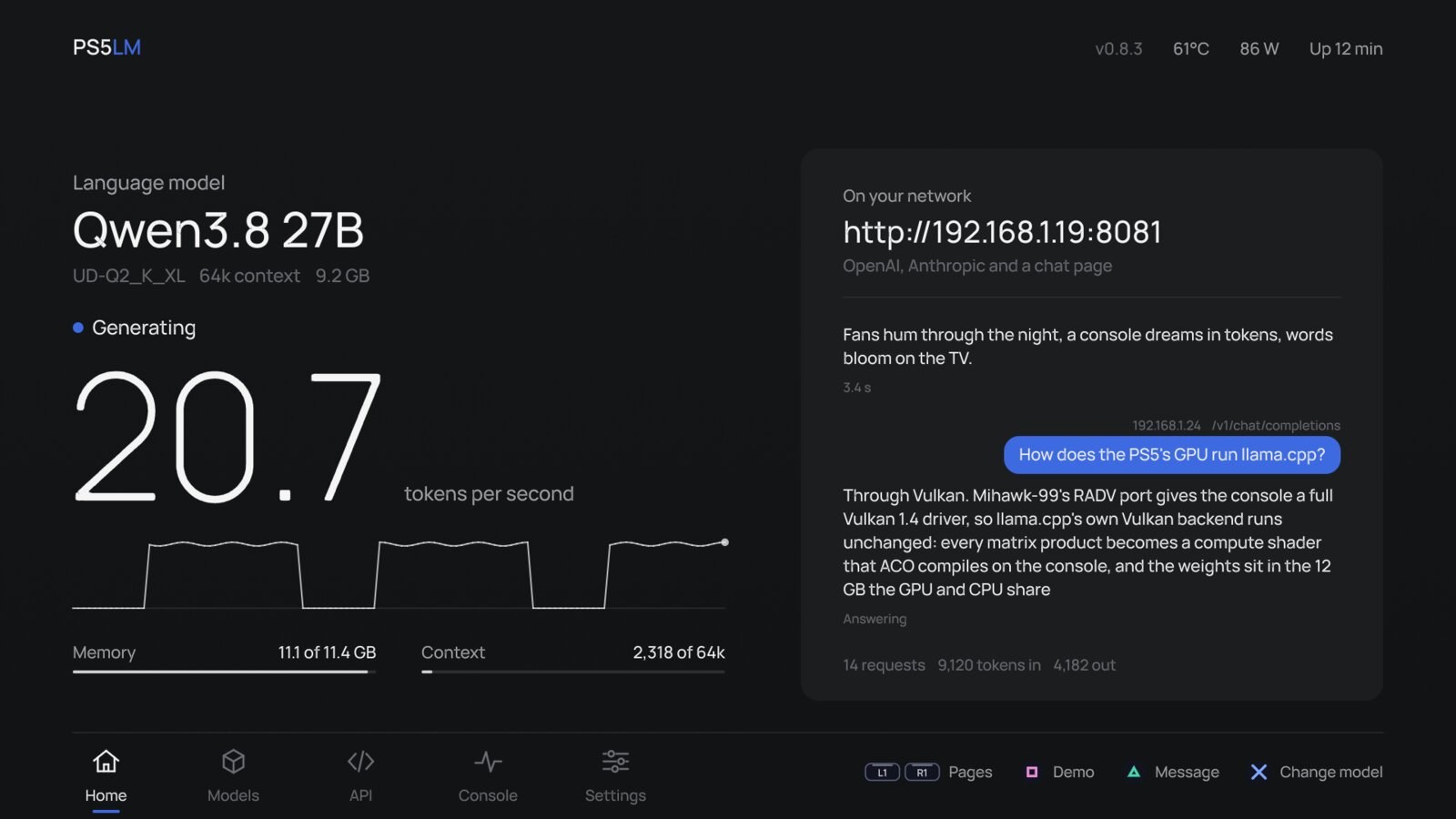 Figure: The web dashboard displays the active model, generation throughput, and real-time request metrics. Source: PS5LM repository.
PS5LM outputs separate prompt prefill latency and token generation rates following each inference request. In early native title builds (October 9), loading the 27B UD-IQ2_XXS weights required 82 seconds, with generation fluctuating between 9 and 21 tok/s. Granular telemetry allows developers to isolate bottlenecks—differentiating memory bandwidth limits from raw compute saturation.
Dual API Server Acts as a Persistent Home Compute Node
Getting low-level inference running is only half the battle; real-world developer workflows demand frictionless API integration. PS5LM embeds an HTTP web server that converts the console into a shared local network inference gateway. The service provides drop-in compatibility with both OpenAI and Anthropic API specifications. Local coding tools like Claude Code can route requests directly to the PS5 simply by pointing to its LAN endpoint.
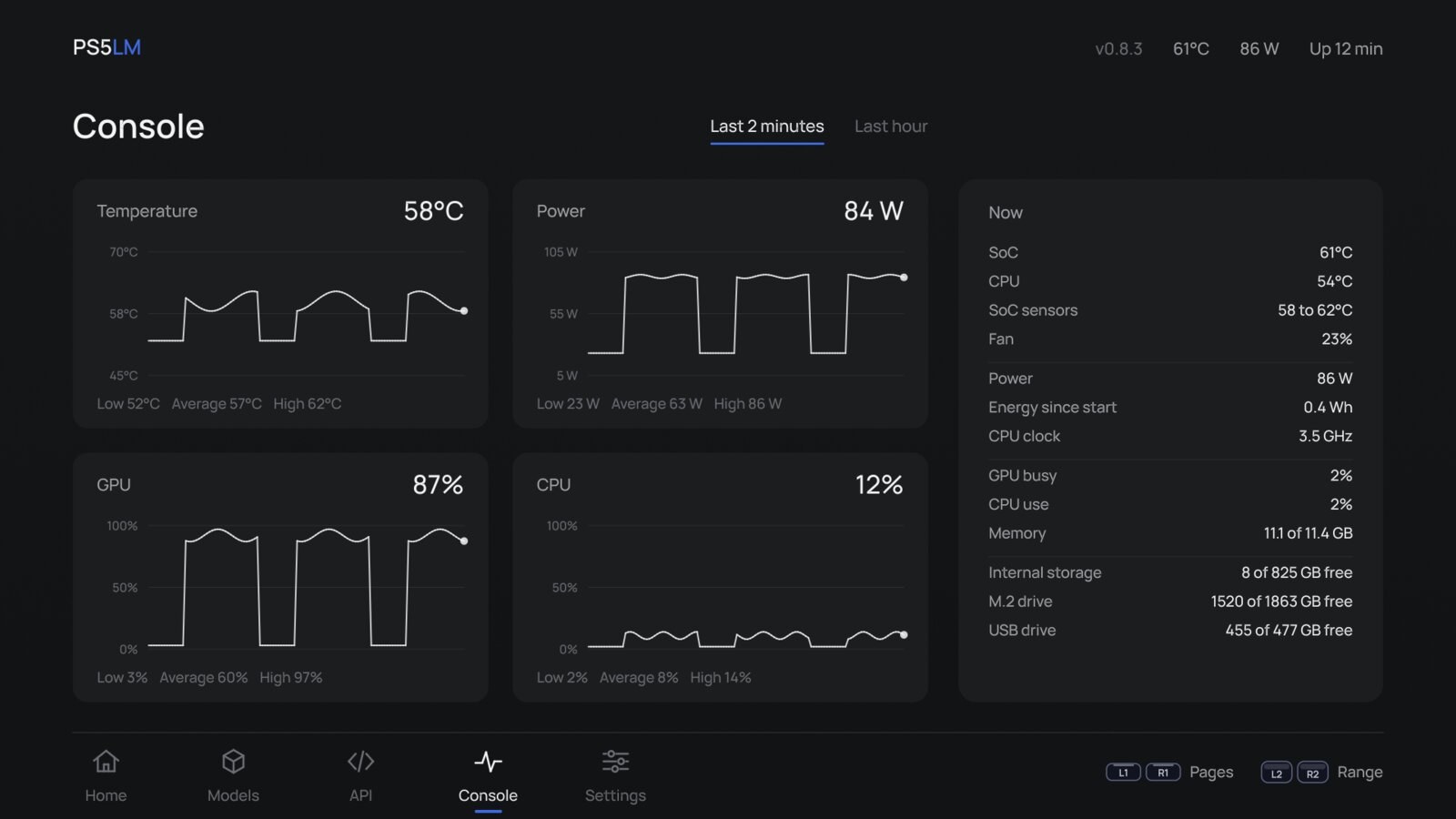 Figure: Web console telemetry tracking console power draw, temperatures, and real-time GPU/CPU load curves. Source: PS5LM repository.
The web dashboard handles model management and doubles as a persistent telemetry display for a connected television. It graphs temperatures, power consumption, and processor utilization curves in real time, with configurable observation windows of 2 minutes and 1 hour. For lightweight decision routing, the project also exposes Ollaya routing via the /v1/systemone endpoint.
When first loading a model, the system automatically synchronizes common sampling presets from LM Studio, preserving temperature, top-p, and penalty parameters. Standard GGUF weights liberate model deployments from proprietary ecosystem lock-in. Developers can drop existing quantized weights onto the console without tedious format conversions.
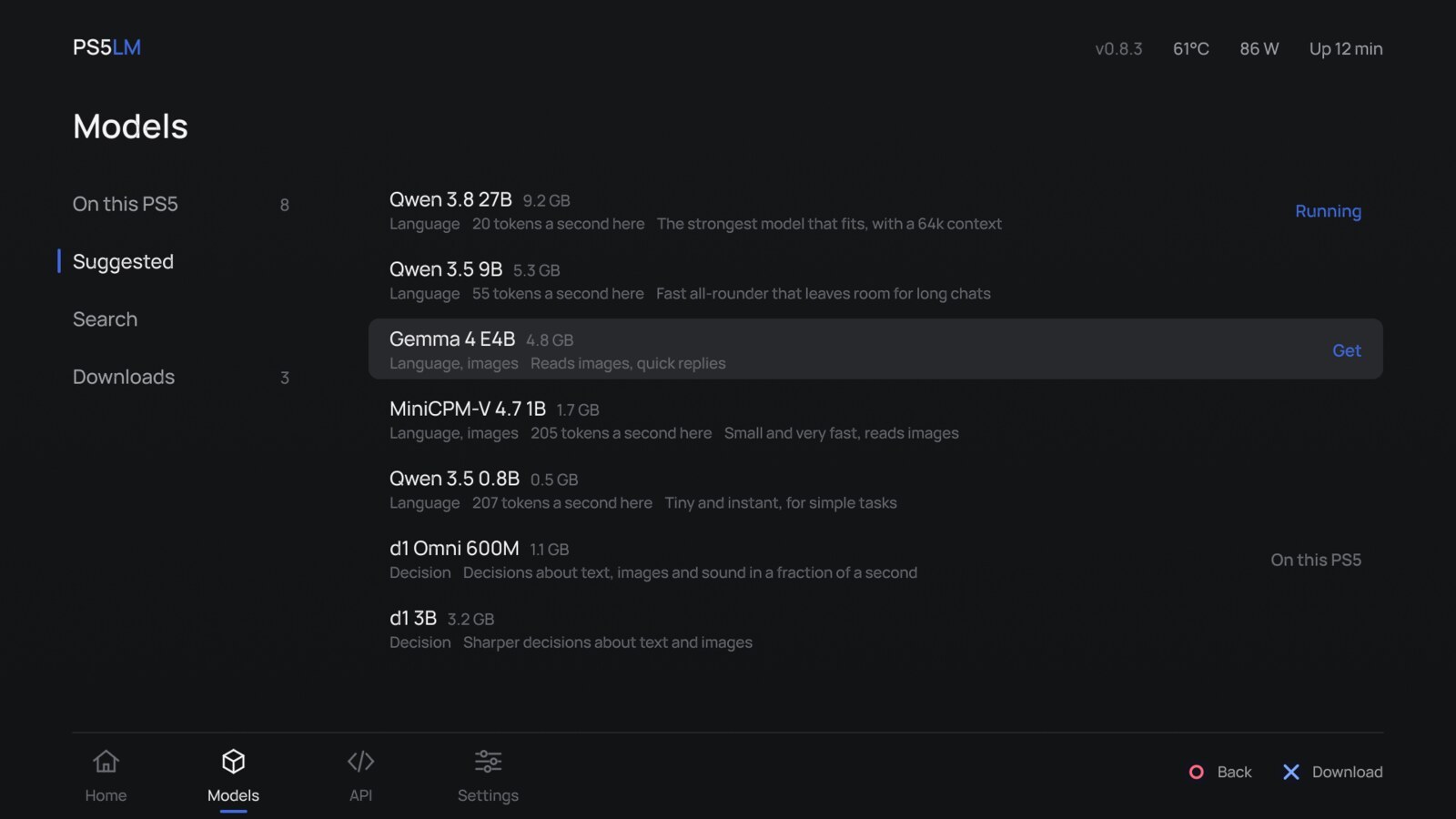 Figure: Model management view for storing, inspecting, and switching local GGUF weight files. Source: PS5LM repository.
Firmware Locks and Out-of-Tree Drivers Raise Maintenance Overhead
Transforming a gaming console into an inference appliance comes with stringent operational constraints. PS5LM requires a jailbroken console running firmware between 7.00 and 13.60. Devices running current official firmware cannot execute unsigned binaries. The hardware barrier shifts from GPU market availability to hunting down consoles on vulnerable system versions.
The intricate staging toolchain also challenges long-term reliability. Booting the environment requires sequentially initializing the kstuff-lite kernel patch alongside payloads like etaHEN. Under heavy concurrent load, the out-of-tree RADV Vulkan driver lacks enterprise-grade fault tolerance. Driver panics frequently freeze the kernel, demanding a hard reboot and re-jailbreak cycle.
The project maintains strict legal compliance boundaries in its build process. The repository contains zero proprietary Sony SDK code, decryption keys, or dumped firmware blobs. The RADV driver is compiled directly on-device by the end user, avoiding copyright distribution issues. Published under the GPL-3.0 license, the project’s commit history even credits Claude Opus 5.5 as a co-author.
Local Compute Frontiers Shift from Silicon to Driver and Firmware Access
PS5LM highlights the untapped potential of high-bandwidth unified memory lurking inside mainstream consumer hardware. The PS5’s 16 GB of unified GDDR6 memory provides sufficient headroom for daily 27B model inference. As consumer hardware evolves, the primary bottleneck for local AI deployment is shifting from sheer memory capacity toward driver openness and firmware execution privileges.
A 20 tok/s decoding speed easily satisfies daily coding and conversational assistance. Yet without an officially supported, battle-tested software ecosystem, the console remains ill-suited for mission-critical production. As long as low-level platform access remains locked behind security exploits, living-room hardware will stay firmly in the realm of hacker experimentation.
Reference Links:
- PS5LM GitHub Repository
- Hacker News Discussion