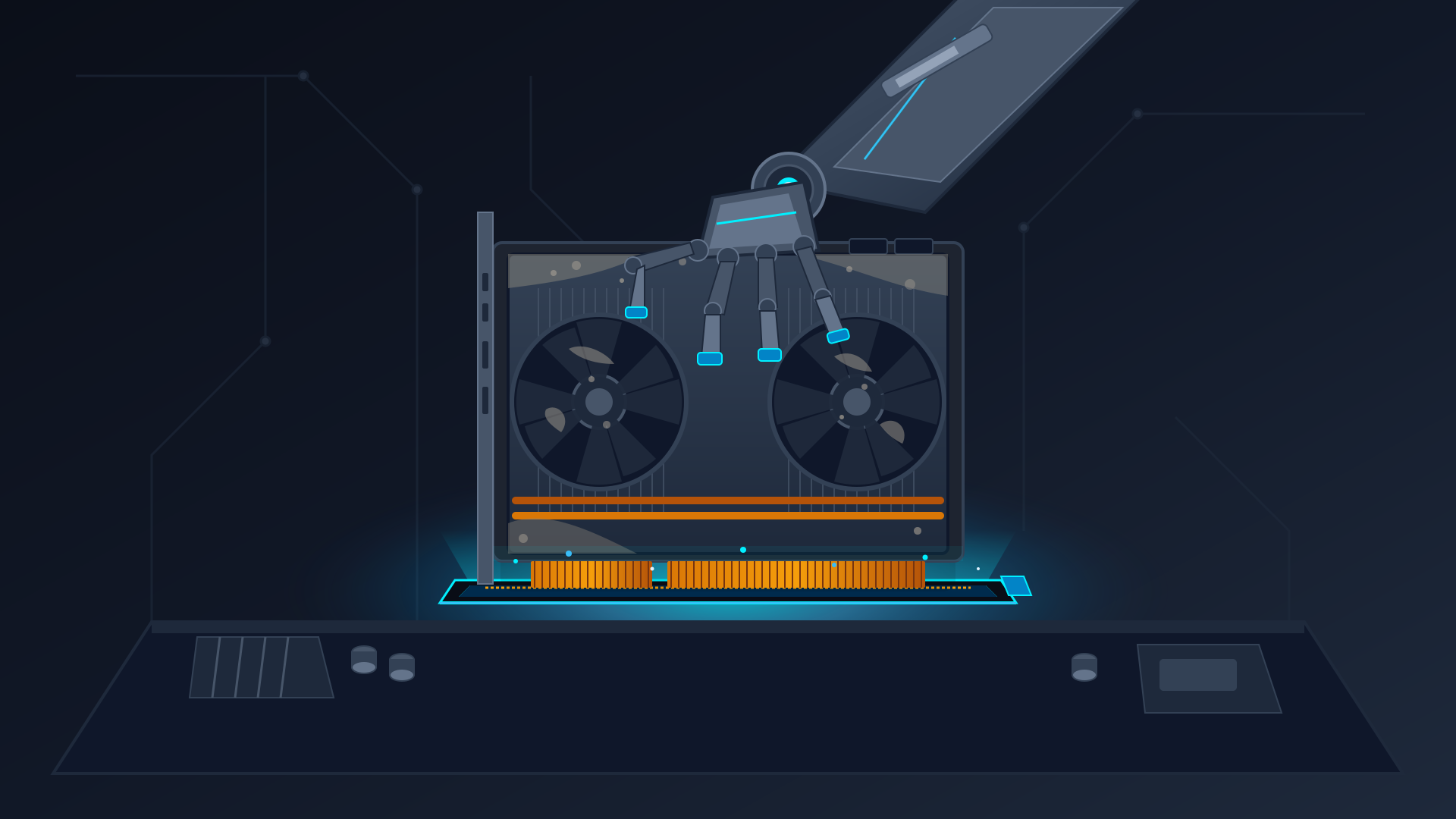
In November 2025, a tinkerer going by DevQuasar picked up an AMD BC-250 board on eBay for $60. The hardware came with an awkward pedigree: it was built around a PlayStation 5 system-on-chip that had failed Sony’s quality control, which AMD then salvaged and repackaged into crypto-mining boards. When the mining boom collapsed, entire racks of these machines were dumped onto the surplus market as e-waste. DevQuasar rescued one, flashed a custom BIOS, overhauled the cooling, 3D-printed a mini chassis—and now the rig runs Cyberpunk 2077.
Over three short years, the exact same slice of silicon completed a full lifecycle: gaming console → mining rig → e-waste → gaming PC. The silicon itself was never broken; what collapsed was merely the market narrative surrounding it.
Banished to the Mines: The Chip That Failed the PS5 Cut
The BC-250’s lineage traces directly back to Sony’s manufacturing tolerances. The custom APU powering the PS5 is manufactured by AMD on TSMC’s 7nm process. Yields vary across every silicon wafer, and Sony imposes uncompromising performance standards: the GPU must deliver a full 36 Compute Units (CUs), and core clock frequencies, power draw, and leakage current must all clear tight margins.
Dies that fall short are not thrown away. AMD gathers the imperfect chips, disables the defective functional blocks, and repacks them for commercial sale. The BC-250 utilizes these “cut-down” processors: the GPU is dialed back from 36 CUs to 24 CUs, while the CPU preserves 6 cores and 12 threads on the Zen 2 architecture, paired with 16GB of unified GDDR6 memory. The enthusiast community quickly coined a fitting moniker: “A chip that failed the PS5 exam, exiled to the crypto mines.”
AMD supplied these chips on BC-250 compute cards to ASRock, which integrated them into high-density 12-card 4U rackmount servers shipped straight into mining facilities. In a server rack, hash rate is all that matters—no display output, no video ports needed. Yet the physical BC-250 board actually houses a complete set of I/O ports: DisplayPort, USB, Gigabit Ethernet, an M.2 NVMe slot for storage, and an 8-pin PCIe power header. Despite its PCIe card form factor, it is fundamentally a fully autonomous single-board computer.
The Crypto Crash and the Descent into E-Waste
When the crypto bubble burst in 2022, mining pivoted overnight from lucrative windfall to money-losing liability. Mining farms shut down en masse, dumping sea of secondhand rigs onto liquidators. The BC-250 suffered an even harsher fate than standard consumer graphics cards: lacking mainstream recognition as a “gaming card,” the market wrote it off as obsolete e-waste fit only for scrap recovery.
Prices on eBay tumbled into the $60 to $100 range. That budget cannot secure any modern discrete graphics card, yet it buys an entire working computer with a 6-core Zen 2 CPU, a 24-CU RDNA 2 GPU, and 16GB of unified high-speed memory—provided you are willing to get your hands dirty.
DevQuasar’s build log makes clear that the barrier to entry is substantial. Out of the box, the BC-250 splits its 16GB memory into an 8GB/8GB CPU/GPU partition. Running games smoothly requires flashing custom BIOS v3.00, which unlocks chipset settings to force a nominal 512MB VRAM allocation. While counterintuitive, this is an APU rather than a discrete card: the GPU needs permission to dynamically allocate system memory as video RAM rather than hoarding a rigid static partition. Cooling demands destructive physical modification to the closed server finstack so two 120mm fans can be mounted. Operating system options are constrained to Linux—Windows has no viable graphics driver for this hardware. The final case had to be custom 3D-printed.
Playable Cyberpunk, but Leave 4K Ray Tracing at the Door
Community benchmarks deliver surprisingly respectable numbers: Cyberpunk 2077 achieves playable framerates at 1080p on low settings, while titles like GTA V, Counter-Strike 2, and Hitman 3 run smoothly. Overall performance lands in the ballpark of a modern entry-level discrete GPU. It is by no means an ultra-high-fidelity experience, but it is undeniably playable gaming on a budget.
 Figure: Real-world Cyberpunk 2077 benchmark framerates on the BC-250. Source: DevQuasar
 Figure: The original ASRock 12-card BC-250 4U mining rig, now broken down on the second-hand market. Source: DevQuasar
 Figure: DevQuasar’s mini gaming PC assembled in a custom 3D-printed case. Source: DevQuasar
 Figure: The bare BC-250 board—fully loaded with I/O, essentially a complete single-board computer. Source: DevQuasar
In the Hacker News discussion, debate centered on the practical economics. A $60 computer comes with notable power consumption—mining boards were never optimized for idle power or efficiency curves, meaning cooling overhead and electricity bills represent hidden expenses. The perennial question of mining hardware longevity resurfaced as well: running 24/7 under sustained load induces capacitor wear and thermal stress. DevQuasar offered a pragmatic counter: at $60 a pop, if it burns out, you just buy another one.
The Silicon Wasn’t Broken—Only the Narrative Was
The enduring significance of the BC-250 lies not in raw gaming benchmarks, but in what it reveals about the “salvage economy” across the semiconductor supply chain. A die cut from a wafer fails Sony’s specifications and is rejected; AMD salvages it into mining hardware; the crypto crash strips the board of its financial utility, casting it into the e-waste pile; and a DIY enthusiast resurrects it for sixty bucks. The physical lifespan of silicon routinely outlasts every cycle of market narrative built around it.
Within this cycle, there are neither clear winners nor outright losers. Sony received qualified chips, AMD squeezed secondary profit from manufacturing defects, miners cashed in during the bull market, and hobbyists snagged bargains in the aftermath. The sole casualty repeatedly paying the price is the environment, as every handoff generates batches of genuinely unrecoverable scrap.
The sharpest lesson of the BC-250 is how arbitrary the label “e-waste” truly is. A processor sentenced to death by speculative finance becomes a viable gaming machine simply by changing contexts. The mining crash shattered a financial model, not the underlying silicon. What $60 buys ultimately depends on what the prevailing narrative chooses to dismiss as junk.
Reference Links:
- DevQuasar’s BC-250 How-To Guide (GitHub Repository)
- Hacker News Discussion Thread
- AMD BC-250 Hardware Specs and Community Benchmarks