At the XDC 2026 conference in Toronto on September 30, 2026, Valve’s Linux graphics driver team delivered an update on legacy hardware support. Starting with the Linux 6.19 kernel, GPUs based on the GCN 1.0 and 1.1 architectures—including the Radeon HD 7000 series first launched in 2012—are transitioning away from the legacy Radeon driver and moving to the modern AMDGPU driver by default.
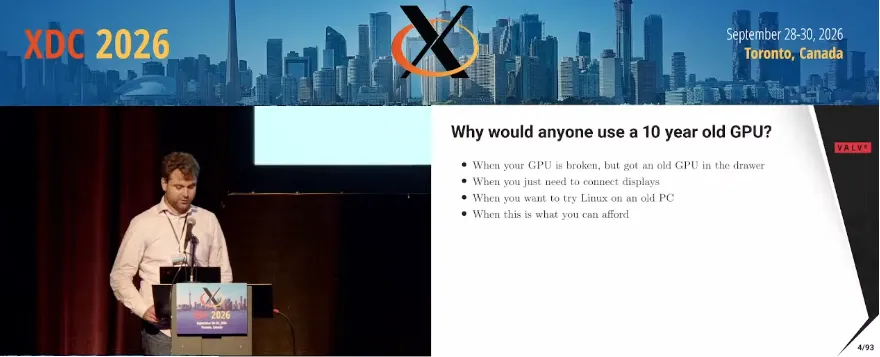 Timur Kristóf presenting on kernel driver development at XDC 2026. Credit: Phoronix
Migrating these cards to the AMDGPU stack provides out-of-the-box RADV Vulkan support and delivers a roughly 30% performance boost in benchmarks. This extended lease on life for decade-old hardware is largely the result of dedicated developer efforts to resolve long-standing driver limitations.
Filling the Gaps Left by Upstream Code
Migrating older architectures to a modern codebase presented numerous technical hurdles. Architectures like GCN 1.0 (“Southern Islands”) and GCN 1.1 (“Sea Islands”) have been on the market for well over a decade. Over the years, AMD chose not to allocate core resources toward refactoring drivers for these aging cards, leaving them tied to the legacy radeon kernel module.
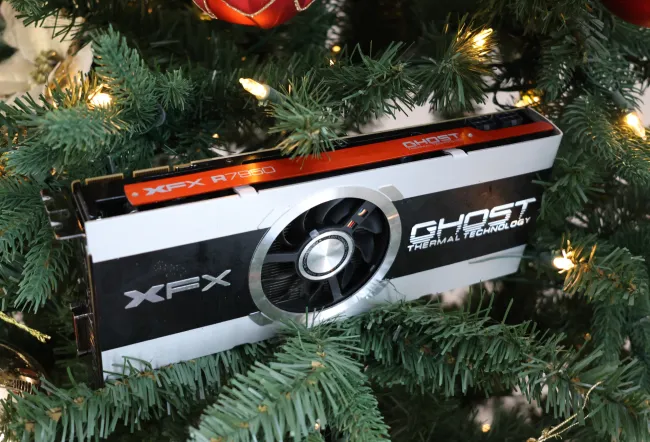
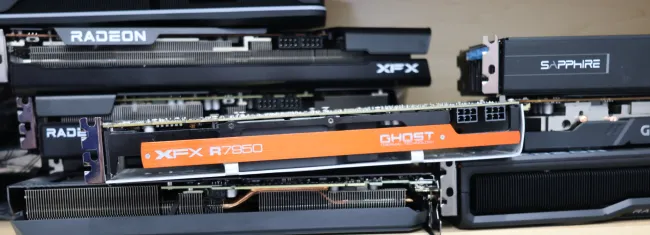 The Radeon HD 7950, released in 2012 and one of the target GPUs in this driver overhaul. Credit: Phoronix
While the AMDGPU framework has long powered newer graphics cards, users on older hardware previously had to pass special kernel module parameters to opt into experimental AMDGPU support manually. This manual switch was plagued by system instability and missing low-level hardware features. Valve engineer Timur Kristóf bridged these feature gaps by implementing missing display engine code, resolving tricky power management logic, and adding soft reset support, effectively fixing critical backward-compatibility defects.
A Kernel Migration Unlocking 30% More Performance
Once the driver achieved full feature parity and stability, AMD greenlit changing the default driver configuration in the upstream Linux kernel. Severing ties with legacy Radeon and integrating into the AMDGPU ecosystem instantly unlocked tangible performance gains.
 Phoronix benchmarks showing performance gains unlocked by AMDGPU in Linux 6.19. Credit: Phoronix
Benchmark data from Phoronix shows that switching driver stacks yields an approximate 30% performance boost for GCN 1.0/1.1 hardware. Moving away from an unmaintained legacy driver proved essential to unleashing latent hardware performance. A modernized software framework enhances the compute capabilities of these older architectures, and migrating the underlying code enables modern Vulkan APIs, driving noticeable system-wide speedups.
Tapping into the Modern Gaming Graphics Ecosystem
The primary catalyst behind this performance leap is AMDGPU’s seamless integration with the RADV Vulkan driver. In the contemporary Linux gaming landscape, robust Vulkan support is an absolute necessity for running Windows titles through Proton.
Remaining on the legacy Radeon driver restricted users to outdated OpenGL rendering pipelines or left them without modern graphics API support altogether. With the updated kernel code in place, cards like the Radeon HD 7800 and 7900 series can hook directly into Mesa 3D’s mainstream codebase, taking full advantage of the open-source community’s ongoing Vulkan optimizations. Routing rendering pipelines through modern API standards dramatically improves how this aging silicon handles contemporary workloads.
Bridging User Space and Kernel Space
This overhaul exemplifies effective cross-layer engineering. Timur Kristóf had spent years working on user-space Mesa 3D drivers; tackling this migration originally started as an avenue to gain deeper experience with kernel-space AMDGPU development.
Kernel-level programming requires managing direct hardware register access and complex power-state machines. Because Kristóf was already deeply familiar with user-space Vulkan requirements, he was uniquely equipped to tailor kernel-side scheduling and resource allocation to match. By bridging user-space insights with kernel-space mechanics, he successfully brought the driver overhaul to completion.
How the Linux Ecosystem Extends Hardware Longevity
Relying on community and third-party developers to maintain aging hardware continues to offer immense value to users. Discussions across the developer community highlight that vintage mid-range GPUs retain substantial practical utility in Linux environments.
Most legacy driver quirks on mature hardware have already been identified and patched upstream, flowing seamlessly into distributions to provide a rock-solid graphics environment. By contrast, brand-new GPU releases often require weeks or months of kernel maturation, occasionally lagging behind proprietary alternatives in advanced feature parity.
Bringing decade-old GCN architectures into the modern Vulkan era and merging those changes into mainline Linux proves that older hardware can thrive within modern software stacks. When developers invest the effort to patch legacy code, aging devices can keep pace with contemporary software demands—a compelling showcase of Valve’s engineering commitment to low-level hardware support.
References:
- XDC 2026: Valve’s Timur On Moving Old AMD GPUs To AMDGPU
- Linux 6.19’s Significant ~30% Performance Boost For Old AMD Radeon GPUs
- Kernel driver dev using old AMD GPUs (PDF)