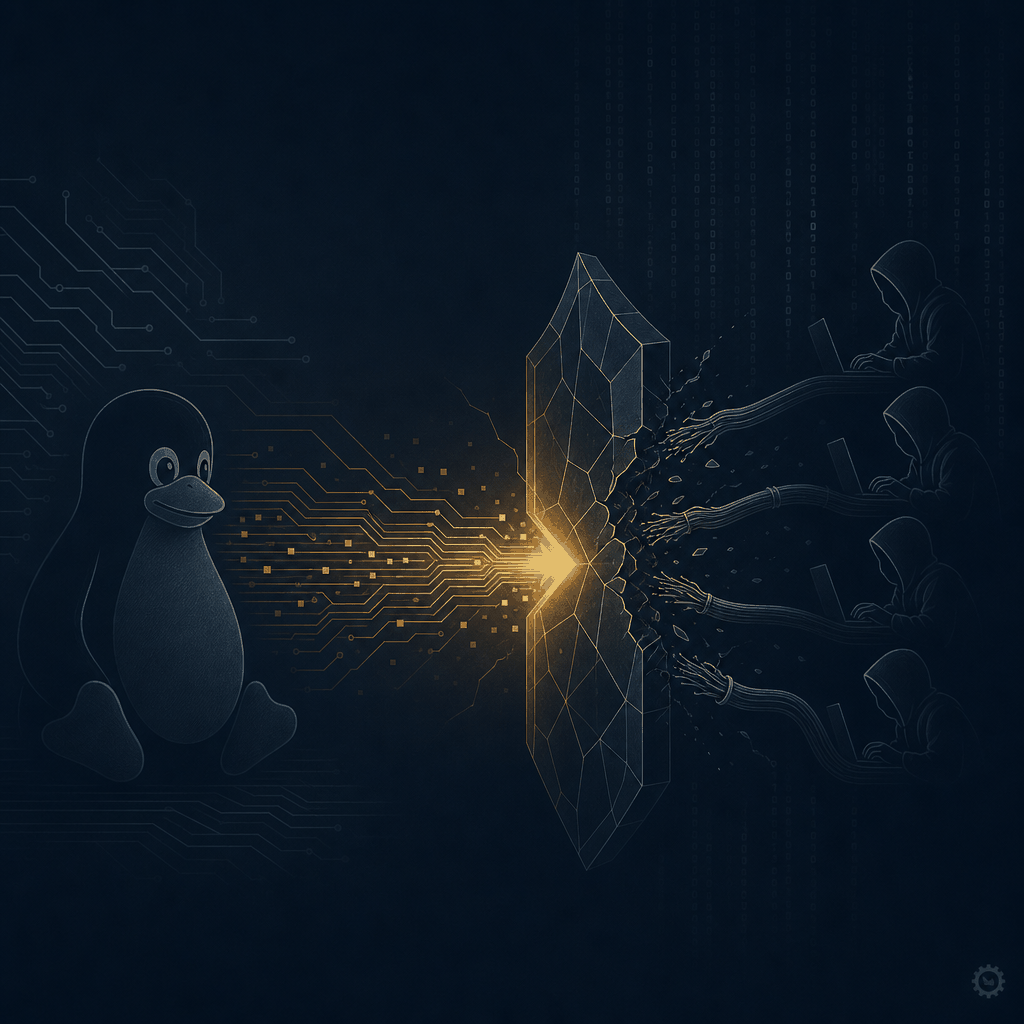
On July 15, 2026, something unusual happened on the Linux Kernel Mailing List (LKML): someone said “no” to Linus Torvalds.
The person who said “no” was Laurent Pinchart, a core developer who has long contributed code to the Linux kernel. What he rejected was a proposal pitched personally by Linus himself — to use large language models (LLMs, the class of AI technology behind ChatGPT) to assist in reviewing kernel code patches.

What happened?
Let me set the background for readers who don’t write code. The Linux kernel is the most important open-source software project in the world — your Android phone, your Wi-Fi router, and the backend servers at your bank almost all run it. The project receives hundreds of code-change proposals (called “patches”) every day, which experienced developers must review line by line to confirm there are no bugs, no security holes, and consistent code style before they can be merged. This work is called “code review,” and it’s the most central — and most labor-intensive — part of the kernel development process.
Linus believes AI can help. Recently Google donated an AI review tool called Sashiko to the Linux Foundation; it automatically scans every submitted patch, flags potential problems, and offers revision suggestions like a human reviewer. On the mailing list, Linus tried to persuade everyone to accept the tool — or at least not to reject it.
But Laurent Pinchart wasn’t having it. His core demand: AI-generated review comments should not be sent directly to the developers writing the code; they should first pass through manual verification and filtering by a maintainer (the subsystem lead). His reasoning: AI frequently “hallucinates” — with great confidence it points out problems that don’t exist at all, and if those are fired straight at developers, they actually increase the workload rather than reduce it.
This concern isn’t unfounded. According to media reports, the kernel’s media subsystem previously tried letting Sashiko send review comments directly to the developer mailing list, and the result was that the AI produced a flood of nonsense “hallucinated issues.” Confused developers forwarded those AI comments to human maintainers for verification, and in the end the maintainers’ workload went up rather than down.
The flashpoint: double standards
So far, this was just an ordinary engineering debate. But the discussion on the Lobsters tech community — the post garnered △119 points and 101 comments, the highest-quality discussion of the day — dug out a more thought-provoking side to the matter.
A comment by Lobsters user ayushnix received the top vote of △63, and here’s how he summarized it:
“Linus tried to push using LLMs, and after Laurent basically said ‘no thanks,’ Linus said we only go by technical arguments, and if you can’t produce them then don’t bother, don’t sell us on your personal beliefs about LLMs — but this was said after he himself had just done exactly that. Laurent pointed this out with solid reasoning. It’s a beautiful confirmation of ‘appeal to authority’ — probably the shallowest and weakest form of argument, and invoking Linus’s name doesn’t automatically make an argument stronger.”
When the author read this comment, he couldn’t help but stop and reread it. What ayushnix points out is a logical problem: You use your personal authority to sell AI; when someone rejects AI on personal grounds, you say “we only look at the technical merits.” Is that fair?
Of course, people immediately came to Linus’s defense. User atmosx countered: Linus has led the world’s most complex software project for over 30 years, balancing technical geniuses, competing companies, legal issues, and social controversies to keep the project moving forward — that in itself is no small feat. He made a judgment; you can disagree, but he has earned the right to make that kind of judgment.
The tension between these two comments is exactly the most valuable part of this story.
The rift between tools and trust
The reason this debate blew up into 101 comments on Lobsters isn’t that it’s novel — Linus ranting, Linus bucking the consensus, these are regular programming in the open-source world. What really kept the discussion going is this: the incident pinpoints the open-source community’s contradictory psychology of both expecting and fearing AI.
From Linus’s perspective, his logic is clear: AI is a tool, just like an editor, a compiler, or a static-analysis tool. In its own testing, Sashiko could catch about half of the bugs in 1,000 real kernel patches that human reviewers had missed — that’s real, concrete technical value. If you ban the tool just because “some people don’t like AI,” what’s the difference from banning the C++ compiler back in the day because some people didn’t like C++?
But Laurent’s concern is equally real. AI is not a compiler. A compiler is deterministic — the same code produces the exact same machine instructions every time. An LLM is probabilistic — the same prompt may yield different answers at different moments. In a setting like an OS kernel, where “one line of buggy code could bring down servers worldwide,” staying wary of something that’s only “probably correct” isn’t ignorance — it’s professionalism.
The deeper question was best summed up by another Lobsters user. The author attempts to convey the gist: Everyone is right — these tools do work, but LLMs happen to embody exactly the kind of industry problems Linux set out to avoid at its founding.
What does that mean? Linux was born in 1991, when the software industry was monopolized by commercial giants like Microsoft, and individual developers had almost no voice. Linus created Git (a version-control tool) and the Linux kernel collaboration model, essentially solving one problem: How do you get thousands of strangers, with no boss and no corporate hierarchy, to collaboratively produce high-quality code purely on the basis of technical merit?
This system has run for 34 years on one iron law: “code review is done by human eyes.” Every line of code that enters the kernel was written by a flesh-and-blood person, read line by line by another, with clear accountability. AI-generated review comments — who is accountable? AI-suggested code changes — who do you go to when something breaks? The answers to these questions are, for now, fuzzy.
The author’s view
As a writer observing this discussion from the sidelines, the author doesn’t pretend to judge who’s right and who’s wrong. But three things are clear.
First, the engineers Linus encountered this time understand the complexity of kernel development better than any outsider. What Laurent Pinchart cares about is whether AI review results need to pass through human filtering. That’s an engineering question about process design, not a matter of “faith” in whether you trust AI.
Second, “appeal to authority” is indeed a weak form of argument, but an “authority’s judgment” isn’t necessarily wrong. In 2005, Linus bucked the consensus and wrote Git in C — some thought he was crazy at the time, but in hindsight it was the right engineering call. Whether his judgment on AI turns out right or wrong, time will tell — not a Lobsters vote.
Third, and the point that moves the author most: the reason the open-source community has run healthily for 34 years is precisely that someone dares to say “no” to Linus.
In most tech companies, when the CEO or CTO says “we’re pushing AI,” employees below will most likely just nod along. But on LKML, when the founder personally pitches a technology, a core developer immediately steps up and says “your way of arguing has a problem.” That is exactly what’s most worthy of respect in open-source culture.

Afterword
The debate continues. Linus’s latest position is that Linux is not an “anti-AI” project, and if someone can’t accept AI tools, they can “do what open source is supposed to do — fork it, or just walk away.” But he has also made clear he won’t force any subsystem to use AI; each maintainer has their own discretion.
In other words, Linus left the disagreement at the engineering level: each subsystem maintainer decides for themselves whether the AI tool is a help or a burden. The answer comes not from authority, but from data in actual use.
That is probably the most reassuring way for this whole affair to wind down.
Reference links:
- LKML mailing list: Linus Torvalds’s proposal on LLMs
- Lobsters discussion (s/pb6d8m)
- ZDNET: Linus Torvalds puts his foot down, tells anti-AI programmers to ‘fork it’
- Neowin: Linus Torvalds fires back at Linux’s anti-AI crowd
- PBX Science: Linus Torvalds Tells AI Critics to Fork It or Walk Away