On July 16, Chinese AI company Moonshot AI released Kimi K3 — an enormous language model with 2.8 trillion parameters that beats OpenAI’s GPT-5 on multiple technical benchmarks, and pledges to fully release its model weights by July 27. As soon as the news broke, the Hacker News discussion thread shot up to 1023 points and 630 comments. The community moved from its initial dismissive “just another Chinese model” shrug to genuine technical analysis. But at the same time, a controversy over API terms of service was brewing in the comments: Moonshot’s API agreement defaults to allowing customer data to be used to keep training its models — pushing the battle lines between “openness” and “privacy” right down to the API layer.
 Image: Kimi K3 launch key visual. Source: kimi.com
What does 2.8 trillion parameters mean?
To understand why this matters, you need some background: over the past year or so, the “size” of open-source AI models has kept growing, but the largest until now topped out at DeepSeek V4 Pro’s 1.6 trillion parameters. Kimi K3 pushes that ceiling to 2.8 trillion — nearly double the previous record. To use a building analogy, earlier open-source models were like 30-story towers; Kimi K3 effectively builds straight up to 55 stories.
But “more parameters” doesn’t automatically mean “more capable.” What’s truly eye-catching are several technical breakthroughs that came along with it. Here’s the author’s attempt to explain two of the core innovations in the plainest possible terms:
“Divide-and-conquer experts” (MoE, Mixture of Experts): A traditional model is like a generalist — every time it answers a question, it runs its entire brain. Kimi K3 has 896 “expert modules” inside, but wakes up only the 16 most relevant ones each time. To use an analogy: when you go to the hospital, you don’t need all 800-plus doctors in the building to consult on your case — you just book the right department. This design makes K3 about 2.5x more efficient than its predecessor K2 — delivering more intelligence for the same compute.
“Attention residual connections”: This is an architecture improvement developed in-house by Moonshot. Put simply, it lets the model “look back” at information from earlier layers while thinking deeply, so it doesn’t forget what came before by the time it reaches the end. It’s like reading a thick novel and still clearly remembering the foreshadowing planted on page 3 when you’re on page 800. Combined with a million-word-scale context window (roughly the amount of text in three copies of The Three-Body Problem), this lets K3 excel at long-document analysis and complex programming tasks.
According to benchmark data released by Moonshot, Kimi K3 surpasses GPT-5.5’s high-compute mode and Anthropic’s Claude Opus 4.8 on multiple benchmarks, but still trails the current strongest closed-source models — Claude Fable 5 and GPT-5.6 Sol. On Arena.ai’s frontend-coding arena, K3 even briefly topped the charts, surpassing Claude Fable 5.
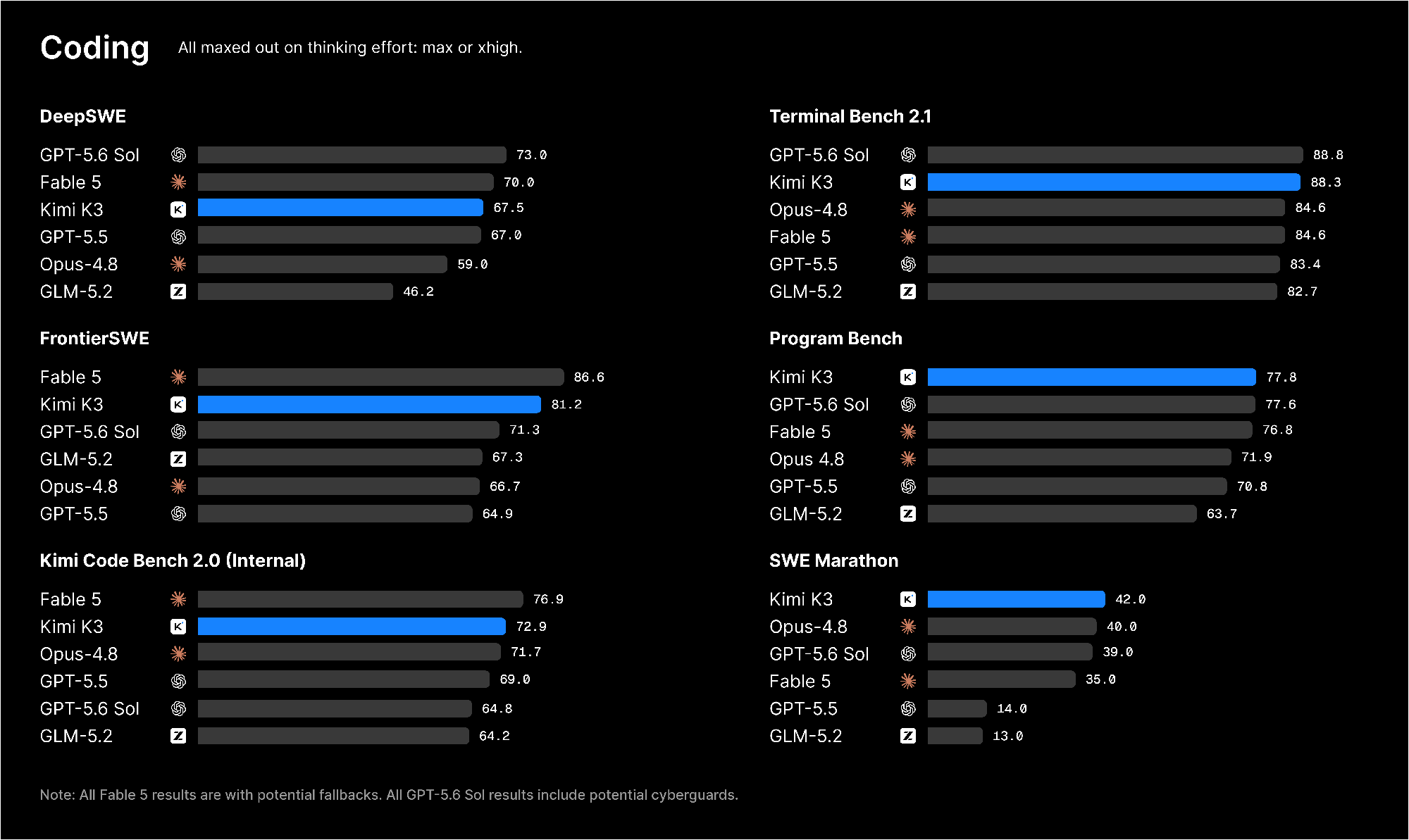 Image: Kimi K3 benchmark comparison against other models. Source: kimi.com
Free and open — but not free of privacy costs
So far, the story sounds like an inspirational drama of “Chinese open-source power rising up against the American closed-source giants.” But a highly-upvoted comment in the HN thread threw cold water on the celebration.
User dovin posted an excerpt from Moonshot’s API terms of service: the platform “may use Customer Content to provide, maintain, develop, support, and improve the Services,” unless the customer signs a separate written agreement. In plain English: the data you upload through the Kimi API can, by default, be used by the company to train its next-generation models.
For the programmer community, this is explosive information. In the American AI ecosystem, OpenAI and Anthropic’s API terms explicitly state that data transmitted through their APIs will not be used for model training. This is an industry norm and the trust foundation that lets enterprise customers plug sensitive operations into APIs. Moonshot has drawn this line in a completely different place.
The comments quickly split into two camps. One side argued that “OpenAI and Anthropic aren’t any better — at least the Chinese company open-sourced its model and gave back to the community.” The other side countered: “It’s not the same — American companies face clear legal constraints at the API level, and violating them could get them sued into bankruptcy through class actions, whereas with Chinese AI companies you have almost no legal recourse.”
The author won’t render a verdict. But this controversy does reveal a paradigm shift that’s underway: in the past we focused on whether the “model itself is open-source,” but now the battleground has advanced to whether the “terms of service around the model are open.” Open weights let you deploy it yourself and control your data flows; but if you use the official API, that tiny terms-of-service checkbox may matter more for your data’s fate than the code being open-source itself.
Why should ordinary people care?
You probably won’t deploy a 2.8-trillion-parameter model yourself — the GPU cost alone could buy you an apartment in a first-tier city. But three ripple effects of this event will ultimately touch everyone who uses AI:
First, the price war will heat up. Kimi K3 is priced at $3 per million input tokens and $15 per million output tokens — the most expensive among domestic Chinese models, but still far below GPT-5.6 Sol globally. When a near-top-tier open-source model appears, any company can deploy it and set its own price, and the premium pricing space of closed-source vendors gets continuously squeezed.
Second, the “Chinese open source vs. American closed source” narrative is shifting. From DeepSeek to Kimi, Chinese AI companies’ investment in the open-source community is real. A Hacker News user commented that “at least the Chinese companies give something back to the community” — a sentiment almost unimaginable a year ago. Whatever your position on data-privacy terms, China’s AI contributions at the level of open science are now being taken seriously by developers worldwide.
Third, the very definition of “open” is changing. The Kimi K3 case forces the industry to confront a more nuanced question: a model can simultaneously be “open” (weights publicly downloadable) and “closed” (API data used for training). The old “open-source / closed-source” binary for discussing AI models no longer suffices; we need a new vocabulary to describe degrees of openness.
The devil is in the details
One point calls for sobriety: all the benchmark data released so far comes from Moonshot itself. An evaluation report from independent third party Artificial Analysis has just come out, with preliminary conclusions pointing in the same direction as the official data but not perfectly aligned. The model weights won’t actually be downloadable for verification until July 27. In the AI industry, there’s often a gap between vendor-reported benchmarks and community-tested results — the author won’t predict that “it’s bound to flop,” but “wait for the community to run it” remains the rational choice.
Well-known developer Simon Willison found in testing that Kimi K3 consumes significantly more inference tokens than GPT-5.6 Sol to complete the same task — meaning that, although the per-token price is lower, the actual cost advantage for finishing a job isn’t as large as the headline numbers suggest. This touches on a frequently overlooked dimension in AI: token efficiency.
Kimi K3’s release will very likely be written into the key milestones of the AI industry in 2026. It simultaneously stirs three sensitive nerves — “open weights,” “data privacy,” and “China vs. America” — forcing the whole industry to face more complex questions. That significance runs far deeper than a mere benchmark score.
Reference links:
- Kimi Official Blog: Kimi K3 announcement
- HN discussion (item?id=48935342)
- Artificial Analysis: Kimi K3 independent evaluation
- Simon Willison: Kimi K3 and the pelican test
- VentureBeat: China’s Moonshot releases Kimi K3, the world’s largest open-source model