
On July 16, 2026, Microsoft did something nobody expected: it open-sourced a 30-year-old chat application.
This wasn’t an infrastructure project “first released 30 years ago and still maintained today.” It was a long-forgotten, oddly-styled chat tool called Microsoft Comic Chat.
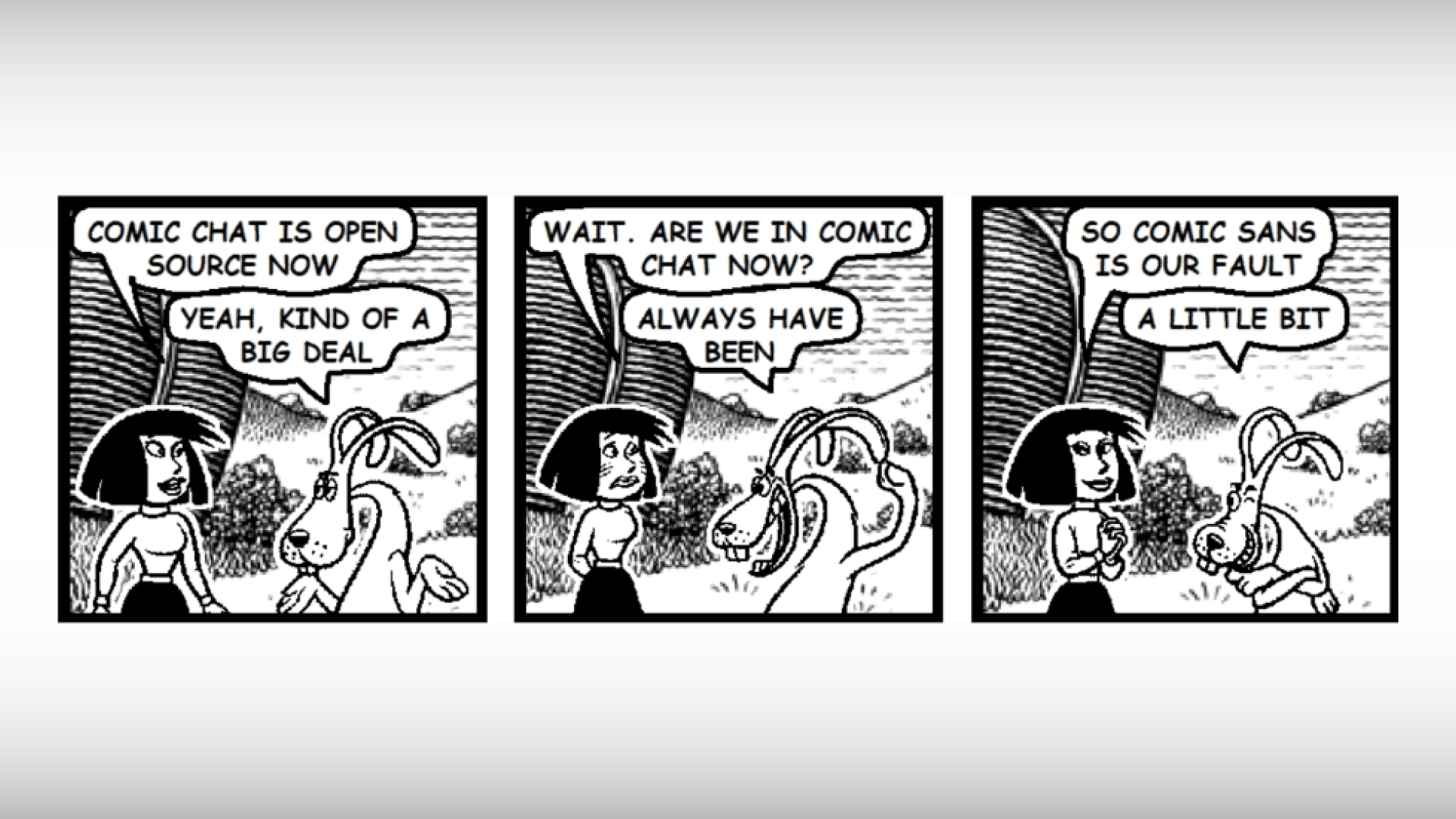
The day the news broke, Hacker News racked up 455 upvotes and 103 comments. In the comments, one user shared this memory: “Comic Chat was my first experience with online chat. I was just a kid, poking around in the system32 directory, when I found mschat.exe. It opened up a whole new world for me.”
What did this software do?
What did online chat look like in 1996? Screen after screen of scrolling plain text. You typed; the other person saw the words. That was it.
Comic Chat did something that bordered on crazy for its era: it automatically turned your conversations into comic strips.
Every participant became a comic-book character. You say “I like this,” and your character points to itself. You get angry, and the character frowns and crosses its arms. The dialogue unfolds panel by panel, with speech bubbles, facial expressions, and body language. It wasn’t just a skin slapped over text — it read the emotional cues in your words and automatically decided how each panel should be drawn.
Comic Chat’s visual style came from independent cartoonist Jim Woodring. The development team would hand real chat logs to Woodring and have him draw them by hand, then use those samples to judge whether the direction was worth pursuing. The verdict: yes, it was.
The software has an unexpected “legacy”: it carried the Comic Sans font to every corner of the world. Microsoft typographer Vincent Connare designed Comic Sans in 1994, and Comic Chat became the font’s first “home.” The handwritten, casual texture of the speech bubbles paired naturally with the comic-book interface. Comic Sans later became famous — or rather, infamous — as one of the most controversial fonts of the digital age, yet few people know it was originally born for comic chat.
Why open-source it now?
The official wording on the open-source blog was: “to preserve an important piece of software history and give the community a chance to explore, learn, and build.” That rationale sounds perfectly reasonable.
But the real story was hidden in the comments.
In the Hacker News thread, a user named Robert Standefer revealed his identity: “Hi, I’m the person who made this happen — of course, with a lot of support from others. How it all came about is an interesting six-year story, and the key to its success literally depended on being in the right place at the right time.”
Standefer is a technical advisor at Microsoft. In the comments he repeatedly clarified one thing: he was not the original author of Comic Chat. The original author was David “DJ” Kurlander, a Microsoft Research engineer who retired more than two decades ago. Kurlander was “very supportive, even enthusiastic” about the open-sourcing.
Six years. One person pushed inside the company for six years, just to bring a 30-year-old piece of software back into the light.
Inside a large, layered enterprise with tens of thousands of employees, pushing to open-source an old piece of software that generates no revenue and affects no KPI means facing untold internal processes, approvals, and legal reviews — things outsiders can hardly appreciate. Standefer didn’t spell out the details of those six years in the comments, but the phrase “being in the right place at the right time” hints that, for much of those six years, he was neither in the right place nor at the right time.
From “closed-source fortress” to “embracing open source”
Comic Chat was born in 1996. That year, Bill Gates sent a famous memo to all employees titled “The Internet Tidal Wave.” Microsoft had just realized the internet was a big deal and began pivoting toward it with full force.
That same year, Microsoft’s internal attitude toward open source could be summed up in one word: hostile. Gates called Linux “a cancer,” and the Windows source code was among the most tightly guarded trade secrets in the world. Back then, the very phrase “Microsoft open-sourced something” was a contradiction in terms.
Three decades on, today’s Microsoft owns GitHub, is a platinum member of the Linux Foundation, and has over 6,000 employees actively contributing on GitHub. Microsoft has open-sourced .NET, VS Code, TypeScript, and WSL — not fringe toys, but core infrastructure.
The open-sourcing of Comic Chat is a small period at the end of this long arc of transformation. If open-sourcing .NET represents a strategic pivot, then Comic Chat represents a cultural loosening — a company taking seriously something with no commercial value, driven purely by sentiment and nostalgia, and announcing it solemnly on its official blog.
This is not a story of “a company deciding to open-source.” It’s a story of “one person who didn’t give up.”
The community’s response
Of the 108 comments on Hacker News, the vast majority shared memories.
Someone mentioned “Jerk City” — a webcomic series created with Comic Chat that was moderately well-known on the late-90s to early-2000s internet. Others reminisced about nights chatting on MSN with Comic Chat. The most touching comment came from a user named JeremyHerrman: Comic Chat inspired him to found his first startup in 2008 — a comic-creation site called Chogger, which grew to 30,000 monthly users, mostly educators using it to help students write stories in a more engaging way.
The fact that a piece of software can, nearly three decades after its release, still make people stop and leave memories in the comments says something about what it once touched.
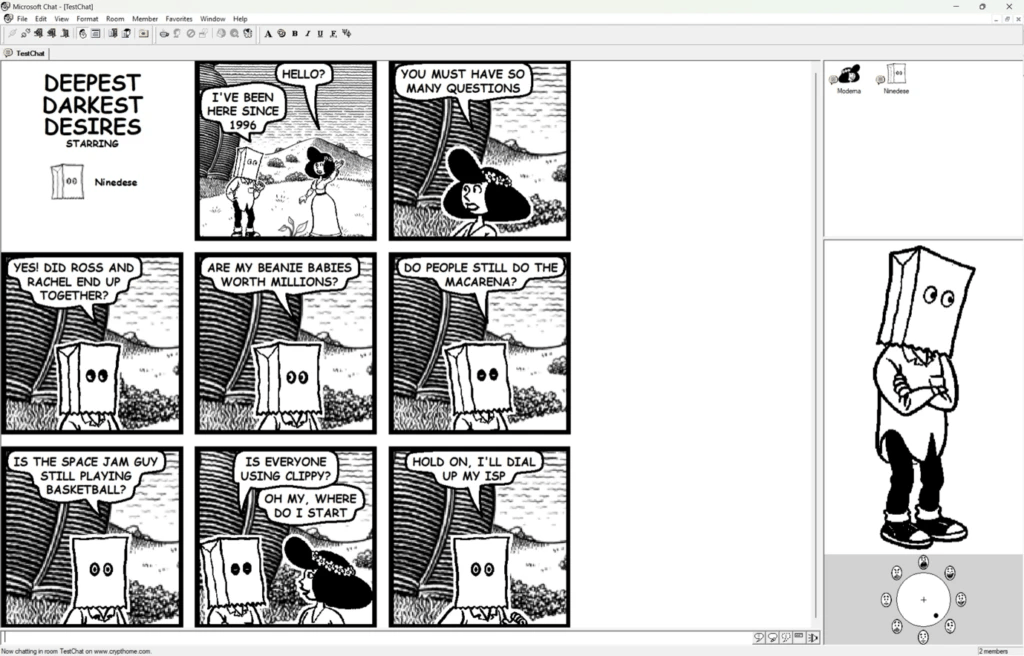
What’s in the open-source package?
Comic Chat’s source code is now hosted on GitHub in the microsoft/comic-chat repository under the MIT License — one of the most permissive open-source licenses, with virtually no usage restrictions.
The repo includes the original snapshot code, along with several AI-assisted “modernization attempts” — getting this 90s software, written in Visual C++ 4.0 and MFC, to compile successfully in the current version of Visual Studio. That’s an interesting footnote in itself: code from three decades ago and today’s hottest AI technology meet in the same repository.
My own impression is that Comic Chat’s core idea in 1996 — automatically turning textual conversation into visual expression — feels remarkably ahead of its time in today’s AI era. The emoji reactions, stickers, GIFs, and AI-generated chat content we now take for granted are, in a sense, all traveling down the path Comic Chat blazed. It just took thirty years for that path to go from “whimsical experiment” to “part of everyday communication.”
The above is based on the public information from Microsoft’s open-source blog and discussions in the Hacker News community. The author has no first-hand experience using Comic Chat; the narrative and judgments here are compiled from public sources. If you happen to be a longtime Comic Chat user or contributed to this open-source project, please feel free to point out any shortcomings.
Reference links:
- Microsoft Open Source Blog: Microsoft Comic Chat is now open source
- HN discussion (item?id=48936426)
- GitHub repository: Microsoft Comic Chat