Visit a Broken URL, and an iPod Powers Up
Enter music.apple.com/this-url-doesnt-exist into your browser’s address bar and hit enter. There are no playlists, no login prompts—just “Page Not Found” text below which reads “Give this a spin instead.” The phrase “spin” works on two levels: both “give it a whirl” and “spin a record.” The page contains only these two lines of text and a single device.
Centered on the page is a first-generation iPod released on October 23, 2001—complete with its clickable scroll wheel, Menu button, play button, and forward/back controls, all fully functional. Error pages are typically the most neglected parts of a website, where most companies place nothing more than a link back to the homepage, with visitors staying for mere seconds. Apple has placed a fully interactive hardware replica in this position—the place with the least traffic, yet containing the most engaging element.
The trigger is remarkably accessible: enter any non-existent URL, and anyone who makes a typo will stumble upon it. This low barrier to entry combined with high execution quality is rare for Easter eggs.
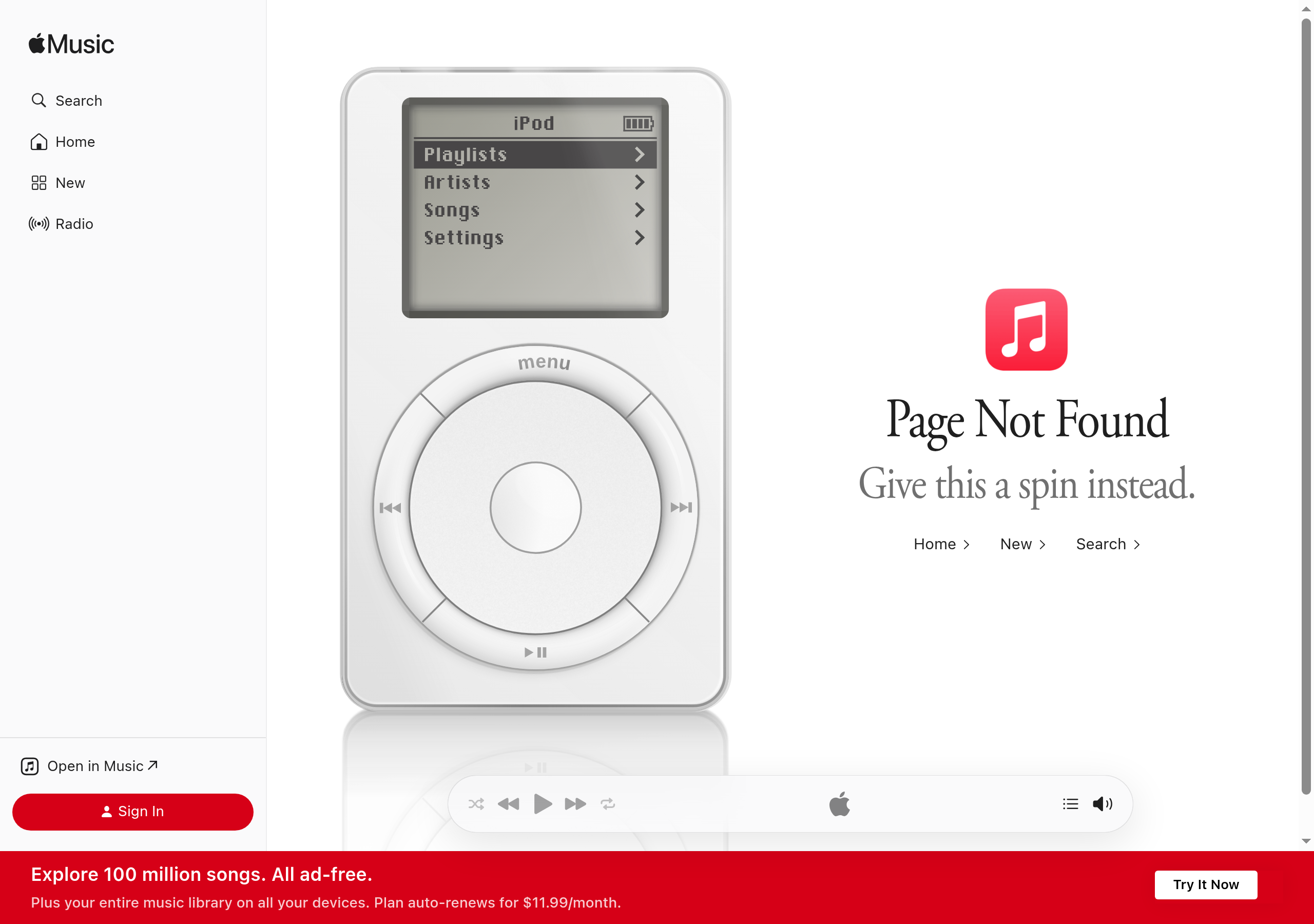 Figure: The 404 page on Apple Music featuring a first-generation iPod with a functional scroll wheel, Menu button, and play button. Source: Screenshot captured by the publication
MacRumors reported on it on October 23, 2026—exactly 25 years after the first iPod’s release. Apple placed its most recognizable hardware interface in the page type with its lowest traffic.
The Scroll Wheel Turns, 90-Second Previews with Real Songs
The controls perfectly mirror the 2001 device: scroll up and down through the list with the wheel, use the Menu button to go back, press the center button to select, and use the play button to pause or skip tracks. The entire experience works without a keyboard, with the navigation path identical to that of 25 years ago. The song library connects directly to Apple Music’s official preview system, featuring artists like Alicia Keys, Beyoncé, Britney Spears, Coldplay, Daft Punk, Drake, Dr. Dre, Eminem, Lady Gaga, Michael Jackson, and U2, with each song playable for 90 seconds.
Ninety seconds is just enough to reach the chorus, requiring users to return to the main Apple Music app to hear full songs—effectively driving traffic from the Easter egg. The library spans multiple generations, appealing to both original iPod users from 25 years ago and their children. No placeholder data was used here; from the song library to the playback pipeline, this is a product-grade implementation. This web iPod is a real device, just placed in an error page.
Place the 2001 and 2026 music listening experiences side by side, and the difference becomes clear. Back then, every song required deliberate selection: press Menu to access menus, scroll to find an album, press select, and then choose the next track—selecting songs was part of the listening experience itself. Today’s Apple Music features algorithmically curated recommendations and playlists that handle the ordering, leaving users only to press play. There is no “Recommended For You” section on this web iPod interface.
A Second Easter Egg Hidden in Settings: Hold for 5 Seconds to Reveal Pinball
There’s a second, deeper Easter egg. In the iPod interface, navigate to Settings → About and hold the center button for 5 seconds. The screen transitions to launch a pinball game. This game, called Brick on the actual iPod, mimics the classic Atari arcade game Breakout; both Wozniak and Jobs had worked on the Breakout version for Atari in their early days, making its inclusion in an iPod a meaningful tribute. The gameplay remains identical to the arcade original: control a paddle to bounce a ball and break a row of bricks.
Creating these two Easter eggs required significant development work, rebuilding the interface, audio, and game logic for the web. The placement is also deliberate: Settings → About is the most inconspicuous corner of the menu. To discover it, users must navigate menus layer by layer, just as users did over 20 years ago. Someone on Hacker News even posted specifically to point it out: “Can’t believe no one mentioned this hidden game—hold the center button for 5 seconds in Settings → About.”
Even the path to discovering the Easter egg replicates the old iPod user experience: explore menus first, then encounter surprises. The first layer requires mistyped URLs, the second requires menu exploration—both discovery paths are carefully designed.
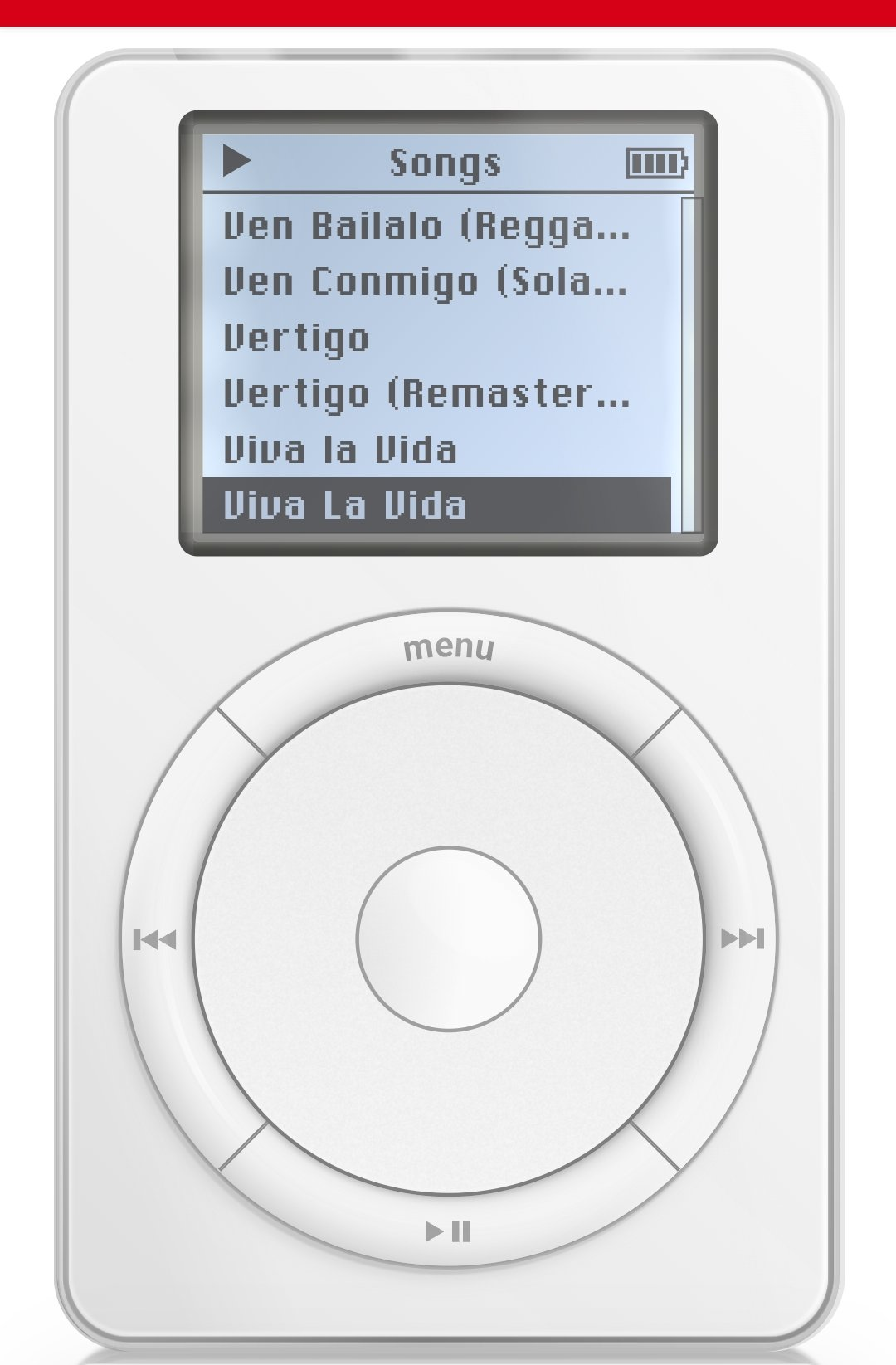 Figure: A screenshot shared on X showing the hidden iPod page, which initially spread across social networks. Source: X user @kianworld
The Easter Egg Was Discovered on iPod’s 25th Birthday
Looking at the timeline: October 23, 2001, marks the first iPod’s release; October 6, 2026, Apple Music introduced a new logo; October 21, the new interface launched; and around October 23, users discovered the Easter egg, with MacRumors reporting it the same day. In 17 days, three major steps occurred, with the Easter egg appearing in the same week as the new interface’s full rollout, coinciding exactly with the 25th anniversary.
The alignment of these dates suggests this iPod was part of the planned new interface release. There are many ways to commemorate a 25th anniversary—publishing a retrospective article or creating a special feature page would suffice. Apple chose the most labor-intensive approach: building the commemoration into the product itself, allowing users to discover it organically. The momentum of the new interface update and the nostalgic feelings surrounding the 25th anniversary reinforced each other that week.
Nostalgists Praise the Wheel’s Feel, While Others Have Stopped Choosing Music
The Hacker News comments section divided into two camps. One side praised the scroll wheel as “an incredibly satisfying interaction, even though technological progress has made it unnecessary.” The other countered with everyday scenarios: someone complained that their car’s infotainment system automatically starts playing Apple Music when their iPhone connects, requiring no screen interaction from the moment they get in the car until they leave.
Both sides agree on the wheel’s quality; their disagreement lies in whether it’s worth daily use. Nostalgists see a discarded tactile experience, while convenience advocates see eliminated steps—evidence drawn from the same everyday context: hands remember the wheel, but car systems don’t offer the choice. Both are reading from the same iPod script but reaching opposite conclusions, each backed by their own daily experiences. No one questions the wheel’s design quality; the debate has always been whether it belongs in daily life or in memorials.
The Wheel Still Turns, But Few Pass By Now
Zooming out to Apple’s own product line: Apple Music’s homepage is driven by recommendation algorithms, and the new interface integrates playback and playlists more seamlessly, with song selection compressed into search boxes and manually maintained playlists. Recommendations reduce the cost of choosing songs but also eliminate the pleasure of “browsing albums.” In 2001, selecting songs was the core action; in 2026, it’s become a task that can be delegated. This iPod, with its intact wheel, licensed music library, and even two layers of Easter eggs, has been placed on a page only accessible via mistyped URLs.
This placement in the 404 page is also logical: error pages have no conversion metrics, leaving no traffic to be cannibalized.etrics, no push notifications, and engineers aren’t held accountable for data here. What’s beenabandonné abandonné (eliminated) by product logic can be preserved intact. On this product line, the only place left without an algorithm’s presence is the error page.
“Give this a spin instead” is clever copywriting, with “spin” referring to both the wheel and records. Yet 25 years ago, spinning the wheel was the daily main operation; now, you must first mistype a URL before you get to spin it.