
In October 2026, Apple introduced a beta release of an all-new tool: Pass Designer. In Apple’s official framing, whether you are a local gym owner, an organizer running an underground music venue, or an engineer at a global airline or national coffee chain, you can now easily design digital boarding passes, loyalty cards, and event tickets directly on macOS 27 using this WYSIWYG editor. The tool itself is free to download—all it takes is signing in with an Apple Account, agreeing to the developer terms, and completing a free enrollment. On the surface, Apple appears to have demolished the visual barrier to entry for digital wallets, throwing the doors wide open to merchants everywhere.
Yet beneath this seemingly frictionless onboarding lies a cold architectural reality: while the design canvas is free, getting that beautifully crafted pass to actually work on a customer’s iPhone requires crossing a paid toll booth. Every valid Apple Wallet pass must be cryptographically signed by a certificate issued by Apple. And that Pass Type ID certificate remains strictly locked behind Apple’s $99-per-year Developer Program. You can spend hours perfecting colors and layouts on your Mac, but until you pony up ninety-nine dollars, your pass can never leave the preview window.
Packaging Structured Data with a Single Template
Pass Designer is far more than a basic vector drawing app. Within its editing canvas, users can start from Apple-provided templates, import their own brand logos and background assets, and tweak color palettes and typography while viewing real-time previews that match the exact rendering behavior on iOS and watchOS devices. This WYSIWYG approach significantly reduces design errors, ensuring that what designers see on macOS is precisely what end customers will see on their screens.
Crucially, the tool enforces semantic tags over raw pixel placement. When building a pass, creators must supply structured data: flight departure and arrival times, venue coordinates with precise latitude and longitude, or loyalty point balances. The operating system parses these structured fields to power contextual native interactions on iPhone. As departure time approaches, Siri surfaces proactive travel suggestions; when walking near an event venue, Apple Maps navigation triggers automatically. The system even generates a backwards-compatible fallback layout for legacy devices that do not yet support modern semantic tags.
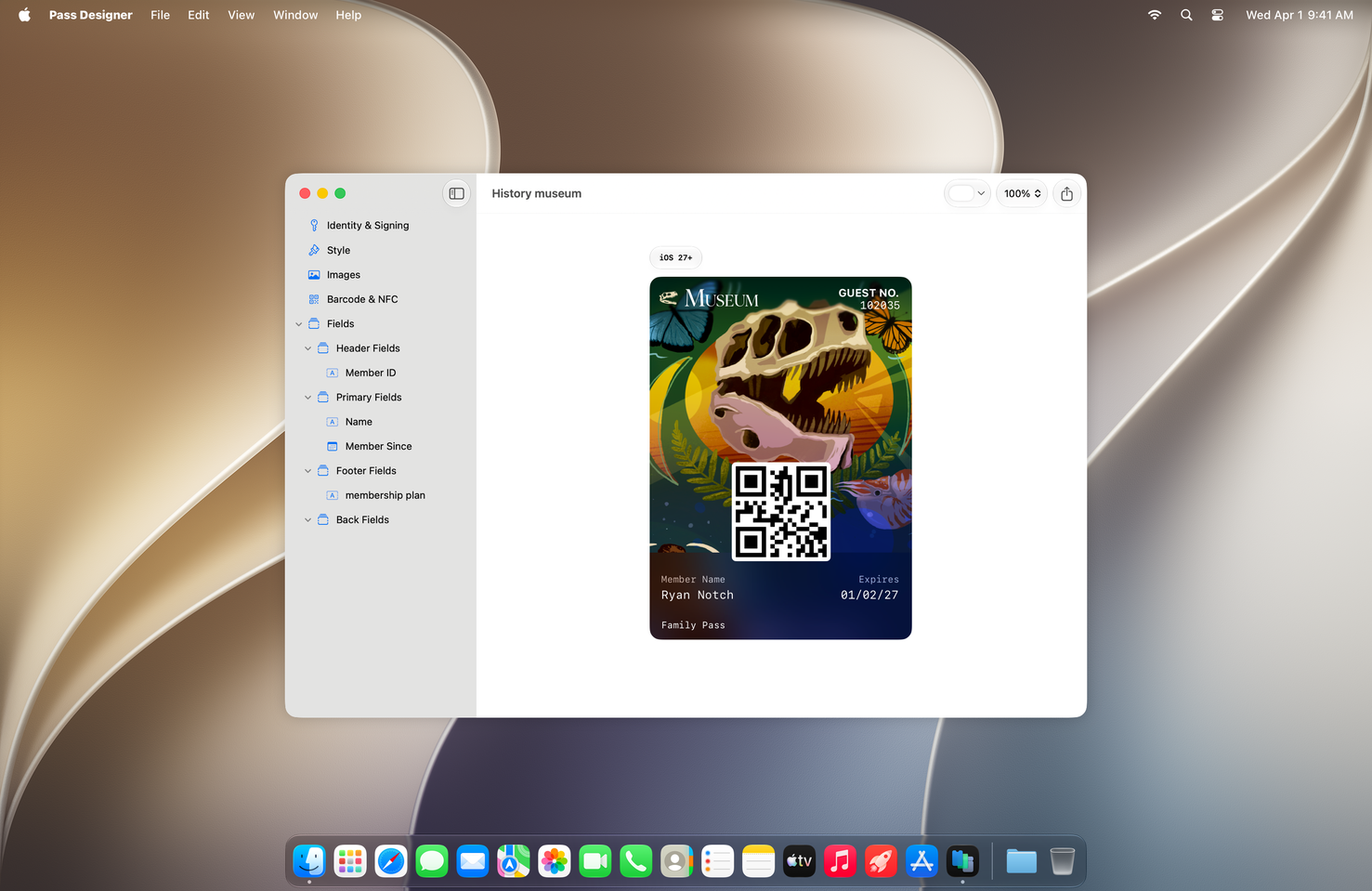 Figure: The Pass Designer editing interface and live preview on macOS. Source: Apple Developer
Through this workflow, Apple effectively channels fragmented offline business data into standardized, machine-readable structures. Trading a free visual editor for high-quality structured services is a remarkably favorable exchange for Apple. While the app makes layout effortless, its broader architectural objective is assimilating global ticketing and credential formats into Apple’s proprietary framework.
The $99 Wall Shuts Out Long-Tail Merchants
The technical wall becomes immediately apparent when a small business owner—say, a boutique gym operator who spent an afternoon crafting a loyalty card with glossy foil effects—hits the export button. Under the hood, an Apple Wallet pass is an archive containing JSON metadata and image assets, bound together by a critical PKCS #7 cryptographic signature. If the package is not signed using a verified Apple private key, iOS devices will reject it outright with a generic error dialog upon import.
Obtaining a valid private key requires accessing the Certificates, Identifiers & Profiles portal in Apple Developer. There is no “free tier for small businesses” and no “pay-per-pass” option; the sole admission ticket is an active $99 annual Apple Developer Program membership. For national franchises that already maintain native iOS apps, that fee is an already-absorbed sunk cost. But for a high school theater club distributing 50 digital tickets or a neighborhood cafe issuing 100 customer loyalty passes, this recurring fixed cost presents an insurmountable hurdle.
Tying pass verification to a paid developer account serves a dual purpose: locking down the ecosystem while screening out spam and abuse. By imposing a $99 annual toll, Apple erects a physical barrier against ephemeral issuers and potential scammers. Faced with a choice between open access and system trust, Apple’s platform architects unambiguously chose cost as the first line of defense.
The Community Turns to Proxies to Bypass Official Gatekeeping
Whenever official channels become prohibitively expensive, developers and users invariably forge informal workarounds. Community reaction to Pass Designer’s $99 certificate barrier has been notably muted. Across developer forums, many dismissed the release as largely inconsequential. As Hacker News commenter gruez pointed out, as long as the cryptographic signing mechanism remains unchanged, anyone without a $100 annual subscription will still be left on the outside looking in.
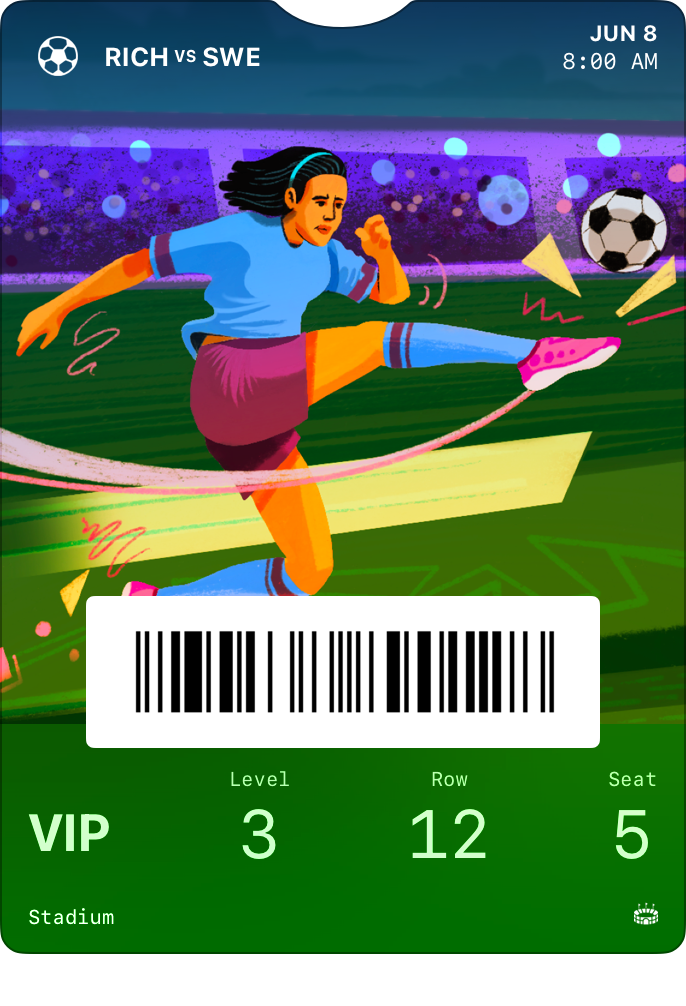 Figure: An event ticket style Wallet pass containing structured date, time, and seating data. Source: Apple Developer
In practice, alternative workarounds have flourished for years. Everyday users and micro-merchants routinely rely on third-party proxy services like Pass2U Wallet, SuperCards, or Pass4Wallet. These platforms effectively act as certificate proxies: merchants configure their card details on the intermediary site, and the service signs the package using its own corporate developer certificate before delivering the pass to the end user. Although cumbersome, ad-supported, and fraught with privacy risks by exposing customer data to intermediaries, this pragmatic proxy ecosystem thrives because getting the pass onto the device remains paramount.
Meanwhile, iOS 27 now allows users to create basic, temporary passes directly inside the native Wallet app. With the OS offering its own lightweight entry point for informal passes, Pass Designer’s positioning as a desktop app tethered to developer certificates appears increasingly awkward.
Dynamic Payment Codes Cannot Enter Static Wallets
Another tension within Apple Wallet lies in the divide between static presentation and dynamic transaction security. Many users hoped that a simpler pass authoring tool would finally let them uninstall bloated merchant apps whose sole function is displaying a payment barcode—such as Tim Hortons in North America. Users have long clamored to consolidate these single-purpose apps into their native system wallet.
Yet technical constraints block this path. Wallet passes are fundamentally designed for static identifiers whose underlying string values remain unchanged over long periods. While sufficient for basic membership IDs, using static codes for monetary transactions poses severe fraud risks, as a simple screenshot allows anyone to drain account balances. By contrast, true payment QR codes require dynamic client-side regeneration based on timestamps and local cryptographic secrets, refreshing with every scan. Due to Apple’s strict sandboxing rules, Wallet passes cannot execute arbitrary third-party client code to dynamically recalculate cryptographic tokens.
Security ultimately defines the functional boundaries of Wallet. When a transaction requires on-device cryptographic calculations and dynamic token rotation, a lightweight zip archive limited to static JSON data and predefined styling will never replace a standalone native app.
Permission Matters More Than Design Experience
In the domain of digital identity and credentials, visual presentation has never been the actual moat; power belongs to whoever holds the private cryptographic keys. With Pass Designer, Apple has delivered an elegant aesthetic toolkit, allowing anyone to freely experiment with building visual components inside the iOS ecosystem.
Yet when it comes time to breathe life into those visual shells and activate them on physical hardware, the gate of the developer certificate program stands firmly shut. Even for standardized airline boarding passes, adding tickets to Wallet can still suffer from erratic success rates. Apple has democratized pass design for everyone, while keeping iPhone trust behind a paywall. The real barrier to entry in the Wallet ecosystem has always been the cryptographic signature. Pass Designer opens the front door to aesthetics, but keeps permission firmly under lock and key. By decoupling rendering from signing, Apple has ensured that Pass Designer remains a design canvas for paying developers rather than a universal ticketing utility for all.
References:
- Apple Developer Official Site
- Hacker News Discussion