On September 30, 2026, Nature published a paper that made the brute-force compute dogma of large frontier models look distinctly awkward. A system named Ataraxos, developed jointly by researchers at Carnegie Mellon University, MIT, and partner institutions, crushed four-time world champion Pim Niemeijer in the classic board game Stratego with a record of 15 wins, 1 loss, and 4 draws—using a modest cluster of 16 GPUs and an estimated training budget of just $8,000. Four years earlier, top industry labs poured 1,024 dedicated accelerator chips and millions of dollars into cracking the very same fortress, yet failed to master the elusive game-theoretic challenge of bluffing.
16 GPUs Overturn the Brute-Force Compute Monopoly
This marks a sharp course correction for frontier AI research. In head-to-head matches against Pim Niemeijer, Ataraxos exhibited commanding dominance. The terms were straightforward: for every game won, the research team paid $100 to the grandmaster, who has held the world number-one ranking for over 600 weeks. Niemeijer knew the AI was fixed and would not adapt dynamically between matches, allowing him to patiently probe for algorithmic blind spots. Yet over 20 high-stakes games, the human champion managed only a single victory.
The research team provided a grounded engineering post-mortem: the lone defeat and four draws were largely driven by Stratego’s mandatory random blind piece placement at the start, where short-term variance cannot be smoothed away by the law of large numbers across a 20-game sample. During a live 40-game exhibition at the 2025 Stratego World Championship against varied opponents fielding unorthodox setups, Ataraxos won 38 games. But while besting the reigning world champion turned heads, what truly rattled industry orthodoxy was the modesty of the compute bill.
 Figure: Stratego’s complex board state and concealed pieces. Source: Getty Images (via Ars Technica)
Ataraxos’s computational footprint was remarkably small: just 16 GPUs running for one week, plus 4 GPUs running for four days to train its belief model. The authors estimated total training expenditure at roughly $8,000. By comparison, DeepMind’s 2022 predecessor, DeepNash, harnessed 1,024 specialized accelerators for two to three months—amounting to an estimated $3 million to $4.5 million at 2025 hardware prices. Ataraxos required roughly one-thirtieth of DeepNash’s self-play volume and compressed sample complexity down to one percent. Between the two systems lies a three-order-of-magnitude gulf in compute investment, yet the newcomer achieved complete dominance with off-the-shelf silicon. Brute-force compute scaling has hit diminishing marginal returns; throwing millions at exhaustive search is no longer the only—or best—path forward.
10^33 Opening Configurations Break Pure Search
To understand why millions of dollars hit a brick wall in Stratego, one must inspect the game’s intrinsic structural complexity. Unlike chess or Go, which are perfect-information games where every piece on the board is visible to both players, Stratego is an imperfect-information game enveloped in dense fog of war. Each player commands 40 pieces—ranging from the Marshal down to the Spy, alongside immobile Bombs and a single Flag that must be defended at all costs. At the start of the match, you see only the positions of the opponent’s pieces, with zero knowledge of their true identities.
Only when two pieces collide on the board does the referee reveal their ranks. The weaker piece is removed, while the survivor remains—simultaneously disclosing its crucial identity to the entire board. This mechanism drives an exponential explosion in state space. While Texas Hold’em is also an imperfect-information game, each player holds only two private hole cards, creating just 1,326 initial combinations. Stratego, in stark contrast, features more than 10^33 possible opening piece setups.
Even more challenging is the depth of the decision tree. A standard chess game typically concludes within roughly 40 moves, whereas a prolonged Stratego contest can easily surpass 2,000 moves. This extreme interaction horizon elevates a variable where standard reinforcement learning frequently stalls: bluffing. Advancing a worthless scout or miner disguised as an intimidating Marshal is a devastating tactical maneuver. If you bluff too aggressively, your opponent will call the bluff and capture your piece; if you play entirely honestly, your opponent will map your strength and overwhelm you locally. Striking a game-theoretic equilibrium between genuine threats and deceptive feints across 2,000 turns is precisely what DeepMind’s 2022 architecture failed to resolve. In the face of an astronomical game tree, conventional algorithms attempting multi-step sequential bluffs simply burned through available compute without converging.
A Belief Model Pierces the Fog of War
Ataraxos bypassed this roadblock by restructuring the problem itself. Rather than attempting brute-force search over a combinatorial void of unknown information, the authors introduced a dedicated second neural network dubbed the “Belief Model.” Across 163 million self-play matches, this belief model’s central task was to infer the identities of concealed enemy pieces in reverse, deducing their roles from the opponent’s observed movement patterns.
By sampling the most probable board configurations for the opponent’s hidden pieces at any given state, it reduced traversing an infinite possibility space into local search across a handful of high-probability candidate layouts. With this belief model in place, Ataraxos could finally bring AlphaGo-style Monte Carlo tree search—evaluating prospective future branching moves before committing to an action—to the realm of Stratego.
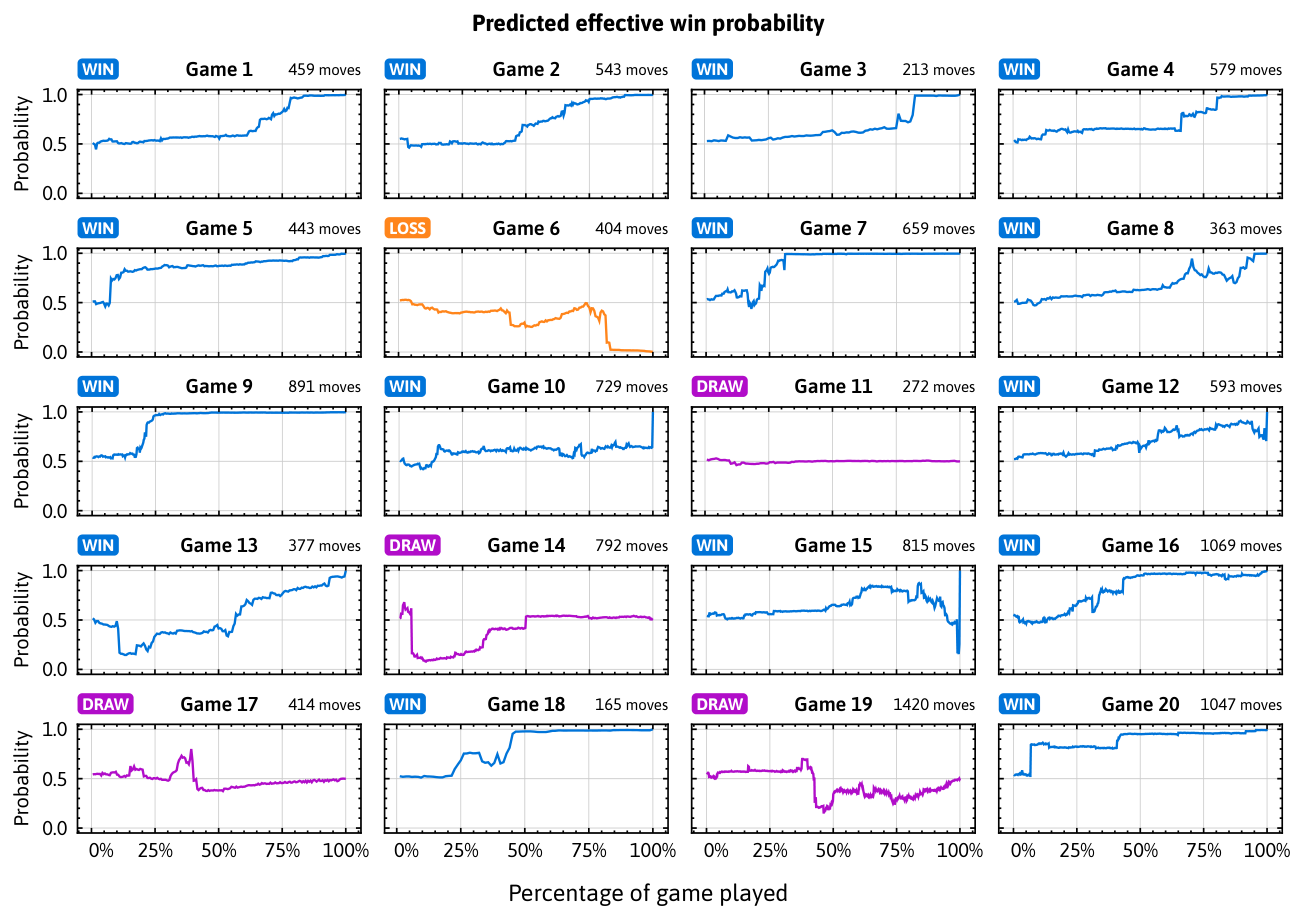 Figure: Value prediction and estimated win rates during matches against Pim Niemeijer. Source: arXiv:2511.07312
Constrained by immense hidden state uncertainty, prior systems could never reliably construct deep search trees in Stratego, having to rely purely on model-free value intuition. Ataraxos proved that in imperfect-information environments, inferring the opponent’s hidden state first—converting fog into high-confidence approximations—is the prerequisite for unlocking the true power of tree search. This structural shift even redefined traditional strategic play. Against Niemeijer, Ataraxos repeatedly deployed an unconventional defensive layout: tucking its critical Flag directly into a far board corner shielded tightly by just two Bombs. While human masters long dismissed this setup as rigid and brittle with low error tolerance, algorithmic verification proved it to be the most resilient defensive redoubt on the board.
Cold Calculation Stripped of Human Psychology
This architectural breakthrough translated directly into a unique playing style that human competitors found deeply unsettling: Ataraxos was utterly devoid of emotional baggage and human endgame panic. In analyzing game logs, researchers noted that when human players see their real-time win probability crater to a desperate 2%, they almost invariably gamble on suicidal charges or wild, reckless bluffs.
Ataraxos, placed in identical deficits, methodically combed the decision tree for any branch offering even a 0.1% boost in win expectation, patiently grinding the position back toward equilibrium. The researchers observed that it could bluff its way back into the game with eerie composure. For the machine, feigning strength with a weak piece required no adrenaline spike or psychological strain; it was simply the mathematically optimal action given its current belief distributions.
This unfeeling objectivity was equally evident in how Ataraxos handled its own tactical vulnerabilities. If the AI left a gaping hole in its defense, but its belief model deduced that the opponent was unaware of it, Ataraxos refused to squander resources patching the flaw. An omniscient observer with full vision of both sides might anticipate imminent disaster, but Ataraxos remained unbothered. Human players can rarely manage this degree of detachment; knowing you harbor an exposed secret inevitably bleeds into hesitant maneuvers, hurried tempos, and nervous defensive overreactions. The machine harbored no such neurosis: if it judged that you didn’t know, it acted as though the threat did not exist.
Real-World Strategic Games Never Reveal the Hole Cards
The architecture validated by Ataraxos is far from limited to Stratego. The team has already transferred the framework to defeat three world champions in Barrage Stratego, master the cooperative card game Hanabi (which hinges entirely on mutual inference of hidden cards), and surpass leading AI baselines in Dou Dizhu (Fight the Landlord). At a fraction of historical compute costs, the framework has cut through the fog across vastly different rulebooks.
Yet board and card games are merely the proving ground. The researchers are now working on enabling the system to articulate its strategic reasoning in natural language. Their long-term ambition is to adapt this imperfect-information decision framework to real-world domains like corporate negotiations, supply-chain positioning, and financial market dynamics.
The Stratego breakthrough is ultimately a referendum on AI methodology. In complex problems plagued by prolonged horizons and incomplete information, structuring the pipeline to deduce hidden reality before executing local search defeated brute-force scaling for just $8,000. When an AI can pinpoint a world champion’s hidden cards across 10^33 permutations of fog, the rules of frontier research shift. The race is no longer won merely by whoever hoards the most accelerator clusters, but by whoever discovers the true latent geometry of the problem.
Reference Links:
- Nature paper: Scalable decision-making for games of imperfect information
- Ars Technica reporting
- Hacker News discussion (item?id=49933740)