
Inside ChatGPT, the path to building a website has shrunk to a single sentence. Turnaround times that once demanded weeks of team roadmapping have collapsed into a few seconds of conversational flow, making spinning up a functioning web application faster than registering a new account.
From Concert Epiphany to Playable Game in Under an Hour
During a live concert, one developer came up with a quirky game concept: a mouse hunting for cheese in higher-dimensional mazes. That very night, using the newly unveiled ChatGPT Sites, he turned the idea into a fully playable game—in under an hour. The friction of bootstrapping a full-stack project from scratch was completely wiped away. Users simply mention @Sites in the chat, drag and drop reference assets or screenshots, and watch an in-app browser render a live preview that can be tested and iterated on the fly.
Bootstrapping steps that traditionally consume hours—configuring environments, setting up routing, provisioning servers—are compressed into mere seconds. Historically, the tallest barrier preventing non-technical creators from turning ideas into working software was getting past that initial local environment setup. By abstracting away infrastructure and dependency management into the platform, users can pour all their cognitive energy directly into validating business logic. When frontend tooling reaches its ultimate destination, it fades into invisible infrastructure.
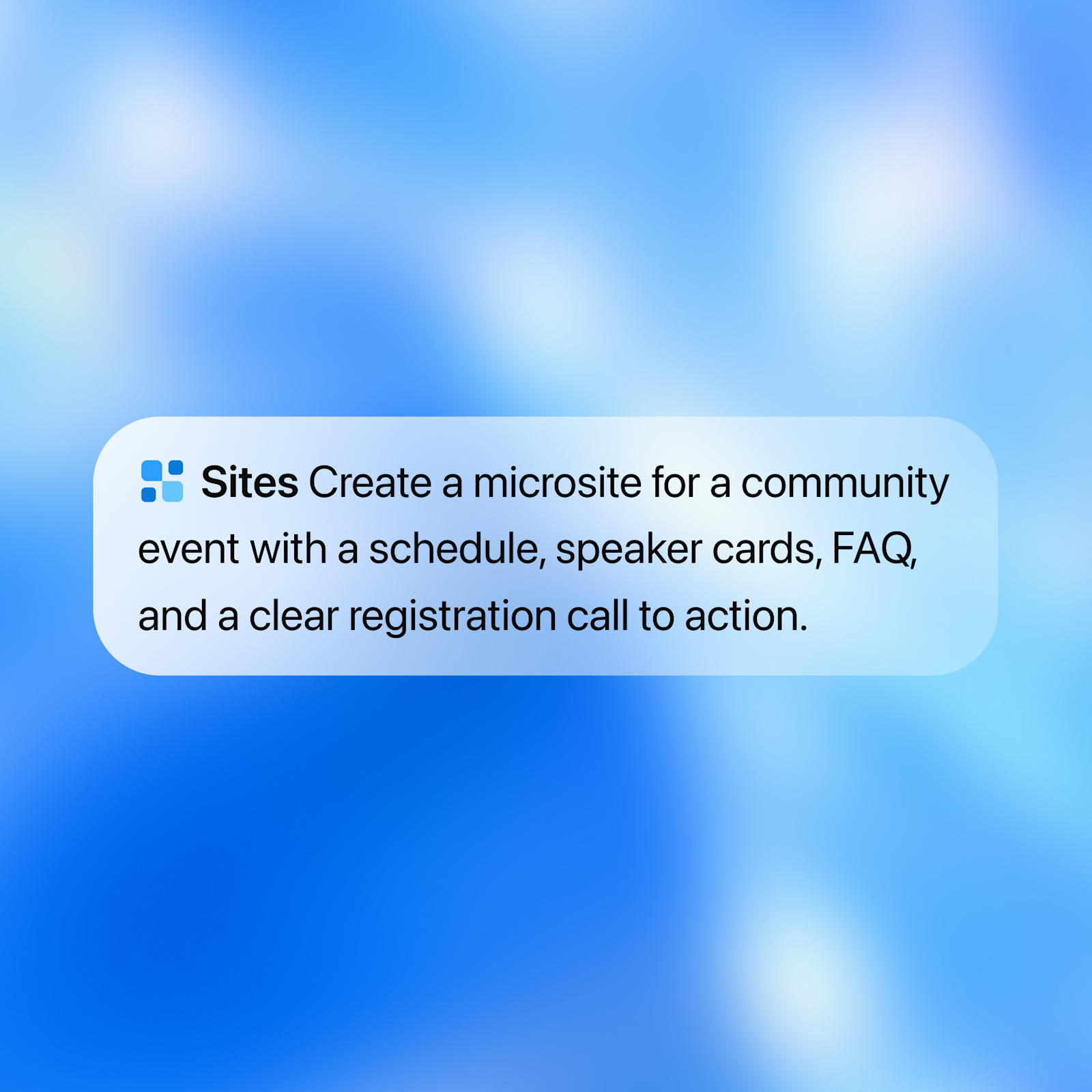 Figure: Generating an interactive application interface directly from a one-line prompt in ChatGPT. Source: OpenAI
The feature also allows starting directly from existing Codex projects. Creators can tweak layouts, revise copy, and add or prune features through conversational prompts at any time. When team members collaborate within a shared workspace, editors see live persisted state while external visitors are restricted to a read-only view. This role-based data isolation packs enterprise-grade access controls into an approachable, no-fuss configuration panel.
Deeper still is the mechanism for data connectivity. Enterprise workspaces can grant a site permission to read data from tools members have already connected to ChatGPT. Crucially, the site can only access resources the authenticated member already has explicit clearance to view. The system prevents unauthorized cross-boundary reads and prohibits write-backs into the source tools. This unidirectional authorization model ensures that wiring an AI site into internal knowledge bases does not puncture corporate security perimeters.
Zero-Barrier Creation Just Defers the Technical Debt
Faced with sub-hour prototyping speeds, the developer community has hardly succumbed to uncritical euphoria. Skeptics point to a familiar historical pattern: platforms like WordPress and Wix pushed site-building barriers to the floor years ago. The hard part of software engineering was never getting an initial version deployed. The looming peril is that six months down the line, a project cobbled together from AI-generated patches will decay into an impenetrable digital ruin that nobody dares touch.
Code generation tools foster a dangerous illusion by equating “it runs” with “it is maintainable.” Disciplines like state management, component modularity, and strict interface contracts exist precisely so that software can still be safely modified on day one hundred. When natural language takes over the authoring process, every incremental prompt quietly injects entropy into the codebase. Over the first month, it feels like an agile superpower; by month six, it risks congealing into a tangled black box of opaque logic.
Technical debt does not vanish simply because the author was an LLM; it is merely deferred to the maintenance lifecycle. Teams eager to capitalize on near-zero initial development costs must prepare for the eventual reality of doubled refactoring expenses. To ease ongoing operations, the platform lets creators configure scheduled background tasks. ChatGPT evaluates application characteristics, suggests run cadences, and awaits human confirmation before taking over. Hiding the complexity of a scheduling engine behind a conversational prompt noticeably lowers the operational bar for recurring jobs.
Disposable Micro-Apps Carve Out the Long Tail of SaaS
This new paradigm has predictably rekindled debate over an impending “SaaS apocalypse.” Some observers project that within weeks or months, such workflows will effortlessly host sprawling, mission-critical web applications. A more pragmatic viewpoint cautions otherwise: for the 90% of long-tail internal use cases, an unpolished, prompt-generated micro-app is already more than good enough.
Enterprises are awash with ad-hoc tooling needs that have vanishingly short shelf lives: a standalone check-in form for an offsite event, a temporary metrics dashboard needed for just two weeks, or a quick voting poll spun up for a sprint retrospective. Historically, these niche requests could never justify dedicated engineering sprint capacity and were clumsily shoehorned into bulky, generic SaaS suites. Today, they can be stood up and discarded as instant, disposable utilities.
Standardized best practices are the foundational value proposition of mainstream SaaS products. Sites, by contrast, thrives in the realm of highly non-standard, fragmented edge requirements. It cannot immediately displace the intricate, mission-critical operational logic of core enterprise platforms. Yet it decisively peels away the periphery of lightweight, ad-hoc internal tools. Workplace headaches that previously forced organizations to purchase a fleet of minor SaaS subscriptions can now be solved with a handful of disposable websites.
A 2026 GeoCities Returns the Real Limits to Humans
 Figure: The hero visual on OpenAI’s official Sites landing page, showcasing overlapping website and application preview cards. Source: OpenAI
Comparing ChatGPT Sites to a 2026 incarnation of Yahoo GeoCities is an apt analogy. Over two decades ago, GeoCities gave ordinary people their first personal static web pages on the open internet. Today, Sites offers non-engineers their first customized, dynamic, interactive web applications. Both revolutions serve the same underlying purpose: tearing down the professional barriers required to create digital assets.
Sites arrives paired with surprisingly mature infrastructure. Creators can rename their hosted subdomains at will or bind custom domains, with the system automatically orchestrating redirects from old URLs to new ones. Seamless traffic routing relieves solo builders from the operational overhead typically required to run early-stage side projects. Behind the user-facing interface sits a complete engineering stack—bundling an automated code generator, continuous integration and deployment pipelines, and managed hosting into a unified bundle.
When typing out syntax ceases to be the development bottleneck, the ultimate constraint reverts back to the human architect. The upper bound of what an application can achieve is dictated by your own structured imagination and domain comprehension. A machine can effortlessly expand a one-line prompt into a thousand lines of functional code. What it cannot do is decide how your application should handle edge-case failures when network connectivity drops, or how to isolate core transactions when user traffic suddenly spikes.
At its core, software development is the art of translating ambiguous human intent into rigorous, deterministic state machines. The magic of generating an application from a single sentence reshapes the first mile of software production. But it cannot pay the future maintenance bill. The tangled codebase that no engineer dares modify six months later is the inescapable reality awaiting us once the initial honeymoon of efficiency fades.
Reference Links:
- OpenAI Official Product Page
- Hacker News Discussion