Nine Frontier Models Share the Same Stylistic Pathology
On October 21, 2026, researchers Thomas Hikaru Clark, Matias B. Martin, and Kyle Mahowald submitted a paper (arXiv:2610.29162) to the Computation and Language (cs.CL) category. The study dissects the pervasive fatigue readers feel when consuming AI-generated prose. Many have experienced this: reviewing a report written by a chatbot where every individual word is recognizable, yet strung together, the text feels dense and unabsorbable. The authors evaluated nine frontier and near-frontier large language models on the market, discovering that this readability issue spans the entire industry—rooted in training reward mechanisms that actively pushed human readability out the door.
To investigate how AI structures language, the three authors constructed a cross-domain AI text corpus spanning casual conversation, code explanations, and open-ended essay prompts. They ran batch API calls across platforms like Amazon Bedrock; Appendix Table 1 in the paper documents detailed API costs per million input and output tokens. Under this standardized evaluation, not a single model was spared. Collectively, they abandoned the conversational habits humans evolved over tens of thousands of years, adopting an unnaturally dense machine style.
Examining specific syntactic patterns, all nine models relied far more heavily on inanimate subjects paired with animate verbs. Where a human naturally writes, “Engineers used this algorithm to detect vulnerabilities,” an LLM writes, “This algorithm examines and intercepts potential vulnerabilities.” Furthermore, all nine models heavily packed sentences with rare n-grams—infrequent, multi-word combinations. Instead of choosing familiar everyday expressions, they consistently favored obscure, formal literary couplings.
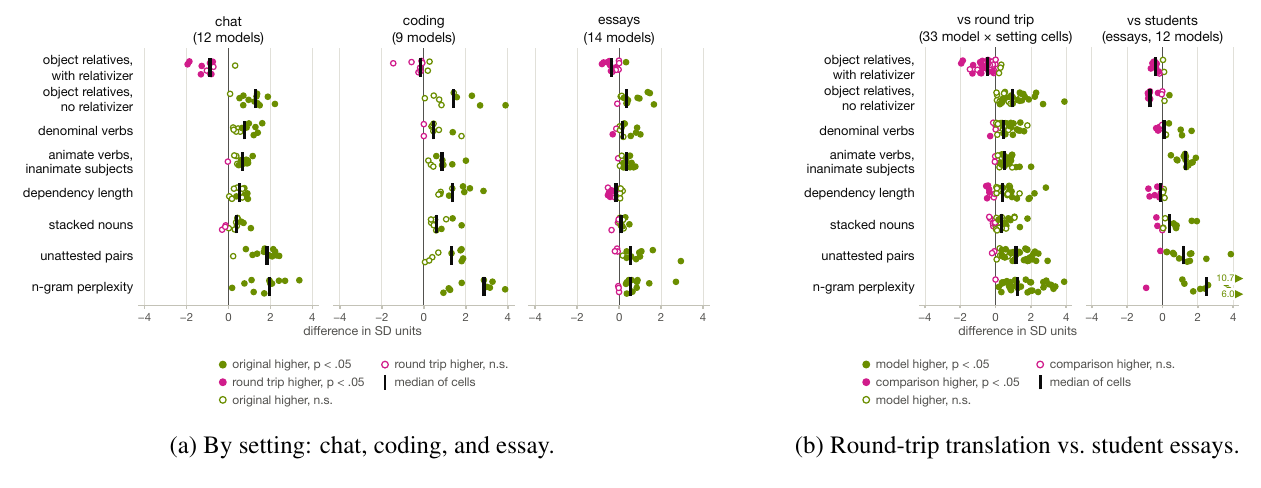 Figure: Paper Figure 3, summary of linguistic feature shifts across different settings. Taller bars indicate more frequent usage by the model. Source: arXiv:2610.29162
Mental Working Memory Strained by Long Dependencies: Machine Translation Cleared of Guilt
In conversational settings, most models exhibited three additional bad habits: inflated dependency distance, excessive noun compounding, and reduced object relative clauses. Reading human language taxes working memory much like a sorter holding an intake tray: once encountering a subject, the brain must hold it suspended until reaching the predicate verb to discharge the memory load. LLMs routinely pack heavy modifier strings between subject and verb, stretching dependency distance to an extreme. They also omit relative pronouns and connectives, causing nested clauses to interlock like Russian nesting dolls.
In the past, observers often attributed this convoluted phrasing to “translationese,” suspecting it was an artifact of multilingually curated training corpora. To test this hypothesis, the researchers ran a controlled experiment using the open-source translation model NLLB-200. They took human-written text, translated it into Japanese, and translated it back into English. This round-trip translation preserved human rhetorical structure while adding an automated translation layer.
The results thoroughly cleared machine translation of blame. The nine frontier LLMs depended far more on these cognitively demanding structures than the NLLB-200 round-trip Japanese rewrites. Simple machine translation does not generate reading friction this severe. The real culprit making text stiff and unwieldy is the pragmatic preference the models developed during post-training.
Compute Poured into Benchmark Scores Leaves Readers with Compressed Data Packets
Why do capable models generate such taxing prose? The paper attributes this to a mismatch in evolutionary pressures. Over tens of thousands of years of human language evolution, the sole evaluator was the human listener across the table; sentence structure naturally evolved to facilitate successful communication. Today’s LLMs face an entirely different tribunal during training: math benchmarks, code compilers, and automated reward evaluators.
As training priorities shifted toward mathematics, code, and formal reasoning, optimization pressure converged on maximizing information density. The paper categorized the evaluated models into four major families: baseline pre-frontier models, heavily post-trained frontier models, open-weight near-frontier models, and the GPT family. The syntactic fingerprints of the four families differed markedly: the more aggressive the post-training and the higher the focus on benchmark reasoning, the denser the stacks of compounded noun phrases became.
In discussions on Hacker News, commenters compared this to professional workplace communication: typical professional Gmail messages also average around 1.3 requests or questions per sentence. Human professional writing is concise, but that conciseness is engineered so the recipient can quickly parse and respond. AI’s conciseness exists solely to maximize answer density. It packages every sentence into a high-ratio data archive, without regard for whether unpacking it overloads the reader’s working memory—because cognitive load is never on the evaluator’s rubric.
Tweak One Penalty Rule and the AI Changes Its Voice Immediately
If poor readability stems from misplaced training objectives, can adjusting the objective immediately shift the prose style? The research team designed a proof-of-concept experiment. During the reinforcement learning (RL) phase, they added a simple length penalty, docking scores whenever a response grew too long.
The outcome is illustrated in Figure 7 of the paper. Once the length penalty was introduced, the model’s linguistic preferences diverged sharply from normal human behavioral baselines. To pack the same number of scoring criteria into a tighter word count, the model doubled down on stripping conjunctions, compounding nouns relentlessly, and pushing per-sentence information density to its limits.
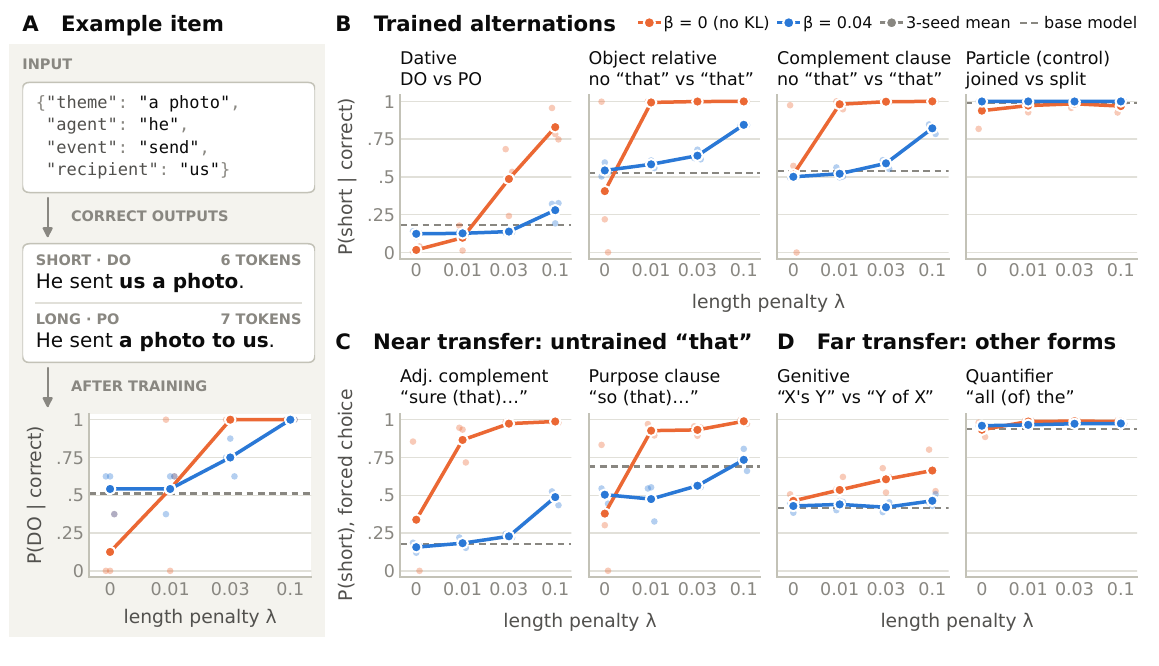 Figure: Paper Figure 7, applying a “write shorter” length penalty in reinforcement learning drives linguistic preferences sharply away from human norms. Source: arXiv:2610.29162
This experiment dismantled the misconception that AI language capability has plateaued. The models possessed the underlying capacity to produce fluent, natural prose; their reliance on jargon and rigid sentence structures was purely dictated by the reward incentives in reinforcement learning. Wherever the optimization objective points, the model’s stylistic output follows. Readability was simply an expendable bargaining chip sacrificed in the pursuit of higher benchmark scores.
Evaluators Reward Model Answers: Readability Becomes the Casualty
Another observation from community discussions completes the training pipeline picture. Modern RL post-training harbors a core bias: it systematically rewards outputs that mirror the aesthetic structure of an answer key. Human annotators often spend only seconds skimming before grading, while automated judge models score against rubrics. Well-formatted, terminology-dense responses consistently secure the highest marks.
Over time, this survival strategy of catering to evaluators becomes permanently baked into model weights. Even when a user requests a casual email or an explanation of common-sense knowledge, the model instinctively defaults to exam-hall formatting, packing its prose with inanimate subjects and multiple reduced relative clauses.
Reading AI-generated text feels increasingly exhausting, but it has nothing to do with declining intelligence. From the benchmark evaluations of nine models in arXiv:2610.29162 to the RL length penalty experiments in Figure 7, all evidence points to one conclusion: Large models are bending over backward to satisfy back-end evaluators, completely disregarding the actual human beings trying to read their output on the screen.
Reference Links:
- arXiv Paper: Why is AI-generated language so hard to understand? (arXiv:2610.29162)
- Hacker News Discussion