
The American creative sector has suffered a net loss of more than 200,000 jobs over the past four years. At the center of this contraction, the motion picture and sound recording industries shed over 100,000 workers—slashing total employment in the sector by nearly a third. A workforce drain of this severity has occurred only twice before in the past three decades.
Public commentary often rushes to blame the explosion of generative AI for this wave of layoffs. However, granular industry data paints a far more complex picture than a simple story of technological displacement. From Broadway stages to music festivals across the country, in-person live entertainment continues to expand at a steady pace. The real collapse is heavily concentrated in content sectors that rely entirely on purely digital distribution.
This stark divergence between the physical and the digital points directly to the underlying economic mechanism. An infinite supply of content circulating across the internet is relentlessly diluting the finite attention span of audiences. What generative AI has actually done is drive the marginal cost of creating digital content down toward zero. Creative fields that lack physical, real-world moats are now undergoing a brutal reassessment of their commercial value.
200,000 Jobs Lost in Four Years: Film and Publishing Suffer Deepest Slump in Thirty Years
Data from the Bureau of Labor Statistics (BLS) indicates that overall employment across creative industries has dropped by more than 200,000 since its peak in 2022. Over the past year alone, the sector saw a net loss of nearly 50,000 positions. This four-year chronic bleeding has effectively wiped out a decade of employment gains.
Zooming out across a thirty-year horizon, an employment contraction of this scale has only happened twice: first during the 2001 dot-com crash, and again during the 2008 Great Recession. Even during the sudden shock of the 2020 pandemic lockdowns, the creative sector rebounded far more quickly than it has today. The prolonged four-year downturn underscores that the creative economy is facing deep structural realignment.
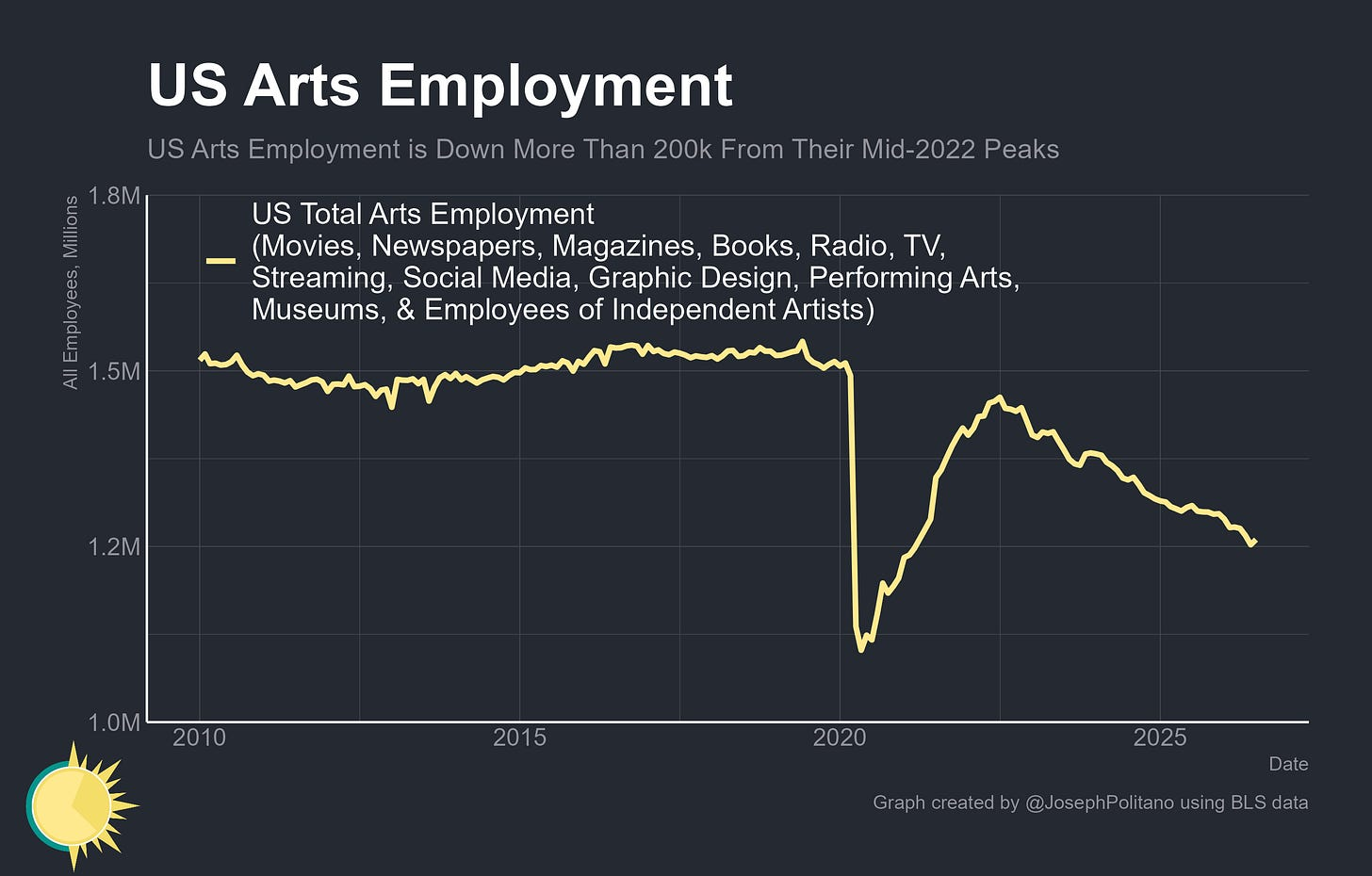 Figure: Total creative industry employment compared to historical downturns. Source: Apricitas Economics
The retrenchment has not hit every segment evenly. The publishing sector shed more than 70,000 jobs over the same timeframe. American newspapers once employed roughly 500,000 people—a workforce larger than the domestic oil extraction industry at the time. Today, newspaper payrolls have contracted by nearly 85%, while periodical publishers have reduced staff by 66% since the 1990s. Book publishing positions have fallen by 40%, as the scarcity premium once commanded by print mediums continues to erode.
Film and Sound Hit Quarterly Lows as Hollywood Sheds a Third of Its Workforce
Among all creative sub-sectors, motion pictures and sound recording have absorbed the heaviest blow. Over the last four years, Hollywood and its broader production ecosystem eliminated more than 100,000 positions. By the summer of 2026, employment in the division dipped beneath its lowest level recorded during the 2008 financial crisis, nearing a 30-year historic nadir.
Many observers pointed to the historic SAG-AFTRA and WGA strikes as the primary catalyst behind Hollywood’s paralysis. Yet more than two years after those strikes concluded, the anticipated production rebound and hiring wave have failed to materialize. Hollywood’s real impasse stems from the exhaustion of legacy revenue streams while streaming subscriptions fail to support legacy budgets. To protect operating margins, major legacy studios have sharply curtailed production slates and greenlights.
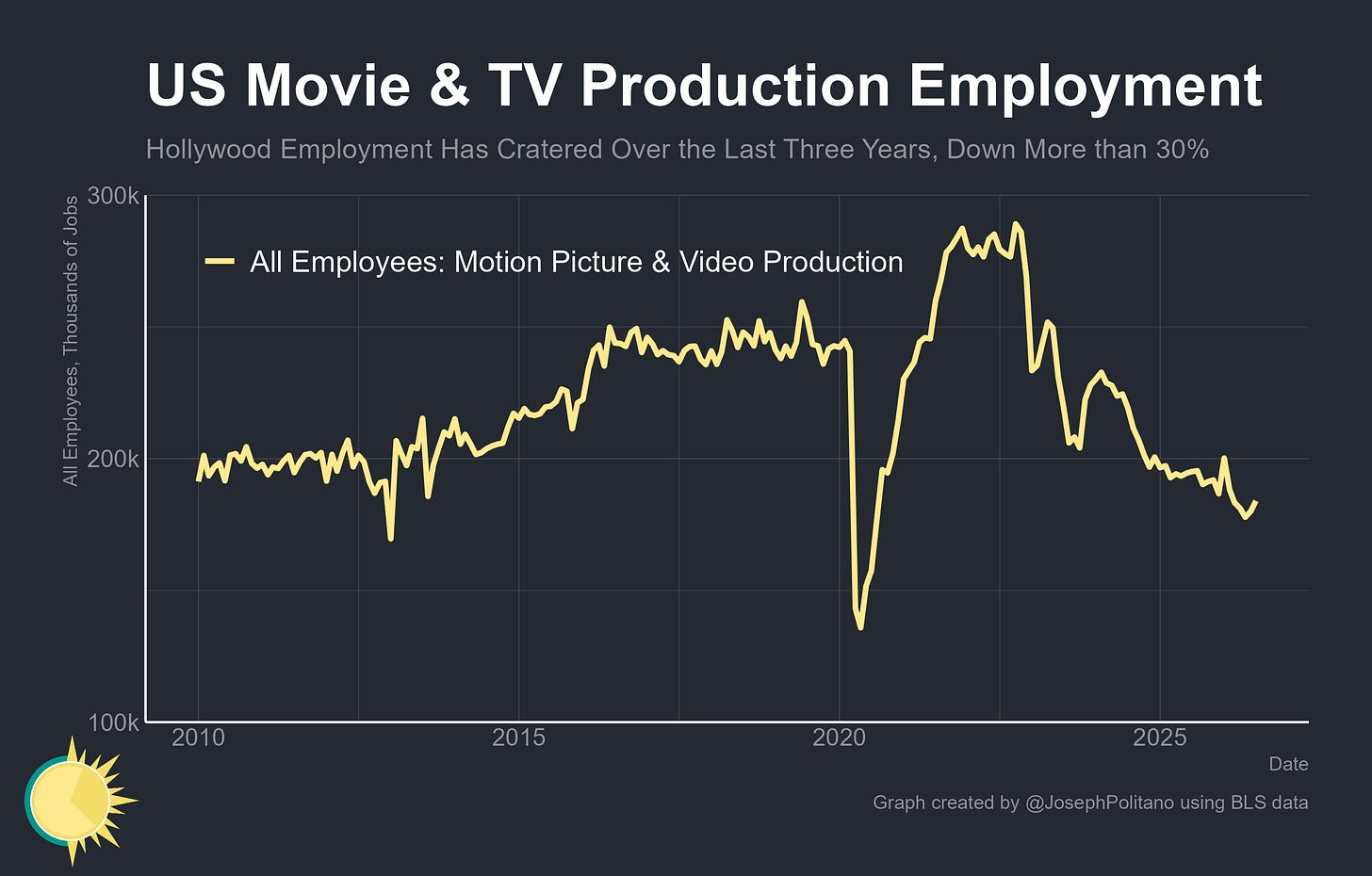 Figure: Employment trajectory in motion picture and sound recording. Source: Apricitas Economics
The breakdown of two historical pillars—theatrical box office and pay-TV carriage fees—stripped Hollywood of its primary profit engines. US box office revenue remains 25% below its 2019 pre-pandemic peak. Cable television affiliate revenue has dropped 18% from its high-water mark, with cord-cutting accelerating each quarter. Monthly streaming subscription fees simply cannot replace the tens of billions of dollars in lost operating income once generated by legacy television networks.
Live Entertainment Defies the Trend as Pure Digital Collapses
Widening the lens across the broader entertainment landscape exposes a glaring bifurcation. Employment across live concerts, performing arts venues, and theme parks has maintained consistent positive growth. Audiences remain more than willing to pay premium prices for irreproducible, in-person experiences. Massive multi-year stadium tours by pop superstars continue to drive ticket prices higher across US arenas.
Standing in stark contrast to live performance is the broad-based contraction across digital mediums. Traditional broadcasting, streaming networks, graphic design, and social media marketing have all suffered simultaneous downturns. The divergence between booming live events and shrinking digital roles disproves the theory of a general consumer spending recession. Overall consumer entertainment spending has not evaporated; capital has simply migrated toward physical, live experiences.
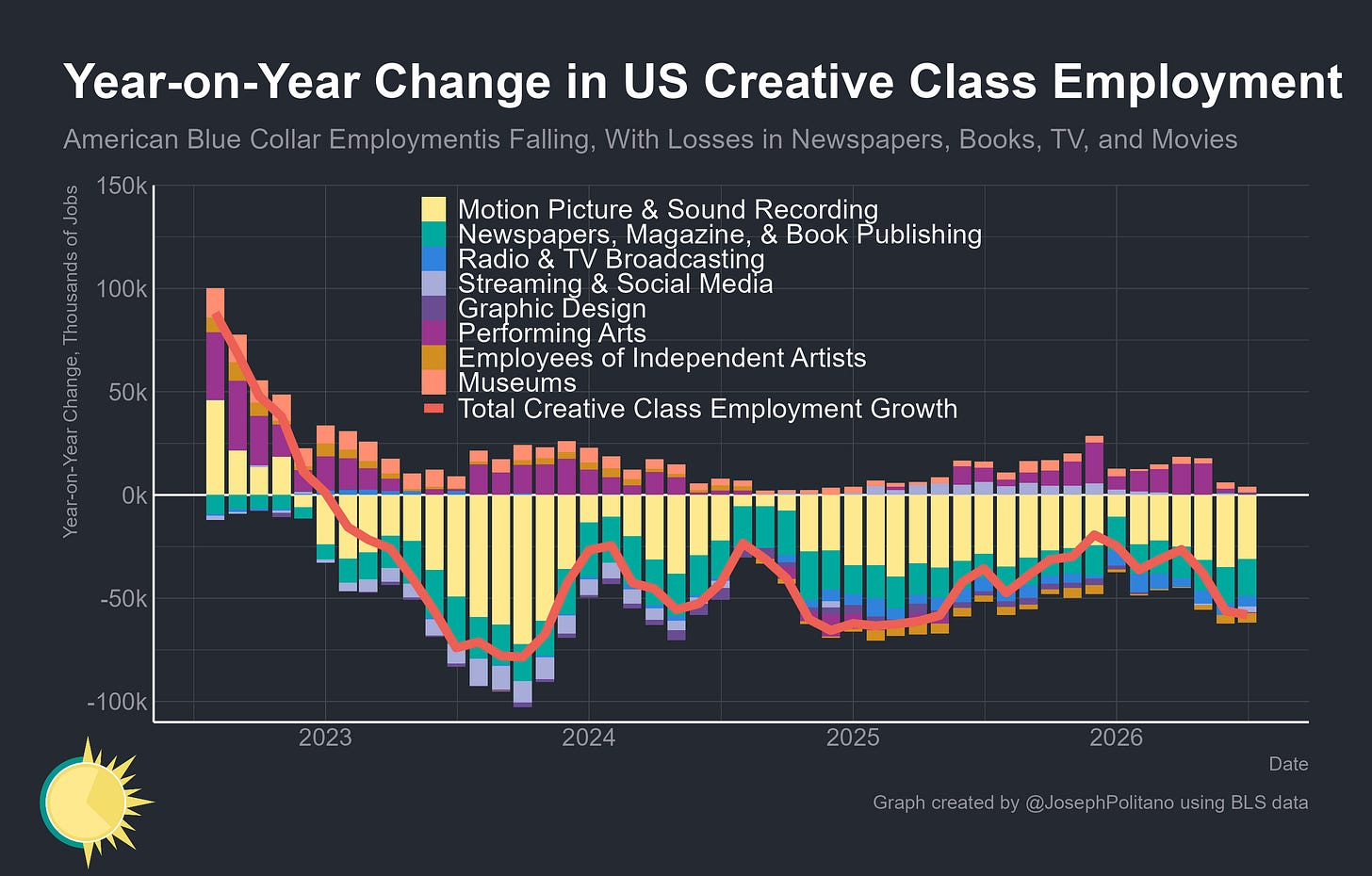 Figure: Employment shifts across media sub-sectors. Source: Apricitas Economics
The contrasting fortunes of music and film vividly illustrate this mechanism. Streaming initially devastated physical recorded music sales as well. Yet musical artists possessed an offline lifeline: touring bigger stadiums and commanding higher ticket prices to secure cash flow. Film and television enjoy no such offline sanctuary; collapsing per-viewer monetization on screens directly ruptured the industry’s labor pipeline.
Supply Explosion Dilutes Attention: Why AI Is Not Solely to Blame
Blaming 200,000 creative layoffs squarely on generative AI lacks empirical economic grounding. Surveys show that only about 32% of US arts and entertainment workers actively use generative AI tools—far lower than the 62% average adoption rate observed across the broader US economy. Furthermore, under strict union collective bargaining agreements, AI has never received institutional clearance to replace end-to-end screenwriting or cinematography.
Broader labor market dynamics also contradict the narrative of wholesale technological displacement. The headline US unemployment rate remains below the historical median of the 2010s. Knowledge-intensive industries such as legal services and engineering continue to hire steadily. Only the technology sector entered prolonged headcount trimming after adding 300,000 workers in the 2022 hiring boom.
The decisive force is a radical tilt in the supply structure of digital content. Algorithmic recommendations and short-form video platforms have unleashed an essentially bottomless feed of media. Generative tools further equalized the playing field, enabling casual creators and marketing accounts to assemble audio-visual clips at will. As distribution shifted to algorithmic feeds, an avalanche of zero-marginal-cost content diluted finite audience attention. Human attention has a hard ceiling; an exponential explosion in supply shattered the premium formerly attached to any single production.
Physical Moats Reshape Valuation: Digital Pipelines Without Live Assets Lose Their Premium
The cultural marketplace is beginning to flash telling counter-signals. Despite intense pressure from e-books, physical print book sales in the US grew 70% over a six-year period. Book cover aesthetic culture and social shelf displays endowed printed paper with renewed social value. Readers eagerly pay for the tactile presence and cultural identity embodied in physical books.
Capital allocation at the frontier of AI research is also undergoing a quiet recalibration. Anthropic explicitly bypassed the development of consumer image, audio, and video generation models. OpenAI shelved its standalone video generation initiative Sora, reallocating computing clusters toward scientific reasoning. Frontier AI labs are recognizing that generating endless audiovisual pixels fails to build durable commercial moats.
The loss of 200,000 jobs in Hollywood and related creative fields represents an overdue reckoning with the zero-marginal-cost era. Algorithms did not eradicate human artistic talent, but they stripped digital production of its historical monopoly premium. Pure digital assets that lack physical, live interaction are depreciating rapidly under the weight of zero marginal costs. Content that cannot deliver a physical, live experience must inevitably face the steep discounts dictated by audience attention dilution.
Reference links:
- Apricitas Economics: AI and the Fall of the Creative Class
- Bureau of Labor Statistics (BLS): Current Employment Statistics survey