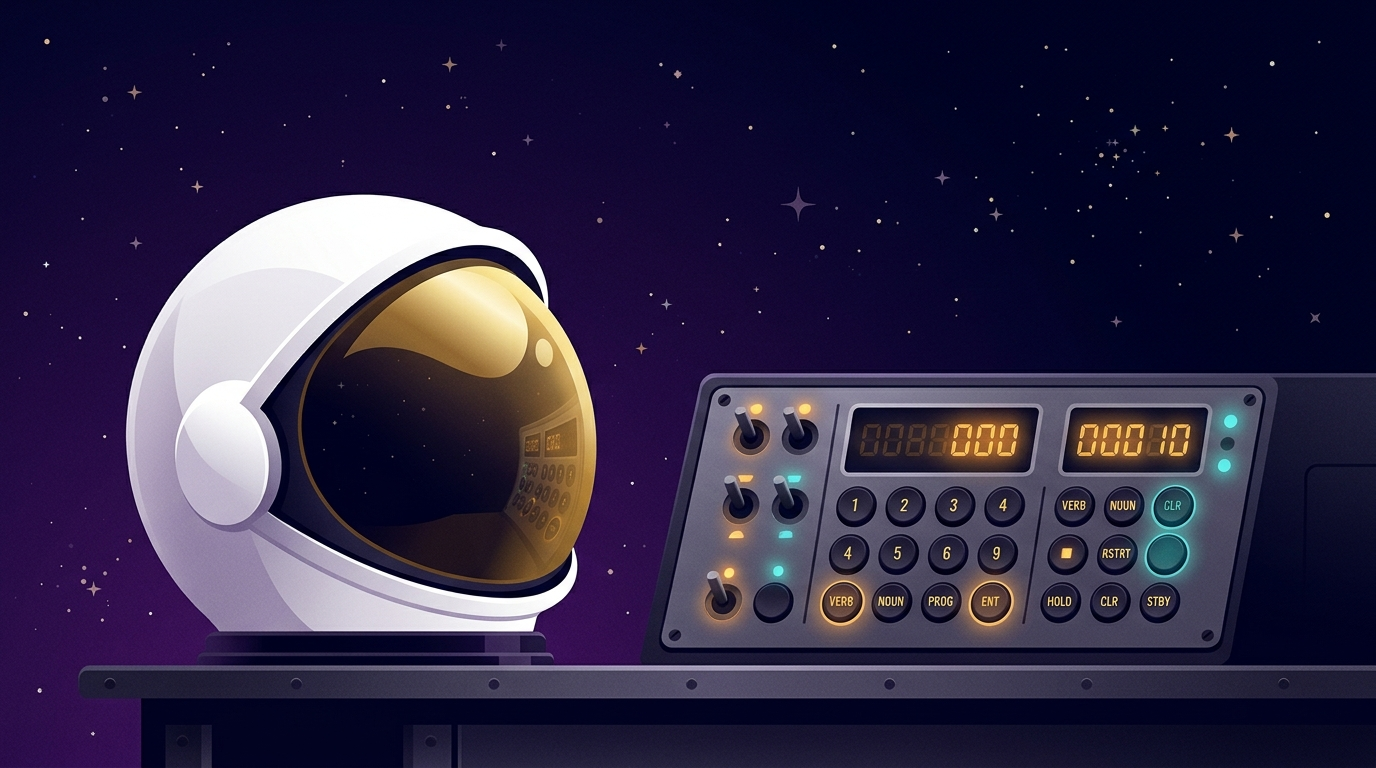
Less than 100KB of memory and a clock speed of just 1.024MHz. The scratch space required to open a single GIF today is enough to fill multiple Apollo Guidance Computers (AGCs). Modern developers are accustomed to gigabytes of headroom, reinforcing the intuition that deep-space exploration inherently demands massive hardware compute.
Apollo 11 shattered that assumption in 1969. With one AGC on the Command Module and another on the Lunar Module—each delivering compute power roughly on par with a later Apple II—astronauts orchestrated orbital rendezvous and lunar descent without graphical interfaces, relying entirely on physical keycodes.
The Moon landings proved an enduring engineering truth: a system’s true ceiling comes from trimming software down to its physical limits. More than half a century later, Canadian avionics engineer Michael Newton resurrected this machine on his desk using open-source hardware and 3D printing.
An Avionics Engineer Builds an Apollo Console on His Desk
Newton, who spends his days servicing avionics on commercial aircraft, launched an open-source initiative dubbed “Recreate Apollo.” His ambition: construct a full 1:1 functional replica of the DSKY (Display and Keyboard Unit)—the primary human-machine interface astronauts used to fly Apollo.
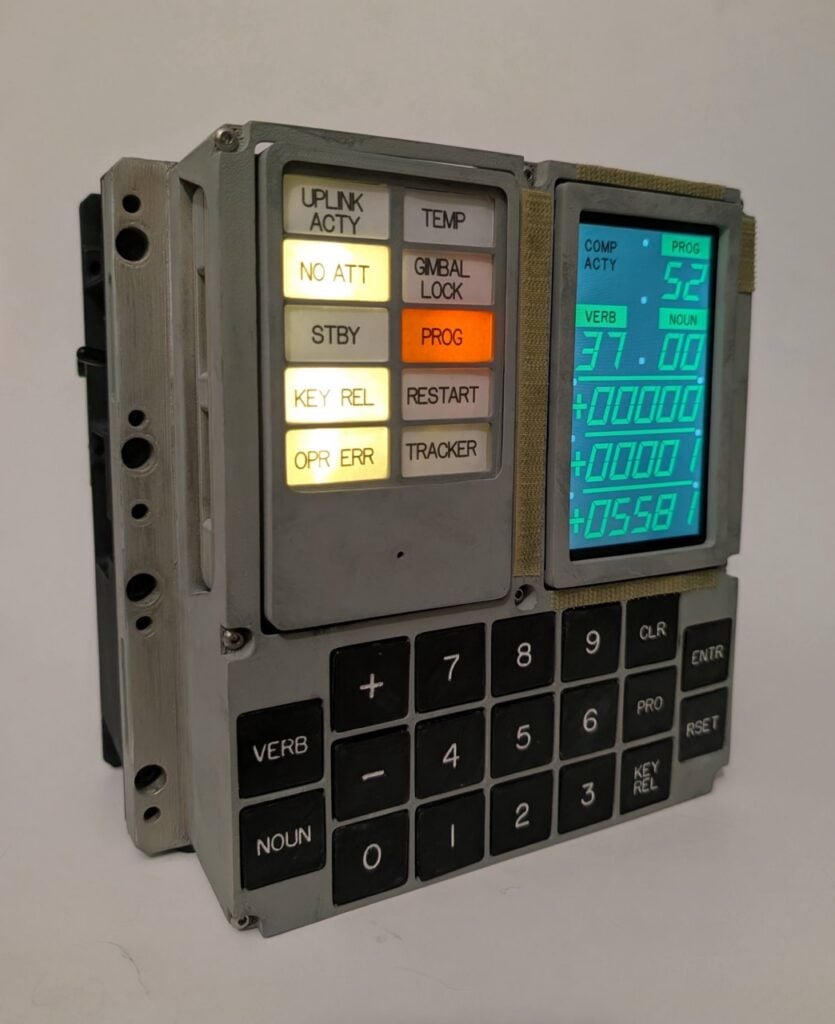 Photo: The replica DSKY enclosure, faithfully modeled after the original, looks freshly salvaged from a spacecraft. Source: Raspberry Pi
The housing is assembled from modular 3D-printed segments, finished in matte military-gray automotive paint with authentic status indicator lights. Behind the retro facade beats a Raspberry Pi single-board computer running an emulator loaded with the exact flight software from the Apollo 13 Command Module.
Writing in The MagPi issue 171, Newton explained why the Raspberry Pi was the ideal engine. Its modest power draw and manageable thermal footprint allow it to run reliably inside a sealed plastic enclosure. Onboard networking simplifies remote debugging, and the complete OS environment can be packaged into a flashable SD card image for other makers.
Navigating Deep Space on Less Than 100KB of Memory
The MIT Instrumentation Laboratory delivered the initial AGC design in 1966, three years before Neil Armstrong walked on the Moon. Pushing through early development compelled the team to compromise between immature silicon and severe weight budgets. The AGC became the first computer built around silicon integrated circuits, consuming nearly 60% of US chip production at its peak.
In an era of scarce silicon, memory was rationed with ruthless precision. The AGC packed roughly 4KB of read-write RAM (erasable memory) for real-time telemetry and flight variables, alongside several tens of kilobytes of read-only memory (ROM) for navigational programs. Together, they totaled under 100KB—yet simultaneously handled state estimation, thrust vectoring, and orbital trajectory corrections.
The user interface was stripped to the absolute bone. The display featured no pixels, only segmented numerical readouts and status lamps. Astronauts interrogated orbital metrics by keying in two-digit “Verb” and “Noun” codes. This architecture eliminated all decorative overhead, dedicating every clock cycle to the equations of celestial mechanics.
Pushing Software to the Physical Limit to Reach Space
Constrained by unyielding hardware limits, MIT engineers pioneered revolutionary software architectures. To guarantee programs survived power interruptions and cosmic radiation, code was physically woven into core rope memory. Technicians used needles to thread copper wire through miniature ferrite toroids: passing through a core represented a 1, while bypassing it represented a 0. This hand-woven ROM achieved densities surpassing early chips while remaining inherently immune to radiation and vibration.
Even more ingenious was the task scheduler. Engineer Hal Laning created a priority-driven, preemptive scheduling model for the tiny machine. As Apollo 11 descended toward the lunar surface, an improperly configured rendezvous radar inundated the CPU with extraneous interrupts. The internal job queue filled rapidly, triggering the famous “1202” and “1201” program alarms.
Modern consumer operating systems often freeze or crash under sudden resource exhaustion. The AGC scheduler, however, acted decisively: it dropped low-priority tasks like radar display updates, reserving every cycle of the central processor for thruster gimbaling and altitude stabilization. By jettisoning non-critical work, the AGC held the spacecraft steady and guided the Eagle to a safe touchdown.
Decoding Archival Blueprints and Open-Sourcing a 100-Page Guide
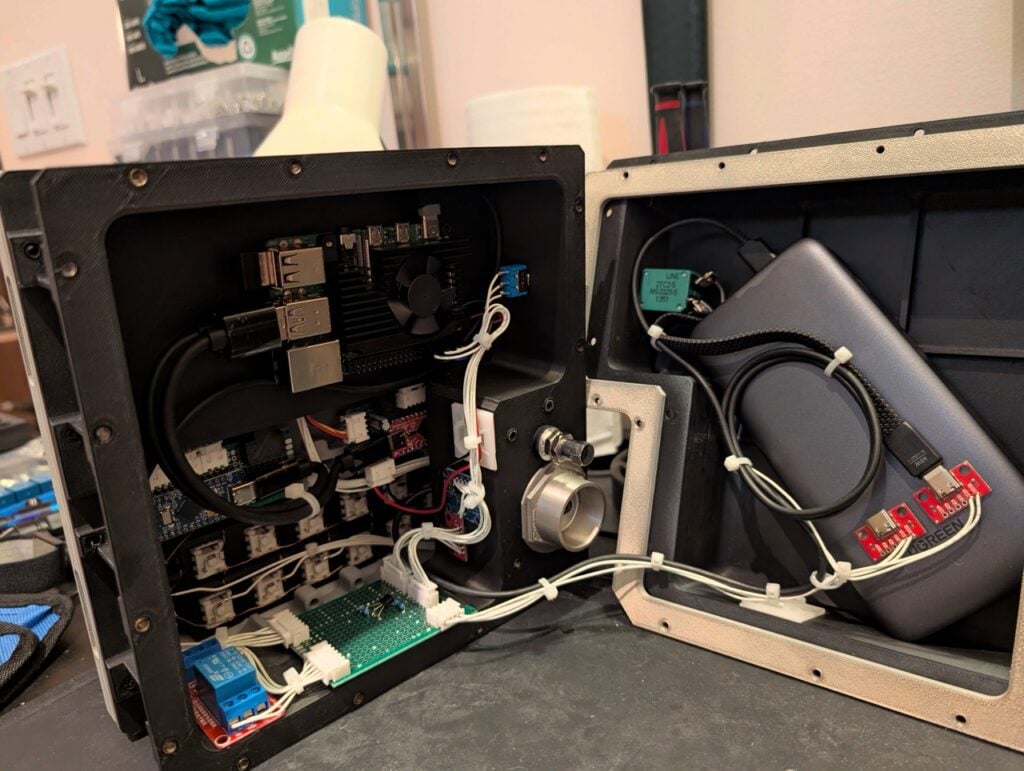 Photo: All 3D-printed parts were modeled directly from archived NASA blueprints. Source: Raspberry Pi
Bringing the AGC back to life required painstaking forensic engineering. Space enthusiasts obtained original engineering schematics via Freedom of Information Act requests. These historical scans were curated by the Virtual AGC team, after which volunteers spent months converting faded technical drawings into CAD models compatible with modern machining software.
Newton picked up where fellow maker Eric had left off, modeling missing components and running iterative test prints. To accommodate modern switches, LEDs, and displays, he introduced sensible engineering adjustments: the exterior preserves 90% historical fidelity, while internal snap-fits and keycap typography were subtly tuned for contemporary desktop 3D printing.
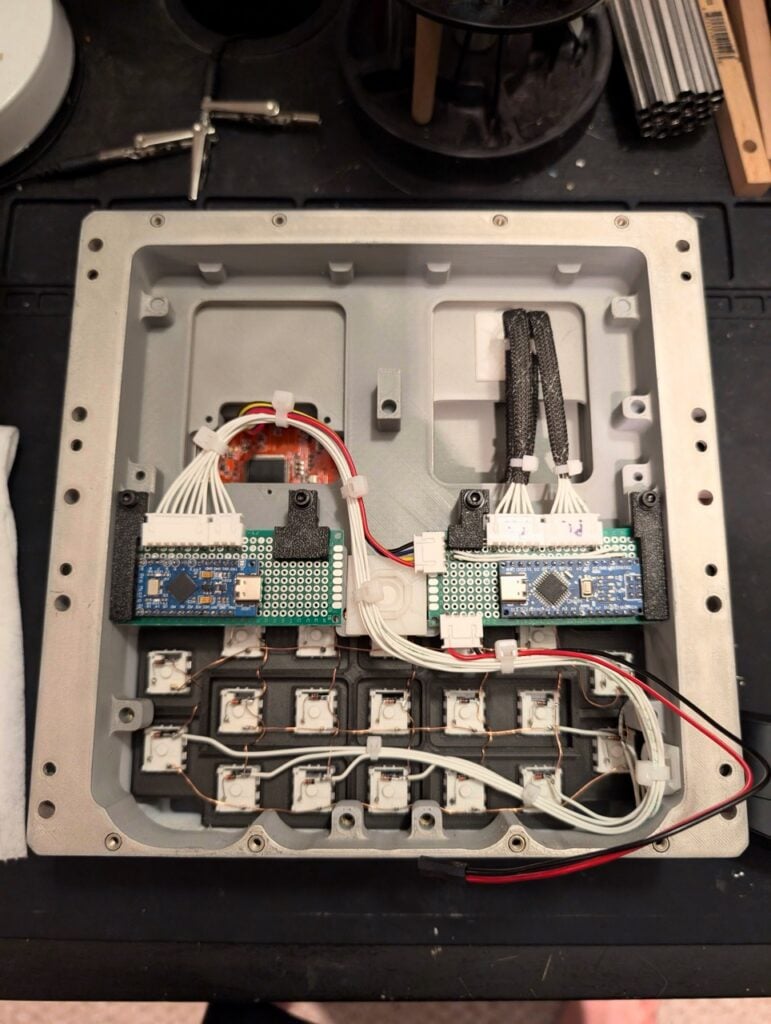 Photo: CAD files, schematics, and a 100-page assembly manual are freely available on GitHub. Source: Raspberry Pi
Newton published the entire project under an open-source license. Beyond CAD models and schematics, he authored a comprehensive 100-page assembly manual. The guide breaks down fabrication and wiring steps so that makers can recreate a piece of spaceflight history in home workshops. A historic artifact once confined behind museum display glass is now an accessible hands-on educational platform.
Why an Age of Compute Abundance Needs Minimalist Engineering
Contemporary software development is caught in an escalating cycle of bloat. Modern smartphones ship with 12GB of RAM, yet routine applications stutter under layers of redundant code and bloated dependencies. Rendering a plain text box often drags in hundreds of megabytes of framework runtime.
The Apollo Guidance Computer replica serves as a stark mirror for today’s engineering culture. It demonstrates in cold hardware that humanity’s boldest voyage did not require endless compute horsepower. Genuine engineering excellence lies in disciplined restraint—stripping away excess and funneling precious resources into the critical path.
If an antique 1.024MHz computer could reach the Moon, modern software systems must rethink their tolerance for architectural sprawl. Raw compute is merely a substrate; it can never compensate for sloppy design. Only through discipline and respect for system limits can engineering endure under real-world pressure.
References:
- Raspberry Pi Official Coverage
- Virtual AGC Historical Project Archives
- Recreate Apollo Open-Source Hardware Guide